

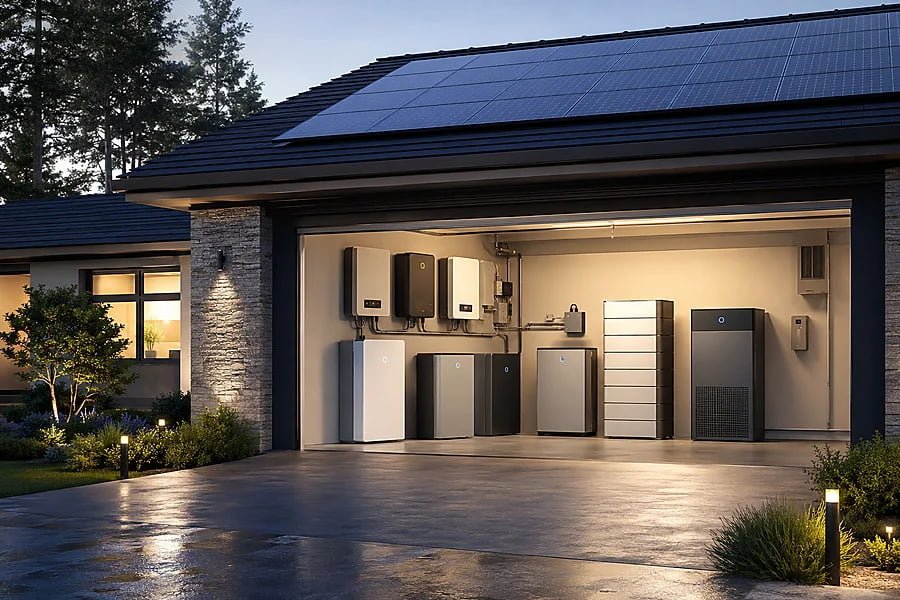
](https://voltcrave-battery.com/wp-content/uploads/2026/06/Top-5-Tesla-Powerwall-Alternatives-in-2026-The-Ultimate-Home-Battery-Guide.jpg)
Energy prices are rising fast and the power grid is becoming less stable every year. You want energy independence, but the high price and long wait times for big brands are frustrating.
The best Tesla Powerwall alternatives in 2026 include high-capacity LiFePO4 systems that offer modular designs and longer lifespans. Leading options now focus on Lithium Iron Phosphate technology, which provides over 6,000 charge cycles, better thermal safety, and easier integration with existing solar arrays at a much lower cost.
I have worked in the solar and energy storage industry for over a decade. I see many homeowners get caught up in brand names while missing out on better technology. If you stay with me, I will show you how to find a battery that actually fits your house and your budget.
What is the best alternative to a Tesla Powerwall?
Most people want a battery but feel limited by the high entry cost of famous brands. This keeps many families stuck with high utility bills and no backup power during local grid failures.
The best alternative is a modular LiFePO4 battery system that allows for easy expansion and uses open-protocol inverters. These systems provide higher safety ratings and can last twice as long as traditional lithium-ion batteries. They offer better value by focusing on performance and longevity rather than just aesthetic design or brand marketing.
Understanding the Shift to LiFePO4
In the early days of home energy, most batteries used Nickel Manganese Cobalt (NMC). This is the same tech used in phones. But by 2026, the industry has shifted toward Lithium Iron Phosphate (LiFePO4). I prefer this chemistry because it is much harder to ignite. It does not suffer from "thermal runaway" like older technologies. When I look at a battery for a home, safety is the first thing I check. LiFePO4 also handles heat much better, which is vital if you live in a warm climate.
Modularity and Scalability
One major problem with famous brands is that they often come in one size. If you need just a little more power, you have to buy a whole second unit. Modern alternatives use a modular "stackable" design. You can start with a 5kWh module and add more as your budget grows. This flexibility is the smartest way to manage your home energy investment.
Key Comparison: Powerwall vs. Modern Alternatives
| Feature | Tesla Powerwall 3 | Tier 1 LiFePO4 Alternatives |
|---|---|---|
| Battery Chemistry | NMC / LFP (varies) | Pure LiFePO4 |
| Cycle Life | 3,000 - 5,000 | 6,000 - 8,000 |
| Expansion | Requires full units | Modular 5kWh increments |
| Inverter Choice | Integrated (Closed) | Flexible (Open Protocol) |
| Warranty | 10 Years | 10 - 15 Years |
Why Open Systems Matter
I always tell my friends to look for "open" systems. A closed system forces you to use one specific app and one specific service team. An open system works with many different hybrid inverters. If one company goes out of business or raises their prices, you can still get parts and service from others. This protects your investment for the next 20 years.
What battery does Elon Musk use?
Many homeowners believe that the biggest tech companies make every single part of their products. This confusion makes people think they must buy one specific brand to get the highest quality components.
Elon Musk’s company uses batteries from several large global suppliers like CATL, BYD, and LG Energy Solution. For energy storage products like the Megapack and some Powerwall models, they have moved toward LFP (Lithium Iron Phosphate) cells. These cells are chosen for their lower cost, high safety standards, and the fact that they do not require cobalt, which is difficult to mine.
The Global Supply Chain Secret
The truth is that the "brain" of the battery is often the only thing made by the famous brand. The actual "cells" that hold the electricity come from a few massive factories in Asia. When you buy a high-quality alternative, you are often buying the exact same battery cells found in a Tesla or a high-end electric car. I have visited these factories and seen the same production lines making batteries for many different labels.
Why LFP is the Secret Winner
Elon Musk has publicly stated that a large portion of their energy products will use LFP chemistry. This is a huge shift. LFP is heavier than NMC, but for a house, weight does not matter. What matters is that LFP can be charged to 100% every day without wearing out the battery. Older lithium batteries preferred to stay between 20% and 80%. Using LFP means you can actually use all the energy you paid for.
Identifying Quality Cells
When you look for an alternative, you should check for "Grade A" prismatic cells. These are the gold standard in 2026.
- Grade A: These are the best cells from the production run with the longest life.
- Prismatic Shape: These are more stable and stay cooler than the small "AA" style cells used in older packs.
- Safety Certifications: Look for UL1973 or CE labels. These prove the cells passed the same tests as the big brands.
The Value of the "Non-Brand" Name
If you buy a battery from the same factory that supplies the big guys, you are getting the same engineering. You are simply not paying for the massive marketing budget and the celebrity CEO. In my experience, you can often save 30% to 40% by choosing a Tier 1 manufacturer that focuses on industrial supply rather than consumer advertising.
What is the best whole house battery?
A small backup battery might keep your phone charged, but it won't help when your food is rotting in the fridge. Most people buy a system that is too small and feel disappointed when the power goes out.
The best whole house battery is an All-in-One system with a capacity between 15kWh and 30kWh. It must have a high continuous power output (at least 8kW to 10kW) to run heavy appliances like air conditioners, well pumps, and electric stoves. A truly effective system also includes a fast switch-over time, so your electronics don't even flicker when the grid fails.
Measuring Power vs. Energy
I see this mistake all the time. People confuse "Energy" (how much power the battery holds) with "Power" (how much it can give you at once). If you have a 20kWh battery but only a 3kW inverter, you cannot run your microwave and your AC at the same time. For a whole house, you need a high-power inverter. I suggest looking for systems that can handle "surge" loads. This is the extra kick of power needed to start a large motor, like in a refrigerator.
Ideal Sizing for 2026 Homes
In 2026, our homes use more electricity than ever because of electric cars and heat pumps. You need to size your battery based on your "critical loads."
| Home Size | Recommended Capacity | Recommended Power |
|---|---|---|
| Small Apartment | 5 - 10 kWh | 3 - 5 kW |
| 3-Bedroom House | 15 - 20 kWh | 8 - 10 kW |
| Large Estate | 30+ kWh | 12+ kW |
The Importance of the BMS
The Battery Management System (BMS) is the most important part of a whole house battery. It acts like a brain that protects the cells. It prevents the battery from getting too hot or too cold. It also balances the cells so they all work equally hard. A high-quality alternative will have a "Smart BMS" that you can monitor from your phone. If the BMS is good, the battery can last for 15 to 20 years.
All-in-One vs. Split Systems
I usually recommend "All-in-One" systems for whole-house use. These units have the battery and the inverter in one box. It looks cleaner on your wall and makes installation much faster. This reduces the labor cost you pay to your electrician. Since the components are designed to work together, you also have fewer technical glitches.
How to get a free Powerwall?
The price of energy storage is the biggest barrier for most people. Even if you want to help the environment, spending ten thousand dollars or more is a hard choice for any family.
While you cannot usually get a battery for zero dollars, you can use government incentives, tax credits, and utility programs to reach a "net-zero" cost. In many regions, the combined savings from tax rebates and participating in a Virtual Power Plant (VPP) can pay for the entire cost of the battery within 5 to 7 years. After that point, the energy you store is essentially free for the rest of the battery's life.
Navigating Government Incentives
Many countries are desperate to fix their power grids. They offer huge tax credits for home batteries. In the United States, the Inflation Reduction Act provides a 30% tax credit. In Europe, many local governments offer direct grants that cover a large part of the hardware cost. When you combine these with a lower-cost alternative battery, your out-of-pocket expense drops significantly.
Earning Money with Virtual Power Plants (VPP)
A VPP is a system where the utility company "borrows" a little bit of your stored energy when the grid is under stress. They pay you for this service.
- Grid Services: You help prevent local blackouts.
- Monthly Credits: You see a deduction on your power bill every month.
- Automatic Control: The software does all the work while you sleep.
By joining a VPP, your battery becomes a small income generator. I have seen some users earn back $50 to $100 a month just by letting the grid use their battery during peak hours.
The Return on Investment (ROI) Calculation
I like to look at the "levelized cost of storage." This is the total cost of the battery divided by how much energy it will move over its life. Because modern alternatives last for 6,000+ cycles, the cost per kilowatt-hour is often lower than what the utility company charges you. This means every time you use your battery, you are actually saving money compared to buying power from the grid.
Why DIY or Local Brands Save More
If you are handy or work with a local installer, you can save thousands by avoiding the "authorized dealer" markup. Big brands require you to use their certified installers, who often charge a premium. By choosing a high-quality alternative with standard certifications, you can use any qualified electrician. This competition in the labor market helps you get the best price and brings you closer to that "free" energy goal.
Frequent outages and rising rates prove you need reliable storage. Don't settle for a one-size-fits-all battery. Discover the best 2026 Powerwall alternatives tailored to your specific home energy needs.
The top five Tesla Powerwall alternatives in 2026 are FranklinWH aPower 2 for whole-home backup, Enphase IQ Battery 5P for microinverter users, EG4 PowerPro for high-value savings, Generac PWRcell 2 for generator integration, and SolarEdge Home Battery. These options prioritize LFP chemistry for safety and modular scalability.
My insights: Beyond the Hype—Top 5 Strategic Alternatives to Tesla Powerwall in 2026
Tired of Tesla’s closed ecosystem and long lead times? Choosing the wrong backup system can leave you powerless during a grid failure. Discover the five superior 2026 alternatives tailored for your home.
The top 5 Tesla Powerwall alternatives in 2026 are the FranklinWH aPower 2 (whole-home power), Enphase IQ Battery 5P (Enphase users), EG4 PowerPro (budget-conscious), Generac PWRcell 2 (generator synergy), and SolarEdge Home Battery (DC-coupled systems). Selection depends on matching LFP chemistry with your specific inverter and backup load requirements.
The Strategic Shift in 2026 Home Energy Storage
In 2026, the residential battery market has moved beyond "raw capacity" to "intelligent integration." The transition to LFP (Lithium Iron Phosphate) chemistry is now standard, offering superior thermal stability and a 10,000-cycle lifespan that outperforms older NMC technologies.
Critical thinking suggests that homeowners must prioritize Peak Continuous Output over total kWh. A battery that cannot surge to start a 5-ton HVAC unit is merely a "light-and-fridge" backup, not a whole-home solution. Furthermore, with the maturation of NEM 3.0-style policies, the focus has shifted toward "round-trip efficiency"—ensuring that the energy you store isn't lost to heat during conversion.
The Ecosystem Advantage: Efficiency vs. Flexibility
The most efficient systems are DC-coupled (SolarEdge, Generac), which avoid multiple AC/DC conversions. However, AC-coupled systems (FranklinWH, Enphase) offer unparalleled flexibility for retrofitting existing solar arrays.
Power vs. Budget: Solving the 2026 Value Equation
For homeowners prioritizing ROI, the EG4 PowerPro has disrupted the market by offering high-capacity LFP storage at a fraction of the "big brand" cost, though it requires a more sophisticated installer.
| Alternative | Primary Use Case | Battery Chemistry | 2026 "Killer Feature" |
|---|---|---|---|
| FranklinWH aPower 2 | High-load Whole-Home | LFP | Best-in-class generator & smart-grid integration. |
| Enphase IQ 5P | Existing Enphase PV | LFP | Distributed architecture; no single point of failure. |
| EG4 PowerPro | Maximum ROI / DIY | LFP | Industry-leading $/kWh value for large arrays. |
| Generac PWRcell 2 | Complex Backup | NMC/LFP | Highly modular; seamless sync with Generac home generators. |
| SolarEdge Home | DC-Coupled Efficiency | LFP | Optimized for 94.5% round-trip efficiency. |
Conclusion
The best Tesla Powerwall alternatives in 2026 offer safer LiFePO4 chemistry, modular growth, and better financial returns. By choosing high-quality Tier 1 systems, you gain energy independence without the brand-name premium.
](https://voltcrave-battery.com/wp-content/uploads/2026/06/How-Big-Can-the-Battery-Grid-Storage-Market-Get-768x512.jpg)
](https://voltcrave-battery.com/wp-content/uploads/2026/06/The-Real-Cost-of-Commercial-Battery-Energy-Storage-in-2026-What-You-Need-to-Know-768x512.jpg)
](https://voltcrave-battery.com/wp-content/uploads/2026/06/Why-Is-It-So-Important-to-Store-Energy-in-Large-Scale-Batteries-768x512.jpg)