

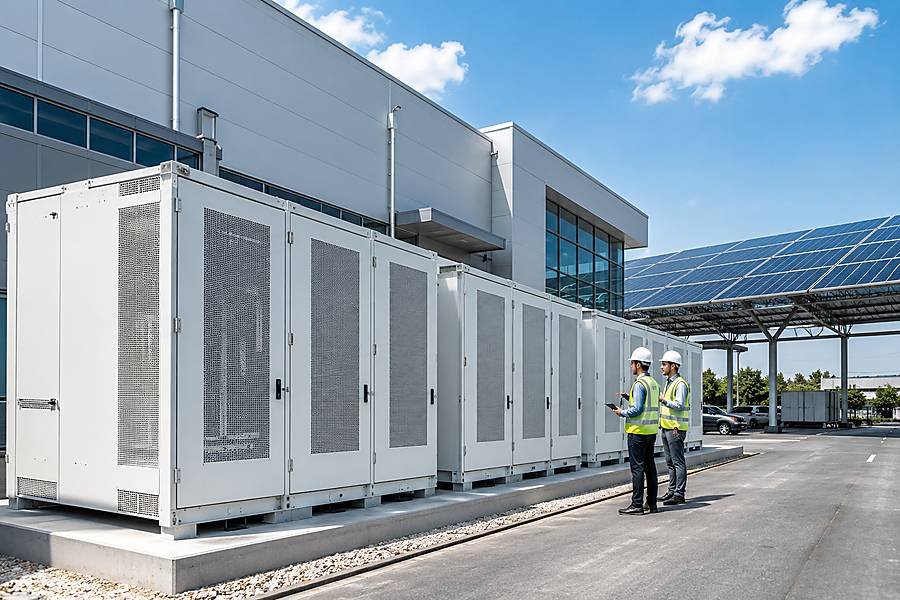
](https://voltcrave-battery.com/wp-content/uploads/2026/06/The-Real-Cost-of-Commercial-Battery-Energy-Storage-in-2026-What-You-Need-to-Know.jpg)
High energy prices and unreliable equipment are ruining your project margins right now. You are likely tired of small suppliers who lack certifications and fail to deliver your orders on time.
In 2026, the cost for a commercial Battery Energy Storage System (BESS) is projected to stay between $250 and $450 per kilowatt-hour (kWh). This price includes the battery cells, the power conversion system, and the installation labor. Costs are becoming more predictable as global supply chains stabilize.
I have spent years managing large-scale production lines and leading R&D teams to solve these exact problems. If you stop reading now, you will likely choose a supplier that cannot support your long-term growth or meet the strict safety standards required for your local market.
How much does a commercial BESS cost?
You want to lower your overhead, but the high upfront cost of a battery system feels like a huge risk. It is hard to know if the investment will actually pay off in the next five years.
For most medium-sized businesses in 2026, a turnkey BESS project costs between $300 and $400 per kWh for Lithium Iron Phosphate (LFP) systems. Total project costs usually start at $250,000 for small commercial units and can go up to several million dollars for large industrial sites.
Breaking Down the Component Costs
When we look at the total bill, the battery cells and modules are the biggest part. In 2026, these parts make up about 50% of your total spend. But you must also think about the Power Conversion System (PCS). This includes the inverters that turn DC power into AC power. At our facility, we have seen that using automated production lines—like our 32 automated lines—helps reduce the labor cost of these parts. This makes the final product cheaper for you without losing any quality.
Why System Integration Matters
A common mistake is buying parts from different places. If the battery does not talk to the inverter, the system will fail. Integration costs usually add another 15% to 20% to the price. We focus on "All-in-One" solutions because they are tested together in the factory. This reduces the time your team spends on-site. It also means fewer technical glitches after the system is turned on. When you have over 800 patents behind a system, you know the integration is built on solid science.
The Impact of Soft Costs and Labor
You cannot ignore the "soft costs." These are things like engineering designs, local permits, and the labor for the electrical hookup. In 2026, these costs are about 25% of the total project. I always suggest looking for a supplier that provides full documentation and installation manuals. This makes the job easier for your local engineers. It also speeds up the process with city inspectors, which saves you money on every project.
Estimated Cost Structure for 2026
| Cost Item | Estimated Price (per kWh) | Percentage of Total |
|---|---|---|
| LiFePO4 Battery Modules | $170 | 48% |
| Hybrid Inverters / PCS | $60 | 17% |
| Fire Suppression & Cooling | $25 | 7% |
| Engineering & Permitting | $40 | 11% |
| On-site Installation | $60 | 17% |
Choosing the Right Scale
Large industrial systems are cheaper per unit than small commercial ones. This is because of the "economy of scale." If you order 1MWh of storage, the shipping and logistics costs are spread out over more units. This is why many of our partners prefer to buy in bulk. With a monthly capacity of 500,000 units, we see how high-volume production keeps prices steady. Always plan for your maximum energy needs so you do not have to pay for a second installation later.
Will the lithium price go up in 2026?
You are worried about the "lithium rollercoaster." You see news about price spikes and fear that if you wait to buy, the price will go out of your reach.
Lithium prices in 2026 are expected to remain stable with only minor changes. This is because many new mines are finally opening in places like Australia and South America. While the demand for electric cars is high, the supply of raw lithium is finally catching up to the market needs.
Supply Chain Stability and Partnerships
The biggest factor in lithium price is who controls the supply. We are a subsidiary affiliated with Greatpower and Sunwoda. This gives us a massive advantage in getting raw materials. When you have a strong supply chain, you do not have to worry about prices jumping 50% in one month. In 2026, we expect the market to be much calmer than it was three years ago. This is great news for your procurement planning because you can give your customers fixed quotes.
The Shift to LiFePO4 (LFP)
Most commercial systems now use LFP chemistry. This is a big deal for cost. LFP does not use expensive metals like cobalt or nickel. Because these materials are not needed, the price stays more predictable. Our R&D team of over 300 people has spent a lot of time perfecting LFP for commercial use. It is safer, lasts longer, and is much cheaper to produce at scale. In 2026, this will be the global standard for any business that wants a good return on investment.
Recycling and Resource Efficiency
By 2026, the "circular economy" will be a real thing. We are getting much better at taking old batteries and reusing the lithium. This helps keep the price of "new" lithium from going up. It also helps with your environmental goals. Many governments now require a plan for what happens at the end of a battery's life. Having a supplier that understands these rules is key for your business reputation.
Key Lithium Market Influencers
- New Mining Methods: Direct Lithium Extraction (DLE) is making production faster.
- EV Market Growth: Trucks and buses are using more batteries, but supply is keeping up.
- Geopolitics: Trade deals between the US, Europe, and Asia are becoming more clear.
- Inventory Levels: Most manufacturers are keeping more "buffer" stock to avoid shortages.
Managing Price Risks
If you are a distributor, I suggest looking at long-term supply contracts. In 2026, you should not be buying "spot" prices if you can avoid it. We work with our long-term partners to offer price stability. This allows you to win more bids because your prices are not changing every week. Having 32 production lines means we can plan months in advance, and we pass that stability on to you.
What country makes the most batteries?
You need a reliable supplier who can deliver on time. If you choose a supplier from a country with trade wars or slow shipping, your whole project could be delayed for months.
China makes the most batteries by a large margin, controlling about 75% of the global market. While the United States and Europe are opening new factories, China has the most mature supply chain and the lowest production costs for 2026.
The Advantage of the Greater Bay Area
Our main facilities are in Dongguan and Huizhou. This is the heart of the global battery industry. Being in this area means we have the best access to parts, engineers, and shipping ports. In 2026, the speed of production in China is still much faster than in any other country. We can go from a design to a finished product in half the time it takes in Europe. For a procurement director, this speed is the difference between finishing a project this year or next year.
Why Certifications Matter More Than Origin
Some people worry about where a battery is made because of local rules. But what really matters is the certification. In 2026, you cannot sell a battery in Europe or the US without CE, UL, or FCC markings. We hold 680 international certifications. This means our products are ready for the global market immediately. You do not have to worry about your shipment getting stuck at the border because the paperwork is wrong.
The Growth of Global Manufacturing Hubs
While China leads, we also see growth in Southeast Asia and parts of Europe. This is good for the world because it creates more options. However, these new hubs often struggle with "quality consistency." They do not have the ten years of experience that a mature factory has. We use automated testing for every single battery cell. This ensures that the first unit is exactly the same as the 500,000th unit.
Top Battery Producing Regions (2026 Forecast)
| Region | Global Market Share | Primary Focus |
|---|---|---|
| China | 72% | Efficiency, Scale, Cost |
| North America | 12% | High-end Tech, Tax Credits |
| Europe | 10% | Sustainability, Recyclability |
| Rest of World | 6% | Local Project Support |
Logistics and Market Response
In 2026, logistics will be just as important as manufacturing. We have built a network across the Greater Bay Area and Yangtze River Delta to make sure we can ship to any port quickly. If you are in Australia or the Middle East, you need a supplier that understands your local shipping lanes. A large company with multiple facilities can shift production to meet your deadlines. This is why we continue to expand our Guangdong facility. We want to make sure we are always ready for your next big order.
Does charging to 90 extend battery life?
You want your battery to last ten years or more. It is a big expense, and you do not want to see the performance drop after only a few hundred uses.
Yes, stopping your charge at 90% significantly extends the life of a commercial battery. Charging to 100% puts high stress on the lithium cells and creates more heat. By staying at 90%, you can increase the total number of cycles the battery can perform by 20% to 50%.
The Science of Voltage Stress
When a battery is pushed to 100%, the internal voltage is at its highest point. This causes the materials inside to expand and creates tiny cracks. Over time, these cracks make the battery weaker. Our R&D team has tested thousands of cells to see this effect. We found that the last 10% of charging is the most "violent" for the battery chemistry. By setting your BMS to stop at 90%, you keep the battery in a "relaxed" state. This is how you get 6,000 cycles instead of 3,000.
Temperature Control and Safety
Heat is the number one killer of batteries. Charging from 90% to 100% generates more heat than charging from 20% to 30%. In a large commercial system, heat can build up quickly. If the system stays cooler, it is much safer. We design our systems with advanced cooling, but smart charging habits make the cooling system’s job much easier. This also reduces the energy used by the fans, which makes your system even more efficient.
Maximizing ROI for Integrators
If you are an installer, you want to avoid "truck rolls." This is when you have to send a technician to a customer site to fix a failed battery. If you set your customers' systems to a 90% charge limit, the batteries will be much more stable. This means fewer service calls and happier clients. You are selling a solution that lasts longer than the competition. This is a huge selling point for your brand.
Comparison of Cycle Life vs. Charge Limit
| Charge Limit | Expected Cycles (LFP) | Total Energy Delivered (Lifetime) |
|---|---|---|
| 100% | 3,500 | 3.5 GWh |
| 95% | 4,800 | 4.5 GWh |
| 90% | 6,500 | 5.8 GWh |
| 80% | 8,000+ | 6.4 GWh |
Smart Management Systems
In 2026, you don't need to manually check the battery. Our "All-in-One" systems use smart software to handle this. You can remotely monitor the State of Charge (SoC) for all your projects from one dashboard. You can even adjust the charge limits based on the weather. If you know a storm is coming, you can temporarily bump it to 100% for extra backup. For daily use, keep it at 90%. This flexibility is what makes modern storage systems so powerful for businesses.
My insights: Navigating the 2026 Commercial BESS Cost Landscape: Scaling Efficiency and ROI
Skyrocketing energy demands and complex pricing make BESS budgeting a nightmare. Miscalculating "soft costs" or ignoring scale-driven discounts can destroy your ROI. Our 2026 guide provides the clarity needed.
In 2026, commercial BESS installed costs typically range from $180 to $580 per kWh. Large containerized systems (500kWh+) leverage economies of scale to reach $180–$320/kWh, while smaller retrofits remain higher. Key drivers include LFP chemistry dominance, federal incentives like the Inflation Reduction Act, and stabilizing hardware prices.
Decoding the 2026 Storage Economy: Beyond the Sticker Price
To achieve a defensible financial model, developers must shift from focusing on upfront CAPEX to Total Cost of Ownership (TCO). While cell prices have plummeted to near $70/kWh, the "installed" price remains higher because hardware only represents roughly 40-50% of the project.
The "Soft Cost" Reality
Engineering, permitting, and grid interconnection fees—often called "soft costs"—are the most volatile variables. In 2026, these can exceed 25% of the total budget. Regional labor rates and specific utility requirements for "behind-the-meter" integration often dictate whether a project sits at the high or low end of the price spectrum.
Duration vs. Density
System duration significantly alters the math. A 4-hour system has a lower cost per kWh than a 2-hour system because the expensive power electronics (inverters/PCS) are spread across more battery capacity.
| Project Category | Capacity Range | Estimated Installed Cost (per kWh) | Primary Driver |
|---|---|---|---|
| Small Commercial | 50–200 kWh | $500 – $1,000 | Custom engineering & labor |
| Mid-Size C&I | 200–500 kWh | $280 – $580 | Integrated "all-in-one" units |
| Large Scale C&I | 500 kWh+ | $180 – $320 | Economies of scale & LFP |
| Utility-Scale | Multi-MWh | $110 – $125 | Bulk procurement & standardization |
Strategic Optimization
For 2026, the most successful projects will be those utilizing Lithium Iron Phosphate (LFP) for safety and longevity, while aggressively pursuing federal tax credits (like the ITC) which can offset up to 30-50% of the investment. Understanding the balance between hardware costs and long-term O&M is essential for a realistic payback period.
Conclusion
The 2026 BESS market offers stable costs and high-performance technology. By choosing certified, large-scale suppliers and using smart charging limits, you can ensure a reliable and profitable energy future.
](https://voltcrave-battery.com/wp-content/uploads/2026/06/Why-Is-It-So-Important-to-Store-Energy-in-Large-Scale-Batteries-768x512.jpg)
](https://voltcrave-battery.com/wp-content/uploads/2026/06/Top-5-Tesla-Powerwall-Alternatives-in-2026-The-Ultimate-Home-Battery-Guide-768x512.jpg)
](https://voltcrave-battery.com/wp-content/uploads/2026/06/What-Are-the-Conditions-Necessary-for-Energy-Storage-768x512.jpg)