

](https://voltcrave-battery.com/wp-content/uploads/2026/06/Why-Is-It-So-Important-to-Store-Energy-in-Large-Scale-Batteries.jpg)
Clean energy sounds simple until the sun goes down, the wind slows, or demand jumps at night. That gap can make a modern grid feel less stable.
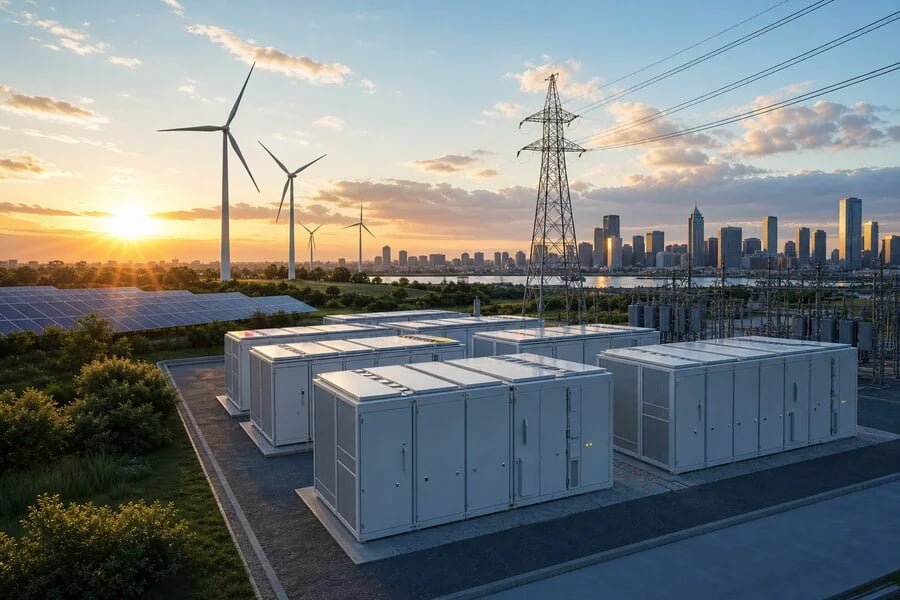
It is important to store energy in large-scale batteries because they help balance electricity supply and demand, store extra renewable power, reduce waste, support grid reliability, and deliver electricity quickly when people need it most. As renewable energy grows, large-scale battery storage becomes a key tool for making clean power more dependable. The IEA says rapid energy storage growth is critical for managing hour-to-hour variability from wind and solar power.
I think of large-scale batteries as the shock absorbers of the power grid. They do not create energy by themselves. They make energy easier to use at the right time. That matters because electricity has always had one hard rule: supply and demand must stay balanced every second.
Why Is Battery Energy Storage Important?
Battery energy storage is important because it gives the grid flexibility. It stores electricity when there is too much supply and sends it back when demand rises.
In the past, most grids relied on power plants that could increase or reduce output when needed. That model worked, but it was not always clean, cheap, or fast. Today, more electricity comes from solar and wind. These sources are useful, but they are also variable. Solar production rises in the daytime and falls in the evening. Wind may produce more at night or during certain weather patterns. Battery energy storage helps match this changing supply with real demand.
Batteries Turn Variable Energy Into Usable Energy
I see battery energy storage as a bridge between energy production and energy use. Without that bridge, renewable electricity can be wasted during sunny or windy hours. With the bridge, the same electricity can support homes, factories, farms, EV charging stations, telecom sites, and commercial buildings later in the day.
| Grid Challenge | How Battery Storage Helps |
|---|---|
| Solar peaks at midday | Stores extra solar power for evening use |
| Wind output changes | Smooths short-term supply swings |
| Demand rises quickly | Discharges electricity within seconds |
| Grid congestion happens | Holds energy closer to where it is needed |
| Outages occur | Provides backup power for critical loads |
Battery storage also supports reliability. The IEA reported that batteries now play an essential role in continuously balancing supply and demand in regions with high renewable integration. It also noted that utility-scale battery storage accounted for about four-fifths of global battery capacity additions in 2025.
This is why battery storage is not just a clean energy accessory. It is becoming part of core grid infrastructure. It helps reduce pressure on transmission lines, supports peak demand, and makes renewable projects more valuable. For businesses, it can also reduce disruption risk. For communities, it can make electricity supply more stable during stress events. For energy planners, it creates another way to manage the grid without always building more fossil-fuel peaker plants.
What Is the 40 to 80 Rule for Batteries?
The 40 to 80 rule means keeping a lithium-based battery between about 40% and 80% state of charge when possible. This can reduce stress and help extend battery life.
This rule is most often discussed for phones, laptops, electric vehicles, and portable power stations. It is not a strict law for every battery system. It is a practical habit. A battery can usually be charged to 100% when needed. But keeping it full for long periods can increase stress, especially in hot conditions.
Why Charge Range Affects Battery Aging
Batteries age because of chemistry. Each charge and discharge cycle creates small changes inside the cell. High state of charge, deep discharge, heat, and high charging voltage can increase wear. Battery University explains that limiting the charge range can prolong lithium-ion battery life, though it also reduces the amount of energy available per cycle.
For large-scale batteries, the same idea appears in a more professional form. Operators manage depth of discharge, state of charge windows, temperature, charge rate, and discharge rate. They do this through a battery management system, or BMS. The goal is not only to store energy. The goal is to store energy safely, predictably, and profitably over many years.
| Battery Practice | Main Purpose |
|---|---|
| Avoid long time at 100% | Reduce high-voltage stress |
| Avoid deep discharge | Protect cell chemistry |
| Control temperature | Slow degradation and improve safety |
| Use BMS monitoring | Balance cells and prevent unsafe operation |
| Limit depth of discharge | Extend cycle life |
For grid-scale storage, the 40 to 80 rule should not be copied blindly. A project may need a wider operating range to meet energy shifting, backup, or frequency response needs. A commercial battery energy storage system must be designed around its duty cycle. A battery used for daily solar shifting may age differently from one used for short grid services. So the real lesson is simple: battery life depends on how the battery is used. Good design protects both performance and return on investment.
What Are the Advantages of Storing Energy in Large Rechargeable Batteries?
Large rechargeable batteries help the grid use electricity more efficiently. They can store low-cost or surplus energy and release it during peak hours.
The biggest advantage is timing. Electricity becomes more valuable when it is available at the right moment. Large batteries make timing flexible. They can charge when demand is low or renewable output is high. Then they can discharge when demand rises, prices increase, or the grid needs fast support.
Key Advantages for Modern Energy Systems
Large rechargeable batteries provide several practical benefits. They support renewable integration, reduce curtailment, improve resilience, and help manage peak demand. They can also provide services such as frequency regulation and reserve power. American Clean Power notes that energy storage can save operational costs, improve reliability and resilience, integrate generation sources, and reduce environmental impacts.
| Advantage | Why It Matters |
|---|---|
| Energy shifting | Moves solar or wind power to high-demand hours |
| Peak shaving | Reduces pressure during demand spikes |
| Backup power | Keeps critical systems running during outages |
| Faster response | Supports grid balance in seconds |
| Lower curtailment | Reduces wasted renewable electricity |
| Modular deployment | Allows projects to scale by adding battery units |
I also see a business advantage. A large battery can act like more than one asset. It can support generation, transmission, distribution, and customer-side energy management. This makes it useful for utilities, solar developers, factories, data centers, farms, and remote energy projects.
There is also a speed advantage. Battery projects can often be built faster than many traditional power plants. The IEA says median construction times for utility-scale batteries are around 275 days, far below gas plants and nuclear plants.
This does not mean batteries solve every energy problem. Most lithium-ion grid batteries are best for short-term balancing, often from one to several hours. Long-duration storage, pumped hydro, demand response, stronger transmission, and flexible generation still matter. But large rechargeable batteries are one of the fastest tools available for improving grid flexibility now.
Why Do Batteries Store Energy?
Batteries store energy because they convert electrical energy into chemical potential energy during charging. They convert it back into electricity during discharge.
A battery does not store electricity in the same way a tank stores water. It stores energy through chemical changes. When the battery charges, ions and electrons move in ways that increase chemical potential energy inside the cell. When the battery discharges, that stored chemical energy is converted into electrical energy that can flow through a circuit.
The Simple Science Behind Battery Storage
The U.S. Department of Energy explains that batteries accept, store, and release electricity on demand by using chemistry in the form of chemical potential energy. In a rechargeable battery, ions move through the electrolyte while electrons move through the external circuit. During charging, this process stores energy. During discharging, it releases energy as electricity.
| Battery Part | Basic Role |
|---|---|
| Anode | Stores or releases ions depending on charge state |
| Cathode | Works with the anode to create electrochemical movement |
| Electrolyte | Allows ions to move inside the battery |
| Separator | Helps keep internal parts apart for safety |
| External circuit | Allows electrons to flow and power loads |
| BMS | Monitors voltage, current, temperature, and safety |
In large-scale battery systems, many cells are connected into modules, racks, and containers. The system also includes thermal management, fire protection, inverters, monitoring software, and grid connection equipment. The battery stores energy as direct current, or DC. The inverter converts it into alternating current, or AC, so it can connect to the power grid.
This matters because large-scale batteries are not just bigger versions of phone batteries. They are engineered energy systems. They need safety design, control logic, cooling, certification, and long-term performance planning. When designed well, they can charge and discharge thousands of times while helping the grid stay balanced.
My Insights: Why Is Large-Scale Battery Energy Storage So Important for the Future Grid
Large-scale battery energy storage is important because the future grid needs flexibility as much as it needs generation. More power plants alone are not enough.
I believe the real value of grid-scale batteries is not just backup power. It is control. Batteries give energy systems more control over when power is used, where it is delivered, and how fast the grid can respond. That control becomes more important as solar, wind, electric vehicles, heat pumps, data centers, and industrial electrification grow.
My Main View
The future grid will not be judged only by how much energy it can produce. It will be judged by how well it can move, store, and release energy at the right time. Large-scale batteries help solve that timing problem.
| Future Grid Need | Battery Storage Role |
|---|---|
| More renewable energy | Stores variable clean power |
| Higher peak demand | Supports fast discharge during stress |
| More distributed energy | Balances local generation and loads |
| More electrification | Adds flexible capacity |
| More extreme weather | Supports resilience and recovery |
| More energy cost pressure | Helps shift energy to better times |
This is why the question “Why is it so important to store energy in large-scale batteries?” has a clear answer. It is important because electricity demand is changing, energy supply is changing, and the grid needs a buffer between the two.
A battery is that buffer. It cannot replace every power plant. It cannot cover every long winter shortage by itself. It cannot fix weak transmission alone. But it can make the whole system work better. It can reduce waste, smooth renewable output, respond quickly to grid events, and support cleaner electricity use.
The strongest energy systems will not depend on one technology. They will combine solar, wind, hydro, storage, transmission, flexible demand, and smart controls. In that mix, large-scale batteries play a practical role. They make clean power easier to use in real life, not just easier to generate on paper.
Conclusion
Large-scale batteries matter because they turn stored energy into grid flexibility, making renewable power more reliable, useful, and ready when demand rises.
](https://voltcrave-battery.com/wp-content/uploads/2026/06/How-Long-Do-Grid-Storage-Batteries-Last-768x512.jpg)
](https://voltcrave-battery.com/wp-content/uploads/2026/05/Is-Home-Battery-Storage-Worth-It-768x512.jpg)
](https://voltcrave-battery.com/wp-content/uploads/2026/06/What-Are-the-Dangers-of-Lithium-Battery-Storage-Facilities-768x512.jpg)