

](https://voltcrave-battery.com/wp-content/uploads/2026/06/What-Is-the-Most-Efficient-Energy-Storage-System.jpg)
Energy storage sounds simple, but the word “efficient” can mislead buyers, engineers, and project owners if they only look at one number.
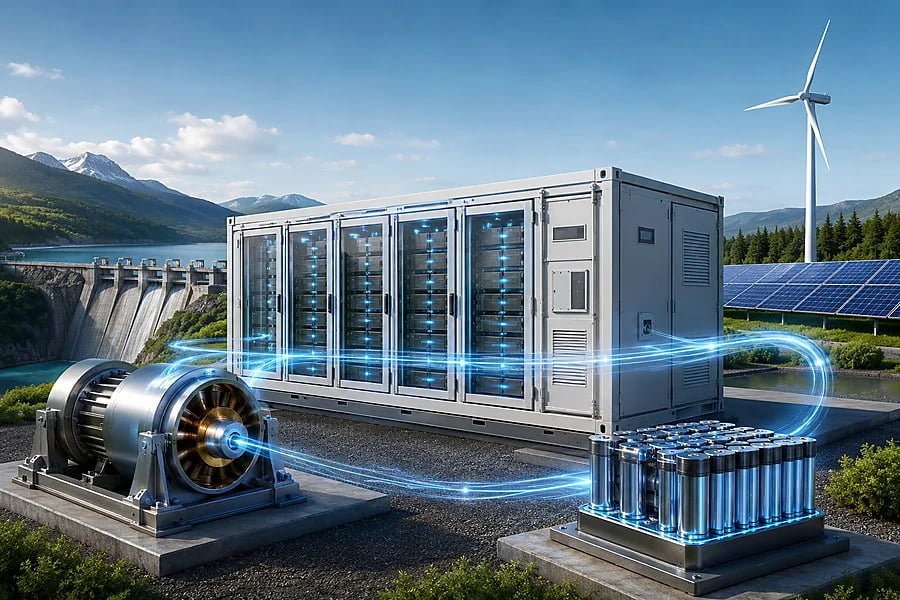
The most efficient practical energy storage system for short-duration electricity storage is usually lithium-ion battery storage, often around 85–90% AC round-trip efficiency. For very short bursts, supercapacitors and flywheels can be highly efficient, but they store energy for shorter periods. For large long-duration storage, pumped hydro remains one of the most proven options. Round-trip efficiency means the share of electricity put into storage that can later be taken back out, and a higher value means lower energy loss.
I do not think there is one universal winner. I think the best answer depends on the job. A home solar system, a commercial BESS project, a grid frequency-response plant, and a long-duration renewable energy project all need different storage behavior. So I judge efficiency with four questions: how much energy comes back, how fast the system responds, how long it can discharge, and how well it performs over its lifetime.
Which Energy Storage Has the Highest Efficiency?
Lithium-ion batteries are usually the highest-efficiency mainstream option for practical grid and commercial energy storage, while supercapacitors and flywheels can be very efficient for short power bursts.
In real electricity projects, I treat lithium-ion BESS as the leading answer when the goal is short-duration storage, fast response, and high round-trip efficiency. Sandia National Laboratories lists lithium-ion battery round-trip efficiency at about 85–90%, while one utility planning report also gives lithium-ion systems a general AC round-trip efficiency range of 85–90%.
Efficiency Is Not Just One Number
I like to separate “highest technical efficiency” from “best usable efficiency.” A device can lose very little energy during a short charge-discharge cycle, but it may still be a poor fit if it cannot store enough energy for the application.
| Storage system | Typical strength | Main efficiency lesson |
|---|---|---|
| Lithium-ion BESS | Short-duration grid, commercial, and solar storage | High round-trip efficiency and fast response |
| Flywheel | Frequency regulation and short power support | Very fast, but not ideal for long energy storage |
| Supercapacitor | Seconds-level power delivery | Very efficient for bursts, but low energy duration |
| Pumped hydro | Large-scale and long-duration storage | Slightly lower efficiency, but very large capacity |
| Hydrogen storage | Seasonal or very long-duration storage | Lower round-trip efficiency, but useful when duration matters more than losses |
The U.S. Energy Information Administration reported that in 2019, the U.S. utility-scale battery fleet had an average monthly round-trip efficiency of 82%, while pumped-storage facilities averaged 79%. That makes batteries look slightly better on efficiency alone. But pumped hydro can store huge amounts of energy for longer periods. That makes it hard to replace in some grid systems.
So my answer is clear but careful: lithium-ion is usually the most efficient practical electricity storage system for common short-duration use. Pumped hydro may be the better system when the project needs massive energy capacity, long asset life, and multi-hour or longer discharge.
Why Are People Against BESS?
People are against BESS because they worry about fire risk, toxic smoke, nearby siting, emergency response, property values, noise, and whether local authorities can manage rare but serious failures.
This question may seem separate from efficiency, but it matters. The most efficient system is not always the most accepted system. A lithium-ion battery facility may perform well on round-trip efficiency, but public trust can become a project risk.
Efficiency Does Not Remove Safety Concerns
Battery energy storage systems use dense electrical and chemical energy. That is why people ask hard questions when a BESS facility is planned near homes, schools, farms, or commercial buildings. EPA guidance says lithium battery fires can be difficult to extinguish, may reignite hours or days later, and can release harmful gases during fire events.
| Public concern | Why it matters for BESS projects |
|---|---|
| Fire risk | Thermal runaway can be hard to control if design and spacing are weak |
| Toxic emissions | Battery fires can release gases that affect nearby residents and first responders |
| Emergency response | Local fire teams need training, site access, and incident plans |
| Noise | HVAC systems, fans, transformers, and inverters can create background noise |
| Visual impact | Containerized battery blocks can look industrial |
| End-of-life handling | Damaged or retired batteries need correct recycling and disposal |
I think this is where many project discussions fail. Developers may talk about efficiency, renewable integration, and peak shaving. Residents may talk about fire access, smoke direction, and evacuation routes. Both sides are talking about real issues, but not always the same issue.
A good BESS project should not only say, “Our battery is efficient.” It should also show certified equipment, safe spacing, thermal management, battery management systems, emergency plans, drainage controls, and local responder coordination. Efficiency helps the business case. Safety and transparency help the project survive public review.
Is OTEC Better Than Solar Energy?
OTEC is not usually better than solar energy for mainstream electricity production, but it can provide steady tropical power where ocean temperature differences are strong and where constant output is valuable.
Ocean Thermal Energy Conversion uses the temperature difference between warm surface seawater and cold deep seawater to generate power. EIA explains that OTEC systems need a temperature difference of at least 20°C, or 36°F, to power a turbine.
OTEC Has Steady Output, But Low Conversion Efficiency
Solar PV is widely deployed because it is modular, mature, and easy to install in many places. OTEC is more location-specific. It needs tropical or subtropical ocean conditions, deep cold water access, large seawater flow, marine engineering, and strong coastal infrastructure.
| Factor | OTEC | Solar PV |
|---|---|---|
| Resource | Warm surface ocean and cold deep water | Sunlight |
| Best location | Tropical coastal or offshore areas | Wide global use |
| Output pattern | Can be steady | Daytime and weather-dependent |
| Maturity | Less commercial deployment | Highly mature and widely deployed |
| Storage need | Lower if output is constant | Often paired with batteries |
| Main limit | Low thermal efficiency and large seawater systems | Intermittency and land/grid limits |
NOAA describes OTEC as a constant clean source of electricity, different from intermittent renewable resources such as wind and wave. IRENA also states that OTEC plants can have a very high capacity factor, around 90–95%, but OTEC’s thermal conversion efficiency is low because the temperature difference is small.
So I would not call OTEC “better” than solar in general. I would call it different. Solar is usually the stronger commercial choice for most regions. OTEC may be attractive for islands, tropical coastal systems, desalination-linked projects, or places where steady renewable baseload power has high value. But if the question is pure market-ready efficiency and cost-effective deployment, solar plus lithium-ion battery storage is usually easier to justify today.
What Is the Most Efficient Energy Storage Method?
The most efficient energy storage method depends on storage duration: lithium-ion batteries for common short-duration power, flywheels or supercapacitors for seconds-level response, and pumped hydro for large long-duration storage.
I use duration as the first filter because it changes the answer fast. A system that is excellent for seconds may fail for hours. A system that works for ten hours may not respond as fast as a battery. A system that stores energy for weeks may lose more energy but still solve a bigger grid problem.
Match Efficiency to the Job
| Use case | Best-fit storage method | Why I would choose it |
|---|---|---|
| Home solar backup | Lithium-ion or LFP battery | High efficiency, compact size, mature products |
| Commercial peak shaving | Lithium-ion BESS | Fast response and good daily cycling |
| Grid frequency regulation | Flywheel or lithium-ion | Very fast power response |
| Large grid energy shifting | Pumped hydro or lithium-ion | Depends on site, duration, and cost |
| Long-duration storage | Pumped hydro, flow battery, thermal, or hydrogen | Duration may matter more than round-trip losses |
| Seasonal storage | Hydrogen or other chemical storage | Low efficiency, but very long storage time |
Pumped storage hydropower is more than 80% energy efficient through a full cycle, and it can often provide longer discharge duration than many battery projects. Argonne also notes that new pumped storage hydropower plants have typical round-trip efficiency around 80%.
This is why I avoid ranking storage systems from best to worst in a simple list. Lithium-ion may win on round-trip efficiency for many daily applications. Pumped hydro may win on scale and lifetime. Hydrogen may lose on efficiency but still matter for seasonal storage. A project owner should not ask only, “Which method wastes the least energy?” The better question is, “Which method delivers the needed energy, at the needed time, for the lowest lifetime cost and acceptable risk?”
My Insights: What Is the Most Efficient Energy Storage System for Real Projects
The most efficient energy storage system is usually lithium-ion battery storage for short-duration electricity use, but the best overall system depends on duration, scale, location, safety, and lifecycle cost.
This is my core insight: efficiency is not only a lab result. It is a project result. I want high round-trip efficiency, but I also want useful discharge duration, reliable operation, safe siting, easy maintenance, and a clear replacement plan.
My Practical Ranking
| Ranking by project type | Storage system I would consider first | Reason |
|---|---|---|
| Highest practical short-duration efficiency | Lithium-ion BESS | Strong round-trip efficiency and mature deployment |
| Highest short-burst performance | Flywheel or supercapacitor | Fast response and low short-cycle losses |
| Best large long-duration mature system | Pumped hydro | Proven, long-life, very large capacity |
| Best for difficult long-duration needs | Flow battery, thermal storage, or hydrogen | Lower efficiency may be acceptable if duration is the priority |
| Best island or tropical baseload concept | OTEC, where suitable | Constant output, but limited by location and cost |
IEA says lithium-ion batteries dominate new storage applications today, and LFP batteries accounted for 80% of new battery storage in 2023. This market signal matters because efficiency must also be buildable. A storage system that looks strong on paper does not help if supply chains, permitting, and service support are weak.
But I would not use lithium-ion for every project. If I needed ten hours or more at huge scale and had the right geography, I would look seriously at pumped hydro. If I needed backup across several days, I would compare flow batteries, thermal storage, compressed air, hydrogen, and hybrid systems. If I needed seconds of grid response, I would not ignore flywheels or supercapacitors.
The best real answer is this: lithium-ion BESS is the most efficient mainstream choice for many modern electricity storage projects, especially solar-plus-storage, commercial BESS, and daily grid balancing. Pumped hydro is still the strongest proven option for massive long-duration storage. Other methods can be better when the project values duration, safety profile, local materials, or seasonal storage more than round-trip efficiency alone.
Conclusion
Lithium-ion battery storage is usually the most efficient practical short-duration system, but pumped hydro, flywheels, supercapacitors, OTEC, and hydrogen each fit different energy storage needs.
](https://voltcrave-battery.com/wp-content/uploads/2026/06/Commercial-Energy-Storage-Systems-The-Future-of-Reliable-Power-for-Businesses-768x512.jpg)
](https://voltcrave-battery.com/wp-content/uploads/2026/06/What-Is-a-Battery-Management-System-BMS-768x512.jpg)
](https://voltcrave-battery.com/wp-content/uploads/2026/06/Stationary-Storage-Battery-Key-Guardians-of-Energy-Security-768x512.jpg)