

](https://voltcrave-battery.com/wp-content/uploads/2026/06/What-Are-the-Negatives-With-Battery-Storage-Facilities.jpg)
Battery storage sounds clean and simple, but many people worry when a BESS project is planned near homes, schools, farms, or businesses.
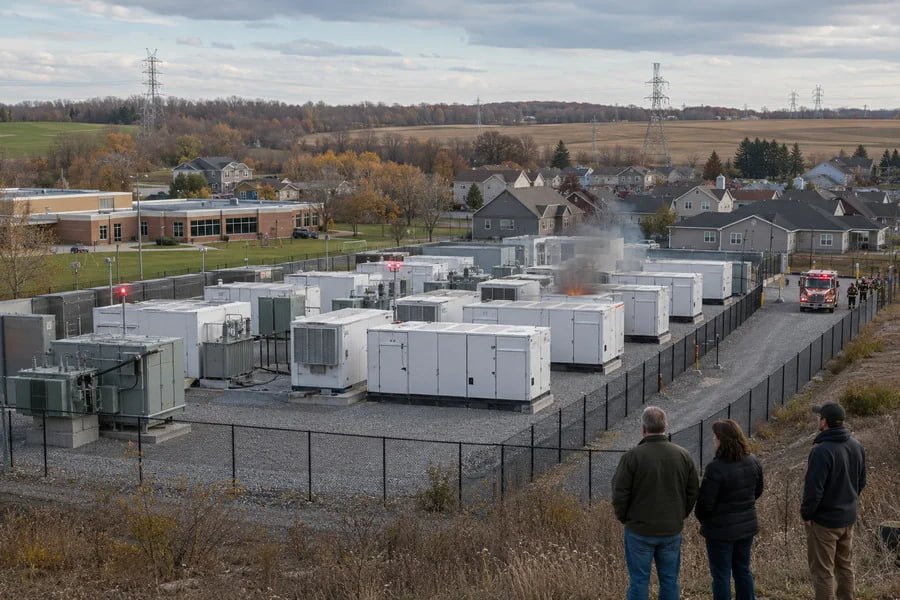
The negatives with battery storage facilities include fire risk, thermal runaway, toxic smoke during rare failures, contaminated runoff, emergency-response difficulty, noise, visual impact, land-use conflict, battery degradation, and end-of-life recycling concerns. These risks do not make every facility unsafe, but they do make siting, design, certification, and emergency planning essential. EPA says BESS supports grid reliability, but lithium battery fires at some installations have raised legitimate safety concerns in communities.
I do not see battery storage as a simple “good or bad” issue. I see it as an infrastructure decision. A well-designed battery energy storage system can support renewable energy and grid stability. A poorly sited or poorly managed project can create public fear, safety concerns, and long-term trust problems.
Is It Safe to Live Near a Battery Storage Facility?
Living near a battery storage facility can be safe when the site uses certified equipment, strong fire protection, enough separation, trained responders, and clear emergency plans.
The problem is that “safe” does not mean “risk-free.” Lithium-ion batteries can fail under certain conditions. UK government guidance says thermal runaway can be caused by physical damage, misuse, aging, or temperatures outside the safe range, and it can lead to fire, explosion, toxic gases, or water runoff.
What I Would Check First
When I look at safety, I do not only ask whether the battery cells are high quality. I ask whether the whole facility has been planned as a risk system. That includes cell chemistry, battery management systems, container spacing, fire detection, ventilation, drainage, access roads, and local firefighter training.
| Safety factor | Why it matters |
|---|---|
| Site distance | More space can reduce exposure to homes, roads, and sensitive buildings. |
| Battery chemistry | Some chemistries have different fire and thermal behavior. |
| Fire detection | Early detection helps operators isolate faults faster. |
| Emergency access | Fire crews need space, information, and safe entry routes. |
| Runoff control | Firewater or damaged battery materials may need containment. |
A battery facility may operate normally for years without releasing pollutants. ACP states that in normal operation, energy storage facilities do not release pollutants to air or waterways, but chemistry-specific hazards can appear under fault conditions. That is the key distinction. Normal operation is usually not the main fear. The main fear is the rare incident. This is why communities often ask for independent safety reviews, setback rules, emergency plans, and public disclosure before approval.
Why Are People Against BESS?
People are often against BESS because they worry about fire, toxic smoke, property value, nearby schools, unclear emergency plans, and whether developers are moving faster than local safety review.
I think the strongest opposition usually comes from uncertainty. Many residents do not oppose clean energy itself. They oppose feeling that a hazardous industrial project has been placed near them without enough explanation.
Why Opposition Grows
Recent public concern has grown because some high-profile battery fires received broad attention. A Financial Times report published in June 2026 said opposition to battery storage projects is increasing across the U.S., with more than 160 jurisdictions enacting moratoriums, mainly because of fire and toxic-fume concerns.
That does not prove every BESS project is dangerous. It proves that public trust is now a major project risk.
| Public concern | What residents usually want |
|---|---|
| Fire risk | Clear fire modeling and prevention details |
| Toxic smoke | Air monitoring and emergency communication plans |
| Water runoff | Drainage and containment design |
| Noise | Acoustic study and limits |
| Visual impact | Screening, setbacks, and site landscaping |
| Emergency response | Fire department training before operation |
I think developers make a mistake when they treat public concern as misinformation only. Some concerns are emotional, but many are practical. A battery storage facility is not the same as a solar panel field. It stores a large amount of chemical and electrical energy in one location. That means people want proof, not slogans. They want to know who monitors the system at night, who responds if a unit overheats, and what happens if smoke leaves the site. Better answers do not remove all opposition, but they can separate real risk from fear.
What Are the Disadvantages of Battery Storage Systems?
The main disadvantages of battery storage systems are high upfront cost, limited duration, performance degradation, safety management needs, recycling challenges, and dependence on the electricity used to charge them.
A battery does not create electricity. It stores electricity. That means its real value depends on charging time, discharge time, grid prices, renewable supply, and system design.
Technical and Economic Limits
Battery storage is useful, but it is not magic. A grid-scale battery may help balance solar and wind, support peak demand, and provide backup power. ACP describes energy storage as a technology that can support renewable integration, emergency backup, cost reduction, and grid balancing. But each benefit comes with limits.
| Disadvantage | Practical meaning |
|---|---|
| Degradation | Batteries lose capacity as they age and cycle. |
| Replacement cost | Modules may need replacement before other site equipment. |
| Duration limit | Many systems are built for hours, not days or weeks. |
| Standby management | Cooling, monitoring, and controls are always needed. |
| Recycling burden | End-of-life batteries need proper handling. |
| Grid dependence | Climate benefit depends on the power source used for charging. |
ACP notes that grid battery life depends on usage and that batteries degrade based on chemistry, charge-discharge cycles, and environmental temperature. This matters because a project that looks profitable on paper can change if cycling is heavier than expected or if replacement costs rise.
There is also a planning issue. Batteries are excellent for short-term flexibility, but they are not always the best answer for long-duration shortages. A four-hour battery can help with evening peak demand. It cannot solve a week-long low-wind period by itself. That does not make BESS weak. It means buyers, utilities, and communities should understand what problem the system is designed to solve.
What Are the Dangers of Lithium Battery Storage Facilities?
The main dangers of lithium battery storage facilities are thermal runaway, fire spread, toxic gas release, explosion risk, electrical hazards, stranded energy, and difficult cleanup after an incident.
These dangers are usually low-probability but high-consequence. That is why the discussion should focus on prevention, isolation, response, and recovery.
The Incident Chain
Thermal runaway is the core danger. NFPA explains thermal runaway as a rapid, uncontrolled release of heat energy from a battery cell, where the battery creates more heat than it can release. When this starts inside a battery module, the goal is to stop it from spreading across racks, containers, or buildings.
EPA says lithium battery fires are extremely difficult to extinguish and may reignite hours or days later. EPA also notes that battery fires can release harmful gases and that damaged batteries require specialized cleanup and disposal.
| Danger | Why it is serious |
|---|---|
| Thermal runaway | It can move from cell to module if not controlled. |
| Toxic gases | Smoke may create health risks for responders and nearby people. |
| Explosion risk | Flammable gases can build up in enclosed spaces. |
| Reignition | Stored energy can remain after visible flames stop. |
| Electrical shock | High-voltage equipment creates responder hazards. |
| Cleanup complexity | Burned batteries need special disposal procedures. |
One important point is that response strategy can differ from a normal fire. ACP says some manufacturers use a strategy that allows a fire in an individual enclosure to burn out in a controlled way while preventing spread to other enclosures. That may sound strange to residents, but it can be part of a planned approach to reduce explosion risk and protect surrounding units.
For me, the danger is not only the battery chemistry. The danger is poor system thinking. A safe project needs strong engineering, but it also needs transparent emergency planning, trained local responders, and real accountability after commissioning.
My Insights: What Do the Negatives Really Mean for Battery Storage Facilities
The negatives do not mean battery storage facilities should be rejected automatically. They mean every project should be judged by risk, location, design quality, and emergency readiness.
I would frame the issue this way: battery storage is useful infrastructure with real hazards. The right question is not “Are batteries good?” The better question is “Has this specific battery storage facility reduced its worst risks enough for this specific location?”
A Better Way to Judge a BESS Project
When I review the negatives, I divide them into three groups.
| Risk group | Examples | What should be required |
|---|---|---|
| Safety risks | Fire, explosion, toxic smoke, electrical hazards | UL certification, thermal testing, fire modeling, emergency plans |
| Community risks | Noise, visual impact, traffic, property concerns | Setbacks, screening, acoustic controls, public engagement |
| Lifecycle risks | Degradation, replacement, recycling, disposal | Maintenance plan, recycling contract, decommissioning plan |
This approach is more useful than a yes-or-no debate. A remote BESS site with strong separation, proven equipment, clean drainage, trained responders, and clear monitoring may be acceptable. A dense neighborhood site with weak public communication, unclear fire access, and poor runoff planning may deserve serious pushback.
The negatives also show why battery selection matters. Lithium-ion BESS is not one single product. Cell chemistry, enclosure design, battery management software, ventilation, fire barriers, spacing, and monitoring can change the risk profile. EPA says communities should consult BESS safety experts when considering and designing installations, and it also notes that improvements in quality and design have reduced failure incidents per gigawatt-hour deployed.
My final insight is simple. Battery storage facilities are not harmless boxes, and they are not automatic disasters. They are engineered energy assets. Their negatives become manageable only when the project treats safety, community trust, and end-of-life responsibility as core design requirements, not as public-relations details.
Conclusion
Battery storage facilities can support a cleaner grid, but their negatives are real. Fire safety, siting, emergency planning, noise, degradation, and recycling must be addressed before approval.
](https://voltcrave-battery.com/wp-content/uploads/2026/06/The-Real-Cost-of-Commercial-Battery-Energy-Storage-in-2026-What-You-Need-to-Know-768x512.jpg)
](https://voltcrave-battery.com/wp-content/uploads/2026/06/Energy-Storage-in-Telecom-Base-Stations-Innovations-Trends-768x512.jpg)
](https://voltcrave-battery.com/wp-content/uploads/2026/05/Is-Home-Battery-Storage-Worth-It-768x512.jpg)