

](https://voltcrave-battery.com/wp-content/uploads/2026/06/What-Are-the-Dangers-of-Lithium-Battery-Storage-Facilities.jpg)
Lithium battery storage facilities can support clean energy. But one hidden battery fault can turn a useful energy asset into a serious safety concern.
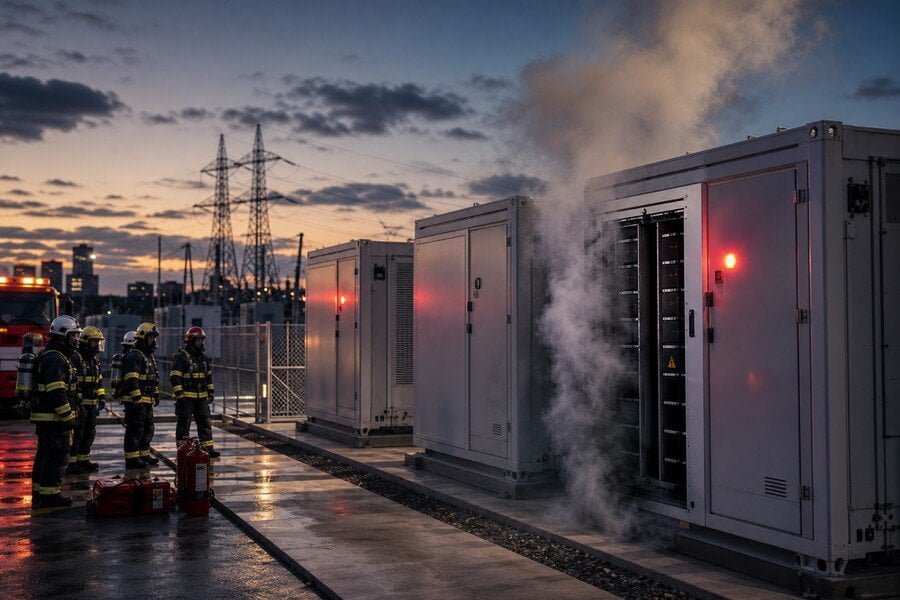
The main dangers of lithium battery storage facilities are thermal runaway, fire, toxic gas release, explosion risk, reignition, environmental contamination, and difficult emergency response. These risks are not constant during normal operation, but they become serious when batteries are damaged, overheated, poorly controlled, or involved in a system failure.
Lithium battery storage is not simply unsafe. Its risks can be reduced through strong design, testing, monitoring, spacing, ventilation, fire planning, and emergency coordination.
Where's the Safest Place to Store Lithium Batteries?
The safest place to store lithium batteries is a cool, dry, well-ventilated area away from heat, direct sunlight, flammable materials, exits, sleeping areas, and escape routes.
For small lithium batteries, storage safety starts with simple habits. I would avoid hot rooms, wet areas, metal clutter, direct sun, and places where people must pass during an emergency. NFPA advises people not to store batteries near evacuation pathways, windows, doors, or sleeping areas. USFA also says lithium-ion batteries should be stored at room temperature when possible and should not be charged below 32°F or above 105°F.
Safe Storage Depends on Scale
A phone battery, an e-bike battery, and a grid-scale battery container do not need the same storage plan. The basic idea is the same, but the risk level changes with stored energy.
| Storage Situation | Safer Practice | Why It Matters |
|---|---|---|
| Small spare batteries | Keep in a cool, dry place | Reduces heat and moisture risk |
| E-bike or tool batteries | Store away from exits and bedrooms | Keeps escape routes open |
| Damaged or swollen batteries | Isolate and seek proper disposal | Reduces fire and venting risk |
| Commercial battery rooms | Use monitoring, ventilation, and fire-rated design | Supports early detection |
| BESS facilities | Use spacing, access roads, sensors, and emergency plans | Reduces fire spread and response delays |
For large lithium battery storage facilities, the safest place is not only a physical location. It is a properly designed site. The facility should meet local codes, zoning rules, fire access needs, separation distances, and safety standards. EPA recommends considering battery chemistry, manufacturing quality, unit design, BMS capability, system integration, remote sensors, and first responder planning before installing a BESS.
So I would define the safest place as a controlled environment, not just an empty space. It should control heat, detect abnormal conditions, isolate failures, allow firefighters to access the site, and reduce risk to nearby people and buildings.
Why Are People Against BESS?
People are against BESS mainly because they worry about fire, toxic smoke, explosions, land use, environmental cleanup, nearby property risk, and whether local emergency teams are prepared.
These concerns are not random. Some high-profile BESS fires have made communities more cautious. EPA says lithium battery fires at some installations have raised legitimate safety concerns in many communities, even though BESS can help stabilize electrical grids.
Public Concern Usually Comes From Risk Visibility
A BESS site may look quiet most days. But people often focus on what happens during a rare failure. They may ask whether smoke could reach homes, whether water runoff could be contaminated, whether batteries could reignite, and whether firefighters have the right training.
| Public Concern | Why It Matters |
|---|---|
| Fire risk | Battery fires can be hard to extinguish |
| Toxic gas | Thermal runaway can release harmful emissions |
| Explosion risk | Gas buildup can ignite under some conditions |
| Reignition | Damaged batteries may flare up again later |
| Cleanup | Burned batteries need special handling |
| Emergency response | Fire crews need site-specific plans |
| Trust | Poor communication increases opposition |
The concern is stronger when developers do not explain the safety design clearly. People want to know where the batteries will be placed, how far they are from homes, what chemistry is used, how the site is monitored, and what happens if a container fails.
I think many objections are really trust problems. A community may accept BESS when the project shows clear spacing, UL 9540A testing, fire response planning, air monitoring plans, and public communication. But if the project only talks about clean energy benefits and avoids safety details, people may resist it.
EPRI’s BESS Failure Incident Database also shows why public concern exists. It tracks stationary storage incidents that caused increased safety risk, often thermal risks such as fire or explosion. But EPRI also says the failure rate per cumulative deployed capacity dropped by 99% from 2018 to 2025 as lessons from early failures were added into newer designs and best practices.
That means both sides have a point. People are right to ask safety questions. Project owners are also right that modern BESS design has improved.
What Are the Odds of a Lithium Battery Exploding?
There is no single public number for the odds of a lithium battery exploding. The risk depends on battery quality, chemistry, damage, charging control, temperature, system design, and safety protection.
A lithium battery does not usually explode during normal use. But explosion risk can appear when a battery enters thermal runaway and releases flammable gas. If that gas builds up in an enclosed area and then ignites, a deflagration or explosion can happen. FSRI says data shows that accumulated thermal runaway gas can create an explosion hazard, and its research studied delayed ignition after off-gas accumulated and mixed within a structure.
The Risk Is Low, But the Consequence Can Be High
For BESS facilities, I would not describe explosion risk as common. I would describe it as a low-frequency, high-consequence hazard. That makes it important for design review, ventilation, gas detection, container layout, and emergency response.
| Risk Factor | Effect on Explosion Risk |
|---|---|
| Physical battery damage | Can trigger internal short circuit |
| Overheating | Can start or accelerate thermal runaway |
| Poor BMS control | May miss abnormal voltage or temperature |
| Enclosed gas buildup | Increases deflagration risk |
| Weak ventilation | Allows flammable gases to collect |
| Poor spacing | Can increase fire spread |
| Lack of testing | Leaves failure behavior less understood |
The odds also change by battery type. A certified battery pack in a professionally designed BESS is very different from a damaged e-bike battery stored in a hallway or a mixed pile of batteries in a warehouse. Risk is not only about lithium-ion chemistry. It is about condition, control, and environment.
This is why I would be careful with simple claims like “batteries explode easily” or “batteries never explode.” Both are misleading. A better statement is this: lithium batteries are generally stable when designed, certified, installed, and used correctly, but they can create fire and explosion hazards under failure conditions.
UL 9540A exists because engineers and safety officials need real test data, not guesses. UL says UL 9540A is used to assess fire propagation related to thermal runaway events in battery energy storage systems, and it is cited in major safety codes and standards.
Can Lithium Batteries Start a Fire When Not Plugged In?
Yes, lithium batteries can start a fire when not plugged in if they are damaged, defective, overheated, internally shorted, contaminated, poorly stored, or already unstable from past abuse.
Charging is a common trigger, but it is not the only trigger. A battery stores chemical energy even when it is unplugged. If an internal fault develops, that stored energy can release as heat. If the heat cannot be controlled, the cell can move toward thermal runaway.
Stored Energy Is Still Energy
This is an important point. An unplugged battery is not “off” in the same way a lamp is off. It may not be powering a device, but it still contains energy. A damaged separator, crushed cell, poor manufacturing defect, water ingress, or previous overcharge can create conditions for failure later.
| Unplugged Battery Condition | Why It Can Be Dangerous |
|---|---|
| Swollen battery | May indicate internal gas or damage |
| Crushed battery | Can cause internal short circuit |
| Hot battery | May already be unstable |
| Previously overcharged battery | May have internal stress |
| Water-damaged battery | Can cause corrosion or shorting |
| Mixed loose batteries | Terminals may contact metal or each other |
| Old or degraded battery | May have weaker internal stability |
EPRI’s incident database includes examples where BESS incidents occurred while systems were charged but inactive, showing that inactivity does not always remove risk. EPA also lists BESS fire response concerns such as difficult suppression, harmful emissions, and special cleanup needs, which remain relevant even if the initiating fault is not active charging.
For homes and businesses, I would treat damaged lithium batteries as a separate hazard. Do not keep them in drawers, near doors, beside beds, or in hot storage rooms. Do not place loose cells where terminals can touch metal objects. Do not throw them into normal trash. For facilities, damaged or suspect batteries need isolation, monitoring, documentation, and proper disposal procedures.
The practical answer is simple: unplugging reduces some charging-related risk, but it does not erase stored-energy risk. A lithium battery must still be stored, inspected, and handled correctly.
My Insights: What Are the Dangers of Lithium Battery Storage Facilities
The dangers of lithium battery storage facilities are not only about batteries catching fire. They are about how fast one fault can spread if the site is poorly designed.
I see five major danger layers. The first is cell-level failure. The second is module or rack-level propagation. The third is container-level gas and fire behavior. The fourth is site-level fire spread. The fifth is community-level response, evacuation, cleanup, and trust.
The Real Risk Is a Chain Reaction
A single bad cell is not always a disaster. The bigger danger is a chain reaction. One cell overheats. Then nearby cells heat up. Gas forms. Pressure rises. A container fills with smoke or flammable vapor. Emergency teams need to decide whether to cool, isolate, ventilate, monitor, or let the unit burn while protecting nearby assets.
| Danger Layer | What Can Go Wrong | What Reduces the Risk |
|---|---|---|
| Cell | Internal short, overheating | Quality control and BMS monitoring |
| Module | Heat spreads to nearby cells | Thermal barriers and pack design |
| Rack | Fault grows beyond one module | Isolation and shutdown logic |
| Container | Gas accumulates | Ventilation and gas detection |
| Site | Fire spreads between units | Spacing and fire access |
| Community | Smoke, evacuation, cleanup | Emergency planning and communication |
This is why battery storage safety should not depend on one device. A BMS is important, but it is not enough alone. Fire detection matters. Thermal design matters. Ventilation matters. UL 9540A testing matters. Site layout matters. First responder training matters. Clear public communication matters.
I also think BESS opposition often grows when project owners discuss benefits but not hazards. People do not only want to hear that batteries support renewable energy. They want to know what happens during a worst-case event. They want to see data, design controls, and response plans.
The balanced view is this: lithium battery storage facilities have real dangers, but those dangers are manageable when the project is designed around failure prevention and failure containment. A safe facility does not pretend failures cannot happen. It assumes they can happen, then designs every layer to detect, isolate, slow, and control them.
Conclusion
Lithium battery storage facilities can create fire, gas, explosion, reignition, and cleanup risks, but strong design, testing, monitoring, spacing, and emergency planning can reduce those risks.
](https://voltcrave-battery.com/wp-content/uploads/2026/05/Is-Home-Battery-Storage-Worth-It-768x512.jpg)
](https://voltcrave-battery.com/wp-content/uploads/2026/06/How-Big-Can-the-Battery-Grid-Storage-Market-Get-768x512.jpg)
](https://voltcrave-battery.com/wp-content/uploads/2026/06/What-Is-a-Commercial-Energy-Storage-System-768x512.jpg)