

](https://voltcrave-battery.com/wp-content/uploads/2026/06/How-Long-Do-Grid-Storage-Batteries-Last.jpg)
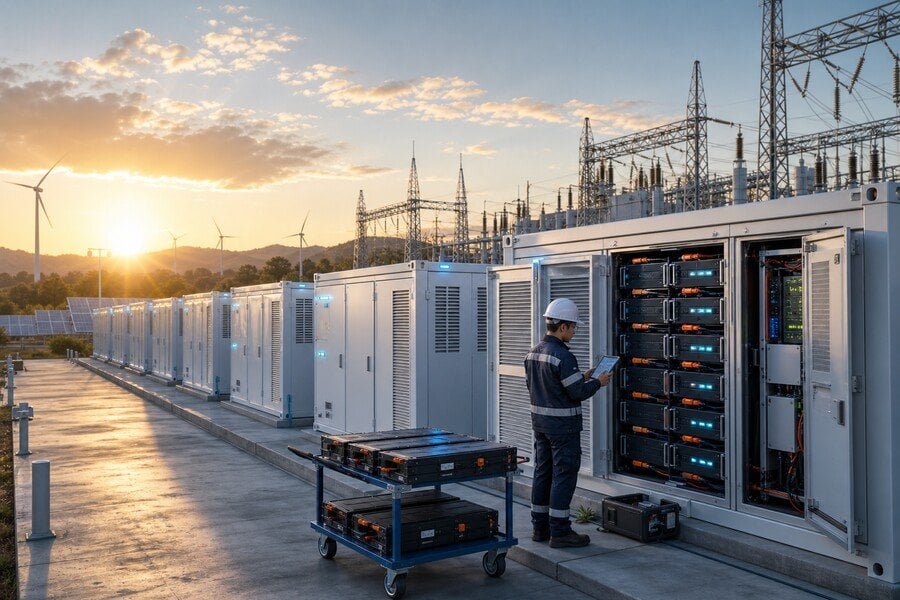
Grid storage batteries can look like fixed infrastructure. But inside each container, thousands of cells slowly age every time they store and release power.
Most lithium-ion grid storage batteries last about 10 to 15 years in practical project use. Their actual life depends on battery chemistry, cycle count, depth of discharge, temperature control, BMS quality, maintenance, and whether the project uses battery augmentation to replace lost capacity over time. NREL’s 2024 utility-scale battery assumptions include augmentation costs that allow a system to operate at rated capacity through a 15-year lifetime.
Battery life is not one fixed number. A well-managed grid battery can keep useful capacity for years, while poor design or operation can shorten performance fast.
What Is the Lifespan of a Grid Scale Battery Storage System?
The lifespan of a grid-scale battery storage system is usually around 10 to 15 years for lithium-ion systems, though some projects may operate longer with augmentation, replacement, or conservative use.
A grid-scale BESS does not usually fail all at once. It loses usable capacity over time. This is called degradation. The system may still work after year 10 or year 15, but it may not store the same amount of energy it stored when it was new. Many projects define end of life when the battery falls to about 70% to 80% of its original usable capacity.
Battery Life Has Two Clocks
A battery ages in two main ways. The first is calendar aging. This happens as time passes, even when the battery is not cycling heavily. The second is cycle aging. This happens when the battery charges and discharges. Both clocks run at the same time.
| Lifespan Factor | How It Affects Grid Battery Life |
|---|---|
| Battery chemistry | LFP, NMC, sodium-ion, and flow batteries age differently |
| Cycle count | More full cycles usually mean faster wear |
| Depth of discharge | Deeper cycles often create more stress |
| Temperature | Heat can speed up degradation |
| Charge/discharge rate | High power operation can increase stress |
| BMS quality | Better monitoring can protect cells |
| Thermal design | Good cooling helps keep cells consistent |
| Augmentation plan | Added or replaced modules can maintain rated capacity |
For many modern utility-scale projects, lithium iron phosphate, or LFP, is a common choice. The IEA says lithium iron phosphate batteries are still the preferred choice for grid-scale storage based on cost and energy-density considerations.
I also think project owners should separate battery cell life from full system life. The battery cells may be the most visible aging part, but the complete BESS also includes inverters, HVAC, fire safety equipment, transformers, control systems, and software. A good maintenance plan looks at the whole system, not only the cells.
How Do I Know When My Solar Battery Needs Replacing?
You may need to replace a solar battery when it stores much less energy, discharges too quickly, fails to charge fully, shows repeated fault alarms, overheats, swells, leaks, or can no longer support your normal loads.
A solar battery does not need replacement just because it is old. It needs replacement when performance, safety, or reliability no longer meets the job. For home and small commercial solar systems, many lithium batteries maintain useful performance for about 10 to 15 years before replacement becomes practical. EnergySage says most solar batteries maintain strong performance for 10 to 15 years before needing replacement, though they gradually lose capacity over time.
Practical Signs of Battery Replacement
The clearest sign is shorter runtime. A battery that once powered key loads through the night may now drain in only a few hours. Another sign is weak charging behavior. The battery may stop charging early, charge very slowly, or show unstable SOC readings.
| Replacement Sign | What It May Mean |
|---|---|
| Runtime is much shorter | Usable capacity has declined |
| Battery drains faster than before | Internal resistance or aging may be rising |
| Frequent BMS alarms | The system detects unsafe or abnormal behavior |
| Battery cannot reach full charge | Cells may be imbalanced or degraded |
| Overheating | Thermal or cell health risk |
| Swelling or leakage | Serious safety concern |
| Inverter communication faults | Battery control or compatibility issue |
| Warranty capacity threshold reached | Replacement may be covered or recommended |
For a grid storage battery, the same logic applies at a larger scale. Operators watch SOH, capacity tests, fault logs, temperature history, cycle data, cell imbalance, and availability. They do not wait until the battery “dies.” They plan service or augmentation before performance falls below contract requirements.
I would not judge replacement only by age. I would check data. A 9-year-old battery with good SOH may still be useful. A 5-year-old battery exposed to high heat and deep cycling may already need attention. Battery replacement is a performance decision, a safety decision, and a financial decision at the same time.
What Are the Disadvantages of BESS?
The disadvantages of BESS include battery degradation, limited duration, high upfront cost, fire safety risk, recycling needs, mineral supply pressure, site permitting issues, and performance loss over time.
Battery energy storage is useful, but it is not perfect. I think the biggest mistake is to treat BESS as a magic solution for every grid problem. It is best at fast response, short-duration storage, peak shifting, frequency support, solar shifting, and backup power. It is weaker when a grid needs many days or weeks of energy storage.
BESS Has Limits That Buyers Should Understand
A lithium-ion BESS is usually designed for a specific duration, such as 1 hour, 2 hours, or 4 hours. It can discharge quickly, but it cannot keep discharging forever. For long cloudy or windless periods, the grid may need other resources too, such as long-duration storage, pumped hydro, stronger transmission, flexible demand, or firm clean generation.
| Disadvantage | Why It Matters |
|---|---|
| Degradation | Capacity falls with age and cycling |
| Limited duration | Most lithium BESS projects cover hours, not days |
| Upfront cost | Project economics need careful modeling |
| Fire safety risk | Thermal runaway must be managed |
| Recycling and disposal | End-of-life handling must be planned |
| Critical minerals | Supply chains can affect cost and risk |
| Auxiliary energy use | HVAC and controls consume power |
| Integration complexity | BMS, PCS, EMS, and grid controls must work together |
Safety is also part of the discussion. EPRI’s BESS Failure Incident Database says stationary storage incidents still occur, but the failure rate per cumulative deployed capacity dropped by 98% from 2018 to 2024 as lessons from earlier failures were built into newer designs and practices. ([EPRI Storage Wiki][4])
This tells me two things. First, safety risk is real. Second, the industry is improving. Better cells, better BMS logic, UL 9540A testing, ventilation, spacing, fire detection, and emergency planning all matter.
The other disadvantage is economic uncertainty. A BESS may look profitable in a model, but actual value depends on market rules, electricity prices, cycling strategy, battery degradation, demand charges, and grid service payments. A system that cycles too aggressively may earn revenue today but lose capacity faster tomorrow. So the best BESS strategy balances short-term income with long-term battery health.
What Kind of Batteries Are Used for Grid Storage?
The most common batteries used for grid storage today are lithium-ion batteries, especially lithium iron phosphate batteries. Other options include NMC batteries, flow batteries, sodium-ion batteries, lead-acid batteries, and emerging long-duration technologies.
Lithium-ion batteries dominate many grid storage projects because they are efficient, modular, fast responding, and commercially mature. Within lithium-ion, LFP has become especially common for stationary storage because it offers good safety characteristics, strong cycle life, and cost advantages compared with some other lithium chemistries. The IEA identifies lithium iron phosphate as the preferred choice for grid-scale storage based on cost and energy-density considerations.
Different Batteries Serve Different Jobs
Not every grid storage project needs the same chemistry. A system used for frequency regulation may need high power and fast response. A solar shifting project may need several hours of energy. A remote microgrid may need reliability and easy maintenance. A long-duration project may need a chemistry with lower degradation over long discharge periods.
| Battery Type | Common Role | Strength | Limitation |
|---|---|---|---|
| LFP lithium-ion | Utility and commercial BESS | Cost, safety, cycle life | Still degrades over time |
| NMC lithium-ion | Some storage and mobility uses | High energy density | More thermal management concern |
| Flow battery | Long-duration storage | Long cycle life potential | Higher system complexity |
| Sodium-ion | Emerging grid storage | Lower material supply pressure | Still scaling commercially |
| Lead-acid | Backup and legacy systems | Low upfront cost | Shorter life and lower energy density |
| Second-life EV battery | Some stationary projects | Potential lower cost | Variable quality and warranty complexity |
A PNNL/Sandia storage cost and performance report noted that lithium-ion batteries offered the best option for a 4-hour BESS in terms of cost, performance, calendar and cycle life, and technological maturity at the time of the assessment.
I think the future grid will use more than one battery type. LFP may remain strong for many short-duration and medium-duration projects. Flow batteries, sodium-ion batteries, and other storage technologies may grow where duration, safety, mineral supply, or lifecycle cost matter more than compact size. The right choice depends on the project goal, not only on the battery name.
My Insights: How Long Do Grid Storage Batteries Last
Grid storage batteries last as long as their useful capacity, safety, and economics remain acceptable. For most lithium-ion BESS projects, that usually means about 10 to 15 years, but the true answer depends on how the battery is designed, operated, cooled, monitored, and maintained.
I believe the most useful way to understand grid battery lifespan is to look at “usable life,” not calendar age. A battery can still turn on after 15 years. But if it cannot meet energy capacity, discharge power, safety margin, or warranty targets, it may no longer be useful for the project.
My Main View
Battery lifespan is not just a product specification. It is a project strategy. The same battery can age differently in two different sites because the duty cycle is different.
| Project Choice | Lifespan Impact |
|---|---|
| Conservative SOC window | Can reduce chemical stress |
| Good HVAC design | Can slow heat-related aging |
| Accurate BMS monitoring | Helps detect weak cells early |
| Moderate cycling | Can extend usable life |
| Regular maintenance | Protects uptime and safety |
| Augmentation budget | Maintains rated project capacity |
| Strong integration | Reduces control errors and stress |
I would also ask one more question before buying or designing a grid battery: “What happens after year 10?” That question forces a better plan. It leads to warranty review, spare parts planning, recycling planning, capacity testing, software support, and augmentation strategy.
The simple answer is that grid storage batteries often last 10 to 15 years. The more useful answer is that their lifespan is managed, not guessed. A project with strong thermal design, high-quality cells, good BMS control, realistic cycling, and planned augmentation can protect more value over time. A project that ignores degradation may look cheaper at first but cost more later.
So when I think about grid storage battery life, I do not only look at cycles or years. I look at usable capacity, operating data, temperature history, safety logs, and the business case. That is where the real lifespan becomes clear.
Conclusion
Grid storage batteries usually last about 10 to 15 years, but good chemistry, cooling, BMS control, maintenance, and augmentation can protect their useful life.
](https://voltcrave-battery.com/wp-content/uploads/2026/06/What-Is-the-Most-Efficient-Energy-Storage-System-768x512.jpg)
](https://voltcrave-battery.com/wp-content/uploads/2026/06/What-Is-a-Commercial-Energy-Storage-System-768x512.jpg)
](https://voltcrave-battery.com/wp-content/uploads/2026/06/What-Is-a-Battery-Management-System-BMS-768x512.jpg)