

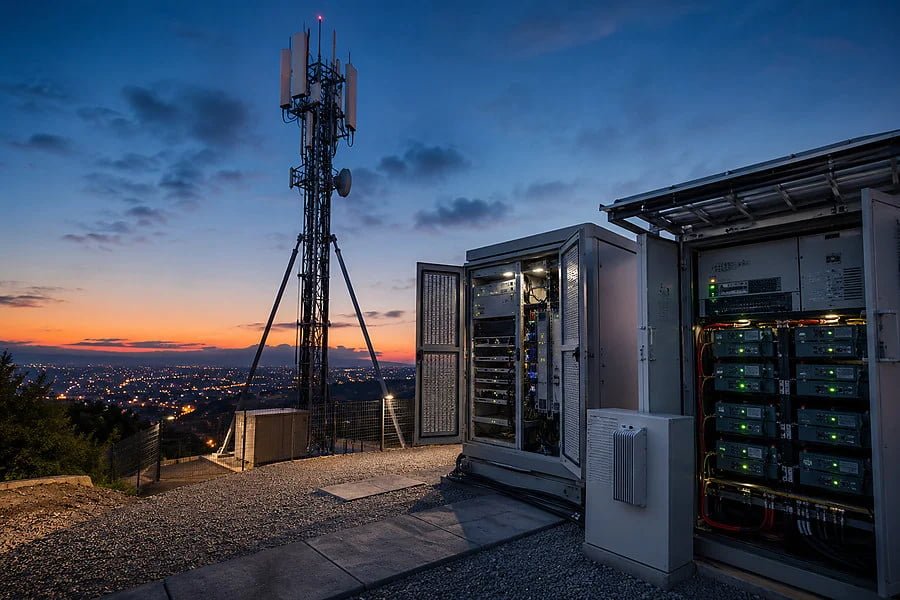
](https://voltcrave-battery.com/wp-content/uploads/2026/06/How-Can-You-Build-Reliable-Base-Station-Power-Solutions-for-Telecom-Networks.jpg)
Telecom networks face a major crisis when the grid fails. Dropped calls and lost data connections lead to angry customers and lost revenue for every minute the station stays dark.
A reliable base station power solution requires a high-efficiency DC power system, typically 48V, integrated with LiFePO4 battery backup and intelligent rectifiers. These systems must provide seamless transition during outages, handle the high energy demands of 5G, and offer remote monitoring to ensure constant uptime.
Many prioritize low upfront costs but ignore expensive future repairs. True network stability requires technical focus to build power systems that last. Let’s dive into these critical technical details.
Why is 48V Used in Telecom Networks?
Standard electrical systems often use voltages that are either too dangerous or too inefficient for long-distance cabling. Using the wrong voltage leads to high energy loss and puts technicians at great risk.
The telecom industry uses 48V DC because it provides the best balance between safety and electrical efficiency. It is classified as Safety Extra Low Voltage (SELV), meaning it is safe for technicians to handle while still being high enough to minimize energy loss over long cables.
The Technical Logic of 48V
When I look at the design of a base station, the choice of 48V is very practical. In the early days of telephone systems, engineers found that 48V was enough to carry signals over miles of copper wire without losing too much power. Today, we keep this standard because it works. If we used 12V or 24V, the current would be so high that we would need massive, expensive copper cables to prevent the wires from melting. 48V keeps the current low enough that we can use standard, manageable wiring.
Safety and Regulatory Standards
Safety is always my first priority. 48V DC is below the 60V threshold that many international safety bodies define as dangerous. This means that a technician can work on a "live" system with much less risk of a fatal electric shock. This simplifies the installation process and reduces the need for heavy protective gear. It also means you do not need the same level of high-voltage permits that you would need for 110V or 220V AC systems.
Efficiency and Battery Integration
Most telecom equipment is designed to run on DC power naturally. By using a 48V DC system, we avoid the need for extra inverters that turn battery power back into AC. Every time you convert power, you lose energy as heat. A 48V system is very efficient because the batteries can connect directly to the power bus.
Voltage Comparison for Power Distribution
| Voltage Level | Safety Rating | Cable Cost | Energy Loss |
|---|---|---|---|
| 12V DC | Extremely Safe | Very High | Very High |
| 24V DC | Very Safe | High | High |
| 48V DC | Safe (SELV) | Moderate | Low |
| 110V/220V AC | Dangerous | Low | Minimal |
Practical Benefits for Maintenance
- Hot-Swapping: Most 48V modules can be swapped while the system is running.
- Commonality: Almost all radio units (RRUs) and baseband units (BBUs) use this standard.
- Grounding: 48V systems often use positive grounding to prevent cable corrosion in damp environments.
What is the Power Supply for Telecom Equipment?
A base station cannot run directly on the unstable power from the public grid. If the power spikes or dips even slightly, sensitive electronics will burn out or reboot, causing a network crash.
A telecom power supply is a complete system that converts AC grid power into stable 48V DC power. It consists of rectifiers to handle the conversion, a distribution unit to send power to different parts of the site, and a battery backup for emergencies.
The Conversion Process
The first part of the system is the rectifier. I always tell people the rectifier is the most important part of the chain. It takes the alternating current (AC) from the city and turns it into clean direct current (DC). Modern rectifiers are very smart. They can handle a wide range of input voltages, which is important in places where the grid is not stable. If the grid voltage drops, a good rectifier will still provide a steady 48V to the equipment.
The Role of the Battery Management System (BMS)
You cannot just connect a battery to a radio and hope for the best. You need a BMS to act as the brain of the power supply. The BMS monitors the temperature, voltage, and current of each battery cell. I have seen systems fail because a single cell got too hot and the system did not shut it down. A professional power supply will have a BMS that can talk to the main controller, giving you early warnings before a failure happens.
Load Distribution and Protection
A telecom site has many different parts. You have the main radios, the cooling fans, and the transmission equipment. The power supply uses a Power Distribution Unit (PDU) to manage these. It uses breakers to make sure a short circuit in one radio does not kill the whole site. It also uses "Low Voltage Disconnect" (LVD). This means if the batteries are almost empty, the system will turn off the fans first so the radios can stay on for a few more minutes.
Essential Components of a Telecom Power System
- Rectifier Modules: These do the heavy lifting of power conversion.
- Controller: The "commander" that manages all the modules and alarms.
- LiFePO4 Batteries: The energy storage that provides backup power.
- Enclosure: A weather-proof box that keeps the electronics cool and dry.
System Configuration Comparison
| Component Type | Standard Rectifier | High-Efficiency Rectifier |
|---|---|---|
| Efficiency | 90% - 92% | 96% - 98% |
| Heat Output | High | Low |
| Long-term Cost | Higher Electricity Bills | Lower Operational Costs |
| Common Use | Legacy 3G/4G sites | New 5G Installations |
What is the Best Portable Power Station for Power Outage?
When a remote site fails, your team needs a way to power their tools or keep the site online while they fix the main system. Relying on heavy diesel generators is difficult for small crews and rooftop sites.
The best portable power station for an outage is a unit that uses LiFePO4 battery technology and offers at least 2kWh of capacity. It must have a pure sine wave inverter to safely power sensitive diagnostic tools and a fast-charging feature to minimize downtime.
Why Chemistry Matters
In my work, I always prioritize LiFePO4 over the older NMC technology. If you are carrying a power station in a hot truck, you want the safest chemistry possible. LiFePO4 is much more stable and does not have the "thermal runaway" risks that other lithium batteries have. It also lasts much longer. A standard LiFePO4 unit can be used every day for ten years, whereas other types might wear out in just three years.
Capacity and Output Requirements
A technician often needs to run a laptop, a heavy-duty drill, and perhaps a small cooling fan. You need a station that can handle a high "surge" or "starting" power. Some tools pull a lot of electricity the moment you turn them on. I recommend a station with an AC output of at least 2000W. This ensures that the station does not shut down the moment you start a power tool.
UPS Functionality for Critical Gear
One feature I always look for is the Uninterruptible Power Supply (UPS) mode. If you are updating software on a base station, you cannot let the laptop die. A portable power station with a fast UPS switch can take over in less than 20 milliseconds. This is fast enough that the electronic equipment will not even notice the grid went down.
Key Features to Check Before Buying
- Cycle Life: Look for 3,000 cycles or more.
- Charging Speed: It should charge from 0% to 80% in less than two hours.
- Ports: You need a mix of AC plugs, USB-C for modern electronics, and DC ports.
- Weight: It should be light enough for one person to carry up a flight of stairs.
Portable Power Comparison Table
| Feature | LiFePO4 Power Station | Traditional Gas Generator |
|---|---|---|
| Noise Level | Silent | Very Loud |
| Maintenance | None | High (Oil/Fuel) |
| Indoor Use | Yes (Safe) | No (Carbon Monoxide) |
| Operating Cost | Very Low | High (Fuel Costs) |
How Much Power Does a 5G Base Station Use?
The transition from 4G to 5G has changed the energy landscape for telecom operators. 5G is much faster, but this performance comes with a significant increase in electricity consumption that many older sites cannot handle.
A 5G base station typically uses between 1,000W and 1,500W for the basic radio equipment alone. When you add the cooling and secondary systems, the total power demand can reach 2,000W to 4,000W per site, which is nearly three times the consumption of 4G.
The Reason for High Power Demand
I often get asked why 5G is so "hungry" for power. The answer is in the technology. 5G uses "Massive MIMO" antennas. Instead of a few antennas, it uses dozens of them to send data to many people at once. Each of these antennas needs its own power amplifier. Processing all that data also requires a lot of computing power. This causes the equipment to generate a lot of heat, which then requires more power for cooling fans or air conditioning.
Thermal Management Challenges
As power usage goes up, heat becomes a huge problem. Batteries do not like heat. If a 5G site gets too hot, the life of the backup batteries will be cut in half. I have seen sites where the internal temperature reached 50 degrees Celsius. This is why modern power solutions for 5G must include better thermal design. We use heat sinks and intelligent airflow to keep the power modules cool. If the cooling fails, the power usage actually goes up even more as the components become less efficient.
Strategies for Energy Saving
To manage these high costs, many operators are looking at "peak shaving." This means you use a battery to power the station during the times of day when electricity is most expensive. You charge the battery at night when power is cheap. This does not change the total power used, but it changes the cost of that power. It also helps the grid stay stable.
4G vs. 5G Energy Comparison
| Site Component | 4G Power (Watts) | 5G Power (Watts) | Increase |
|---|---|---|---|
| Radio Units | 400W | 1200W | 3.0x |
| BBU (Baseband) | 200W | 500W | 2.5x |
| Cooling | 100W | 400W | 4.0x |
| Total Per Site | 700W | 2100W | 3.0x |
Practical Advice for Site Upgrades
- Check the Wiring: Older wires may be too thin for the higher current of 5G.
- Upgrade the Rectifiers: You will likely need more rectifier modules to handle the load.
- Expand Battery Capacity: A battery that gave you 8 hours of backup on 4G might only give you 2 hours on 5G.
My insights: Engineering Resilient and Scalable Power Architectures for Modern Telecom Networks
Frequent power outages disrupt connectivity and damage reputations. Deploying a modular -48V DC system with LiFePO₄ storage and intelligent monitoring ensures uninterrupted service and long-term network reliability.
To build reliable base station power, implement a modular -48V DC architecture combining grid inputs, redundant rectifiers, and high-density LiFePO₄ batteries. Integrate remote monitoring (EMS) for real-time health tracking and hybrid energy sources (solar/generators) for weak-grid sites. This scalable design ensures continuous uptime, thermal stability, and 5G expansion readiness.
The Framework for Strategic Power Management and 5G Evolution
Building reliability requires shifting from reactive hardware to a proactive, integrated ecosystem. As 5G increases power demands, traditional static systems fail. Reliability today is defined by modularity, allowing operators to scale capacity without downtime, and thermal resilience, ensuring electronics survive extreme outdoor climates.
The transition to LiFePO₄ batteries is the most critical upgrade, offering superior energy density and cycle life compared to lead-acid. When paired with an Intelligent Energy Management System (EMS), operators gain predictive maintenance capabilities, identifying potential failures before they impact network availability. For remote sites, a hybrid approach—integrating solar and diesel—decouples site uptime from grid instability.
| Feature | Traditional Solution | Modern Reliable Solution |
|---|---|---|
| Battery Type | Lead-Acid (VRLA) | Lithium-ion / LiFePO₄ |
| Architecture | Fixed / Static | Modular & Scalable |
| Monitoring | Manual / On-site | AI-Driven Remote EMS |
| Energy Source | Grid-Dependent | Hybrid (Solar/Grid/Diesel) |
| Maintenance | Reactive (Fix after failure) | Predictive (Analytics-based) |
Three Pillars of Modern Base Station Power
1. The Shift to Intelligent Lithium-Based Storage
LiFePO₄ batteries provide 10x the cycle life of lead-acid, making them essential for sites with frequent cycling or high-temperature environments where lead-acid prematurely degrades.
2. Modular Scalability and Thermal Resilience
Modular rectifiers allow for N+1 redundancy. If one module fails, others pick up the load. Furthermore, high-grade outdoor enclosures with active cooling prevent thermal runaway in high-density 5G installations.
3. Proactive Management through Digital Platforms
Remote monitoring (FSU/EMS) tracks "State of Health" (SOH) in real-time. This digital layer transforms the power system from a passive "black box" into a visible, manageable asset that reduces OPEX through fewer site visits.
Conclusion
Building a reliable telecom power system requires high-efficiency 48V DC architectures, safe LiFePO4 battery storage, and robust portable backups to manage the significant energy demands of modern 5G network equipment.
](https://voltcrave-battery.com/wp-content/uploads/2026/06/How-Big-Can-the-Battery-Grid-Storage-Market-Get-768x512.jpg)
](https://voltcrave-battery.com/wp-content/uploads/2026/06/How-Much-Does-a-100kWh-Commercial-Battery-System-Really-Cost-in-2026-768x512.jpg)
](https://voltcrave-battery.com/wp-content/uploads/2026/06/What-Are-the-Pros-and-Cons-of-Solar-Energy-Storage-768x512.jpg)