

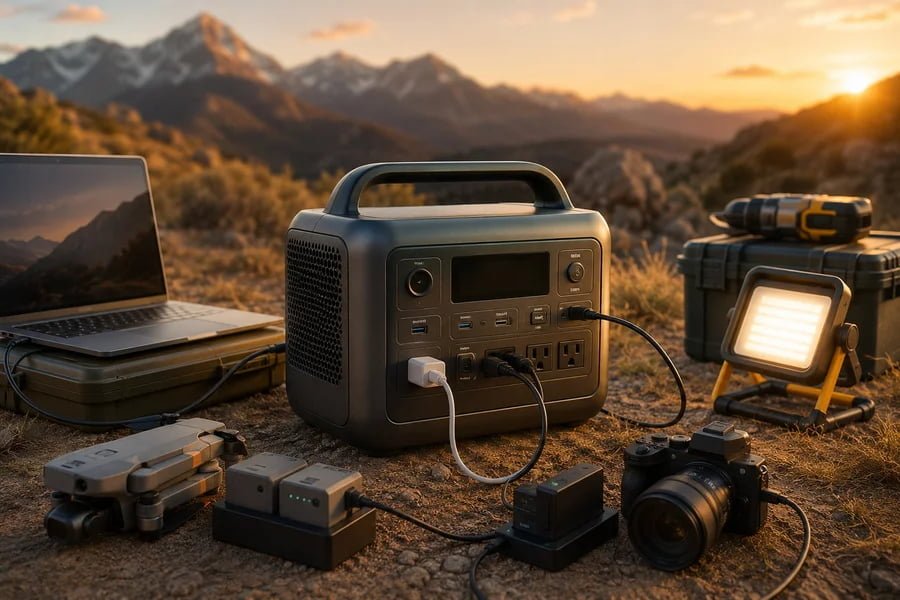
](https://voltcrave-battery.com/wp-content/uploads/2026/06/What-is-the-Best-Portable-Outdoor-Power-Station.jpg)
You are miles away from the city and your equipment stops working. A dead battery ruins your project and wastes your time. It is a common problem that stops people from working off-grid.
The best portable outdoor power station is a unit that uses LiFePO4 battery cells for safety and long life. It should have at least 1000Wh of capacity and multiple output ports. You must ensure it has UL or CE certifications to guarantee it works safely in high-demand outdoor environments.
I have seen many power stations fail when they are needed most. Reliability is not just a feature; it is a necessity for anyone working or living outdoors. Let me show you how to choose the right one.
What is the best power station for outdoor use?
Outdoor work puts heavy stress on electronics. Dust, heat, and constant movement will break a poorly made unit very fast. You need a station that is built to handle these specific environmental challenges without failing.
The best power station for outdoor use must feature a rugged outer shell and an advanced Battery Management System (BMS). It should prioritize LiFePO4 chemistry over standard Lithium-ion to ensure it can handle high temperatures and thousands of charge cycles. Portability and fast solar recharging are also essential for long-term off-grid utility.
Why Battery Chemistry Changes Everything
I have spent a long time analyzing battery performance. In the past, most units used NCM (Nickel Cobalt Manganese) batteries. They were light but did not last long. Now, the industry has moved to LiFePO4 (Lithium Iron Phosphate). These batteries are slightly heavier, but they are much safer. They do not catch fire easily and can last for over 10 years. If you are using a station outdoors in the heat, LiFePO4 is the only safe choice.
Essential Features for Rugged Environments
When you are outside, you do not have a wall outlet. This means your station must charge quickly from solar panels. I look for units with a high MPPT (Maximum Power Point Tracking) efficiency. This helps the station pull more power from the sun even when it is cloudy. You also need a Pure Sine Wave inverter. Cheap inverters can damage your laptop or medical equipment. A Pure Sine Wave inverter produces clean power exactly like the outlet in your home.
Comparison of Outdoor Power Needs
| Device | Power Consumption | Recommended Station Capacity |
|---|---|---|
| Small Drone | 60W | 500Wh - 700Wh |
| Portable Fridge | 45W - 60W | 1000Wh - 1500Wh |
| Electric Grill | 1200W - 1500W | 2000Wh+ |
| Laptop | 60W - 100W | 500Wh+ |
Protection and Durability
I always check the build quality of the ports. Outdoors, ports get full of dirt. The best units have rubber covers for every outlet. You should also look for a unit with a high-contrast screen. It is very hard to read a dim screen when you are standing in direct sunlight. A good screen tells you exactly how many hours of power you have left based on your current usage. This prevents you from being surprised by a dead battery at night.
Which is better, Jackery or Ecoflow?
Many people get confused by marketing when looking at these two brands. Both companies make high-quality products, but they serve different types of users. You must decide if you want simple operation or high-speed performance.
Ecoflow is generally better for users who need the fastest charging times and advanced app control. Jackery is better for those who want a simple, durable design that is very easy to use. While Ecoflow pushes the limits of technology, Jackery focuses on a classic, reliable user experience for casual campers.
The Speed Advantage of Ecoflow
I have tested many units, and Ecoflow is the leader in charging speed. Their X-Stream technology allows you to charge from 0% to 80% in about an hour. This is a huge benefit if you are at a job site and only have a short time to plug into a generator. Their mobile app is also very detailed. It lets you change settings and monitor power use from a distance. If you like technology, you will likely prefer Ecoflow.
The Reliability of Jackery
Jackery was one of the first companies in this market. Their units have a very distinct orange and black design. They are very sturdy. I find their interface to be the most intuitive. There are no complex menus. You just push a button and the power starts flowing. While they were slower to adopt LiFePO4 batteries, their newer "Plus" models now include this superior chemistry. They are a great choice if you just want something that works every time without checking an app.
Key Differences at a Glance
- Charging Speed: Ecoflow is much faster on AC power.
- Portability: Jackery often has better integrated handles for carrying.
- Expansion: Ecoflow makes it easier to add extra battery packs.
- Solar Setup: Both offer excellent folding solar panels that are easy to deploy.
Making the Final Choice
I think the choice comes down to your lifestyle. If you are a professional who needs power back quickly, Ecoflow is the tool for you. If you are a casual outdoor enthusiast who wants a reliable backup that is easy for anyone in the family to use, Jackery is often the better fit. Both maintain high resale value because they use high-quality components inside their cases.
What is the best portable power station on the market?
With hundreds of brands available, it is hard to find the one that offers the best value. Many cheap units use low-grade cells that fail after a few months. I believe you must look at the technical specifications, not the price tag.
The best portable power station on the market is the one that provides a balance of high capacity, safety certifications, and a long warranty. It must utilize LiFePO4 cells, offer at least 2000W of output, and hold certifications like UL, CE, and FCC to ensure it meets international safety standards for consumers and businesses.
The Role of International Certifications
I cannot stress this enough: never buy a power station that lacks professional certifications. Certifications like UL (Underwriters Laboratories) mean the unit has been tested for fire safety and electrical stability. When you are sleeping in a tent or a van with a large battery, you need to know it is safe. A high-quality station will have 680 or more international certifications to prove it can be sold and used safely across the globe.
Understanding Capacity vs. Portability
The "best" unit depends on how you move. If you stay in one place, a 2000Wh unit is great because it can run a coffee maker or a heater. However, these units can weigh over 20kg. If you are hiking, you need something under 10kg. The best market options now offer modular designs. This means you can carry a small base unit and add extra battery modules only when you need them.
Technical Performance Standards
| Specification | What "The Best" Looks Like |
|---|---|
| Cycle Life | 3000+ cycles to 80% capacity |
| Inverter Type | Pure Sine Wave |
| AC Input | 1000W+ for fast wall charging |
| BMS | Multi-stage protection (Temp, Volts, Amps) |
Why Internal Build Matters
I have looked inside many of these machines. The best ones use thick copper wiring and high-quality cooling fans. Heat is the enemy of batteries. If a unit has poor ventilation, the battery will degrade quickly. The best units on the market use intelligent fans that only turn on when needed and keep the internal temperature below 45 degrees Celsius. This attention to detail is what separates a professional tool from a toy.
Who is better, Ecoflow or Bluetti?
This is a common debate for people who need large-scale power. Both brands focus on high-capacity units that can replace a gas generator. They both use LiFePO4 technology, but their approach to system design is quite different.
Bluetti is generally better for users who want heavy-duty, modular power with very high solar input capabilities. Ecoflow is better for users who want a high-tech, integrated experience with faster charging and better software. If you are building a permanent off-grid setup, Bluetti is often the preferred choice due to its ruggedness.
Bluetti's Modular Strength
I like how Bluetti designs their large units. Many of their systems are modular. You buy a main controller and then stack battery packs on top. This is very helpful if you want to start small and grow your power system over time. Bluetti also handles high-voltage solar input very well. This allows you to use professional house-sized solar panels to charge your portable station. It is a very efficient way to stay off-grid for weeks at a time.
Ecoflow's Ecosystem and Speed
Ecoflow wins when it comes to the "smart" side of power. Their units integrate perfectly with their smart home panels. You can use their stations to back up your whole house automatically if the power goes out. Their charging speed remains the fastest in the industry. I have found that for users who move their gear frequently, Ecoflow’s designs are often a bit more streamlined and easier to pack into a vehicle.
Comparing High-Capacity Models
- Safety: Both use LiFePO4, so both are very safe.
- Solar Input: Bluetti often supports higher voltage solar arrays.
- Weight: Both are heavy, but Bluetti units are often slightly bulkier.
- Interface: Ecoflow has a more modern, app-focused interface.
The Professional Verdict
In my experience, if you are setting up a base camp or a tiny house, Bluetti is a fantastic partner. Their hardware feels like industrial equipment. If you are a digital nomad or a filmmaker who needs to charge many devices quickly and move to the next location, Ecoflow’s speed and software will serve you better. Both brands represent the top tier of the current energy storage market.
My insights: The Best Portable Outdoor Power Station Is the One Matched to Your Real Load
Dead batteries can stop a campsite, worksite, RV trip, or emergency setup fast. Choosing the wrong power station creates weight, runtime, and reliability problems.
The best portable outdoor power station is usually a LiFePO4 model around 1,000–1,500Wh with at least 1,500W continuous AC output, fast recharging, strong solar input, and multiple AC/USB-C ports. For heavier outdoor use, 2–3kWh models like Anker Solix F3000 are better for RVs, fridges, tools, and backup power.
How to Choose the Right Outdoor Power Station
The “best” unit is not always the biggest one. A 300Wh power station is ideal for phones, cameras, drones, and laptops, but it will fail quickly with coolers or cooking gear. A 1,000–1,500Wh LiFePO4 unit is the best value for most campers because it balances runtime, safety, charging speed, and portability. For RVs, overlanding, power tools, or backup use, a 2–3kWh model gives more usable power, but weight becomes a serious trade-off.
Match Capacity to Your Outdoor Use
| Outdoor Use Case | Recommended Capacity | Continuous Output | Best Fit |
|---|---|---|---|
| Phones, cameras, drones | 200–400Wh | 300–600W | Day trips, hiking, light camping |
| Laptops, lights, fans, cooler | 500–1,000Wh | 800–1,500W | Car camping, outdoor work |
| Fridge, CPAP, tools, small appliances | 1,000–1,500Wh | 1,500–2,000W | Weekend camping, emergency use |
| RV, van life, backup circuits | 2,000–3,000Wh+ | 2,000–3,000W | Heavy off-grid power |
Key Buying Priorities
Prioritize LiFePO4 battery chemistry for long cycle life and safer outdoor use. Check continuous wattage, not just surge wattage, because it determines what the unit can actually run. Fast AC charging and high solar input are also critical because a large battery is less useful if it takes too long to recharge. For outdoor use, rugged casing, sealed ports, strong handles, and manageable weight matter as much as capacity.
Conclusion
The best outdoor power station must have a LiFePO4 battery and proper safety certifications. Focus on your specific needs for capacity and charging speed to choose the right partner.
](https://voltcrave-battery.com/wp-content/uploads/2026/06/How-Can-You-Build-Reliable-Base-Station-Power-Solutions-for-Telecom-Networks-768x512.jpg)
](https://voltcrave-battery.com/wp-content/uploads/2026/06/Does-Rechargeable-Battery-Last-Longer-and-Cost-effective-768x512.jpg)
](https://voltcrave-battery.com/wp-content/uploads/2026/06/Why-Battery-Management-System-BMS-Matters-in-Battery-Energy-Storage-System-768x512.jpg)