
](https://voltcrave-battery.com/wp-content/uploads/2026/10/Which-Is-the-Best-Portable-Power-Station-for-Home.webp)
Power outages can interrupt refrigeration, internet access, lighting, and daily activities. Choosing an undersized portable power station can leave essential appliances without electricity during an emergency.
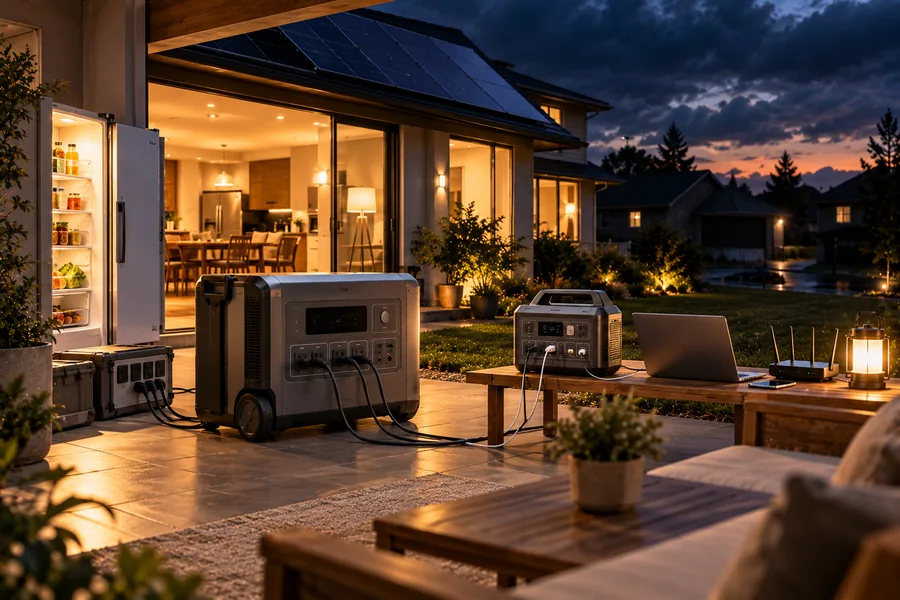
The EcoFlow DELTA Pro 3 is one of the best portable power stations for home backup in 2026, offering 4,096Wh battery capacity, 4,000W continuous AC output, and 120V/240V support. The Anker SOLIX F3800 Plus suits higher-power home applications, while the Anker SOLIX C1000 Gen 2 provides affordable backup for smaller essential loads.
I recommend choosing a home portable power station based on household energy needs, outage duration, appliance requirements, and budget rather than simply selecting maximum battery capacity.
Which Portable Power Station Is Best for Home Backup in 2026?
Portable power stations now offer enough output to operate refrigerators, computers, pumps, and selected household appliances. However, different models provide very different levels of energy storage and electrical compatibility.
The best home backup portable power stations in 2026 include EcoFlow DELTA Pro 3, Anker SOLIX F3800 Plus, Jackery Explorer 5000 Plus, and Anker SOLIX C1000 Gen 2. EcoFlow offers balanced home backup features, Anker provides strong high-power options, Jackery emphasizes large-capacity storage, and smaller Anker models suit essential-load backup.
EcoFlow DELTA Pro 3: Best Overall Home Backup Choice
I consider the EcoFlow DELTA Pro 3 one of the most balanced options for residential emergency electricity.
The unit provides:
- 4,096Wh nominal battery capacity
- 4,000W continuous AC output
- 120V and 240V output capability
- LiFePO4 battery technology
- Compatible solar charging
- Expandable energy storage configurations
- Multiple home backup connection options
- Five-year manufacturer warranty
EcoFlow supports system expansion to 48 kWh in specified configurations involving compatible equipment.
I consider this particularly useful for homeowners who may want to increase their storage capacity in the future.
The DELTA Pro 3 can operate selected high-power appliances, provided their running and starting requirements remain within its electrical limits.
It also supports integration with compatible transfer equipment, including the EcoFlow Smart Home Panel 2.
However, I would not assume that one 4 kWh battery can power every household appliance for an entire day.
The actual backup duration depends on electrical demand and available stored energy.
Anker SOLIX F3800 Plus: Best for High-Power Household Loads
The Anker SOLIX F3800 Plus is designed for more demanding residential backup applications.
Its main specifications include:
- 3,840Wh nominal energy capacity
- 6,000W continuous AC output
- 120V/240V split-phase capability
- Up to 3,200W compatible solar input
- LiFePO4 battery cells
- Modular battery expansion
- Compatible generator charging configurations
- Home backup panel integration
I consider the F3800 Plus especially relevant for households that need higher instantaneous electrical output.
For example, homes with certain 240V appliances may require more than the 120V outlets available on smaller portable stations.
The system can support approved household electrical connections when installed with compatible equipment.
However, its 6,000W output does not mean it stores more electricity than every lower-power model.
The battery capacity is 3.84 kWh before accounting for usable energy limits and conversion losses.
Jackery Explorer 5000 Plus: Best for High-Capacity Backup
The Jackery Explorer 5000 Plus is another strong choice for residential backup.
Its specifications include:
- 5,040Wh battery capacity
- 7,200W rated AC output
- 14,400W advertised surge output
- 120V/240V output capability
- LiFePO4 battery chemistry
- Compatible expansion battery support
- Solar charging capability
- Approved home backup connection options
I consider this model attractive for homeowners who need greater initial energy capacity and strong inverter output.
A 5 kWh-class battery provides more stored energy than many smaller portable power stations.
However, high-power appliances can still discharge it quickly.
The Explorer 5000 Plus weighs approximately 134.5 pounds, making it more suitable for wheeled movement than frequent lifting.
Anker SOLIX C1000 Gen 2: Best for Essential Loads
For smaller household backup requirements, I consider the Anker SOLIX C1000 Gen 2 a practical choice.
The unit provides 1,024Wh of battery capacity and 2,000W of rated continuous AC output.
Its relatively compact design allows users to move it between rooms.
OutdoorGearLab selected this model as a strong value option in its 2026 testing.
It can support compatible low-power appliances, communication equipment, and electronics.
However, its storage capacity is limited.
I would recommend it for selected essential loads rather than unrestricted whole-home backup.
Home Portable Power Station Comparison
| Model | Battery Capacity | Continuous Output | Best Application |
|---|---|---|---|
| EcoFlow DELTA Pro 3 | 4,096Wh | 4,000W | Overall home backup |
| Anker SOLIX F3800 Plus | 3,840Wh | 6,000W | High-power household loads |
| Jackery Explorer 5000 Plus | 5,040Wh | 7,200W | High-capacity backup |
| Jackery Explorer 2000 v2 | 2,042Wh | 2,200W | Portable essential backup |
| Anker SOLIX C1000 Gen 2 | 1,024Wh | 2,000W | Budget-conscious essential loads |
I would not treat these models as a universal performance ranking.
The best system depends on required voltage, average load, operating duration, and available charging sources.
What Size Portable Power Station Do You Need for Your Home?
Many homeowners purchase portable power stations based on advertised wattage without calculating the electricity required during an outage. This can result in disappointing backup duration or unnecessary costs.
For essential home backup, a portable power station with 1–2 kWh of capacity may support communication equipment, lighting, and selected appliances. A 3–5 kWh system provides more flexibility for refrigeration and longer outages. Whole-house backup may require substantially greater expandable battery capacity, depending on electricity consumption and expected operating time.
Understand Battery Capacity and Output Power
I always distinguish between two important electrical specifications.
Kilowatt-hours (kWh) describe the amount of stored electrical energy.
Kilowatts (kW) describe how much power the system can deliver at one time.
For example, a 4 kWh portable power station with a 4 kW inverter may support a substantial electrical load.
However, operating near full output would consume the available stored energy relatively quickly.
A higher inverter rating does not automatically mean longer backup duration.
I therefore evaluate battery capacity and output power separately.
Calculate Household Essential Loads
The first step is identifying which appliances must remain operational during an outage.
Consider the following illustrative example.
| Essential Appliance | Estimated Daily Energy |
|---|---|
| Refrigerator | 1.2 kWh |
| Wi-Fi router | 0.3 kWh |
| LED lighting | 0.5 kWh |
| Laptop and computer | 0.6 kWh |
| Television | 0.4 kWh |
| Fans and small appliances | 1.0 kWh |
| Total | 4.0 kWh |
These figures are examples, not fixed appliance ratings.
Actual consumption depends on appliance efficiency, operating hours, temperature, and usage patterns.
In this example, the home requires approximately 4 kWh per day for selected essential equipment.
A 4 kWh battery may not deliver the entire nominal capacity through its AC outlets.
I would therefore consider additional capacity or an available recharging method.
How to Calculate Battery Size
I use the following simplified formula:
Required Nominal Battery Capacity = Required AC Energy ÷ (Usable Discharge Fraction × Delivery Efficiency)
Suppose a household needs 4 kWh of AC electricity.
Assume:
- Usable battery discharge fraction: 90%
- Delivery efficiency: 90%
The estimated nominal battery requirement becomes:
4 kWh ÷ (0.90 × 0.90) = 4.94 kWh
I would therefore evaluate a system with approximately 5 kWh of nominal capacity or more for this example.
The final selection should also account for reserve energy, battery condition, and unexpected electrical demand.
Recommended Capacity by Home Application
| Home Backup Requirement | Initial Capacity Range |
|---|---|
| Phones, Wi-Fi, and lighting | 500Wh–1kWh |
| Essential electronics | 1–2kWh |
| Refrigerator and selected appliances | 2–4kWh |
| Extended essential-load backup | 4–8kWh |
| Broader household backup | 8–15kWh |
| Longer whole-home backup | 15–30kWh or more |
These ranges are starting points rather than guaranteed system sizes.
A home with electric heating or central air conditioning may require much more energy.
Why Load Management Matters
I believe load management is one of the most effective ways to extend battery backup time.
During an outage, homeowners may not need to operate electric dryers, ovens, water heaters, and EV chargers simultaneously.
Reducing nonessential electricity use allows stored energy to support more important appliances.
For example, reducing average power demand from 1,000W to 500W approximately doubles operating duration when the available battery energy remains unchanged.
I recommend designing backup plans around essential circuits before purchasing additional storage capacity.
How Long Can a Portable Power Station Power a House During an Outage?
Portable power stations can operate household appliances, but actual runtime varies considerably. A unit that powers a router for many hours may run a high-power appliance for only a short period.
A 4,096Wh portable power station could theoretically supply a constant 200W load for approximately 16.4 hours or a 600W load for about 5.5 hours, assuming 80% of nominal capacity is delivered as usable AC energy. Actual runtime depends on appliance demand, inverter efficiency, reserve settings, and battery condition.
Calculate Backup Runtime
I calculate estimated operating duration using:
Runtime (hours) = Available AC Energy (Wh) ÷ Average Load (W)
For example, consider a portable power station with 4,096Wh of nominal storage.
Assume 80% of its capacity becomes available through AC outputs.
Available electricity would be:
4,096Wh × 0.80 = 3,276.8Wh
If the home consumes a constant 400W:
3,276.8Wh ÷ 400W = 8.19 hours
This calculation assumes a constant electrical load and no solar recharging.
Actual results may be lower or higher depending on system operating conditions.
Estimated Runtime by Battery Capacity
The table below assumes 80% of nominal storage is available as AC electricity.
| Battery Capacity | 200W Load | 600W Load |
|---|---|---|
| 1,024Wh | 4.1 hours | 1.4 hours |
| 2,042Wh | 8.2 hours | 2.7 hours |
| 3,840Wh | 15.4 hours | 5.1 hours |
| 4,096Wh | 16.4 hours | 5.5 hours |
| 5,040Wh | 20.2 hours | 6.7 hours |
These calculations are illustrative and do not represent verified runtimes for individual models.
Real appliances also have variable electrical consumption.
Can a Portable Power Station Run a Refrigerator?
Many portable power stations can operate compatible refrigerators.
However, refrigerator electricity consumption depends on appliance size, efficiency, ambient temperature, and compressor activity.
I recommend measuring the refrigerator's daily electricity use.
For example, a refrigerator consuming 1.2 kWh per day could theoretically operate for more than one day from a 2 kWh power station, assuming sufficient usable energy and no other loads.
However, the inverter must also support compressor starting demand.
A high-efficiency refrigerator may use less electricity than an older or larger model.
Can a Portable Power Station Run Air Conditioning?
Some larger portable power stations can support selected air conditioners.
However, air conditioning often requires substantial continuous power.
For example, an air conditioner drawing an average of 1,500W consumes:
1.5 kW × 3 hours = 4.5 kWh
A single 4 kWh-class power station would generally not provide three hours at this load after accounting for energy losses.
I recommend evaluating both running power and compressor starting requirements before choosing an inverter.
For central air conditioning, suitable 240V output and approved electrical integration may also be necessary.
Can Solar Panels Extend Backup Duration?
Yes. Compatible solar panels can recharge portable power stations during daylight hours.
For example, suppose a solar array delivers an average of 500W for four hours.
The energy produced would be:
500W × 4 hours = 2,000Wh
The amount actually stored may be lower after charging losses.
I consider solar input useful during multi-day outages.
However, the system must have compatible charging equipment and sufficient sunlight.
Solar charging cannot guarantee continuous operation during extended poor weather.
What Happens When the Battery Runs Out?
When stored energy becomes depleted, a battery power station can no longer supply its rated electrical output.
The station must recharge from an approved electricity source.
Depending on the model, charging options may include the utility grid, solar panels, compatible generators, or vehicle charging equipment.
I recommend planning the recharging strategy before relying on a portable power station for emergency household electricity.
What Should You Consider Before Buying a Portable Power Station for Home Use?
Portable power stations differ in battery chemistry, inverter output, charging capability, safety certification, and home integration options. A product with impressive specifications may still be unsuitable for a particular household.
Before purchasing a home portable power station, I evaluate usable battery capacity, continuous AC output, 120V/240V compatibility, solar charging, expandability, battery life, safety certification, and warranty coverage. I also check whether approved transfer equipment is available, because ordinary portable outlets do not automatically provide safe whole-house electrical integration.
Choose the Right Battery Chemistry
Many modern portable power stations use lithium iron phosphate (LiFePO4) batteries.
This chemistry offers good cycling durability and favorable thermal stability.
I consider it especially attractive for emergency backup equipment that may also support regular charging and discharging.
However, battery chemistry alone does not establish complete system reliability.
The BMS, cell quality, thermal management, inverter, and electrical protection also matter.
I recommend reviewing the manufacturer's actual cycle-life conditions and warranty.
Check 120V and 240V Compatibility
Many smaller portable power stations provide 120V AC outlets in North America.
However, some homes use 240V appliances such as well pumps, electric dryers, and central air conditioning systems.
The EcoFlow DELTA Pro 3, Anker SOLIX F3800 Plus, and Jackery Explorer 5000 Plus offer 120V/240V configurations.
I consider this an important advantage for larger household backup applications.
However, 240V compatibility does not guarantee that every high-power appliance can operate.
The continuous output rating and starting requirements must also be checked.
Verify Home Electrical Integration
A portable power station used through its built-in outlets is different from a system connected to permanent household wiring.
For panel-based backup, I recommend using manufacturer-approved transfer equipment installed according to applicable electrical codes.
Some manufacturers offer compatible smart panels or transfer switches.
These systems can isolate the home from the utility grid during backup operation.
I would never recommend improvised electrical connections or backfeeding through household outlets.
Improper wiring can create serious risks for occupants and utility workers.
Understand Product Safety Standards
For North American portable power equipment, UL 2743 is an important standard for qualifying portable power packs.
Products intended for installed residential energy storage applications may need appropriate system-level certification under UL 9540.
UL 9540A is a method for evaluating thermal runaway fire propagation.
I distinguish between these requirements because a battery product certified for portable use is not automatically approved for permanent household electrical integration.
I recommend verifying the exact certification scope of the selected equipment and installation configuration.
Compare Charging and Expansion Capabilities
I consider battery expansion particularly useful when backup requirements may increase.
The EcoFlow DELTA Pro 3, Anker SOLIX F3800 Plus, and Jackery Explorer 5000 Plus support compatible capacity expansion.
The Anker SOLIX C1000 Gen 2 is more limited in this respect.
However, expansion capacity does not automatically increase the continuous power rating.
I always check how the manufacturer supports additional battery modules and whether the configuration requires extra electrical equipment.
Evaluate Total Ownership Cost
I do not compare portable power stations based only on purchase price.
The complete cost may include:
- Main battery power station
- Expansion batteries
- Solar panels and charging accessories
- Approved home transfer equipment
- Professional installation
- Shipping and transportation
- Maintenance and replacement requirements
I also evaluate the cost relative to usable battery energy.
A simple initial comparison is:
Purchase Cost per Nominal kWh = Equipment Price ÷ Rated Battery Capacity
For example, a hypothetical $2,500 power station with 5 kWh of rated storage has an equipment purchase cost of:
$2,500 ÷ 5 kWh = $500/kWh
However, this calculation excludes installation, energy losses, maintenance, and service life.
I recommend evaluating the complete backup system rather than relying only on a product's advertised price.
Home Backup Buying Checklist
| Selection Factor | What I Check |
|---|---|
| Battery capacity | Available stored energy |
| Continuous output | Supported running loads |
| Surge capability | Motor and compressor starting requirements |
| Output voltage | 120V/240V appliance compatibility |
| Solar charging | Compatible input and recharging capacity |
| Battery expansion | Future capacity options |
| Backup transfer | Approved home integration method |
| Battery chemistry | Cycle life and thermal characteristics |
| Safety certification | Applicable product and system approvals |
| Warranty | Coverage and service support |
I believe these specifications provide a more reliable basis for selection than choosing a power station based on brand recognition alone.
My Insights: Which Is the Best Portable Power Station for Home
Homeowners often choose portable power stations by comparing advertised wattage or battery size alone. This can result in limited runtime, unsuitable appliance compatibility, or unnecessary costs.
I believe the EcoFlow DELTA Pro 3 is one of the best overall portable power stations for home backup because it combines useful battery capacity, 120V/240V output, and expansion options. However, the Anker SOLIX F3800 Plus is attractive for higher-power loads, while smaller portable stations are often more economical for essential equipment.
I Prioritize Backup Duration Over Maximum Wattage
I do not consider maximum inverter output the most important specification for every household.
A power station with 6,000W output may support larger appliances than a 2,000W model.
However, if both batteries store similar amounts of energy, their operating duration under comparable loads may also be similar.
I therefore calculate backup runtime before selecting the final equipment.
For example, a home that needs to operate only a refrigerator, Wi-Fi router, and selected lights may not require a high-output 240V system.
A smaller power station could provide sufficient power at a lower initial cost.
Home Integration Matters More Than Portability for Larger Systems
I also believe that large portable power stations occupy a position between consumer power stations and installed home battery systems.
They may have wheels and movable enclosures, but their weight makes them less convenient for frequent transportation.
For a home backup project, I would place greater importance on approved electrical integration, load management, and battery expansion.
The ability to supply household circuits safely is more valuable than simply having a large number of outlets.
I always verify the equipment's intended installation method.
Solar Charging Improves Long-Term Backup Flexibility
I consider solar compatibility an important advantage for households that experience extended outages.
Without solar panels or another available charging source, a battery can only deliver its previously stored electricity.
When compatible solar equipment is installed, the battery may recharge during daylight hours.
This can extend backup operation under suitable conditions.
However, I would not assume that a solar-powered battery provides unlimited electricity.
The amount of solar generation must be sufficient to replenish the household's daily consumption.
Battery Expansion Should Match Real Household Needs
I believe modular storage can provide useful flexibility.
A homeowner may begin with a 4 kWh system and expand capacity when backup requirements increase.
However, additional battery capacity should be selected according to actual demand.
I would not automatically recommend expanding a system to 20 kWh or 30 kWh if the household only needs several hours of essential backup.
The best configuration is the one that matches the expected outage duration without unnecessary storage investment.
My Recommended Selection Framework
I evaluate home portable power stations through five connected factors:
Essential Loads → Required Power → Battery Capacity → Backup Duration → Recharging Availability
This approach helps identify the correct balance between power output and stored energy.
I also consider safety certification, manufacturer support, and future expansion before recommending a final configuration.
For a household requiring substantial backup capacity and flexible integration, I would start by evaluating the EcoFlow DELTA Pro 3.
For higher-power 240V loads, I would compare the Anker SOLIX F3800 Plus and Jackery Explorer 5000 Plus.
For basic refrigerator, router, lighting, and communication backup, I would consider a smaller 1–2 kWh power station.
Ultimately, I believe the best portable power station for home use is the system that supplies essential electricity safely, provides sufficient backup duration, and meets the household's actual power requirements without unnecessary costs.
Conclusion
EcoFlow DELTA Pro 3 is a strong overall home backup choice, while Anker and Jackery offer higher-power alternatives. Select based on capacity, appliance demand, and safety.
](https://voltcrave-battery.com/wp-content/uploads/2026/09/BESS-Battery-Energy-Storage-Smart-Solutions-for-Commercial-Power-Efficiency-768x512.webp)
](https://voltcrave-battery.com/wp-content/uploads/2026/10/Portable-Power-Station-vs-Mobile-Energy-Storage-System-The-Real-Boundary-768x512.jpg)
](https://voltcrave-battery.com/wp-content/uploads/2026/08/What-Is-Used-for-Long-Term-Energy-Storage-768x512.webp)