

](https://voltcrave-battery.com/wp-content/uploads/2026/09/Which-Commercial-Energy-Storage-Systems-Solution-Fits-Your-Business.webp)
Commercial energy storage can lower electricity costs, improve resilience, and support renewable energy, but choosing the wrong system size or operating strategy can turn a technically sound battery into a weak investment.
The right commercial energy storage system depends on what your business needs the battery to accomplish. Peak shaving favors high-power, shorter-duration storage; solar shifting often needs longer duration; backup requires sufficient usable kWh and islanding capability; EV charging may require high discharge power; and grid-service projects need suitable controls, communications, interconnection, and market access.
I therefore do not start by asking, “Which battery should I buy?” I start with a more useful question: What business problem must the storage system solve?
What Types of Commercial Energy Storage Systems Are Available?
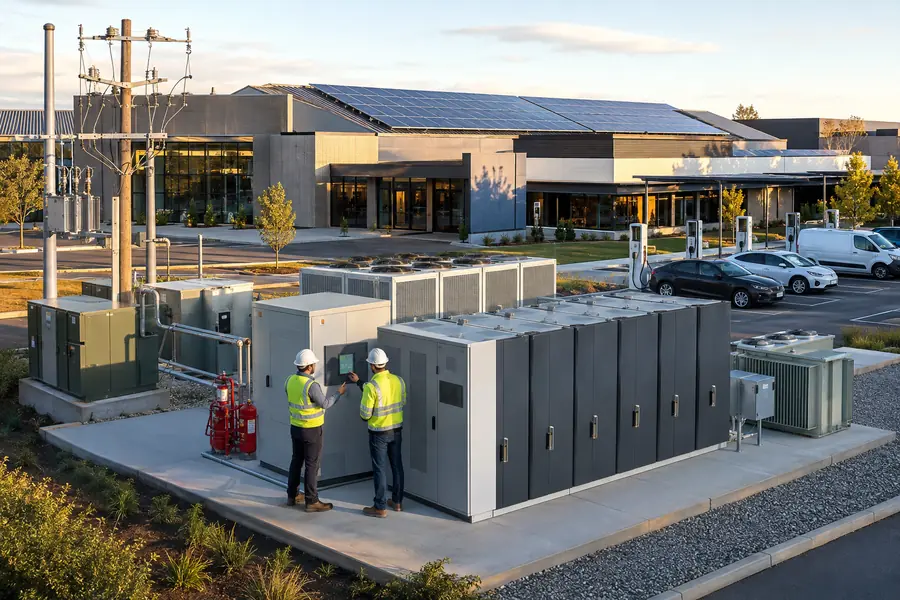
Commercial energy storage is not one standardized product category. Systems can differ in chemistry, power rating, energy capacity, cooling method, inverter architecture, enclosure design, and control strategy.
Most modern commercial battery energy storage systems use lithium-ion batteries, particularly LFP, combined with a battery management system, bidirectional PCS or inverter, energy management system, thermal management, electrical protection, and communications. Commercial systems can be installed behind the meter for bill savings and resilience or front of the meter for market and grid services.
NREL's commercial battery-storage modeling covers systems from roughly 100 kW to 2,000 kW and durations from one to eight hours, illustrating how broad the commercial category actually is. Its current ATB framework also treats LFP as the primary stationary lithium-ion chemistry.
The Main Commercial BESS Building Blocks
A typical commercial system includes:
| Component | Function |
|---|---|
| Battery cells/modules | Store energy |
| BMS | Monitor cells, temperature, current, SOC, and faults |
| PCS/inverter | Convert DC battery power to AC and back |
| EMS | Decide when to charge and discharge |
| Thermal management | Maintain acceptable battery temperature |
| Switchgear/protection | Isolate faults and safely connect equipment |
| Transformer | Match site/grid voltage when required |
| Communications | Connect BMS, PCS, EMS, meters, and remote monitoring |
| Fire/safety systems | Address detection, propagation, gas, and emergency response |
The best solution is the one in which these components are engineered around the site's load profile and operating objective rather than assembled around an arbitrary battery capacity.
Is Peak Shaving the Best Commercial Battery Solution for Your Business?
Peak shaving is often one of the strongest commercial BESS applications when electricity tariffs include significant demand charges.
A peak-shaving battery charges when facility demand is relatively low and discharges during high-demand periods to reduce the maximum grid power recorded for billing. Businesses with short, predictable demand peaks may benefit more from a relatively high-power battery than from an extremely large energy capacity.
DOE describes behind-the-meter storage as a way to reduce peak demand charges by charging during lower building loads and discharging when demand becomes high.
Example: Short Commercial Peak
Suppose a facility normally operates at:
400 kW
but reaches:
550 kW
for two hours each afternoon.
The business wants to limit grid demand to:
450 kW.
The battery needs approximately:
550 kW − 450 kW = 100 kW
of discharge power.
If that reduction is required for two hours:
100 kW × 2 h = 200 kWh
of theoretical energy is required.
A possible starting design might therefore be around:
100 kW / 200 kWh.
However, I would not specify exactly 200 kWh without adding allowances for usable SOC range, inverter losses, degradation, reserve requirements, and imperfect load forecasting.
Peak shaving illustrates why both kW and kWh matter.
If the actual peak lasts four hours instead of two, the same 100 kW battery may require closer to:
400 kWh
of usable energy.
When Is Solar-Plus-Storage the Best Choice?
Solar-plus-storage is particularly attractive when a business produces substantial solar energy during the day but cannot use all of it at the moment it is generated.
A solar-plus-storage system stores excess photovoltaic generation and releases it later when facility demand or electricity prices are higher. It can improve solar self-consumption, reduce export dependence, shift midday production into evening loads, and potentially combine solar savings with peak-demand management.
NREL's battery modeling distinguishes behind-the-meter commercial applications where storage can reduce customer electricity bills and can be operated using peak-shaving or time-varying-price dispatch strategies.
AC-Coupled or DC-Coupled?
One important solar-storage design decision is coupling architecture.
In a simplified AC-coupled system:
Solar DC → solar inverter → AC bus → battery PCS → battery
This can be attractive when adding storage to an existing PV installation because the current solar inverter may remain in place.
In a simplified DC-coupled system:
Solar DC → DC architecture → battery / shared conversion equipment → AC
This architecture can potentially reduce certain conversion steps and may capture PV energy that would otherwise be clipped, depending on design.
Neither architecture is universally better.
I usually prefer AC coupling for:
- Existing solar retrofits
- Independent PV and battery operation
- Easier separation of equipment
I consider DC coupling when:
- Solar and storage are being designed together
- Capturing clipped solar has value
- Shared conversion architecture improves project economics
The correct choice should be modeled using actual energy flows, equipment efficiencies, and operating priorities.
Which Energy Storage Solution Is Best for Backup and Business Resilience?
Backup-oriented storage needs to be sized differently from a battery designed purely for electricity-bill savings.
A commercial backup BESS must provide enough instantaneous power to support critical loads and enough stored energy to operate those loads for the required outage duration. It also needs the correct transfer equipment, protection, control architecture, and grid-forming or islanding capability where required. A normal grid-connected battery does not automatically provide outage backup.
Start With Critical Loads
Suppose a business has:
300 kW total facility demand
but only:
80 kW of truly critical loads.
Those loads include:
- IT/networking
- Refrigeration
- Security
- Essential lighting
- Selected manufacturing controls
If backup is required for:
four hours
the theoretical energy requirement becomes:
80 kW × 4 h = 320 kWh.
A 300 kW battery sized around the total building load might be unnecessarily expensive if only 80 kW must survive an outage.
This is why I perform a critical-load audit before sizing a resilience system.
Backup Reserve Can Conflict With Bill Savings
Suppose the battery is normally used for peak shaving.
If it is deeply discharged shortly before an outage, very little emergency energy remains.
The EMS therefore needs a reserve policy.
For example:
20% SOC reserved for outage backup
or:
50% SOC reserved during severe-weather alerts.
This introduces an economic tradeoff.
More backup reserve means less capacity available for daily arbitrage or peak shaving.
The best design balances resilience value against lost operating revenue.
What Commercial Energy Storage System Works Best for EV Charging?
Commercial EV charging can create large, short-duration power peaks, especially when several high-power chargers operate simultaneously.
Battery storage can support EV charging by limiting grid demand, reducing transformer or service upgrades in some situations, and supplying temporary high-power bursts when charging demand exceeds a site's preferred grid draw. For EV charging applications, battery discharge power can be just as important as energy capacity.
Consider a site with:
four 150 kW DC fast chargers.
The theoretical simultaneous load is:
600 kW.
Suppose the site's available grid capacity is only:
400 kW.
A battery could temporarily provide the missing:
200 kW.
If that deficit lasts for:
30 minutes
the theoretical energy requirement is:
200 kW × 0.5 h = 100 kWh.
This is a high-power, relatively short-duration application.
A:
200 kW / 100 kWh
system might therefore be more relevant than a:
50 kW / 400 kWh
system, even though the second battery stores four times more energy.
DOE is also actively studying deeper integration of BESS with commercial building systems, solar, and EV charging through coordinated energy-management architectures.
Should Your Business Choose a 2-Hour or 4-Hour Battery?
Battery duration should match the duration of the economic or operational problem.
A two-hour commercial BESS is often suitable for short peak shaving, high-power EV charging support, and certain grid services. Four-hour storage is generally more useful when demand peaks persist longer, solar energy must be shifted into the evening, or the business requires longer backup. Longer duration increases total stored energy but can reduce installed cost per kWh because some power-related costs are spread across more capacity.
NREL's commercial BESS analysis shows that cost per kilowatt-hour declines significantly as storage duration increases, which is why accurately estimating required duration is critical.
100 kW Example
Compare:
| System | Power | Energy | Nominal Duration |
|---|---|---|---|
| Option A | 100 kW | 100 kWh | 1 hour |
| Option B | 100 kW | 200 kWh | 2 hours |
| Option C | 100 kW | 400 kWh | 4 hours |
| Option D | 100 kW | 800 kWh | 8 hours |
All four can theoretically discharge at:
100 kW.
But they solve very different problems.
For a 45-minute demand spike, Option D may be unnecessarily large.
For a four-hour evening solar-shifting requirement, Option A would be far too small.
I therefore start with a load-duration curve, not a preferred battery size.
Should You Choose Air-Cooled or Liquid-Cooled Commercial Storage?
Cooling architecture becomes increasingly important as battery energy density, cycling frequency, and thermal load rise.
Air-cooled BESS solutions are generally simpler and can be suitable for moderate energy density and duty cycles, while liquid-cooled systems can provide more precise temperature control and support denser, heavily cycled commercial installations. The better choice depends on ambient climate, C-rate, equipment density, maintenance capability, footprint constraints, and lifetime energy throughput.
When Air Cooling Can Make Sense
I consider air-cooled systems when:
- Duty cycle is moderate
- Ambient conditions are manageable
- Equipment density is relatively low
- Simpler maintenance is valuable
- Initial cost is highly sensitive
Advantages can include:
fewer fluid components
and:
no coolant leak risk.
When Liquid Cooling Becomes More Attractive
I consider liquid cooling for:
- High-density cabinet/container systems
- Frequent daily cycling
- Hot climates
- High charge/discharge rates
- Tight site footprints
- Applications needing strong cell-to-cell temperature uniformity
But liquid cooling adds:
- Pumps
- Coolant
- Seals
- Heat exchangers
- Additional controls
So “liquid cooled” should not automatically be interpreted as “better.”
The system's operating duty should justify the additional complexity.
Does Your Business Need a Modular or Containerized BESS?
Physical architecture depends heavily on project scale and location.
Smaller commercial projects may use modular indoor or outdoor battery cabinets, while larger C&I installations often use integrated outdoor cabinets or containerized BESS platforms. Modular designs can simplify incremental expansion, whereas containerized systems can offer high factory integration and repeatable deployment for larger projects.
Modular Cabinets Work Well When
I favor cabinet-based systems when:
- Capacity is relatively modest
- Installation is near a commercial building
- Future expansion is likely
- Space allows several cabinets
- Technician access is important
A business might start with:
100 kW / 200 kWh
and later expand toward:
100 kW / 400 kWh
if the battery architecture and inverter permit it.
Containerized Systems Work Well When
Containerized BESS solutions become more attractive for:
- Larger manufacturing facilities
- Warehouses
- Data centers
- Logistics hubs
- Utility-connected C&I projects
- Multi-MWh applications
The container is not simply a box of batteries.
It may integrate:
battery racks + BMS + cooling + fire/gas detection + controls + DC protection.
The PCS and transformer may be integrated or installed separately.
The key design question remains:
Does this physical architecture make the site's required MW and MWh easier, safer, and more economical to deploy?
Can a Commercial Battery Generate Revenue From Grid Services?
Potentially, but market access depends on location, system size, interconnection, aggregator arrangements, and market rules.
Commercial storage can potentially provide grid services such as energy, capacity, frequency regulation, and other ancillary services where market rules allow participation. However, I do not assume every behind-the-meter battery can automatically earn wholesale-market revenue. Eligibility, telemetry, minimum size, interconnection, aggregation, and regional market rules must be verified.
FERC Order No. 841 was designed to remove barriers to electric-storage participation in organized wholesale capacity, energy, and ancillary-service markets. It required RTOs and ISOs to establish storage participation models recognizing the physical and operational characteristics of storage resources.
FERC has also described storage as capable of providing energy, frequency regulation and other ancillary services, while potentially helping defer transmission and distribution investment.
Grid Services Should Usually Be an Additional Value Stream
For many commercial sites, I treat grid services as:
additional value
rather than the sole reason for buying the battery.
The primary business case may remain:
demand savings + solar shifting + resilience.
Then, if regional rules permit it, the EMS can potentially participate in:
- Demand response
- Virtual power plants
- Frequency services
- Capacity programs
This creates value stacking.
But battery availability must be coordinated.
A battery cannot simultaneously dedicate 100% of its power and energy to every service.
How Important Is the Energy Management System?
In many commercial projects, the EMS is as important economically as the battery itself.
The EMS determines when the battery charges, discharges, preserves backup reserve, responds to electricity prices, coordinates solar, manages EV charging, and potentially participates in grid programs. A poorly controlled battery can miss demand peaks or consume its energy before the most valuable period, reducing project savings even when the hardware performs perfectly.
DOE's work on grid-interactive commercial facilities emphasizes demand flexibility and the ability of building technologies to help balance energy use during periods of peak demand or high renewable availability.
A Good EMS Needs the Right Inputs
I want the EMS to understand:
- Facility load
- Solar production
- Battery SOC
- Utility tariff
- Demand-charge window
- Export limits
- Backup reserve
- EV charging demand
- Weather forecast when relevant
For peak shaving, it may need to predict whether today's temporary load increase is:
the monthly peak
or merely:
an early, smaller peak.
If it discharges everything at 2 p.m. and the month's largest demand event occurs at 5 p.m., the battery may provide little financial benefit.
Intelligent dispatch therefore converts battery capacity into economic value.
How Should a Business Evaluate Commercial Battery ROI?
The right BESS should be selected using site-specific cash-flow modeling rather than a generic $/kWh rule.
Commercial storage ROI depends on installed CAPEX, demand-charge savings, energy-price arbitrage, solar utilization, resilience value, grid-service revenue, maintenance, financing, degradation, battery replacement or augmentation, and the expected operating life. I recommend modeling realistic interval data before comparing battery quotations.
Start With Interval Load Data
Ideally, I analyze at least:
12 months
of interval consumption.
Fifteen-minute data is especially useful when demand charges are important.
I look for:
- Peak magnitude
- Peak duration
- Peak frequency
- Seasonal variations
- Nighttime load
- Solar production
- Planned EV charging
- Future electrification
Then I model potential battery dispatch.
Compare Lifetime Economics
I evaluate:
CAPEX
against:
annual economic value.
But simple payback is not enough.
A strong analysis may include:
- NPV
- IRR
- Payback
- Battery degradation
- O&M
- Financing
- Augmentation
- Replacement risk
The system with the lowest purchase price may not create the highest lifetime return.
What Safety Standards Should Commercial BESS Buyers Check?
Commercial lithium-ion storage requires system-level safety review, not merely proof that the cells passed a battery test.
I verify whether the complete ESS has the appropriate UL 9540 certification, review relevant UL 9540A fire-propagation data, and confirm local requirements with the authority having jurisdiction. In 2026, NFPA 855 places stronger emphasis on representative fire and large-scale fire testing, making safety documentation an important part of product selection and permitting.
UL states that UL 9540 evaluates complete energy storage systems, including charging/discharging, controls, protection, communications, and grid interaction.
UL also states that the 2026 edition of NFPA 855 and the 2024 IFC require fire and large-scale testing in certain situations, and that UL 9540A is the referenced test method for representative ESS fire testing.
Safety Documentation Can Affect Project Schedule
A system may have excellent:
- kWh
- kW
- efficiency
- price
but still create problems if it lacks suitable:
- certification
- fire-test documentation
- spacing data
- emergency procedures
UL notes that the newer 2026 requirements have increased technical rigor and documentation expectations and can contribute to longer AHJ review cycles and resubmissions.
I therefore put permitting and fire-safety review near the beginning of procurement, not at the end.
My Insights: Which Commercial Energy Storage Systems Solution Fits Your Business
There is no universally best commercial BESS. The correct solution is determined by the shape of the load, the duration of the business problem, the required resilience level, and the economic value of each battery cycle.
The commercial energy storage solution that fits your business is the one sized around your required kW, required kWh, operating duration, electricity tariff, solar production, backup needs, EV loads, available site space, and market opportunities. Peak-shaving businesses may need high power and shorter duration; solar-heavy sites often need longer duration; resilience projects need sufficient usable energy and islanding capability; and large, heavily cycled installations may benefit from liquid-cooled modular or containerized systems.
My First Insight: Choose the Application Before Choosing the Battery
I would rank common applications like this:
| Business Need | BESS Priority |
|---|---|
| Reduce demand charges | High power, correct peak duration |
| Shift solar energy | More kWh and suitable duration |
| Outage backup | Usable kWh + islanding |
| EV fast charging | High discharge power |
| Microgrid | Grid-forming controls + EMS |
| Grid services | Communications + market eligibility |
| Renewable firming | Flexible dispatch and energy capacity |
This simple step prevents one of the most common mistakes:
buying storage capacity before defining its job.
My Second Insight: kW and kWh Must Be Sized Separately
A:
100 kW / 100 kWh
battery and:
100 kW / 400 kWh
battery share the same nominal power.
But one is approximately a one-hour system and the other a four-hour system.
NREL's commercial-storage work covers durations from one to eight hours and emphasizes that required duration strongly affects project cost.
I therefore never ask only:
“How many kWh do I need?”
I ask:
“How many kW, for how many hours?”
My Third Insight: The EMS Can Determine Whether the Project Makes Money
Battery hardware stores electricity.
The EMS determines whether that electricity is discharged at the right time.
For a business with demand charges, a poor dispatch strategy can miss the monthly maximum.
For a solar facility, it can fill the battery too early.
For resilience, it can leave insufficient reserve.
That means my commercial-storage evaluation includes:
control intelligence
alongside:
cell chemistry and inverter efficiency.
My Fourth Insight: Safety and Permitting Are Part of Product Selection
I would reject the idea that permitting is merely an administrative problem after purchase.
In 2026, commercial BESS projects face increasingly detailed fire-test and documentation expectations. UL identifies UL 9540A as the referenced fire-testing method under the 2026 NFPA 855 framework, while complete ESS safety evaluation falls under UL 9540.
Therefore, when I compare vendors, I also compare:
certification + test reports + installation documentation + AHJ readiness.
My Fifth Insight: Which Commercial Energy Storage Systems Solution Fits Your Business?
This directly answers the H1 question.
My practical selection framework is:
| Business Profile | Solution I Would Evaluate First |
|---|---|
| Retail store with short demand spikes | 1–2h peak-shaving BESS |
| Office with solar and evening consumption | 2–4h solar-shifting BESS |
| Factory with sustained peaks | 2–4h high-power C&I BESS |
| Warehouse with rooftop solar | Solar + modular BESS |
| Data-sensitive facility | BESS with strong UPS/resilience architecture |
| EV charging hub | High-power battery with smart charging EMS |
| Hospital/critical site | Resilience-focused BESS integrated with microgrid/generation |
| Data center | High-reliability, high-power BESS with redundancy |
| Large industrial facility | Modular/containerized liquid-cooled BESS |
| Site seeking wholesale/grid revenue | Market-ready BESS with suitable telemetry and controls |
I then follow this decision sequence:
First, define the business objective.
Is the primary goal:
cost reduction, resilience, solar utilization, EV charging, or grid revenue?
Second, calculate peak power.
That determines the required:
kW.
Third, calculate duration.
That determines much of the required:
kWh.
Fourth, define operating frequency.
A battery used once per month for backup is a very different design problem from one cycling every day.
Fifth, choose architecture.
I evaluate:
AC vs DC coupling
air vs liquid cooling
cabinet vs container
standalone vs solar-integrated
Sixth, verify grid and backup requirements.
I determine:
- Export limitations
- Utility interconnection
- Islanding
- Transfer equipment
- Transformer capacity
Seventh, verify safety and permitting documentation.
I check:
- UL 9540
- UL 9540A data where relevant
- NFPA 855 requirements
- AHJ expectations
- Fire-service access
- Site spacing
Eighth, model lifetime economics.
I include:
- CAPEX
- Utility savings
- Revenue
- Efficiency losses
- Degradation
- O&M
- Financing
- Augmentation
The core principle is simple:
The best commercial energy storage system is not the largest battery, the cheapest battery, or the battery with the highest advertised cycle life.
It is the system whose power, energy, controls, safety architecture, and operating strategy match the actual economics and reliability needs of the business.
Conclusion
Choose commercial energy storage by matching kW, kWh, duration, controls, safety, and architecture to your real load profile, tariff, resilience needs, and long-term business value.
](https://voltcrave-battery.com/wp-content/uploads/2026/08/How-to-Pick-the-Right-Portable-Power-Station-768x512.webp)
](https://voltcrave-battery.com/wp-content/uploads/2026/08/Are-Solar-Batteries-Worth-It-in-2026-768x512.webp)
](https://voltcrave-battery.com/wp-content/uploads/2026/09/Which-Brand-of-Portable-Power-Station-Is-Considered-the-Best-768x512.webp)