

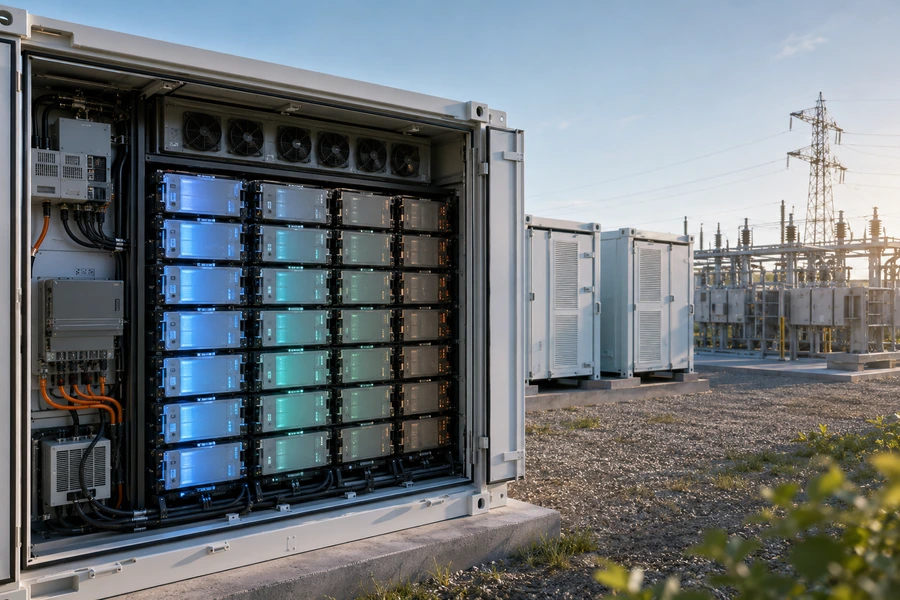
](https://voltcrave-battery.com/wp-content/uploads/2026/08/What-Is-the-Lifespan-of-a-BESS-Battery.webp)
BESS batteries can operate for many years, but daily cycling, heat, high state of charge, and deep discharge gradually reduce their usable capacity.
A lithium-ion BESS typically has a design life of about 10–20 years, with 15 years commonly used for utility-scale planning. Actual battery life depends on chemistry, temperature, depth of discharge, cycle frequency, charging rate, and operating strategy. Some systems use battery augmentation to maintain rated capacity throughout the project life.
I normally use 15 years as a reasonable starting assumption for a modern commercial or utility-scale lithium-ion BESS, then adjust it according to the supplier's warranty, expected cycling, temperature control, and required end-of-life capacity. Battery lifespan should not be confused with the life of the entire energy storage plant.
How Long Does a BESS Battery Normally Last?
A battery does not suddenly stop working when it reaches a particular age. Instead, its capacity and power capability gradually decline.
For modern lithium-ion battery energy storage systems, I generally expect around 10–20 years of useful service. NLR's current utility-scale battery modeling assumes a 15-year system lifetime and includes augmentation costs so the project can maintain rated capacity throughout that period. Some commercial products now offer performance commitments extending to 20 years.
Fifteen Years Is a Useful Planning Benchmark
The National Laboratory of the Rockies' 2024 Annual Technology Baseline models utility-scale battery storage with a 15-year lifetime. Its fixed O&M assumptions include battery augmentation intended to keep the project operating at rated capacity during that period.
I therefore use the following ranges as a practical starting framework:
| BESS condition | Approximate planning life |
|---|---|
| Aggressively cycled lithium-ion system | 8–12 years |
| Typical well-managed lithium-ion BESS | 10–15 years |
| Well-managed LFP BESS with augmentation | 15–20 years |
| Long-term project with battery replacements | 20+ years at plant level |
These are planning ranges rather than guaranteed lifetimes.
The difference between battery life and project life is important.
A BESS site may remain operational for 20 or 30 years even if some battery modules are augmented or replaced during that period.
Twenty-Year Warranties Are Becoming Possible
Some current utility-storage platforms illustrate how project commitments are becoming longer.
Tesla states that Megapack comes with a 20-year warranty and performance guarantees intended to maintain operational capacity over the system lifetime.
I would not interpret a 20-year warranty as proof that every battery cell remains unchanged for 20 years.
The warranty may rely on:
- Controlled operating limits
- Software management
- Battery augmentation
- Module replacement
- Defined energy-throughput limits
- Specified operating temperatures
The exact contract matters more than the headline number.
What Determines the Lifespan of a BESS Battery?
Battery degradation comes from both time and use.
The two major forms of BESS aging are calendar aging and cycle aging. Calendar aging occurs simply as the battery gets older, while cycle aging results from repeated charging and discharging. Temperature, state of charge, depth of discharge, C-rate, and battery chemistry influence both mechanisms and determine when usable capacity falls below the project's required level.
Calendar Life
Calendar life describes aging caused by time.
PNNL defines calendar life as the maximum duration before the storage system reaches its end-of-life condition, regardless of cycling. It notes that calendar life can depend on ambient temperature, pressure, humidity, and the state of charge at which the battery is stored.
This means a BESS can degrade even if it is rarely used.
A backup battery sitting at a high state of charge in a hot environment may still lose capacity over time.
Cycle Life
Cycle life measures how many charge-discharge cycles a battery can complete before reaching its defined end-of-life threshold.
One complete cycle can be thought of approximately as:
Charge → discharge → recharge
However, real BESS operation often consists of partial cycles.
A battery may discharge from:
90% SOC → 60% SOC
and later recharge.
That does not represent the same stress as repeatedly cycling from nearly full to nearly empty.
PNNL notes that cycle life for non-flow battery storage depends on depth of discharge.
End of Life Does Not Mean Zero Capacity
This is one of the most misunderstood concepts in BESS lifespan.
Battery end of life normally means the battery no longer meets a specified performance requirement.
It does not mean the battery contains zero energy.
PNNL's cost and performance methodology gives an example in which lithium-ion end of life can be defined when available energy falls below 60% of rated energy.
Other commercial warranties may use different thresholds.
For example, a project could define end of life at:
- 80% remaining capacity
- 70% remaining capacity
- 60% remaining capacity
A system with 70% remaining capacity still works.
It simply stores less energy than it did when new.
How Does Depth of Discharge Affect BESS Lifespan?
Using the entire battery capacity on every cycle can accelerate degradation.
Depth of discharge, or DOD, describes how much of the battery's capacity is used during a cycle. Shallower cycling generally reduces battery stress and can increase cycle life, while repeated deep cycling increases the amount of electrochemical and mechanical change experienced by the cells. The exact relationship depends on battery chemistry and operating conditions.
A Simple DOD Example
Suppose I have a 1 MWh battery.
If I discharge 200 kWh:
DOD = 20%
If I discharge 800 kWh:
DOD = 80%
If I repeatedly cycle 80% of the battery, the cells experience a more demanding duty cycle than when I repeatedly use only 20%.
This is why many BESS operators maintain operating limits such as:
10% SOC minimum
and
90% SOC maximum
rather than regularly operating from 0% to 100%.
Usable Capacity Is Often Less Than Nameplate Capacity
Suppose a battery has:
Nominal capacity = 10 MWh
but the operator uses only:
10%–90% SOC
The operating window represents approximately:
8 MWh
The owner gives up some usable energy at the beginning of life in exchange for better operational margins and potentially slower degradation.
I therefore ask whether a BESS quotation specifies:
- Nominal capacity
- Usable capacity
- Beginning-of-life capacity
- End-of-life guaranteed capacity
These numbers can be significantly different.
How Does Temperature Affect BESS Battery Life?
Thermal management is one of the most important factors determining long-term battery performance.
High temperatures generally accelerate lithium-ion degradation, while very low temperatures can restrict performance and create additional charging risks. Battery lifetime models therefore include temperature as a major degradation variable. A well-designed BESS uses HVAC or liquid cooling to keep cells within a controlled temperature range and reduce temperature differences across the battery pack.
Heat Accelerates Aging
Lithium-ion batteries experience chemical side reactions during their lifetime.
Higher temperatures can accelerate many of these reactions.
NREL battery-aging research identifies temperature, state of charge, depth of discharge, and C-rate among the important variables affecting degradation.
This means two identical BESS installations can have different lifespans.
A battery operating in a hot climate with weak thermal management may age faster than the same product operated under tightly controlled temperatures.
Temperature Uniformity Also Matters
I do not only care about average battery temperature.
I care about differences between cells.
If one part of a rack operates consistently hotter than another, those cells may degrade faster.
Eventually, the weakest cells can limit the usable performance of the complete string.
This is why modern BESS design emphasizes:
- Liquid cooling
- Temperature sensors
- Cell-level monitoring
- Balanced airflow or coolant flow
- Thermal insulation
- BMS temperature limits
Better thermal management can therefore increase both safety and useful battery life.
Does Daily Cycling Shorten a BESS Battery's Life?
Yes, but daily cycling is expected in many energy storage projects and can be incorporated into the system design.
A BESS that performs one significant cycle every day experiences more cycle aging than a battery used only during occasional outages. However, stationary batteries are specifically designed around repeated cycling. The important question is whether the expected lifetime energy throughput remains within the battery manufacturer's warranty and degradation model.
One Cycle Per Day Adds Up Quickly
One full cycle every day produces approximately:
365 cycles per year
Over 10 years:
3,650 cycles
Over 15 years:
5,475 cycles
Over 20 years:
7,300 cycles
A BESS serving solar shifting may therefore accumulate thousands of equivalent full cycles during its project life.
A backup-only battery may experience far fewer.
This is why I do not evaluate lifespan using years alone.
I evaluate both:
Calendar years
and
Energy throughput / cycles
Whichever limit is reached first can determine the economic life of the battery.
Does LFP Last Longer Than NMC in a BESS?
LFP has become especially attractive for stationary storage because the application values cycle performance, thermal stability, and cost more than extreme energy density.
LFP is generally my preferred lithium-ion chemistry for modern BESS applications. PNNL's analysis shows that the relative lifetime performance of LFP and NMC changes with depth of discharge, with LFP demonstrating higher cumulative throughput at deeper cycling conditions in the scenarios evaluated. Actual lifespan still depends heavily on cell design and operating conditions.
Chemistry Is Only Part of the Answer
Two LFP systems can still have very different lifespans.
Differences include:
- Cell quality
- Electrode design
- BMS limits
- Cooling
- Charge rate
- Discharge rate
- SOC window
- Manufacturing consistency
I therefore avoid statements such as:
“All LFP batteries last 8,000 cycles.”
A cycle-life number is meaningful only when I know:
- Depth of discharge
- Temperature
- C-rate
- End-of-life threshold
- Test conditions
A battery rated for 8,000 cycles to 70% capacity under moderate laboratory conditions may perform differently under high-temperature field conditions and aggressive operation.
What Is Battery Augmentation in a BESS?
Augmentation is one of the main reasons a BESS project can maintain its contractual capacity even while individual batteries degrade.
Battery augmentation means adding battery capacity during the operating life of a BESS to compensate for degradation. Instead of oversizing the entire project on day one, the developer may install additional modules or containers later so that the plant can continue delivering its contracted MWh capacity. NLR explicitly includes augmentation in its 15-year utility BESS assumptions.
Example of Capacity Degradation
Suppose I commission a:
100 MW / 400 MWh BESS
Over time, battery degradation reduces usable energy.
Without augmentation, the system might eventually provide less than 400 MWh.
The operator could install additional battery capacity to restore the required energy output.
The project may therefore remain:
100 MW / 400 MWh
commercially, even though the original battery modules no longer provide their original capacity.
Augmentation Changes Lifecycle Cost
A cheaper battery with faster degradation may require more augmentation.
A more expensive battery with slower degradation may need less.
I therefore compare:
- Initial installed cost
- Expected degradation
- Augmentation schedule
- Replacement cost
- Warranty
- Lifetime throughput
Initial $/kWh alone does not tell me which system has the lowest lifetime cost.
How Can I Extend the Lifespan of a BESS Battery?
Good operating strategy can materially affect how quickly the battery degrades.
I extend BESS life by controlling temperature, avoiding unnecessary high states of charge, limiting excessive depth of discharge, avoiding unnecessarily high C-rates, maintaining cell balance, monitoring degradation, and using the EMS and BMS to operate the battery within validated limits. Proper preventive maintenance also helps protect supporting equipment that affects battery conditions.
Keep the Battery Cool
Thermal management should keep cells within the manufacturer's preferred operating range.
I also monitor temperature spread between modules.
Avoid Unnecessary 100% SOC
Some projects need maximum battery availability.
Others do not.
If operational requirements allow it, avoiding long periods at very high SOC can reduce calendar-aging stress.
Avoid Excessive Deep Discharge
A project may earn more revenue by using the battery aggressively, but it may also accelerate degradation.
I therefore optimize:
Revenue today vs. battery life tomorrow
The EMS should reflect both.
Control Charge and Discharge Rates
High C-rates create greater electrical and thermal stress.
If a grid service does not require maximum battery power, operating at a lower rate may reduce degradation.
Use Predictive Monitoring
Modern BMS and EMS platforms can monitor:
- Cell voltage
- Temperature
- SOC
- SOH
- Internal resistance trends
- Cell imbalance
- Energy throughput
I use these trends to identify aging before it becomes an availability problem.
Is the BESS Battery the First Component That Needs Replacement?
Not necessarily. A complete BESS includes several subsystems with different service lives.
The battery cells are the primary degrading energy-storage component, but a BESS also contains PCS equipment, HVAC or liquid-cooling systems, pumps, fans, contactors, sensors, fire detection, switchgear, transformers, and controls. Some supporting components may require maintenance or replacement before the battery reaches its final capacity threshold.
Battery Life and BESS Life Are Different
A complete project might include:
| Component | Typical lifecycle concern |
|---|---|
| Battery cells | Capacity degradation |
| BMS | Electronics/software reliability |
| PCS | Power-semiconductor and cooling wear |
| Cooling system | Pumps, compressors, fans |
| Contactors | Mechanical/electrical cycling |
| Sensors | Drift or failure |
| Fire detection | Periodic service/replacement |
| Transformer | Long-term insulation condition |
| EMS | Software/hardware obsolescence |
This is why a 20-year storage project needs an operations and maintenance strategy beyond battery degradation.
The project may still be economically viable after individual components are replaced.
What Should I Check in a BESS Battery Warranty?
Warranty terms often provide more useful information than a generic lifespan claim.
I check warranty years, maximum energy throughput, cycle limits, guaranteed end-of-life capacity, allowable temperature, SOC limits, C-rate requirements, augmentation responsibilities, availability guarantees, and excluded operating conditions. A “15-year battery” can have very different economic value depending on how much energy it is guaranteed to deliver during those years.
Years Alone Are Not Enough
Consider two warranties:
Battery A
- 15 years
- 70% capacity retention
Battery B
- 15 years
- 60% capacity retention
Both say 15 years.
But they do not guarantee the same performance.
I also check whether the warranty is limited by:
Years OR energy throughput
If the battery reaches its throughput limit after 11 years, the headline 15-year term may not provide the protection the buyer expected.
Ask Who Pays for Augmentation
This is especially important for utility projects.
Does the contract require the:
- Manufacturer
- Integrator
- EPC contractor
- Project owner
to provide future augmentation?
NLR's modeling includes augmentation as part of fixed O&M for maintaining rated capacity throughout a 15-year life, demonstrating why this cost needs to be considered in lifecycle analysis.
My Insights: What Is the Lifespan of a BESS Battery
I would not define BESS battery life with a single cycle number. The most useful answer combines calendar life, cycling, degradation, warranty, and augmentation.
The lifespan of a modern lithium-ion BESS battery is typically around 10–20 years, with approximately 15 years being a practical utility-scale planning assumption. Actual life depends on chemistry, temperature, depth of discharge, SOC, C-rate, and cycling frequency. Proper thermal management, conservative operation, and planned augmentation can extend useful project performance.
Fifteen Years Is My Starting Point
For a commercial or utility LFP project, I generally begin financial modeling with a 15-year battery-system assumption because current NLR utility-storage modeling uses that lifetime and explicitly includes augmentation to maintain capacity.
I then adjust the model using the actual supplier warranty.
Cycle Life Must Match the Application
A backup BESS and a daily-cycling solar BESS should not be evaluated with the same assumptions.
A battery performing one equivalent full cycle per day can exceed 5,000 cycles during a 15-year life.
I therefore want a degradation model based on the actual operating profile rather than a generic laboratory cycle specification.
End of Life Should Be Defined Before Procurement
I always ask:
At what remaining capacity do we consider the battery finished?
PNNL demonstrates that end of life is a defined performance threshold rather than complete battery failure.
If the project only needs 300 MWh after year 15, degradation may be acceptable.
If the project contract requires 400 MWh every year, augmentation may be necessary.
The commercial requirement changes the meaning of battery lifespan.
I Focus on Lifetime Energy Delivered
Ultimately, I care less about whether a battery lasts 12, 15, or 20 calendar years in isolation.
I care about:
How many useful MWh can it deliver during its economic life, and at what total cost?
A battery that lasts 20 years but cycles rarely is not automatically better than one that lasts 15 years while delivering much greater lifetime energy throughput.
For BESS procurement, I therefore compare:
- Years
- Cycles
- Throughput
- Capacity retention
- Efficiency
- Augmentation
- O&M
- Availability
That gives a much more realistic picture of battery life than a single advertised cycle-life number.
Conclusion
A modern BESS battery typically lasts about 10–20 years, with 15 years a common planning benchmark. Temperature, cycling, DOD, SOC, and augmentation determine its real useful life.
](https://voltcrave-battery.com/wp-content/uploads/2026/09/What-Is-Containerized-Battery-Energy-Storage-768x512.webp)
](https://voltcrave-battery.com/wp-content/uploads/2026/08/Cost-of-Solar-Power-Battery-Storage-A-2026-Engineering-and-Economic-Deep-Dive-768x512.webp)
](https://voltcrave-battery.com/wp-content/uploads/2026/08/What-Is-the-Best-Type-of-Solar-Battery-for-Home-Use-768x512.webp)