

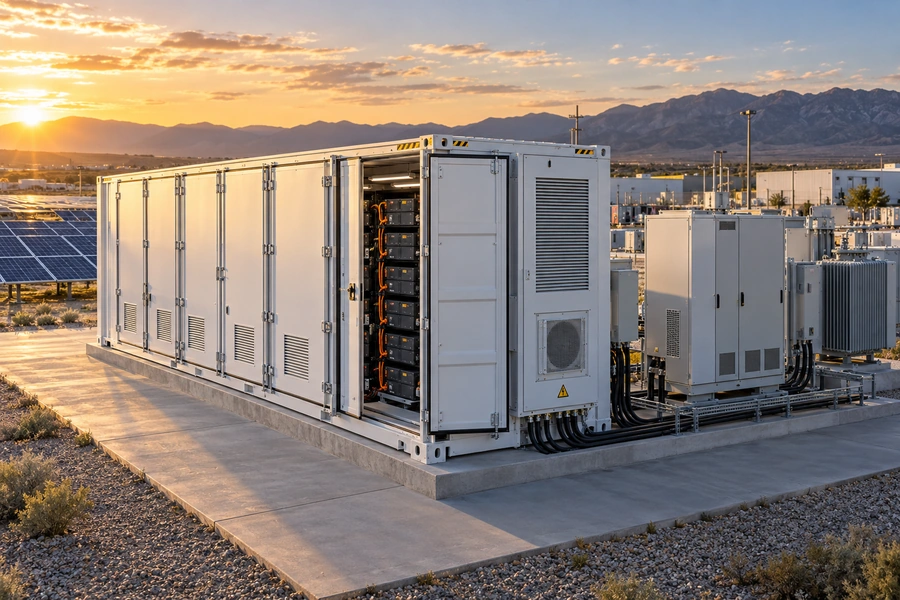
](https://voltcrave-battery.com/wp-content/uploads/2026/09/What-Is-Containerized-Battery-Energy-Storage.webp)
Large-scale energy storage needs more than batteries. Without integrated cooling, controls, protection, and power conversion, deploying hundreds or thousands of battery cells becomes complex.
Containerized battery energy storage is a modular energy storage system that packages batteries, BMS, thermal management, fire protection, monitoring, and related equipment inside a factory-integrated enclosure. These systems store electricity and release it when needed for solar shifting, peak shaving, backup power, microgrids, EV charging, and grid services.
I think of a containerized BESS as a large, intelligent rechargeable energy reservoir. Instead of building a battery room component by component on site, much of the system can be assembled, integrated, and tested before delivery.
What Is a Containerized Battery Energy Storage System?
A containerized BESS combines many individual battery components into a standardized, transportable energy-storage platform.
A containerized battery energy storage system, or containerized BESS, is a large battery installation housed within a purpose-built enclosure resembling a shipping container. It typically integrates battery cells, modules, racks, BMS, thermal management, fire detection and suppression, sensors, communications, and auxiliary equipment, while connecting to external or integrated power conversion and energy-management equipment.
The word containerized can create a misconception.
It does not necessarily mean someone simply places batteries inside an ordinary shipping container.
Modern BESS enclosures are often purpose-built for energy storage. Their design may account for:
structural loading,
electrical insulation,
temperature control,
water and dust protection,
fire detection,
ventilation,
gas management,
maintenance access,
and emergency response.
A simplified architecture looks like:
Battery Cells → Modules → Racks → Container → PCS → Transformer → Grid
Control runs across these physical layers.
The BMS supervises the battery.
The PCS manages electrical power conversion.
The EMS determines when the system should charge or discharge.
This integrated architecture is what transforms a container filled with battery cells into an operational energy-storage system.
What Is Inside a Battery Energy Storage Container?
The batteries are the largest component, but they are only one part of the system.
A modern battery storage container typically contains lithium-ion battery cells assembled into modules and racks, a battery management system, DC protection, sensors, communications, thermal-management equipment, fire-detection and protection systems, and auxiliary electrical equipment. Depending on the design, the PCS and other power equipment may be integrated or installed separately.
The internal hierarchy is usually:
Cell → Module → Rack → Battery System → Container
Battery Cells
Cells are the fundamental energy-storage units.
For stationary BESS applications, lithium iron phosphate, or:
LiFePO4 / LFP
has become a common chemistry.
Battery Modules
Multiple cells are electrically and mechanically combined into modules.
Modules make the system easier to:
assemble,
monitor,
protect,
and service.
Battery Racks
Modules are installed into racks.
Multiple racks can then operate together as one large battery system.
BMS
The Battery Management System monitors parameters such as:
cell voltage,
current,
temperature,
SOC,
and system faults.
It can also control protective devices to keep the battery within its intended operating limits.
Thermal Management
The battery may use:
air cooling
or:
liquid cooling.
Modern high-density systems increasingly use liquid thermal management because it can provide efficient and relatively uniform heat transfer across battery modules.
Safety Systems
These may include:
smoke detection,
heat detection,
gas detection,
alarms,
emergency shutdown,
and fire-protection equipment.
The exact configuration varies by product and installation requirements.
How Does Containerized Battery Energy Storage Work?
A containerized BESS stores electricity when energy is available or inexpensive and releases it when demand or electricity value is higher.
During charging, electricity from the grid, solar PV, wind, or another source is converted into the DC form required by the battery and stored chemically. During discharge, the stored DC electricity passes through a power conversion system that produces grid-compatible AC electricity for buildings, industrial loads, EV chargers, microgrids, or the utility network.
The charging path can be simplified as:
Grid / Solar → PCS → Battery
During discharge:
Battery → PCS → Load / Grid
Suppose a factory has a:
2MW solar array.
At midday, the factory needs only:
1.2MW.
Solar surplus is:
2MW – 1.2MW = 0.8MW.
Instead of exporting all 800kW, a BESS can charge.
Later, solar production falls while the factory's demand remains high.
The BESS discharges the stored energy.
This allows energy produced at one time to be used at another.
That is the core function of battery energy storage:
separating the time electricity is generated from the time it is consumed.
The EMS can automate this process according to:
electricity prices,
solar generation,
load demand,
SOC,
weather forecasts,
and grid commands.
What Is the Difference Between MW and MWh in Containerized BESS?
Confusing power with energy is one of the most common BESS sizing mistakes.
MW measures how much power a containerized BESS can deliver at one moment, while MWh measures how much energy it can store. A 1MW/4MWh BESS can theoretically discharge at 1MW for about four hours, while a 2MW/4MWh system could theoretically deliver the same stored energy in about two hours.
The basic relationship is:
Duration = Energy ÷ Power
For example:
| BESS Rating | Approximate Theoretical Duration |
|---|---|
| 1MW / 1MWh | 1 hour |
| 1MW / 2MWh | 2 hours |
| 1MW / 4MWh | 4 hours |
| 2MW / 4MWh | 2 hours |
| 500kW / 2MWh | 4 hours |
Actual usable duration can differ because of:
system losses,
SOC limits,
reserve requirements,
temperature,
degradation,
and operating strategy.
This distinction matters when selecting a system.
Peak shaving may require:
high MW but relatively short duration.
Solar shifting may require:
several hours of energy capacity.
Backup power requires:
critical-load kW × required backup hours.
So when someone asks:
“How big is the BESS?”
I need two numbers:
MW and MWh.
One without the other does not fully describe the system.
How Much Energy Can a Battery Storage Container Hold?
Modern containerized systems can store several megawatt-hours of energy in a single enclosure, but capacity varies considerably by product generation and design.
A modern containerized battery system may store several MWh of energy in a 20-foot-class enclosure, although there is no universal capacity. Energy density depends on cell chemistry, cell size, rack architecture, cooling design, safety spacing, enclosure dimensions, and whether supporting equipment is integrated inside the same container.
This area has changed quickly.
Older systems often provided considerably less energy per container.
Newer systems can achieve much higher energy density through:
larger-format cells,
cell-to-pack designs,
improved module architecture,
liquid cooling,
and:
more efficient internal layouts.
This means the phrase:
“one 20-foot battery container”
does not tell me its capacity.
One system might provide:
2MWh.
Another could provide:
5MWh or more.
These figures should always be checked against the specific manufacturer's current datasheet.
Another important distinction is:
nominal energy
versus:
usable energy.
A container may contain a certain nominal battery capacity while the operational SOC window provides less usable energy.
That reserve can help manage:
battery protection,
degradation,
and:
system reliability.
Why Are BESS Systems Built in Containers?
Containerization can simplify manufacturing, transportation, installation, expansion, and service.
Containerized BESS designs allow major battery components to be assembled and tested in a controlled factory environment before reaching the project site. Their modular structure can shorten site installation, simplify capacity expansion, standardize interfaces, and allow multiple containers to be combined into systems ranging from commercial-scale storage to hundreds of megawatt-hours.
Imagine a project requires:
100MWh.
Instead of constructing one enormous custom battery room, the developer can deploy multiple standardized battery enclosures.
If each hypothetical container provides:
5MWh,
the battery portion would require approximately:
100MWh ÷ 5MWh = 20 containers.
This modularity makes expansion easier.
A project might initially install:
20MWh
and later add:
another 10MWh.
Containerization also moves a significant amount of work from the project site into a factory.
That can improve:
manufacturing consistency,
quality control,
testing,
and:
installation efficiency.
However, modular does not mean plug-and-play in every situation.
Large BESS projects still require:
foundations,
cabling,
PCS,
transformers,
switchgear,
communications,
fire-safety planning,
interconnection,
and commissioning.
The container simplifies part of the project, not the entire project.
What Does the PCS Do in a Containerized BESS?
The battery stores DC electricity, while commercial facilities and utility grids normally operate using AC electricity.
The Power Conversion System, or PCS, provides the electrical bridge between the DC battery and the AC electrical system. During charging it manages conversion toward DC battery power, and during discharge it converts battery DC into controlled AC. It also regulates power flow and can support grid-control functions depending on system design.
A simple power path is:
Battery DC ↔ PCS ↔ AC Grid
The double arrow matters.
A BESS needs bidirectional power flow.
When electricity is abundant:
AC → DC → battery charging
When stored energy is needed:
battery DC → AC → load/grid
The PCS is therefore similar in principle to a very large bidirectional inverter system.
Its power rating is expressed in:
kW or MW.
Suppose the battery contains:
4MWh
but the PCS is rated:
1MW.
The theoretical full-power duration is:
4 hours.
If the PCS is:
2MW,
the same battery theoretically becomes:
2 hours.
This demonstrates why the PCS determines power while the battery primarily determines stored energy.
Both must be sized together.
What Do the BMS and EMS Do in a Containerized BESS?
The BMS protects the battery, while the EMS decides how the overall energy system should operate.
The BMS monitors battery cells, modules, racks, temperatures, currents, voltages, SOC, and faults to keep the battery within safe operating limits. The EMS operates at a higher level, deciding when and how much the BESS should charge or discharge according to electricity prices, loads, renewable generation, grid signals, and operational objectives.
I describe the relationship this way:
BMS = battery protection and supervision
EMS = energy strategy and optimization
Suppose electricity costs:
$0.08/kWh
at midday
and:
$0.25/kWh
during the evening peak.
The EMS may decide to charge during the lower-cost period and discharge during the expensive period.
But it cannot simply demand unlimited power.
The BMS might report:
high temperature,
low SOC,
high cell voltage,
or:
limited discharge capability.
The EMS must respect those battery constraints.
This creates a control hierarchy:
Cell sensors → BMS → EMS → Site/Grid strategy
A good containerized BESS therefore depends as much on software and control logic as it does on battery cells.
Why Do Containerized BESS Systems Need Cooling?
Battery cells generate heat during charging and discharging, and temperature strongly affects performance, degradation, and safety.
Containerized BESS systems need thermal management to keep battery cells within their intended operating temperature range and reduce temperature differences across the pack. Modern systems may use air cooling or liquid cooling. Effective thermal management can improve operating consistency, reduce thermal stress, support higher power density, and help manage long-term battery degradation.
Imagine two racks.
Rack A consistently operates at:
25°C.
Rack B operates at:
40°C.
Even if both process similar energy, they may not age at the same rate.
Temperature variation within a container can therefore create:
uneven degradation.
That can eventually reduce overall system performance because the weakest cells or modules may constrain the pack.
Air cooling can be:
simpler,
less expensive,
and easier to maintain.
Liquid cooling can provide:
stronger heat transfer,
more uniform temperature control,
and:
higher system density.
But liquid systems add:
pumps,
coolant,
pipes,
heat exchangers,
and:
potential leak-management requirements.
Neither method is automatically best for every application.
The correct choice depends on:
battery density,
climate,
power level,
maintenance strategy,
and project economics.
Are Containerized Battery Storage Systems Safe?
Containerized BESS can be designed for safe operation, but lithium-ion energy storage requires layered safety engineering.
Modern containerized battery storage uses multiple safety layers, including BMS protection, electrical isolation, temperature monitoring, thermal management, smoke or gas detection, emergency shutdown, fire protection, system-level testing, and installation requirements. Safety depends on the complete system design, installation, commissioning, operation, and emergency-response plan—not battery chemistry alone.
For U.S. stationary storage projects, three terms frequently appear:
UL 9540
UL 9540A
and:
NFPA 855.
UL 9540 addresses complete energy-storage systems and equipment.
UL 9540A is a test method used to evaluate thermal-runaway fire propagation characteristics.
NFPA 855 addresses installation of stationary energy-storage systems.
These should not be treated as interchangeable.
A common mistake is saying:
“The battery is UL 9540A certified.”
UL 9540A is fundamentally a test method rather than a simple product safety certification in the same sense as UL 9540.
Safety also depends on installation.
Spacing,
fire access,
ventilation,
emergency procedures,
and:
local authority requirements
can all affect the final project design.
What Is Containerized BESS Used For?
The same battery hardware can create different value depending on how its controls are programmed.
Containerized BESS is used for renewable-energy shifting, peak shaving, demand-charge management, backup power, microgrids, EV charging support, frequency regulation, capacity support, grid stabilization, and energy arbitrage. Commercial and industrial facilities may combine several of these applications to increase battery utilization and improve project economics.
Consider solar shifting.
Solar generation peaks around midday.
A commercial facility may consume more electricity in the evening.
Without storage:
midday solar → grid export
With storage:
midday solar → battery → evening load
Now consider peak shaving.
A factory normally consumes:
1MW
but briefly peaks at:
1.5MW.
A battery could discharge:
500kW
during that peak.
Grid demand becomes:
1.0MW.
For EV charging, the battery can provide temporary power above the site's normal grid capacity.
For example:
grid connection: 500kW
EV charging demand: 800kW
BESS contribution: 300kW
The battery can help bridge the difference for a limited period.
This flexibility is what makes containerized storage useful across so many applications.
How Long Does a Containerized BESS Last?
BESS life should be evaluated through both calendar aging and cycling rather than a single number of years.
A containerized lithium battery system may be designed for roughly a decade or more of operation, but actual useful life depends on chemistry, temperature, cycle frequency, depth of discharge, SOC range, C-rate, cell quality, BMS strategy, and the remaining-capacity requirement. Projects may also use augmentation to maintain required capacity over time.
Suppose a BESS starts with:
10MWh usable capacity.
Over time, battery degradation reduces available energy.
If the project contract still requires:
10MWh
after several years, the operator may add battery capacity.
This is:
augmentation.
It demonstrates an important difference between:
battery life
and:
project life.
Individual cells may degrade.
Modules may be replaced.
Additional capacity may be installed.
Yet the overall BESS project can continue operating.
Therefore, I evaluate:
calendar life,
cycle life,
energy throughput,
capacity retention,
warranty,
and:
augmentation strategy.
A system advertised as:
6,000 cycles
does not automatically last a specific number of years.
Cycle-life specifications only become meaningful when their test conditions are understood.
How Much Does a Containerized BESS Cost?
Containerized battery storage does not have one universal $/kWh price.
Containerized BESS cost depends on battery capacity, PCS power, storage duration, cell chemistry, enclosure design, cooling, fire protection, EMS, transformer, switchgear, EPC work, interconnection, permitting, commissioning, warranty, and long-term maintenance. Battery-container price alone therefore does not represent the total installed project cost.
I separate cost into:
Battery $/kWh
and:
Power-system $/kW.
Then I add project costs.
A simplified framework is:
Total BESS Cost = Battery + PCS + BOS + EMS + Safety + EPC + Interconnection + Commissioning
Suppose two projects both contain:
4MWh.
Project A:
1MW / 4MWh
Project B:
4MW / 4MWh
Both have similar energy capacity.
But Project B needs four times the power output.
That can require larger:
PCS capacity,
transformers,
switchgear,
conductors,
and:
interconnection equipment.
So even identical MWh does not mean identical project cost.
This is why commercial BESS quotations should always specify both:
MW and MWh.
My Insights: What Is Containerized Battery Energy Storage
Containerized storage is best understood as a complete energy-management platform rather than simply a large box of lithium batteries.
Containerized battery energy storage is a modular BESS architecture that packages batteries and supporting systems into transportable, factory-integrated enclosures. It stores electricity for later use and can support renewable-energy shifting, peak shaving, backup power, EV charging, microgrids, and grid services while simplifying deployment and expansion of large-scale storage.
My First Insight: The Container Is an Energy System, Not Just Packaging
The enclosure is not simply there to transport batteries.
It supports:
mechanical protection,
thermal management,
electrical integration,
monitoring,
fire safety,
and:
maintenance access.
That changes how I think about containerized BESS.
The container is part of the engineered energy-storage system.
My Second Insight: MW and MWh Must Always Be Read Together
If someone tells me:
“This is a 5MWh BESS,”
I still do not know how powerful it is.
It could be:
1MW / 5MWh
or:
5MW / 5MWh.
The first theoretically provides five hours at rated power.
The second provides approximately one hour.
So my basic BESS rule is:
MW tells me how fast.
MWh tells me how long.
My Third Insight: Energy Density Is Changing Container Design
A container should not be assumed to have one standard battery capacity.
Battery-cell technology,
pack architecture,
cooling,
and:
system integration
continue to evolve.
As energy density improves, more MWh can potentially fit into a similar physical footprint.
That reduces:
container count,
foundation requirements,
cabling,
and:
land requirements
for a given project capacity.
But higher density also makes:
thermal management,
fire testing,
and:
system safety
even more important.
My Fourth Insight: Software Determines Whether the Battery Creates Value
A 5MWh battery sitting idle creates little operational value.
The EMS determines when stored energy should be used.
It can respond to:
electricity prices,
solar output,
facility demand,
grid signals,
and:
battery conditions.
So I think of a modern BESS as:
battery hardware + power electronics + control software.
Removing any one of those layers leaves an incomplete energy-storage solution.
My Fifth Insight: What Is Containerized Battery Energy Storage?
This directly answers the H1.
| Element | Role in Containerized BESS |
|---|---|
| Battery cells | Store electrical energy chemically |
| Modules | Group cells into manageable units |
| Battery racks | Organize modules into larger battery assemblies |
| BMS | Monitors and protects the battery |
| PCS | Converts DC and AC power bidirectionally |
| EMS | Optimizes charging and discharging |
| Thermal management | Controls battery temperature |
| Fire protection | Provides safety monitoring and response |
| Sensors | Monitor operating conditions |
| Communications | Connect battery, PCS, EMS, and site controls |
| Transformer | Matches system/grid voltage where required |
| Switchgear | Provides switching and electrical protection |
| Container/enclosure | Integrates and protects the system |
| Grid connection | Allows energy exchange with site or utility |
So, what is containerized battery energy storage?
It is a modular way to package large amounts of battery storage into standardized, transportable, integrated enclosures that can be combined to create commercial, industrial, and utility-scale energy-storage systems.
Its most important advantage is scalability.
A project does not need to be designed as one enormous battery.
It can be constructed from repeatable blocks.
Conceptually:
1 container → several MWh
multiple containers → tens of MWh
many containers → hundreds of MWh or more
The exact capacity of each block depends on the product.
The second advantage is integration.
A modern containerized BESS can bring together:
battery cells,
modules,
racks,
BMS,
thermal management,
fire protection,
sensors,
communications,
and:
control equipment
within a coordinated architecture.
The third advantage is flexibility.
The same basic storage platform can be programmed for:
solar shifting,
wind integration,
peak shaving,
backup,
microgrids,
EV charging,
energy arbitrage,
or:
grid services.
This is why I do not define containerized BESS simply as:
“a battery inside a shipping container.”
That description misses most of the engineering.
A better definition is:
a factory-integrated, modular energy-storage platform built around a transportable enclosure.
Its value comes from the combination of:
energy capacity + power conversion + thermal control + safety + intelligent software.
When these systems work together, containerized BESS can move electricity through time—storing energy when it is abundant and releasing it when it is more useful.
Conclusion
Containerized battery energy storage combines batteries, controls, cooling, safety, and power electronics in modular enclosures, creating scalable storage for commercial, renewable, backup, and grid applications.
](https://voltcrave-battery.com/wp-content/uploads/2026/09/BESS-Container-or-Battery-Building-Which-Is-Best-for-Solar-Power-Plants-768x512.webp)
](https://voltcrave-battery.com/wp-content/uploads/2026/06/Why-Battery-Management-System-BMS-Matters-in-Battery-Energy-Storage-System-768x512.jpg)
](https://voltcrave-battery.com/wp-content/uploads/2026/08/What-Is-an-All-in-One-Energy-Storage-System-768x512.webp)