

](https://voltcrave-battery.com/wp-content/uploads/2026/08/What-Is-a-Commercial-Battery-Storage-System.webp)
Businesses often use large amounts of electricity at the wrong time, creating higher costs, demand peaks, and greater exposure to power interruptions.
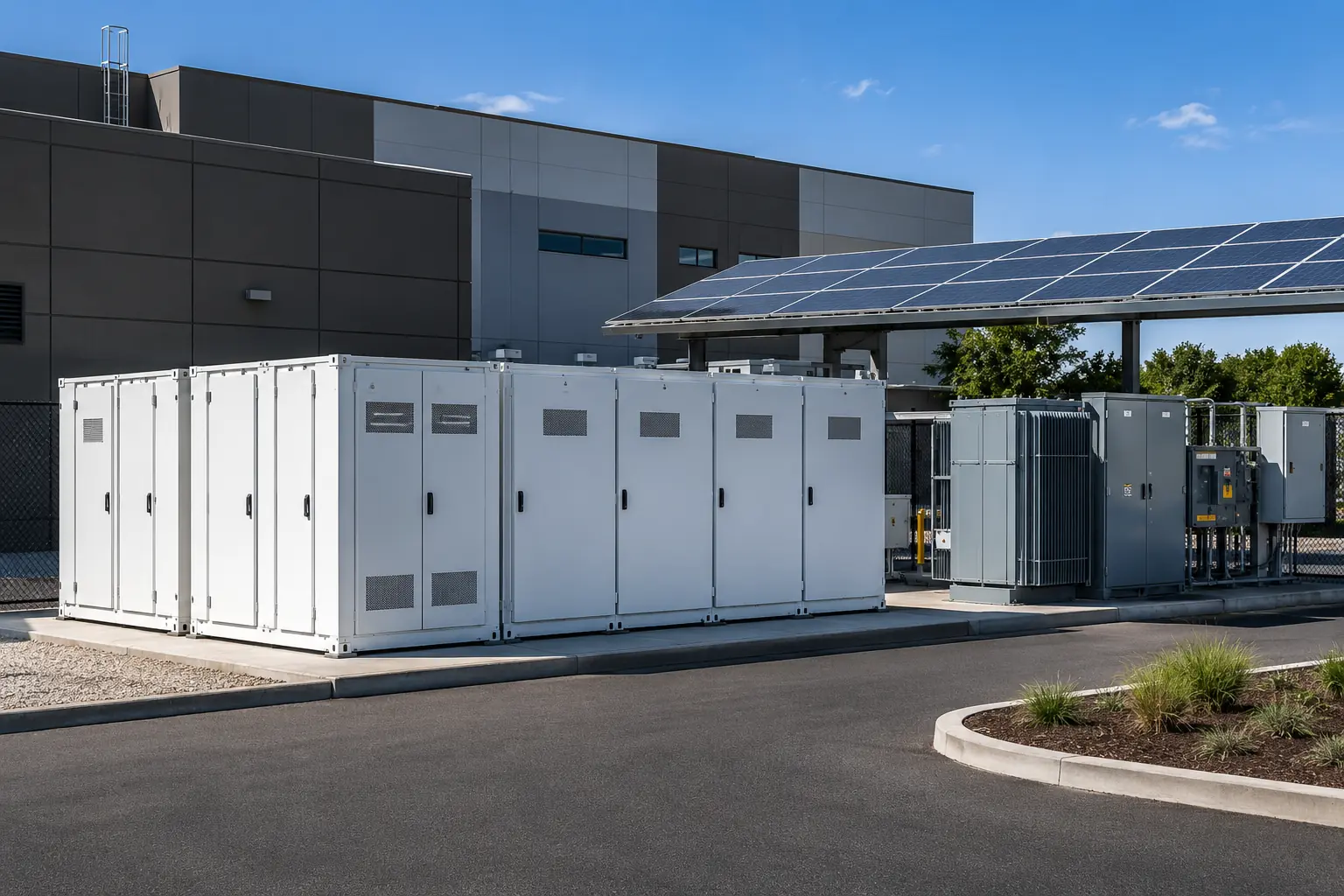
A commercial battery storage system is a battery energy storage system, or BESS, designed for businesses, commercial buildings, and industrial facilities. It stores electricity from the grid or onsite generation and releases it later to reduce peak demand, shift energy use, support backup power, increase solar self-consumption, and improve energy management.
I think the easiest way to understand commercial battery storage is to see it as a controllable energy buffer. The battery does not generate electricity. Instead, it lets me decide when electricity should be stored and when it should be used. A complete system normally combines battery cells, a battery management system, a PCS or inverter, thermal management, electrical protection, and energy management software.
How Does a Commercial Battery Storage System Work?
A commercial BESS works by moving electrical energy between the grid, onsite generation, the battery, and the facility's loads.
During charging, a commercial battery storage system converts available electricity into stored electrochemical energy. During discharge, the battery releases DC electricity and a PCS or inverter converts it into usable AC power. An energy management system decides when the battery should charge, discharge, or remain idle according to facility demand and operating goals.
I Follow the Energy Through the System
Suppose my commercial building has a 500 kW rooftop solar system.
At noon, the building may only need 300 kW.
That leaves:
500 kW solar production − 300 kW building load = 200 kW excess power
Instead of immediately exporting all 200 kW, I may charge the battery.
Later, when solar output falls but the building still needs electricity, the battery can discharge.
The flow can look like this:
During charging:
Grid or solar → PCS/inverter → battery → stored energy
During discharge:
Battery → PCS/inverter → commercial loads or grid
DOE describes onsite battery storage as technology that stores electricity and makes it available on demand. It also notes that energy management software controls transitions between charging, battery discharge, and grid power.
The Battery Is Only One Part of the BESS
I do not describe a commercial BESS as simply a large battery cabinet.
A complete system usually contains several layers:
| Component | Main Function |
|---|---|
| Battery cells | Store energy |
| Battery modules and racks | Organize cells into larger energy units |
| BMS | Monitors and protects the batteries |
| PCS / inverter | Converts AC and DC electricity |
| EMS | Decides when to charge and discharge |
| Thermal management | Controls battery temperature |
| Switchgear and protection | Connects and isolates electrical circuits |
| Transformer | Matches system voltage where required |
| Fire protection | Detects and manages safety events |
These components need to operate together.
The BMS may report battery voltage, temperature, current, state of charge, and alarms.
The PCS controls actual power conversion.
The EMS looks at the larger business objective.
For example, the EMS might detect that facility demand is approaching a monthly peak. It can then command the battery to discharge before the peak becomes larger.
That ability to automatically respond to changing electricity conditions is what makes a commercial battery system different from a simple backup battery.
What Is the Difference Between kW and kWh in Commercial Battery Storage?
I consider this one of the most important concepts when sizing a commercial BESS because power and energy solve different problems.
Kilowatts, or kW, tell me how much power a commercial battery can deliver at one moment. Kilowatt-hours, or kWh, tell me how much energy the battery stores. I need enough kW to support the required load and enough kWh to maintain that output for the required amount of time.
Power Tells Me How Large the Load Can Be
Imagine a battery rated:
500 kW / 1,000 kWh
The 500 kW figure tells me its power rating.
Under simplified conditions, the system could deliver its full 500 kW for about:
1,000 kWh ÷ 500 kW = 2 hours
Now imagine:
500 kW / 2,000 kWh
Its power rating has not changed.
It can still provide 500 kW.
But it now has approximately four hours of nominal energy duration:
2,000 kWh ÷ 500 kW = 4 hours
NREL describes the energy-to-power ratio of a commercial BESS as storage duration in hours and models commercial systems across different power ratings and durations.
| BESS Size | Nominal Duration |
|---|---|
| 250 kW / 250 kWh | 1 hour |
| 250 kW / 500 kWh | 2 hours |
| 500 kW / 1,000 kWh | 2 hours |
| 500 kW / 2,000 kWh | 4 hours |
| 1 MW / 4 MWh | 4 hours |
Real usable duration can be lower because I also need to consider state-of-charge limits, battery degradation, auxiliary loads, and conversion efficiency.
I Size kW and kWh From the Business Problem
Suppose my factory normally consumes 600 kW but reaches 900 kW for 30 minutes each afternoon.
If my goal is only to reduce that peak from 900 kW to 700 kW, I need about 200 kW of battery discharge power during the peak.
For 30 minutes:
200 kW × 0.5 hour = 100 kWh
The battery may therefore need high enough power but relatively little energy for that specific application.
Now imagine I need 200 kW of backup for four hours:
200 kW × 4 hours = 800 kWh
The power requirement is the same, but the energy requirement is eight times larger.
That is why I never select a commercial BESS from kWh alone.
Why Do Businesses Install Commercial Battery Storage?
Businesses install commercial batteries because electricity has different values at different times and because loss of electricity can interrupt operations.
The main commercial battery storage applications include peak-demand reduction, demand-charge management, energy arbitrage, solar energy shifting, backup power, demand response, and other grid-support functions. A single BESS may support more than one application when the battery capacity and control strategy are designed appropriately.
Peak Shaving and Demand-Charge Reduction
Some commercial electricity tariffs charge businesses partly according to their highest demand during a billing period.
Imagine my facility normally uses 400 kW.
One machine starts and briefly pushes consumption to 700 kW.
That short peak can become expensive under a demand-based tariff.
A battery can discharge 200 kW during that period:
700 kW facility demand − 200 kW battery discharge = 500 kW grid demand
The business still receives 700 kW of total power, but only 500 kW comes from the utility grid.
DOE's commercial energy-storage guidance identifies demand-charge management as a major use case, especially for facilities with sharp demand peaks.
Energy Arbitrage
A commercial BESS can also shift electricity through time.
I may charge the battery when electricity is cheaper.
I then discharge it when electricity is more expensive.
This strategy is commonly called energy arbitrage.
For example:
Off-peak electricity price: $0.08/kWh
Peak electricity price: $0.25/kWh
The difference looks attractive, but I still include charging losses, battery degradation, and other operating costs before I call the spread profit.
Solar Energy Storage
Commercial buildings can also combine batteries with rooftop or ground-mounted solar.
DOE notes that storage allows organizations to save onsite renewable electricity for later and increase the number of hours during which they use their own generation.
For me, the key benefit is timing.
Solar may generate the most electricity around noon.
The business may experience its largest electricity demand at 4 p.m. or 6 p.m.
The battery moves part of the noon energy into that later period.
Backup and Resilience
Commercial battery storage can also protect critical loads during grid interruptions when the complete system is designed for backup operation.
A medical facility example documented by DOE used a 1 MWh battery to provide a minimum three-hour backup window for life-safety operations while also supporting demand response and other energy-management functions.
I consider this ability to create both economic and resilience value one of the strongest reasons businesses evaluate BESS.
What Types of Businesses Can Use Commercial Battery Storage?
I do not see commercial BESS as a technology only for factories. Any facility with significant electricity use, high demand peaks, onsite solar, critical loads, or growing electrical demand may have a reason to evaluate storage.
Commercial battery systems can be used by factories, warehouses, offices, hotels, hospitals, farms, supermarkets, retail centers, schools, data centers, telecom sites, EV charging facilities, and other commercial or industrial operations. The best applications usually have identifiable energy costs, demand peaks, resilience needs, or renewable-energy opportunities.
Different Facilities Need Different BESS Designs
A supermarket may care heavily about refrigeration backup.
A factory may care about peak power and production downtime.
A hotel may want solar self-consumption and evening energy shifting.
An EV charging business may use a battery to reduce the short peak created by several fast chargers operating at the same time.
A warehouse may use storage to combine rooftop solar with nighttime loads.
The battery technology can be similar, but the sizing changes.
| Business Type | Possible Storage Goal |
|---|---|
| Factory | Peak shaving and production backup |
| Warehouse | Solar energy shifting |
| Supermarket | Refrigeration backup and demand reduction |
| Hotel | Time-of-use savings and backup |
| Hospital | Resilience and critical-load support |
| EV charging station | Grid-capacity management |
| Data center | Power resilience and peak management |
| Office building | Demand-charge reduction |
| Farm | Solar storage and pump backup |
| Telecom site | Critical-power backup |
I Start With the Load Profile
The business category does not determine the battery size.
The electrical load profile does.
I want to see interval electricity data.
That could be 15-minute, 30-minute, or hourly demand information depending on the project.
I look for:
- Highest demand
- How long peaks last
- Daily energy use
- Nighttime load
- Weekend load
- Seasonal variation
- Solar generation
- Expected future loads
NREL emphasizes the importance of storage duration when estimating commercial BESS cost because different applications require different energy-to-power ratios.
For me, this means the right battery for a warehouse cannot be selected simply because another warehouse installed the same model.
The electrical profile comes first.
What Is the Difference Between Commercial BESS and Residential Battery Storage
The underlying principle is similar, but commercial systems usually operate at higher power and energy levels and often have more complex electrical, control, and economic requirements.
Residential batteries mainly support household solar use, backup, and electricity-rate management. Commercial BESS can perform those same functions at larger scale while also managing demand charges, industrial loads, commercial tariffs, multiple battery racks, sophisticated EMS controls, and sometimes participation in utility or grid programs.
Commercial Systems Are Usually Larger
A residential battery might contain around 10–30 kWh.
A commercial project might contain hundreds of kWh or several MWh.
NREL's commercial BESS modeling has examined systems across commercial and industrial power levels with different storage durations rather than limiting the concept to one standard size.
A commercial system might look like:
250 kW / 500 kWh
500 kW / 1 MWh
1 MW / 2 MWh
2 MW / 8 MWh
The correct size depends on the project.
The Control Strategy Is Often More Complex
A homeowner may use a battery mainly for:
solar during the day → battery at night
A commercial EMS may need to think about several objectives at the same time.
For example:
Do I discharge now to avoid a demand peak?
Should I save energy for a higher electricity-price period later?
Do I need to maintain backup reserve?
Is excess solar available for charging?
Can I participate in a demand-response event?
DOE identifies commercial applications including demand reduction, energy-price arbitrage, renewable-energy shifting, and rapid transitions between battery and grid power.
This means commercial storage increasingly depends on software as much as hardware.
The cells store electricity.
The EMS decides how to create business value from that stored electricity.
What Safety Features Does a Commercial Battery Storage System Need?
Commercial BESS contains substantial electrical and electrochemical energy, so I treat safety as part of system design rather than an optional accessory.
A commercial battery storage system should include appropriate BMS protection, thermal management, electrical isolation, overcurrent protection, emergency controls, monitoring, and fire-safety measures. The required certification and installation standards depend on the country, battery chemistry, system size, building type, and local authority.
I Evaluate the Complete System
A lithium battery cell can have strong safety characteristics, but that does not automatically make the complete commercial installation safe.
I also need to evaluate:
- Battery modules
- BMS
- Enclosure
- PCS
- Cables
- Busbars
- Contactors
- HVAC
- Fire detection
- Emergency shutdown
- Installation spacing
- Switchgear
UL explains that UL 9540 evaluates energy storage systems as complete systems rather than looking only at individual batteries.
This system-level approach makes sense to me because commercial BESS failures can involve interactions between battery, electrical, thermal, and control equipment.
Certification Depends on the Market
For North American systems, UL 9540 is a major ESS safety standard, while UL 9540A addresses thermal-runaway fire-propagation testing in battery energy storage systems.
International projects may need standards such as IEC 62933 requirements as well as local electrical and fire rules.
I do not assume that one certificate gives me access to every market.
A commercial BESS installed in the United States may have different regulatory requirements from a system installed in Europe, Australia, the Middle East, or Southeast Asia.
Procurement Should Include Safety and Interconnection Early
DOE published a commercial-scale lithium-ion BESS procurement checklist specifically to help organizations address project-development issues before purchasing equipment.
I agree with that approach.
I do not buy the battery first and ask about permitting, fire requirements, or grid connection later.
Those issues can change the design and project cost.
How Do I Know if Commercial Battery Storage Is Worth It?
I do not decide from battery price alone. I calculate the value the system can create across its useful life.
A commercial BESS is worth evaluating when the business has high demand charges, time-of-use electricity pricing, excess solar production, expensive outages, grid-capacity constraints, or another clear storage use case. I compare annual savings and revenue with installed cost, battery degradation, maintenance, financing, efficiency losses, and future augmentation or replacement.
I Look for More Than One Value Stream
Suppose my BESS can create:
$40,000/year in demand-charge savings
$20,000/year in energy shifting
$15,000/year in additional solar value
The simplified annual value is:
$75,000
But that is not net profit.
I still need to subtract or model:
- Round-trip energy losses
- Maintenance
- Battery degradation
- Software costs
- Financing
- Insurance
- Replacement
- Augmentation
- Interconnection costs
NREL's commercial storage cost work shows that the battery pack is only one component of total installed system cost. PCS, structural balance of system, electrical equipment, installation, permitting, interconnection, and development costs also matter.
That is an important point.
I never compare BESS projects using battery-cell $/kWh alone.
Duration Must Match the Problem
Suppose my peak lasts 15 minutes.
A four-hour battery may be unnecessarily large if peak shaving is its only purpose.
Suppose my electricity-price peak lasts four hours.
A 30-minute battery may run empty too early.
This is why NREL emphasizes accurately estimating required commercial storage duration when determining system cost.
I select the battery from the duration of the business problem.
That is usually a much better starting point than choosing a standard container size.
My Insights: What Is a Commercial Battery Storage System?
My main insight is that commercial battery storage is not really about owning batteries. It is about gaining control over when a business uses electricity.
I define a commercial battery storage system as a controllable energy asset that stores electricity and releases it when doing so creates greater business value. The battery provides energy capacity, the PCS controls power conversion, the BMS protects the cells, and the EMS decides how to use stored energy for cost savings, resilience, solar optimization, and load management.
I See Four Layers in Every Strong Commercial BESS
The first layer is the battery.
It determines how much electrical energy I can store.
The second is the power conversion system.
It determines how quickly I can move that energy between the battery and the AC electrical system.
The third is protection and thermal management.
These systems keep the battery within its intended electrical and temperature limits.
The fourth is the energy management system.
That is where operational intelligence lives.
I can summarize the structure this way:
| Layer | Main Question |
|---|---|
| Battery | How much energy can I store? |
| PCS | How much power can I move? |
| BMS and thermal system | How do I protect the battery? |
| EMS | When should I charge or discharge? |
A strong project needs all four.
The Best BESS Starts With a Business Problem
I do not begin by asking:
“Should I buy a 1 MWh battery?”
I begin with:
“Why does this business need energy storage?”
Maybe electricity demand peaks for 30 minutes every afternoon.
Maybe solar production is being exported at a low value.
Maybe a factory loses tens of thousands of dollars during an outage.
Maybe an EV charging site cannot get a larger grid connection immediately.
Those are real problems.
Then I determine whether a BESS can solve them.
My Selection Process Is Based on the Application
If I were evaluating commercial battery storage for a business, I would check:
- What is the facility's maximum demand in kW?
- How long do demand peaks last?
- How many kWh are consumed each day?
- Does the tariff include demand charges or time-of-use rates?
- Is onsite solar available?
- How much energy must be reserved for backup?
- What grid import and export limits apply?
- How many battery cycles will occur each year?
- What warranty and throughput limits apply?
- What safety and interconnection requirements apply at the site?
I would then size the BESS.
Not before.
Commercial Storage Is More Than Backup
This is probably the biggest change in how I think about batteries.
A traditional backup battery may sit idle and wait for the grid to fail.
A modern commercial BESS can work almost every day.
It can charge when electricity is cheap.
It can absorb solar energy.
It can discharge before a demand peak.
It can reserve energy for an outage.
It may also respond to utility programs where local rules allow it.
DOE's Better Buildings guidance lists energy arbitrage, demand-charge management, outages, renewable-energy shifting, and grid services among commercial storage applications.
That turns the battery from passive backup equipment into an active energy-management asset.
I Still Do Not Recommend BESS for Every Business
A company with low electricity rates, flat demand, no solar, a highly reliable grid, and no demand charges may have a weak financial case.
Another company may have:
- High demand charges
- Large midday solar surplus
- Expensive evening electricity
- Frequent outages
- EV charging growth
- Limited grid capacity
For that business, one battery may solve several problems at the same time.
That is where commercial energy storage becomes especially valuable.
So when someone asks me, “What is a commercial battery storage system?”, my shortest practical answer is:
It is a business-scale battery system that stores electricity now so the business can use it at a more valuable time later.
The battery hardware makes storage possible.
The way I size, control, and integrate it determines whether it becomes a useful business investment.
Conclusion
A commercial battery storage system stores electricity for later use, helping businesses manage peak demand, energy costs, solar production, backup power, and electrical capacity through one controllable BESS platform.
](https://voltcrave-battery.com/wp-content/uploads/2026/09/Shingled-Solar-Panels-Explained-What-Are-the-Pros-Cons-and-Future-Trends-768x512.webp)
](https://voltcrave-battery.com/wp-content/uploads/2026/08/What-Makes-a-High-Voltage-LiFePO4-Battery-Structurally-Superior-768x512.webp)
](https://voltcrave-battery.com/wp-content/uploads/2026/06/How-Big-Can-the-Battery-Grid-Storage-Market-Get-768x512.jpg)