
](https://voltcrave-battery.com/wp-content/uploads/2026/09/BESS-Container-or-Battery-Building-Which-Is-Best-for-Solar-Power-Plants.webp)
Choosing the wrong battery enclosure can increase civil work, delay commissioning, complicate maintenance, or lock a solar-storage plant into an inefficient expansion strategy.
For most new utility-scale solar power plants, containerized or purpose-built outdoor BESS enclosures are usually the more practical choice because they support factory integration, modular expansion, fast installation, and repeatable testing. A dedicated battery building can be better where indoor service access, extreme climate control, site constraints, customized rack layouts, or centralized maintenance justify the extra building infrastructure.
Choosing between BESS containers and battery buildings depends on capacity, duration, site conditions, safety, construction, and operations, while storage improves solar flexibility and reliability.
What Is the Difference Between a BESS Container and a Battery Building?
The main difference is where integration takes place and how the storage system is physically divided.
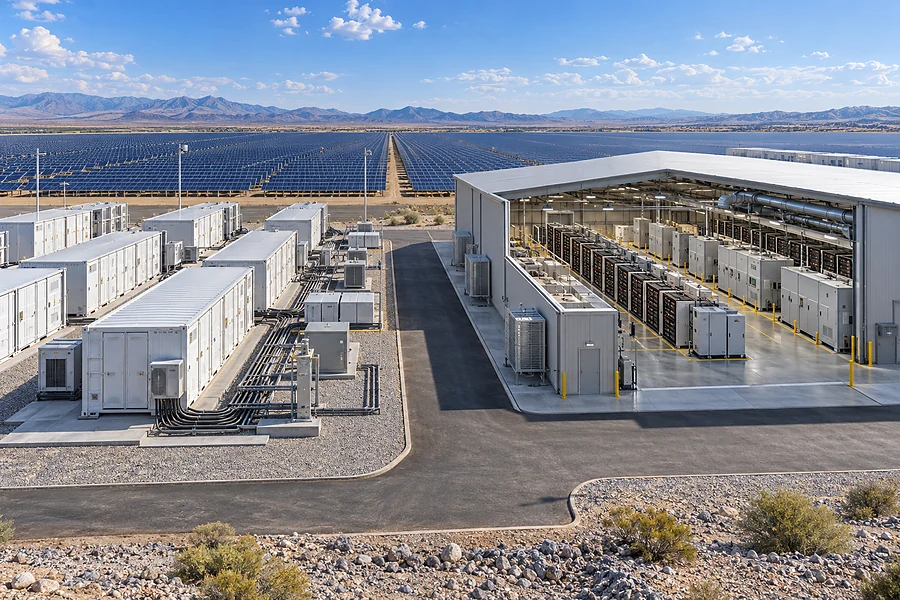
A BESS container is a factory-integrated outdoor enclosure containing battery racks or packs plus supporting systems such as BMS, thermal management, DC distribution, sensors, communications, and fire protection. A battery building is a permanent site-built structure where battery racks and supporting equipment are installed inside dedicated rooms or fire compartments. The electrical function can be similar, but construction and operational architecture are very different.
Modern containerized BESS should not necessarily be understood as ordinary shipping containers filled with batteries.
Many current utility-scale systems are purpose-built outdoor enclosures that use transport-friendly dimensions but are specifically engineered around:
battery mass,
high-voltage DC equipment,
liquid cooling,
fire and gas management,
weather exposure,
structural loading,
and maintenance requirements.
For example, Fluence's current Gridstack Pro 5000 platform provides approximately 4.9 to 5.6 MWh in a 20-foot-class battery enclosure and uses liquid thermal management.
Tesla takes an even more integrated approach with Megapack. Its current utility-scale platform ships with battery modules, inverters, and thermal systems already integrated, emphasizing installation speed and standardized deployment.
A battery building reverses some of that logic.
Instead of bringing the complete enclosure to the plant, the project constructs a permanent structure first and then installs:
battery racks,
electrical distribution,
HVAC or liquid cooling equipment,
fire systems,
gas detection,
cabling,
controls,
and service infrastructure
inside the building.
That can create more design freedom, but also more site integration work.
Why Are BESS Containers Common at Utility-Scale Solar Plants?
Solar power plants usually benefit from repeatable modular construction, which aligns naturally with containerized storage.
Containerized BESS is popular at utility-scale solar plants because storage capacity can be divided into repeatable MWh blocks that are manufactured and tested off-site, transported to prepared foundations, interconnected with PCS and transformers, and commissioned in parallel. This can reduce field assembly, simplify phased expansion, and shorten the interface between battery manufacturing and solar-plant construction.
Imagine a solar-storage project requiring:
100 MW / 400 MWh.
If each battery enclosure provides approximately:
5 MWh,
the storage plant may require roughly:
80 battery enclosures
before accounting for project-specific usable energy, degradation margins, redundancy, and architecture.
That sounds like a large number of units, but repetition is one of the main advantages.
The civil contractor can repeat:
foundations,
cable trenches,
fire spacing,
drainage,
earthing,
and access-road designs.
The electrical contractor can repeat connections between:
battery blocks,
PCS equipment,
medium-voltage transformers,
switchgear,
and plant controls.
The battery supplier can repeat the same tested enclosure design.
This is industrialized construction rather than bespoke room-by-room construction.
Current utility products reflect that approach. Fluence offers multiple enclosure sizes on a unified architecture, while Tesla specifically markets Megapack as a factory-integrated platform for utility and developer projects at gigawatt-hour scale.
Containers Also Match Phased Solar Development
Solar plants are often developed in phases.
A developer may initially construct:
200 MW solar + 100 MW / 400 MWh storage
and later add:
another 100 or 200 MWh.
Containerized systems can make this easier if the original plant reserves:
land,
transformer capacity,
PCS positions,
MV collection capacity,
communication channels,
and fire separation
for future blocks.
I therefore see modularity as one of the strongest reasons containers have become common in renewable-energy projects.
When Is a Battery Building Better Than BESS Containers?
Battery buildings become more attractive when the project values centralized indoor access and custom system integration more than standardized outdoor modularity.
A dedicated battery building can be better when batteries require controlled indoor conditions, technicians need frequent all-weather access, the site has severe space or environmental constraints, a customized rack arrangement is needed, or the owner prefers centralized fire compartments and service infrastructure. Buildings can also simplify certain maintenance workflows by keeping equipment under one roof.
A battery building can provide wide service aisles.
It can provide overhead access for replacement equipment.
It may allow technicians to work during:
heavy rain,
snow,
dust storms,
extreme heat,
or extreme cold
without opening multiple outdoor enclosures.
For some industrial plants, mines, data centers, islands, and remote projects, this can be valuable.
A building can also centralize:
workshops,
spare parts,
fire detection,
ventilation,
gas monitoring,
communications,
and service access.
Buildings Offer More Customization
A container has fixed physical boundaries.
A battery building does not have to follow a 20-foot or 40-foot transport footprint.
That gives the designer more flexibility to optimize:
rack spacing,
equipment rooms,
ventilation pathways,
cable routing,
fire barriers,
maintenance corridors,
and future indoor expansion.
This can be valuable for unusual site conditions or a project built around a highly customized battery architecture.
However, customization creates another problem:
more site-specific engineering.
Each unique room layout may require more structural, electrical, fire, HVAC, and commissioning work.
That is the opposite of the standardized container approach.
Which Option Has the Lower Installation Cost?
Containerized systems often reduce field construction, but project economics depend heavily on site conditions.
Containerized BESS usually has an advantage where factory integration replaces expensive field assembly and the site can accommodate repeated outdoor blocks. Battery buildings add structural steel, walls, roofing, fire-rated construction, ventilation, internal lighting, access systems, and additional building services. However, a building can become economically reasonable when land, climate, maintenance, or local construction conditions favor centralized installation.
I would not compare the two by looking only at:
battery $/kWh.
The enclosure decision affects many other cost categories.
| Cost Area | BESS Container | Battery Building |
|---|---|---|
| Battery equipment | Factory-integrated | Rack/equipment-based |
| Building envelope | Minimal | Major cost item |
| Foundations | Repeated pads | Building foundation |
| Field wiring | Often reduced | Usually more internal installation |
| HVAC/cooling | Integrated per unit or block | Centralized or zoned |
| Fire systems | Per enclosure/block | Building-wide + compartment systems |
| Factory testing | Strong advantage | More site integration remains |
| Site labor | Usually lower | Usually higher |
| Expansion | Add blocks | Extend or reconfigure building |
| Maintenance space | Limited by enclosure | Potentially excellent |
A solar plant on inexpensive rural land usually has little reason to create an expensive building solely to save footprint.
A project in a dense industrial facility could reach the opposite conclusion.
Factory Integration Reduces Interfaces
The strongest economic argument for a container is often not the steel enclosure.
It is the number of interfaces moved from the construction site into the factory.
Tesla states that its Megapack ships ready to install with battery modules, inverter equipment, and thermal systems integrated.
Fluence similarly emphasizes deployment speed and reduced installation complexity in its latest Gridstack Pro architecture.
Every factory-installed:
sensor,
pipe,
connector,
BMS harness,
control panel,
and cooling component
is one less field interface that may need to be assembled under construction-site conditions.
For large solar projects, that can be a major schedule benefit.
Which Is Faster to Install?
Containers generally have the stronger schedule advantage.
A containerized BESS can usually be deployed faster because a large portion of mechanical, electrical, thermal, and control integration is completed before shipment. Once foundations, trenches, transformers, PCS equipment, and network connections are ready, repeated battery blocks can be placed and connected quickly. A battery building requires the structure and supporting services to be substantially complete before final rack installation and commissioning.
Consider the sequence for a building:
civil works,
foundation,
structural frame,
walls and roof,
fire-rated partitions,
HVAC,
electrical rooms,
battery racks,
DC wiring,
fire systems,
controls,
testing,
and final commissioning.
Many of those activities are sequential.
A container project allows more parallel work.
While the solar-site contractor prepares:
roads,
pads,
drainage,
transformers,
and cable trenches,
the battery supplier can manufacture and test enclosures elsewhere.
When the enclosures arrive, much of the internal assembly is already complete.
This construction model is especially useful when the solar plant has a strict commercial-operation date.
Schedule Risk Still Depends on Logistics
Factory integration does not eliminate schedule risk.
Containers can be delayed by:
shipping,
port congestion,
heavy-haul permits,
crane availability,
road restrictions,
and customs clearance.
High-density battery enclosures are particularly heavy.
Therefore, I evaluate not only:
factory completion date
but:
factory-to-foundation logistics.
A battery building may sometimes have an advantage where shipping very heavy complete enclosures to the site is exceptionally difficult.
Which Has Better Maintenance Access?
Battery buildings usually provide easier physical access, while containers can offer stronger fault isolation.
Battery buildings can provide wide indoor aisles, centralized service equipment, controlled working conditions, and easier access to individual racks. Containers offer more limited service space but divide the plant into smaller independent blocks, which can make fault isolation easier and allow technicians to remove one enclosure from service without entering a large shared battery room.
This creates an important tradeoff.
Battery Building Maintenance
A building can provide:
larger aisles,
lifting equipment,
maintenance benches,
spare-component storage,
good lighting,
and stable working temperatures.
For an asset owner with a permanent on-site maintenance team, this may be attractive.
Container Maintenance
Containers or outdoor battery enclosures can be more restrictive.
Some modern designs are not intended for technicians to spend much time inside at all.
Instead, they use:
external service panels,
replaceable battery packs,
remote monitoring,
automated diagnostics,
and modular isolation.
The advantage is compartmentalization.
If one enclosure develops a serious fault, the operator may isolate a few MWh rather than exposing technicians to a large common battery hall.
For a 400 MWh solar-storage plant, removing one 5 MWh block represents only a small fraction of total capacity.
That modular redundancy can be valuable.
Which Is Safer: a BESS Container or a Battery Building?
Neither architecture is inherently safe simply because of its enclosure type.
BESS safety depends on cell behavior, BMS protection, thermal management, electrical protection, gas management, fire detection, suppression strategy, separation distances, enclosure or room design, and validated fire-test evidence. Containers can provide strong physical separation between battery blocks, while buildings can use fire-rated rooms and centralized suppression, but both require system-specific safety engineering.
This is particularly important in 2026 because large-scale fire testing is receiving greater attention.
UL Solutions explains that the 2026 edition of NFPA 855 places stronger emphasis on large-scale fire testing, including scenarios involving fire propagation between BESS units. UL 9540A Edition 6 also updates installation-level testing and includes considerations relevant to enclosure design and, for indoor systems, building-based fire suppression.
UL also confirms that UL 9540A is the fire and explosion test method referenced by the 2026 NFPA 855 framework, with Edition 6 published on March 13, 2026.
Containers Can Create Fire Compartments Naturally
Suppose a plant has:
80 separate battery enclosures.
Each enclosure is physically separated from neighboring units according to the validated site design.
That creates natural compartmentalization.
A failure in one enclosure does not automatically mean all batteries occupy the same fire volume.
Modern high-density containers are increasingly tested under realistic large-scale scenarios.
For example, Fluence reported large-scale fire and explosion testing for its Gridstack Pro 5000 platform, which can hold up to 5.6 MWh in a 20-foot enclosure.
However, those results apply to the tested system configuration.
They should never be generalized to unrelated containers.
Buildings Need Strong Internal Compartment Design
A battery building places more stored energy inside a common structure.
That means designers must think carefully about:
fire compartments,
gas movement,
deflagration,
sprinklers or suppression,
ventilation,
emergency access,
and propagation between racks or rooms.
The building itself becomes part of the safety system.
UL's current guidance specifically notes that installation-level testing for indoor ESS can evaluate the effectiveness of building-based fire suppression.
So a building can be extremely safe.
It simply needs a different safety architecture.
Which Option Uses Land More Efficiently?
A battery building can consolidate equipment, but modern containers are becoming extremely energy-dense.
Battery buildings can use vertical and centralized layouts to optimize constrained sites, but modern containerized BESS has dramatically improved energy density. Current 20-foot-class enclosures can hold around 5 MWh or more, meaning many solar plants can achieve high MWh-per-acre while retaining outdoor separation, service roads, PCS blocks, and transformer access.
Fluence's current Gridstack Pro 5000 offers approximately:
4.9–5.6 MWh
per 20-foot enclosure.
This changes the land-use equation.
Older projects might have needed many more containers to reach:
100 MWh.
At 5 MWh per enclosure, the simplified battery-only count is:
100 ÷ 5 = 20 enclosures.
Of course, actual land use includes far more than battery footprints.
A real plant needs:
separation distances,
fire access,
PCS equipment,
transformers,
switchgear,
cabling,
roads,
drainage,
and setbacks.
That is why I compare:
MWh per complete site area
rather than:
MWh per enclosure footprint.
A building can sometimes create excellent density, but it may also require fire setbacks, parking, service yards, mechanical equipment, and internal access space.
Which Is Easier to Expand Later?
Containers usually make block-level expansion easier.
Containerized BESS is generally better for phased expansion because additional battery blocks can be added to reserved site positions without modifying existing enclosures. A battery building can also be expanded, but expansion may require new structural bays, HVAC capacity, fire systems, busbars, cable routes, and room modifications that affect the existing installation.
However, modular expansion should not be confused with unlimited expansion.
Suppose a solar plant initially installs:
200 MWh
and wants to add:
100 MWh
five years later.
The additional containers still require available:
transformer capacity,
PCS capacity,
MV switchgear,
interconnection capacity,
EMS licenses,
land,
and control infrastructure.
If these were not planned at the beginning, modular batteries alone will not solve the problem.
I therefore design expansion at the plant level.
The initial project should consider:
future battery pads
future cable trenches
future PCS positions
and:
future transformer/interconnection capacity.
Then containers become extremely effective building blocks.
Does AC-Coupled or DC-Coupled Solar Storage Affect the Decision?
Yes, but coupling architecture and enclosure architecture are separate decisions.
Both containerized and building-based batteries can be used in AC-coupled or DC-coupled solar-plus-storage plants. AC coupling connects the storage system through its own power-conversion path, while DC coupling integrates the battery more closely with the PV-side DC architecture. The best enclosure therefore depends on how the PCS, battery voltage, solar inverters, transformers, and plant controls are arranged.
DOE explains that solar-plus-storage projects can use either AC-coupled or DC-coupled configurations and that technical performance and project cost should both influence the choice.
This matters because some container platforms integrate:
battery + PCS
while others function mainly as:
DC battery blocks
connected to separate PCS skids.
A building may similarly contain:
only battery racks,
or:
batteries + PCS + switchgear.
That means I never compare:
container vs building
without first defining:
what equipment each option actually includes.
Otherwise, the comparison is not equivalent.
BESS Container vs Battery Building: Which Is Better for Different Solar Plants?
The answer changes according to project conditions.
For most greenfield utility-scale solar plants with adequate outdoor land, modular containerized BESS is usually the strongest default. Battery buildings become more attractive at land-constrained, climate-sensitive, highly customized, or maintenance-intensive sites. The correct decision should come from project-level engineering rather than a universal preference for one enclosure type.
| Solar Project Condition | Usually Stronger Option | Main Reason |
|---|---|---|
| Large greenfield solar farm | BESS container | Fast modular deployment |
| 100–500+ MWh storage | BESS container | Repeatable utility-scale blocks |
| Phased expansion planned | BESS container | Easy block addition |
| Tight commissioning deadline | BESS container | Factory integration |
| Cheap rural land | BESS container | Building density less valuable |
| Severe transport restrictions | Depends | Container mass may become problematic |
| Very limited site footprint | Battery building may help | Custom compact layout |
| Frequent technician access | Battery building | Better indoor service space |
| Extreme outdoor environment | Battery building may help | Centralized environmental control |
| Highly customized battery layout | Battery building | Greater design flexibility |
| Strong need for compartmentalized blocks | BESS container | Natural unit-level separation |
| Solar plant using standardized EPC design | BESS container | Repetition reduces interfaces |
My default for a new large solar farm is therefore:
containerized or purpose-built outdoor modular BESS.
But default does not mean mandatory.
My Insights: BESS Container or Battery Building—Which Is Best for Solar Power Plants
The choice is ultimately about how the storage plant should be built, operated, expanded, and protected.
For most large greenfield solar power plants, I favor modular containerized BESS because factory integration, repeatable construction, block-level isolation, fast deployment, and future expansion align well with utility-scale PV development. I favor a battery building when indoor maintenance, customized equipment layouts, difficult climate conditions, or severe site constraints create enough value to justify greater building complexity.
My First Insight: The Enclosure Should Follow the Solar Plant's Construction Model
Solar farms are already highly repetitive infrastructure.
Hundreds of PV strings repeat.
Inverter blocks repeat.
Transformer stations repeat.
Cable trenches repeat.
Containerized storage follows exactly the same construction philosophy.
A project can repeat:
5 MWh battery block → PCS → transformer → MV collection.
That makes engineering, procurement, installation, and commissioning easier to standardize.
For a large greenfield plant, this is a major advantage.
My Second Insight: Factory Integration Can Be More Valuable Than the Container Itself
I do not believe the metal enclosure is the main reason containerized BESS wins so many utility projects.
The real advantage is:
pre-integration.
If battery packs, cooling, BMS, sensors, DC protection, and controls are assembled and tested in a controlled factory environment, fewer interfaces remain for the EPC contractor.
Current platforms from Tesla and Fluence are explicitly designed around this factory-integrated deployment model.
The container is therefore partly:
a logistics format
and partly:
a manufacturing strategy.
My Third Insight: Battery Buildings Win When Human Access Becomes a Priority
Modern utility containers increasingly minimize routine internal access.
Remote monitoring and modular component replacement are becoming more important.
That is excellent for a solar farm operated remotely.
It is less ideal when technicians need frequent access to:
individual racks,
cabling,
cooling equipment,
or experimental battery systems.
A dedicated building can create a much better working environment.
So I see the maintenance philosophy as a key decision:
remote modular maintenance → container
frequent indoor rack-level maintenance → building
is a useful starting rule.
My Fourth Insight: Fire Strategy May Matter More Than CAPEX
The storage industry is moving toward larger battery cells and higher MWh per enclosure.
That means the amount of stored energy involved in a single abnormal event is increasing.
At the same time, 2026 NFPA 855 and UL 9540A developments place strong emphasis on representative large-scale fire behavior.
I therefore would not award a BESS solely because one architecture saves slightly more CAPEX.
I would compare:
validated propagation behavior,
separation distance,
gas management,
deflagration strategy,
firefighter access,
emergency procedures,
and insurance requirements.
A cheaper layout can become expensive if it creates permitting delays or requires major redesign later.
My Fifth Insight: BESS Container or Battery Building—Which Is Best for Solar Power Plants?
This directly answers the H1 question.
| Decision Area | BESS Container | Battery Building |
|---|---|---|
| Greenfield solar plant suitability | Excellent | Good |
| Factory integration | Excellent | Lower |
| Deployment speed | Excellent | Moderate |
| Modular expansion | Excellent | Moderate |
| Field construction | Lower | Higher |
| Custom internal layout | Limited | Excellent |
| Indoor maintenance access | Moderate/limited | Excellent |
| Extreme-weather service environment | Moderate | Excellent |
| Block-level fault isolation | Excellent | Depends on compartmentation |
| Fire separation | Natural between units | Engineered inside building |
| Transport sensitivity | High | Lower for individual racks |
| Heavy-haul requirements | Important | Less concentrated |
| Rural land use | Usually acceptable | Often unnecessary |
| Dense constrained site | Good | Potentially excellent |
| Standardized EPC | Excellent | Moderate |
| Unique project engineering | Moderate | Excellent |
| Phased capacity additions | Excellent | More difficult |
| Large utility solar default | Usually preferred | Project-specific |
If I were selecting storage for a typical:
200 MW solar plant with a 100 MW / 400 MWh battery,
adequate rural land,
good heavy-haul access,
and a tight commissioning schedule,
I would normally start with:
containerized or purpose-built outdoor BESS blocks.
The reasons are straightforward.
I can divide the plant into repeatable battery sections.
I can factory-integrate much of the storage equipment.
I can install civil works while batteries are being manufactured.
I can isolate individual storage blocks during faults or maintenance.
I can reserve additional pads for augmentation.
And I can scale the same basic architecture across hundreds of MWh.
If the project instead sits inside a highly constrained industrial property where land is expensive and technicians require constant rack-level access, a battery building deserves much stronger consideration.
The same is true if the site has an extreme environment where maintaining dozens of outdoor service spaces creates a serious operational penalty.
That leads to my final selection principle:
Do not ask which enclosure stores batteries better.
Ask:
Which architecture allows this particular solar power plant to be constructed, transported, tested, permitted, operated, serviced, expanded, and protected at the lowest lifetime project risk?
For most conventional large solar farms in 2026, the answer will often be:
modular outdoor BESS enclosures.
For specialized sites, it may be:
a purpose-designed battery building.
Neither should be selected solely because it looks cheaper on a battery supplier's datasheet.
The enclosure is part of the plant architecture.
Its real value appears only when the complete system—including battery cells, PCS, transformers, controls, fire engineering, logistics, civil works, maintenance, augmentation, and grid connection—is evaluated together.
Conclusion
For most utility solar plants, modular BESS containers offer the strongest balance of speed, scalability, and factory integration, while battery buildings excel where customization and indoor service access dominate.
](https://voltcrave-battery.com/wp-content/uploads/2026/06/A-Complete-Guide-to-the-Lifespan-of-Lithium-Ion-Solar-Batteries-768x512.jpg)
](https://voltcrave-battery.com/wp-content/uploads/2026/09/What-Are-the-Downsides-of-Using-a-Car-Inverter-768x512.webp)
](https://voltcrave-battery.com/wp-content/uploads/2026/08/What-Makes-a-High-Voltage-LiFePO4-Battery-Structurally-Superior-768x512.webp)