
](https://voltcrave-battery.com/wp-content/uploads/2026/09/Sun-Storage-Power-on-Demand-The-PV-Storage-Diesel-Hybrid-Unit-Revolution-Begins.webp)
Solar is clean but variable. Batteries are flexible but finite. Diesel generators are dispatchable but consume fuel. Used alone, each technology has limitations.
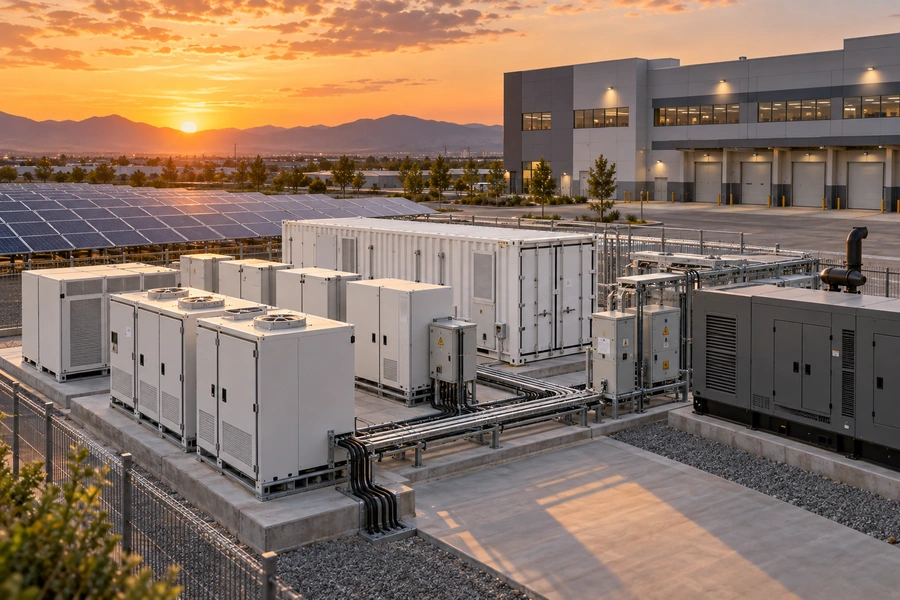
A PV-storage-diesel hybrid unit combines solar panels, battery storage, and diesel generation under intelligent energy controls. Solar normally supplies low-cost daytime electricity, batteries store surplus energy and balance short-term demand, while diesel generation provides dispatchable backup when renewable production and stored energy are insufficient. The result is flexible, resilient power on demand.
Hybrid power is growing rapidly, combining solar, battery storage, diesel generators, and intelligent controls to deliver cleaner, flexible, reliable, and efficient energy for diverse applications.
What Is a PV-Storage-Diesel Hybrid Unit?
A hybrid unit combines three energy resources that have very different operating characteristics.
A PV-storage-diesel hybrid unit is an integrated power system combining photovoltaic generation, battery energy storage, and a diesel generator. Solar provides renewable electricity, the battery stores and shifts energy while responding quickly to load changes, and the generator supplies dispatchable power when required. An EMS or microgrid controller coordinates the three resources.
A simplified architecture looks like:
Solar PV + BESS + Diesel Generator → AC Bus → Loads
The system may also include:
Grid Connection
when used at a commercial or industrial site.
Its main components typically include PV modules, solar inverters, battery racks, BMS, PCS or hybrid inverter, diesel genset, switchgear, transformers, metering, protection, EMS, SCADA, and microgrid controls.
Each resource solves a different problem.
PV = Generate
Battery = Store and Balance
Diesel = Dispatch on Demand
EMS = Coordinate
That combination creates something none of the three resources can provide as effectively alone: a controllable hybrid energy system.
How Does a PV-Storage-Diesel Hybrid System Work?
The operating principle is based on continuously balancing generation and demand.
A PV-storage-diesel system normally prioritizes solar generation, uses battery storage to absorb surplus PV and cover short-term deficits, and starts the diesel generator when solar and battery resources cannot satisfy demand or reserve requirements. Smart controls continuously monitor load, PV output, battery SOC, generator status, and operating limits to determine the most efficient power source.
Consider a remote industrial site consuming:
500 kW.
At midday, solar generates:
700 kW.
The load consumes:
500 kW.
Surplus:
700 – 500 = 200 kW
The system can direct that surplus into the battery.
The energy flow becomes:
PV → Load + Battery
Later, solar output falls to:
200 kW
while the load remains:
500 kW.
The battery can supply:
300 kW.
Now:
PV + Battery → Load
After sunset, PV output becomes zero.
If the battery still has sufficient SOC:
Battery → Load
When battery SOC reaches its protected minimum:
Diesel → Load
and, depending on the operating strategy:
Diesel → Load + Battery Charging.
The objective is not necessarily to eliminate diesel. It is to use diesel more strategically.
Why Combine Solar PV, Battery Storage, and Diesel?
Each energy resource compensates for weaknesses in the others.
PV-storage-diesel hybrid systems combine the low operating cost of solar, the rapid response and energy-shifting capability of batteries, and the dispatchability of diesel generation. Together, they can reduce generator runtime and fuel consumption while maintaining power availability when solar production is low or battery energy is depleted.
Solar alone has one obvious limitation:
No sunlight → No PV production.
Battery storage solves the timing problem, but batteries have finite energy.
A:
1 MW / 4 MWh
BESS can theoretically deliver 1 MW for around:
4 hours.
It cannot supply that power indefinitely.
Diesel generation solves the duration problem because additional fuel can extend runtime.
But continuous diesel operation creates:
fuel consumption,
maintenance,
noise,
local emissions,
and:
fuel logistics.
Hybridization creates a layered approach.
Instead of operating the generator continuously:
PV first.
Then:
Battery.
Then:
Diesel when required.
That changes diesel from the primary energy source into a dispatchable reliability resource.
What Is the Role of Solar PV in a Hybrid Power System?
Solar is normally the lowest-variable-cost energy source in the hybrid architecture once installed.
Solar PV provides daytime electricity directly to site loads and can charge the battery when generation exceeds immediate demand. By replacing part of the electricity that would otherwise come from diesel generation, PV can reduce generator operating hours and fuel consumption while giving the battery access to renewable charging energy.
Suppose an industrial site requires:
5 MWh/day.
Its PV system produces:
3 MWh/day.
If all solar electricity can be used:
Diesel or stored-energy requirement falls from:
5 MWh
to approximately:
2 MWh
before accounting for losses and timing.
But timing matters.
The site may need:
500 kW
at 20:00.
Solar output at that time may be:
0 kW.
That is why annual or daily energy totals do not tell the whole story.
The battery moves solar energy through time.
Instead of:
PV at 12:00 → Use at 12:00
the hybrid system can support:
PV at 12:00 → Battery → Use at 20:00.
This is the fundamental role of storage in renewable hybrid power.
What Is the Role of Battery Storage in a PV-Diesel Hybrid System?
The battery is the flexible bridge between variable solar generation and dispatchable diesel generation.
Battery storage captures surplus solar, shifts energy into evening or nighttime periods, responds rapidly to sudden load changes, reduces generator starts, and can maintain operating reserve. Depending on system architecture, it may also stabilize voltage and frequency, support generator loading, and help maintain power while another resource starts or changes output.
Consider a load suddenly increasing from:
300 kW
to:
600 kW.
The battery can rapidly provide the difference:
600 – 300 = 300 kW.
This gives the system time to decide whether:
solar production will recover,
the peak will disappear,
or:
the diesel generator needs to start.
The battery therefore performs two distinct functions:
Power Buffer
and:
Energy Buffer.
Its kW rating determines how much power it can provide at one moment.
Its kWh rating determines how long it can provide that power.
A:
500 kW / 500 kWh
battery has approximately:
1 hour
of nominal duration at full power.
A:
500 kW / 2 MWh
battery has approximately:
4 hours.
This distinction is essential in hybrid-system design.
What Is the Role of the Diesel Generator?
Diesel remains valuable because batteries cannot create energy and solar cannot be guaranteed at every moment.
The diesel generator provides firm, dispatchable generation when solar production and battery energy are insufficient. In a well-designed hybrid system, the generator can operate less frequently but remain available for prolonged low-solar periods, extended outages, unusually high loads, battery maintenance, or conditions where maintaining minimum battery reserve is more important than avoiding fuel use.
Imagine:
Load = 400 kW
PV = 0 kW
Battery usable energy = 800 kWh.
Theoretical battery duration:
800 ÷ 400 = 2 hours.
If the site requires:
12 hours
of overnight power, the battery alone is insufficient.
One option is to install:
400 × 12 = 4.8 MWh
of usable storage.
Another option is:
Battery + Diesel.
The battery may supply the early evening load.
The generator starts later.
It can supply the load and potentially recharge the battery within an efficient operating range.
This can be economically attractive when long-duration backup events are relatively rare.
Instead of buying enough battery capacity for the worst imaginable event, the designer can combine:
Battery for frequent operation
with:
Diesel for infrequent extended operation.
How Does the EMS Control Solar, Battery, and Diesel?
The EMS is the decision-making layer of the hybrid system.
A hybrid Energy Management System monitors load, solar production, battery SOC, generator status, fuel strategy, tariffs where applicable, and equipment limits. It then determines how much power each resource should provide. The EMS can prioritize solar consumption, maintain battery reserve, minimize generator starts, and coordinate charging without violating battery or generator constraints.
A simple control hierarchy could be:
1. Maintain Safety
2. Supply Critical Loads
3. Use Available Solar
4. Maintain Battery Reserve
5. Optimize Battery Dispatch
6. Start Diesel When Required
The BMS still controls battery safety.
The PCS controls battery power conversion.
The generator controller manages generator operation.
The EMS coordinates them at the system level.
For example:
PV output = 600 kW
Load = 400 kW
Battery SOC = 50%
The EMS may command:
400 kW PV → Load
and:
200 kW PV → Battery.
Later:
PV = 0 kW
Load = 400 kW
Battery SOC = 70%.
The EMS may command:
Battery → Load.
When SOC reaches:
30% reserve,
the EMS can start:
Diesel → Load.
The exact percentages depend on the project, but the control principle remains the same.
What Does “Solar-First, Battery-Second, Diesel-Last” Mean?
This operating philosophy is useful, but it should not be interpreted as a rigid rule.
Solar-first, battery-second, diesel-last means the controller generally prioritizes available PV, then uses stored battery energy to balance demand, and operates the diesel generator only when required by load, battery reserve, weather, equipment constraints, or reliability targets. Smart optimization may change this order when doing so improves overall efficiency or resilience.
For example, imagine the battery is at:
35% SOC
with a protected reserve of:
30%.
Solar output is low.
A storm is expected.
The system could discharge the battery to:
30%.
But that would leave almost no flexible reserve.
Instead, the EMS might start the generator earlier and preserve:
35% SOC.
Similarly, a generator may operate more efficiently at:
70% load
than at:
20% load.
Rather than continuously running the generator at a poor loading point, the controller may operate it at higher output for a shorter period and direct excess power into the battery.
Therefore, the intelligent strategy is not simply:
Avoid Diesel at All Costs.
It is:
Use Each Resource Where It Creates the Most System Value.
Can a PV-Storage-Diesel System Reduce Fuel Consumption?
Reducing generator runtime and inefficient low-load operation is one of the main reasons to hybridize diesel-based power.
A PV-storage-diesel system can reduce fuel consumption by using solar electricity instead of generator output and storing surplus renewable energy for later use. Battery storage can also reduce unnecessary generator starts and allow the generator to operate in more deliberate operating windows rather than continuously following every short-term change in demand.
Suppose a remote site requires:
1,000 kWh/day.
Without solar:
Diesel supplies 1,000 kWh.
Now install solar capable of delivering:
600 kWh/day
of usable energy.
Remaining energy requirement:
1,000 – 600 = 400 kWh/day.
If storage allows more of that solar production to be used instead of curtailed or wasted, diesel generation can fall substantially.
The exact fuel savings cannot be calculated from kWh alone.
They depend on:
generator efficiency,
load factor,
fuel consumption curve,
battery efficiency,
PV production,
battery cycling,
and:
control strategy.
But the energy principle is simple:
Every useful kWh supplied by solar or previously stored solar is a kWh that does not need to be produced by diesel at that moment.
How Can Battery Storage Reduce Diesel Generator Runtime?
Battery storage can separate generator operating time from load operating time.
Instead of keeping a diesel generator online continuously to serve small or variable loads, a hybrid system can use the battery during lower-load periods. The generator can then operate periodically to serve larger loads or recharge storage, potentially reducing runtime, starts, low-load operation, maintenance hours, and fuel consumption.
Consider a site with:
Night load = 100 kW
Generator rating = 500 kW.
Running a 500 kW generator continuously for a 100 kW load means it is operating at only:
20% of rated power.
With storage, the strategy can change.
The battery supplies the 100 kW load.
Later, the generator starts at a more useful operating point and supplies:
Load + Battery Charging.
For example:
Generator output = 400 kW
Load = 100 kW
Battery charging = 300 kW.
After charging, the generator stops.
Then:
Battery → Load
again.
Whether this is more efficient depends on actual equipment performance, but it illustrates why batteries can change generator operating strategy.
How Do You Size a PV-Storage-Diesel Hybrid System?
Sizing should start with the load profile and reliability requirement rather than a predetermined battery or solar package.
PV-storage-diesel sizing requires the hourly load profile, solar resource, required autonomy, battery SOC limits, generator capacity, load growth, conversion losses, and reliability target. PV is sized around renewable energy production, battery kWh around energy shifting and autonomy, battery kW around power requirements, and diesel around residual demand and extended backup conditions.
The basic process starts with:
Daily Energy Demand
Suppose:
Daily load = 10 MWh.
Then determine:
Solar Contribution.
Suppose the PV system provides:
6 MWh/day
under representative conditions.
Remaining daily energy:
10 – 6 = 4 MWh.
But that does not automatically mean the battery should be:
4 MWh.
The hourly profile matters.
Suppose only:
2 MWh
of solar needs to be shifted from daytime into nighttime.
Then the energy-shifting requirement may begin around:
2 MWh
before efficiency, SOC, degradation, and reserve adjustments.
Next determine battery power.
If the largest short-term deficit is:
1 MW,
the PCS may need approximately:
1 MW
or more depending on design margins and operating objectives.
Finally, size the generator around:
maximum residual load,
motor starting requirements,
battery charging strategy,
redundancy,
and:
emergency conditions.
The design sequence should be:
Load → Solar Resource → PV → Battery kW → Battery kWh → Generator → EMS Strategy.
How Much Battery Storage Does a Hybrid System Need?
There is no universal PV-to-battery ratio.
Battery capacity should reflect the amount of energy that must be shifted, the required battery-only runtime, maximum charge and discharge power, minimum reserve SOC, and generator operating strategy. Oversizing increases capital cost, while undersizing can cause frequent generator starts and leave valuable solar energy unused.
Suppose the site needs:
300 kW
of battery support for:
4 hours.
Theoretical energy:
300 × 4 = 1.2 MWh.
If only:
80%
of nominal battery capacity is allocated to normal usable operation:
1.2 ÷ 0.80 = 1.5 MWh.
Additional allowances may be required for:
efficiency,
degradation,
temperature,
and:
reserve.
Now suppose the same site needs only:
300 kW
for:
30 minutes.
Required theoretical energy is:
300 × 0.5 = 150 kWh.
Same power.
Completely different battery.
This is why:
kW ≠ kWh.
How Should the Diesel Generator Be Sized?
The generator should be sized around the hybrid system's worst credible operating conditions rather than simply matching the average load.
Diesel-generator sizing should consider maximum residual load, motor starting currents, battery-charging demand, required redundancy, altitude and temperature derating, transient performance, and whether the generator must support the entire facility when solar and battery resources are unavailable. Hybridization may reduce generator runtime without necessarily reducing required emergency generator power.
Suppose:
Maximum critical load = 800 kW.
PV availability during the design emergency = 0 kW.
Battery is unavailable due to maintenance.
If the reliability requirement says the generator must independently support the critical site, it may still need to cover approximately:
800 kW
plus appropriate design margins.
Now consider a different site where:
Battery availability is guaranteed within the design architecture
and:
non-critical loads can be shed.
The required generator capacity could potentially be different.
This highlights an important principle:
Energy Optimization and Emergency Design Are Not the Same Calculation.
A generator may operate only a few hours each month but still be sized for a severe contingency.
How Does a Hybrid Unit Work in Off-Grid Locations?
Off-grid applications are among the strongest use cases because there is no utility grid available to absorb energy imbalance.
In an off-grid PV-storage-diesel system, solar, battery storage, and diesel generation must collectively maintain electricity supply at all times. The battery handles rapid balancing and short-duration energy shifting, solar supplies renewable energy when available, and diesel provides firm generation during prolonged low-solar conditions or when stored energy falls below reserve.
Examples include:
mines,
remote telecom sites,
islands,
construction camps,
farms,
military facilities,
and:
remote communities.
In these applications:
Grid = 0.
Therefore:
PV + Battery + Diesel = Entire Power System.
This increases the importance of:
forecasting,
reserve management,
redundancy,
black-start capability,
frequency control,
and:
generator coordination.
The BESS may need to operate as a grid-forming resource, depending on system architecture.
That means the inverter helps establish:
voltage and frequency
rather than simply following an existing utility grid.
Off-grid hybrid design is therefore a microgrid engineering problem, not simply an equipment-selection problem.
Can PV-Storage-Diesel Hybrid Systems Be Used for Commercial and Industrial Facilities?
Hybrid systems are also relevant to grid-connected C&I sites that need lower costs and stronger resilience.
Commercial and industrial facilities can combine PV, battery storage, diesel generation, and the utility grid to create layered energy resilience. Solar reduces grid consumption, the battery manages peaks and shifts energy, diesel provides extended backup, and the EMS coordinates these resources according to tariffs, load, SOC, renewable production, and grid availability.
A grid-connected architecture may be:
Grid + PV + BESS + Diesel → C&I Facility.
During normal operation:
PV → Loads
while:
BESS → Peak Shaving / Energy Shifting.
The diesel generator remains off.
During an outage:
Grid = Disconnected.
Then:
PV + BESS + Diesel → Critical Loads.
This creates multiple resilience layers.
The battery can provide immediate power.
The generator can support extended outages.
Solar can reduce generator fuel consumption during daylight.
The result is not:
Battery vs. Generator.
It is:
Battery + Generator + Solar.
How Does a PV-Storage-Diesel Hybrid Microgrid Handle an Outage?
The transition strategy depends on the architecture and equipment response requirements.
During a grid outage, a properly designed hybrid microgrid isolates itself from the utility network and uses local generation and storage to maintain selected loads. Battery storage can provide rapid initial support, solar can contribute when available, and the diesel generator can start for sustained operation when battery energy or renewable production is insufficient.
A simplified sequence could be:
Grid Failure
↓
Island Microgrid
↓
BESS Supports Critical Loads
↓
Generator Starts if Required
↓
PV + BESS + Diesel Coordinate
This can create a smoother transition than depending only on generator startup.
However, not every battery system provides UPS-level transfer performance.
The design must evaluate:
transfer time,
critical-load tolerance,
grid-forming capability,
fault current,
protection coordination,
black start,
and:
generator synchronization.
For highly sensitive loads, a dedicated UPS may still be required.
Why Is LFP Important for Hybrid Energy Storage?
LFP has become the dominant chemistry for stationary battery applications.
Lithium iron phosphate is widely used in PV-storage-diesel systems because stationary applications prioritize cost, cycling capability, and thermal characteristics more than maximum gravimetric energy density. IEA data shows that LFP accounted for around 90% of global battery-storage deployments in 2025, making it the dominant chemistry for modern stationary storage.
LFP is a form of:
lithium-ion battery.
Its widespread adoption has supported the expansion of:
solar-plus-storage,
microgrids,
C&I storage,
and:
utility-scale BESS.
The IEA also reports that battery costs declined by more than 90% between 2010 and 2025, helping storage expand into increasingly energy-intensive applications.
But LFP does not eliminate safety requirements.
Stationary battery systems still require:
BMS protection,
thermal management,
fault isolation,
fire detection,
appropriate spacing,
and:
system-level safety engineering.
What Safety Requirements Matter for Hybrid Battery Systems?
Adding batteries changes the safety architecture of a PV-diesel power plant.
Battery safety must be addressed at cell, module, enclosure, system, and installation levels. In North American projects, UL 9540 provides the foundational ESS product safety framework, while UL 9540A evaluates thermal-runaway and fire-propagation behavior. NFPA 855 addresses stationary ESS installation and its 2026 edition strengthens emphasis on large-scale fire testing.
UL reports that the sixth edition of UL 9540A was published on:
March 13, 2026.
The updated approach includes installation-level large-scale fire testing and evaluates challenging fire conditions relevant to multi-unit BESS installations.
Hybrid projects also contain additional hazards and interfaces associated with:
diesel fuel,
generator exhaust,
electrical switchgear,
PV DC circuits,
battery DC circuits,
and:
multiple power sources.
Emergency shutdown therefore has to consider the entire hybrid system.
The safety question is not simply:
“Is the battery safe?”
It is:
“Can the complete hybrid power plant enter and remain in a safe state when something fails?”
What Are the Economics of a PV-Storage-Diesel Hybrid System?
Hybrid economics depend on avoided fuel and operating costs as well as the capital cost of PV and storage.
The economic case for a PV-storage-diesel system is strongest when solar and battery operation can replace expensive diesel-generated electricity, reduce generator runtime, lower maintenance requirements, or avoid fuel logistics. The correct analysis compares total lifecycle cost rather than only the initial price of PV panels, batteries, or generators.
A simplified comparison is:
Traditional System Cost
= Diesel CAPEX + Fuel + Maintenance + Fuel Logistics
versus:
Hybrid System Cost
= PV CAPEX + BESS CAPEX + Diesel CAPEX + Controls + Fuel + Maintenance.
The hybrid system has higher initial complexity.
But:
PV fuel cost = $0
after installation in the operational sense that sunlight is not purchased.
The battery does not generate energy, but it allows more solar electricity to be used at the correct time.
Diesel then covers residual energy and reliability needs.
The financial question becomes:
How much diesel operation can PV and storage economically replace over the project life?
This is especially important in remote locations where the delivered cost of diesel includes:
transport,
storage,
security,
and:
logistics.
Can Hybrid Systems Eliminate Diesel Completely?
Sometimes, but eliminating diesel can require substantially more solar and battery capacity.
A hybrid system can theoretically operate without diesel if renewable generation, storage duration, power capability, and system redundancy are sufficient for the required reliability level. However, designing for prolonged bad weather or seasonal renewable deficits can require much larger batteries and PV arrays, making a small backup generator economically attractive in some applications.
Consider:
Critical load = 500 kW.
Three days of autonomy without solar:
500 × 24 × 3
= 36 MWh.
That is a substantial battery.
If extended low-solar events happen only occasionally, installing:
36+ MWh
of storage solely for rare events may not be the most economical solution.
A hybrid architecture might instead use:
4–8 hours of battery storage
plus:
diesel backup
for rare extended events.
The best answer depends on:
fuel cost,
renewable resource,
battery cost,
reliability target,
emissions objectives,
and:
site logistics.
Therefore:
100% renewable operation
and:
optimal hybrid operation
are not automatically the same engineering objective.
What Are the Biggest Challenges of PV-Storage-Diesel Integration?
Combining three energy resources creates greater flexibility but also greater control complexity.
The main challenges include correct PV and battery sizing, generator coordination, SOC management, power-quality control, microgrid stability, protection coordination, battery degradation, fire safety, fuel management, communications, cybersecurity, and EMS optimization. Poor coordination can cause unnecessary generator starts, wasted solar energy, battery overcycling, or insufficient emergency reserve.
One major challenge is reserve SOC.
Suppose:
Battery capacity = 2 MWh
Emergency reserve = 30%.
Protected energy:
2 × 0.30 = 0.6 MWh.
Only:
1.4 MWh
remains available above that reserve before considering other operating limits.
An EMS that ignores this distinction might use the battery aggressively for fuel savings and leave insufficient energy for a generator-start failure.
Another challenge is generator cycling.
If the battery repeatedly causes:
Generator ON → OFF → ON → OFF
over short intervals, fuel and maintenance savings may be reduced.
A better EMS can use:
minimum runtime,
minimum downtime,
SOC bands,
load forecasts,
and:
solar forecasts
to create more stable operation.
What Are the Main PV-Storage-Diesel Hybrid Trends in 2026?
The broader energy market is moving toward more renewable generation, more battery storage, and more flexible power systems.
Major 2026 hybrid-power trends include rapidly expanding battery deployment, LFP dominance, longer storage durations, greater energy shifting, smarter microgrid controls, renewable forecasting, and increased use of batteries to reduce fossil-generator runtime rather than simply provide emergency backup. Hybrid systems are becoming actively optimized energy platforms instead of collections of separate equipment.
IEA data shows that global battery-storage additions reached:
108 GW in 2025,
up:
40% year over year.
Approximately:
80%
of new capacity was utility-scale, while the remainder was behind-the-meter storage.
LFP represented around:
90%
of deployments.
Storage duration is also increasing. The IEA reports that the average duration of projects commissioned in 2025 reached around:
three hours,
up from approximately two hours in 2023.
Perhaps even more important is the change in battery applications.
The share of new battery projects primarily focused on energy shifting increased from around:
40% in 2015
to:
more than 90% in 2025.
This shift strongly supports the hybrid model.
Batteries are increasingly being used not just for rapid grid response but for moving meaningful quantities of renewable electricity through time.
My Insights: Sun, Storage & Power on Demand—Why Is the PV-Storage-Diesel Hybrid Unit Revolution Beginning
The biggest change is not replacing one energy source with another. It is assigning each energy resource the job it performs most effectively.
The PV-storage-diesel hybrid revolution is beginning because solar, batteries, and generators solve complementary energy problems. Solar provides renewable energy, batteries provide fast flexibility and energy shifting, diesel provides extended dispatchable backup, and intelligent controls coordinate all three. This can reduce fuel dependence while preserving reliable power when sunlight or stored energy is unavailable.
My First Insight: The Battery Changes the Role of the Diesel Generator
Without storage:
Generator follows load.
With storage:
Battery follows short-term load changes.
The generator can become a more strategic resource.
That can mean:
fewer operating hours,
fewer unnecessary starts,
less low-load operation,
and:
greater ability to use solar.
The battery therefore does more than store PV.
It changes how the generator operates.
My Second Insight: Diesel Can Be a Reliability Layer Rather Than the Primary Energy Source
Traditional remote power might look like:
Diesel → Load.
A hybrid system can look like:
PV → Load
then:
Battery → Load
then:
Diesel → Load
when required.
This changes diesel from:
primary generation
into:
dispatchable resilience.
That is a fundamental architectural shift.
My Third Insight: The Best Hybrid System Is Not Necessarily the One With the Largest Battery
Suppose a rare three-day low-solar event requires:
30 MWh
of energy.
Buying 30 MWh of batteries solely for that rare event may be expensive.
A smaller BESS combined with:
PV + Generator
may achieve the required reliability at lower lifecycle cost.
The correct storage size should be determined by:
daily cycling,
fuel displacement,
power balancing,
reserve,
and:
required autonomy.
Not by the goal of maximizing battery capacity.
My Fourth Insight: The EMS Is What Turns Three Technologies Into One Power Plant
Without coordination:
PV is one system.
Battery is another system.
Generator is another system.
With a strong EMS:
PV + BESS + Diesel = Hybrid Power Plant.
The EMS determines:
when solar should charge the battery,
when the battery should discharge,
when SOC should be protected,
when the generator should start,
when it should stop,
and:
which loads should be prioritized.
The intelligence layer is therefore central to hybrid-system performance.
My Fifth Insight: Sun, Storage & Power on Demand—Why Is the PV-Storage-Diesel Hybrid Unit Revolution Beginning?
This directly answers the H1.
| Power Requirement | PV Role | Battery Role | Diesel Role |
|---|---|---|---|
| Daytime Energy | Primary renewable source | Absorbs surplus | Usually reduced/off |
| Evening Energy | Limited/zero | Shifts daytime solar | Backup when needed |
| Sudden Load Increase | Depends on sunlight | Rapid response | Sustained support |
| Short Cloud Event | Output falls | Balances deficit | Often unnecessary |
| Night Operation | Zero | Supplies stored energy | Extended support |
| Long Bad-Weather Event | Reduced | Finite support | Firm generation |
| Solar Surplus | Produces excess | Charges | Off |
| Battery Low SOC | Recharges when available | Reserve protected | Can supply load/charge |
| Fast Power Balancing | Variable | Strong role | Slower system role |
| Extended Backup | Weather-dependent | Duration-limited | Fuel-dependent duration |
| Fuel Reduction | Major role | Enables more PV utilization | Operates less |
| Microgrid Stability | Generation source | Fast controllable resource | Dispatchable generation |
| Energy Shifting | Creates energy | Stores and shifts it | Usually secondary |
| Emergency Resilience | Helpful when available | Immediate stored energy | Long-duration layer |
| System Intelligence | Controlled resource | Controlled resource | Controlled resource |
The hybrid philosophy can be summarized as:
Sun → Generate
Storage → Shift
Diesel → Guarantee
EMS → Optimize
Consider a remote industrial site with:
Average load = 500 kW
Peak load = 800 kW
PV capacity = 600 kW
BESS = 500 kW / 2 MWh
Diesel generator = 800 kW.
During a sunny afternoon:
PV output = 600 kW
Site load = 400 kW
Surplus:
600 – 400 = 200 kW.
The system operates as:
PV → Load = 400 kW
PV → Battery = 200 kW
Diesel = Off.
Later:
PV output = 200 kW
Load = 600 kW.
Battery supplies:
600 – 200 = 400 kW.
The system becomes:
PV = 200 kW
Battery = 400 kW
Diesel = Off.
At night:
PV = 0 kW
Load = 500 kW.
Battery initially supplies:
500 kW.
A 2 MWh battery could theoretically support that load for around:
2 MWh ÷ 0.5 MW = 4 hours
before reserve and losses are considered.
When SOC reaches its protected threshold:
Diesel Starts.
Now suppose the generator supplies:
700 kW
while site demand is:
500 kW.
The remaining:
200 kW
can potentially charge the battery.
After sufficient recharge:
Generator Stops
and:
Battery Resumes Supply.
The following morning:
Solar Returns.
PV again serves the load and recharges the battery.
This cycle demonstrates why the three resources are complementary.
Solar reduces fuel use.
Battery moves solar energy through time and handles short-term power changes.
Diesel covers the long-duration energy gap.
The EMS decides which resource should operate.
The result is not simply:
Solar + Battery + Generator.
It is:
Renewable Energy + Stored Flexibility + Dispatchable Reliability.
This distinction becomes increasingly important as battery storage expands. The IEA reports that batteries are increasingly serving as a power-system “multi-tool,” while energy shifting has become the dominant primary application for new projects.
The wider power system is also demanding more flexibility as solar PV, wind, EVs, heat pumps, storage, and large electrical loads expand. The IEA's Electricity 2026 analysis specifically identifies increasing flexibility as necessary for secure and cost-effective integration of generation, loads, and storage.
That same principle applies at microgrid scale.
The future hybrid power plant does not have to choose:
solar or diesel.
Nor does it have to choose:
battery or generator.
Instead, it can determine which resource is best for each timescale.
For seconds and rapid fluctuations:
Battery.
For sunny daytime energy:
Solar.
For evening shifting:
Battery.
For prolonged energy shortages:
Diesel.
For deciding between them:
EMS.
This is why the PV-storage-diesel hybrid unit represents more than another power-generation package.
It changes the operating philosophy from:
Burn Fuel Whenever Power Is Needed
to:
Generate Renewable Energy, Store It When Possible, and Use Dispatchable Fuel Only When Required.
That is where the hybrid revolution begins.
Conclusion
PV-storage-diesel hybrid systems combine solar generation, battery flexibility, and dispatchable backup, creating resilient power while reducing unnecessary generator runtime and improving renewable-energy utilization.
](https://voltcrave-battery.com/wp-content/uploads/2026/08/Why-More-Businesses-Are-Investing-in-Commercial-Energy-Storage-768x512.webp)
](https://voltcrave-battery.com/wp-content/uploads/2026/10/What-Is-the-Price-of-a-5-MWh-BESS-Container-768x512.webp)
](https://voltcrave-battery.com/wp-content/uploads/2026/10/What-Is-the-Best-Portable-Power-Bank-in-2026-768x512.webp)







































