
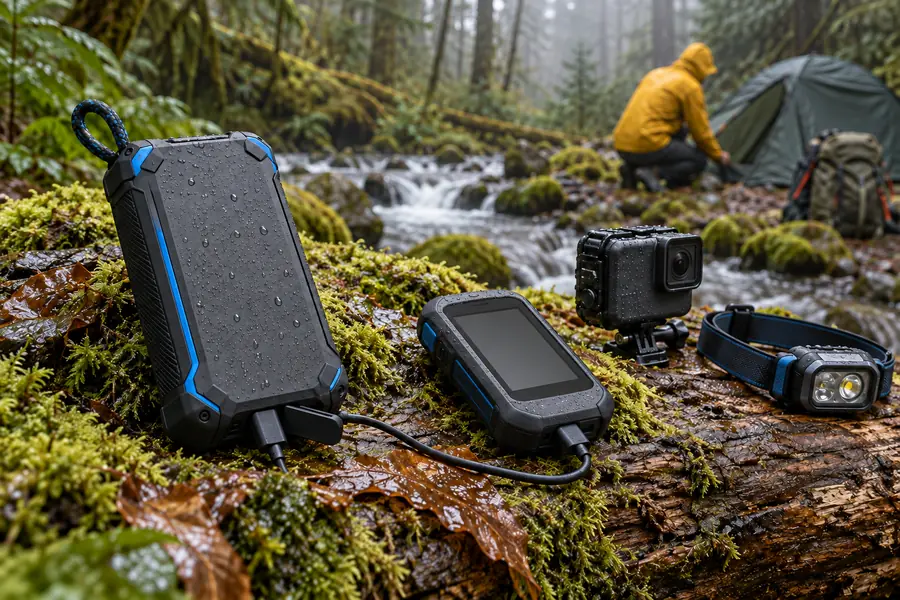
](https://voltcrave-battery.com/wp-content/uploads/2026/10/Which-Power-Bank-Is-Best-for-Outdoor-Use-in-2026.webp)
Outdoor activities often take people far from electrical outlets. A dead smartphone, GPS device, or camera can interrupt an adventure and create problems when reliable communication is needed.
The Nitecore NB10000 Gen4 is one of the best power banks for outdoor use in 2026, especially for hiking and backpacking. It combines a 10,000mAh battery, 143g lightweight design, and IPX7 water resistance. For rugged camping, the NESTOUT 15000 offers stronger dust protection, while larger INIU and UGREEN models provide more energy for extended trips.
I believe the best outdoor power bank should balance battery capacity, portability, durability, and charging performance. A lightweight charger is ideal for hiking, while camping and outdoor work may require greater capacity or higher power output. Understanding these differences helps buyers select portable charging equipment that matches real outdoor conditions.
Which Power Banks Are Best for Hiking, Camping, and Outdoor Travel?
Different outdoor activities require different portable charging solutions. A lightweight power bank works well for hiking, while camping, fishing, and outdoor photography may demand higher battery capacity or stronger weather protection.
The Nitecore NB10000 Gen4 is a strong overall choice for hiking and backpacking in 2026. The NESTOUT 15000 is better suited to rugged outdoor conditions, the INIU P512 20000 provides additional capacity for longer trips, and the UGREEN 145W 25000mAh supports higher-power devices such as compatible laptops.
Best Outdoor Power Banks Compared
I compare popular outdoor power banks according to battery capacity, environmental protection, and their most suitable applications.
| Power Bank | Capacity | Main Advantage | Best Application |
|---|---|---|---|
| Nitecore NB10000 Gen4 | 10,000mAh | 143g, IPX7, 22.5W | Hiking and lightweight backpacking |
| NESTOUT 15000 | 15,000mAh | IP67, shock-resistant design | Rugged camping and outdoor travel |
| INIU P512 20000 | 20,000mAh | Larger energy reserve | Multi-day camping |
| UGREEN 145W | 25,000mAh | 140W single-port USB-C output | Outdoor laptop charging |
| Goal Zero Venture 75 | 19,200mAh | IP67, 60W USB-C, integrated flashlight | Camping and outdoor emergency equipment |
These specifications refer to particular product models. Available capacity, charging speeds, and environmental protection should be checked against the exact version being purchased.
Nitecore NB10000 Gen4: Best for Lightweight Hiking
I consider the Nitecore NB10000 Gen4 an excellent option when carrying weight is a major concern.
It provides 39Wh of battery energy in a compact housing weighing approximately 143g.
The product supports up to 22.5W USB-C charging and features an IPX7 water-resistance rating.
Its compact design allows it to fit into a backpack pocket or small electronics pouch.
CleverHiker selected the NB10000 Gen4 as its best overall backpacking power bank in its July 2026 comparison.
The independent testing highlighted the product's strong usable-energy-to-weight performance.
However, its limited capacity makes it less suitable for charging multiple large devices over several days.
The model also has no published dust-protection rating, which I would consider when traveling in sandy or dusty environments.
NESTOUT 15000: Best for Rugged Outdoor Conditions
For demanding camping environments, I would evaluate the NESTOUT 15000.
It combines a 15,000mAh battery with an IP67-rated enclosure and shock-resistant construction.
Its design includes a hard outer shell, internal cushioning, and protective charging-port covers.
These features make it useful for camping, hiking, fishing, and overlanding.
The product weighs approximately 365g, making it noticeably heavier than the Nitecore NB10000 Gen4.
I would accept that additional weight when dust protection and physical durability matter more than minimizing backpack weight.
CleverHiker identified the NESTOUT 15000 as its best durable power bank in 2026.
INIU P512 20000: Best for Multi-Day Camping
The INIU P512 20000 offers a larger battery reserve for users who spend several days away from electrical outlets.
I would consider this capacity when charging smartphones, headlamps, portable speakers, and other small USB-powered equipment.
Independent testing by CleverHiker selected the INIU P512 as its preferred 20,000mAh backpacking power bank.
However, I would not assume it provides the same environmental protection as a dedicated IP-rated outdoor battery.
For camping in wet conditions, I would store it in a suitable protective pouch or waterproof bag.
UGREEN 145W: Best for Outdoor Laptop Charging
Outdoor professionals sometimes need to charge laptops, tablets, cameras, or other higher-power equipment.
The UGREEN 145W 25,000mAh power bank offers approximately 90Wh of battery energy.
Its primary USB-C port supports up to 140W output with compatible devices and charging cables.
I would consider it for photographers, remote workers, and mobile content creators.
However, the product does not have a published waterproof IP rating.
I would protect it from rain and dust rather than use it as an exposed rugged power bank.
How Much Power Bank Capacity Do You Need for Outdoor Use?
Battery capacity directly affects how long outdoor electronics can operate without recharging. However, larger batteries also increase weight, size, and sometimes charging time.
A 10,000mAh power bank is usually suitable for day hikes and short camping trips. A 20,000mAh battery provides more energy for multi-day travel, while 25,000mAh models are useful for charging multiple devices or compatible laptops. The ideal capacity depends on daily energy consumption, trip length, and available charging options.
Understanding mAh and Wh
Power bank capacity is usually advertised in milliamp-hours (mAh).
However, I prefer comparing battery energy in watt-hours (Wh), especially when reviewing models with different cell configurations.
Milliamp-hours measure electrical charge.
Watt-hours measure stored electrical energy.
The basic formula is:
Battery Energy (Wh) = Battery Capacity (Ah) × Nominal Voltage (V)
For example, a 10,000mAh battery operating at a nominal 3.7V has approximately 37Wh of stored energy.
A 20,000mAh battery using the same nominal voltage has approximately 74Wh.
These values represent battery energy before conversion losses.
The usable energy delivered through USB ports is lower because voltage conversion and device charging consume some electricity.
How Many Times Can a Power Bank Charge a Smartphone?
The number of phone charges depends on battery capacity, conversion efficiency, and the energy required by the smartphone.
The following examples assume a 3.7V nominal battery, an illustrative 75% overall energy-delivery factor, and a smartphone battery storing 15Wh.
| Power Bank Capacity | Approximate Stored Energy | Estimated Full Phone Charges |
|---|---|---|
| 5,000mAh | 18.5Wh | 0.9 |
| 10,000mAh | 37Wh | 1.9 |
| 15,000mAh | 55.5Wh | 2.8 |
| 20,000mAh | 74Wh | 3.7 |
| 25,000mAh | 92.5Wh | 4.6 |
These are illustrative calculations rather than guaranteed charging results.
Actual performance depends on the power bank's design, the smartphone battery, charging efficiency, and environmental conditions.
I would also remember that a phone running navigation applications, GPS tracking, or video recording continues consuming energy while connected to a power bank.
Recommended Capacity for Different Outdoor Activities
Day Hiking
I would normally consider a 5,000–10,000mAh power bank for short trips where the main requirements are phone charging and emergency backup.
Weekend Camping
A 10,000–20,000mAh battery offers more flexibility for smartphones, lighting, and other small electronic devices.
Multi-Day Backpacking
I would consider a 20,000mAh model when recharging opportunities are limited.
However, I would also evaluate weight carefully because carrying extra battery capacity may not be necessary for every trip.
Outdoor Photography
Photographers should calculate the combined energy requirements of cameras, smartphones, lighting accessories, and other equipment.
Outdoor Laptop Work
A power bank with sufficient USB-C Power Delivery output may be necessary for charging laptops.
I would verify both the output wattage and the device's supported charging protocol.
What Features Should a Reliable Outdoor Power Bank Have?
Outdoor power banks face operating conditions that are different from indoor charging environments. Rain, dust, temperature changes, and physical impacts can affect battery performance and product reliability.
A reliable outdoor power bank should offer suitable water and dust protection, durable construction, stable battery performance, and effective electrical safety features. USB-C fast charging, reasonable weight, temperature protection, and verified testing are also important when selecting equipment for camping, hiking, and outdoor travel.
Waterproof and Dustproof Protection
I consider ingress protection one of the most important characteristics of a rugged outdoor power bank.
IP ratings describe defined levels of protection against solid objects and water.
| IP Rating | General Protection |
|---|---|
| IPX4 | Protection against splashing water |
| IPX5 | Protection against water jets |
| IPX7 | Protection against temporary immersion |
| IP65 | Dust-tight and protected against water jets |
| IP67 | Dust-tight and protected against temporary immersion |
The letter X means that no protection rating is specified for that category.
For example, an IPX7 power bank has a defined water-ingress rating, but it does not automatically have a certified dust-protection rating.
I would prefer a model with an appropriate published IP rating when outdoor conditions include frequent rain, dust, or accidental water exposure.
I would also follow the manufacturer's instructions about charging-port covers.
Water resistance should not be interpreted as permission to charge a wet device or connect cables underwater.
Durable Construction and Impact Resistance
Outdoor equipment can experience accidental drops, vibration, and rough handling.
A durable power bank may use reinforced housing materials, internal cushioning, or protective covers.
However, I would not judge durability only by appearance.
A thick rubber case does not automatically mean the product has passed independent drop testing.
I would look for documented testing conditions and realistic product specifications.
Battery Safety and Temperature Performance
Power banks normally use rechargeable lithium-ion batteries.
The battery cells, charging circuit, and protection electronics must work together to maintain safe operating conditions.
Important protection functions include overcharge protection, over-discharge protection, overcurrent protection, short-circuit protection, and temperature monitoring.
I would also review the permitted operating temperature range.
Lithium-ion battery performance can decline in cold weather.
For example, CleverHiker observed an approximately 13% reduction in energy efficiency for the Nitecore NB10000 Gen4 in its cold-temperature testing.
This does not mean the product cannot be used during winter hiking, but it shows why temperature should be considered.
I would keep batteries protected from extreme cold and heat while following the manufacturer's operating instructions.
I would not recharge a lithium-ion battery below its permitted charging temperature.
USB-C Fast Charging and Compatibility
Many modern power banks support USB-C Power Delivery.
This technology allows compatible devices to negotiate charging voltage and current.
For outdoor use, I would examine the maximum output of each port.
A power bank with 22.5W output may be suitable for smartphones but cannot replace a 65W laptop charger in every situation.
I would also check whether multiple connected devices share the available power.
Manufacturers sometimes advertise a high combined charging wattage, but individual USB ports may have lower limits.
For users carrying several devices, port arrangement and charging compatibility can matter as much as total battery capacity.
Is a Solar Power Bank Better for Camping and Outdoor Adventures?
Solar charging offers an additional way to obtain electricity when conventional outlets are unavailable. However, not every solar power bank generates enough energy to support extended outdoor use.
A solar power bank can provide supplemental charging during camping, but a conventional power bank paired with a separate foldable solar panel is often more effective. Small integrated solar panels typically generate limited electricity. Larger portable solar panels offer better charging potential when sunlight, panel positioning, and device compatibility are favorable.
How Do Solar Power Banks Work?
A solar power bank combines a rechargeable battery with a photovoltaic charging source.
Sunlight reaches the solar cells, which generate electrical energy.
A charging circuit regulates that energy before supplying it to the battery.
The battery then stores electricity for later use.
I consider solar charging useful for camping, hiking, and off-grid travel, especially when a trip lasts several days.
However, charging performance depends on solar panel area and environmental conditions.
Why Are Small Integrated Solar Panels Often Slow?
Compact power banks provide limited surface area for solar cells.
This restricts the amount of sunlight the device can collect.
During its August 2026 testing, OutdoorGearLab found that integrated solar battery packs generally performed much worse at solar energy collection than larger standalone charging panels.
I would therefore avoid relying on a small integrated panel as the primary charging source for an extended trip.
It may help provide supplemental energy, but it may not generate enough electricity to replace daily smartphone consumption.
Solar Power Bank vs. Separate Solar Charger
| Feature | Integrated Solar Power Bank | Separate Solar Panel + Power Bank |
|---|---|---|
| Portability | Convenient single device | Requires two components |
| Solar collection area | Usually small | Can be substantially larger |
| Charging speed | Often limited | Higher potential output |
| Positioning flexibility | Limited | Easier to position toward sunlight |
| Best use | Supplemental charging | Extended off-grid charging |
| Battery temperature | Can heat during sun exposure | Battery can be kept separately in shade |
I generally prefer a separate solar panel when regular off-grid recharging is important.
Keeping the battery in a shaded, ventilated location while positioning the solar panel in sunlight can also help manage battery temperature.
However, I would verify that the solar charger's voltage, current, and charging interface are compatible with the power bank.
When Should I Choose a Portable Power Station Instead?
A conventional USB power bank is designed mainly for smartphones, tablets, cameras, headlamps, and compatible laptops.
A portable power station normally provides larger energy capacity and may include AC outlets.
I would consider a portable power station for equipment such as camping refrigerators, portable workstations, or higher-power appliances.
However, portable power stations are usually much heavier than standard power banks.
For lightweight hiking and backpacking, I would generally select a compact USB power bank.
For vehicle camping or outdoor work, I would compare portable power stations according to battery capacity, inverter power, and charging options.
My Insights: Which Power Bank Is Best for Outdoor Use
I believe the best outdoor power bank depends on three priorities: the amount of energy required, the conditions in which the device will operate, and how much weight the user is willing to carry.
A well-designed outdoor charger should deliver dependable usable energy rather than simply advertise the highest battery capacity.
My Preferred Choice for Most Hikers
I would select the Nitecore NB10000 Gen4 as my leading choice for hiking and lightweight backpacking.
Its compact construction, low weight, and IPX7 water resistance make it practical for many outdoor trips.
I also value independent energy-efficiency testing because it helps explain how much useful electricity a power bank delivers relative to its weight.
However, I would not choose the NB10000 Gen4 for every situation.
Its capacity is limited compared with larger models, and it lacks a published dust-protection rating.
My Choice for Demanding Outdoor Environments
For camping, fishing, and outdoor activities involving dust or rough handling, I would consider the NESTOUT 15000.
Its IP67 rating provides an additional layer of environmental protection.
Its protective housing is also designed for rugged outdoor conditions.
The trade-off is weight.
I consider that trade-off reasonable when weather protection matters more than ultralight backpacking.
Battery Capacity Should Match Trip Duration
I would avoid choosing a large-capacity power bank without calculating the actual energy required.
For example, a hiker carrying only a smartphone may not need 25,000mAh.
A photographer operating multiple rechargeable devices may require much more energy.
I would estimate the daily charging requirements and include a reasonable reserve for unexpected delays or adverse weather.
Usable energy, rather than advertised milliamp-hours alone, is the more useful comparison.
Safety and Reliability Matter More Than Extra Features
I also place importance on battery quality and protection systems.
An outdoor power bank should provide stable charging, clear electrical specifications, and suitable temperature protection.
A product with a flashlight or digital display may offer additional convenience, but these features do not replace reliable battery engineering.
For business buyers, I would verify manufacturing quality, product traceability, relevant test reports, and international transport documentation.
For travelers, I would also check airline restrictions before carrying a large-capacity power bank.
My Recommendations by Application
| Outdoor Application | My Preferred Option | Main Reason |
|---|---|---|
| Day hiking | Nitecore NB10000 Gen4 | Lightweight and compact |
| Rugged camping | NESTOUT 15000 | IP67 environmental protection |
| Multi-day camping | INIU P512 20000 | Larger battery capacity |
| Outdoor laptop charging | UGREEN 145W | High USB-C power output |
| Wet-weather camping | Goal Zero Venture 75 | IP67 rating and practical outdoor features |
I would use these models as a starting point for comparison rather than treat the list as a universal ranking.
Conclusion
The best outdoor power bank balances capacity, portability, charging performance, and durability. Nitecore suits lightweight hiking, while NESTOUT, INIU, and UGREEN serve different outdoor power needs.
](https://voltcrave-battery.com/wp-content/uploads/2026/08/What-Is-the-Best-Power-Station-for-Outdoor-Use-768x512.webp)
](https://voltcrave-battery.com/wp-content/uploads/2026/09/How-Much-Does-a-Power-Battery-Cost-768x512.webp)
](https://voltcrave-battery.com/wp-content/uploads/2026/08/What-Are-Power-Walls-768x512.webp)







































