
](https://voltcrave-battery.com/wp-content/uploads/2026/10/What-Is-the-Best-Power-Bank-for-Outdoor-Use-in-2026.webp)
Outdoor adventures often take people far from electrical outlets. A dead phone, camera, or GPS device can interrupt a trip or create safety problems when communication is needed.
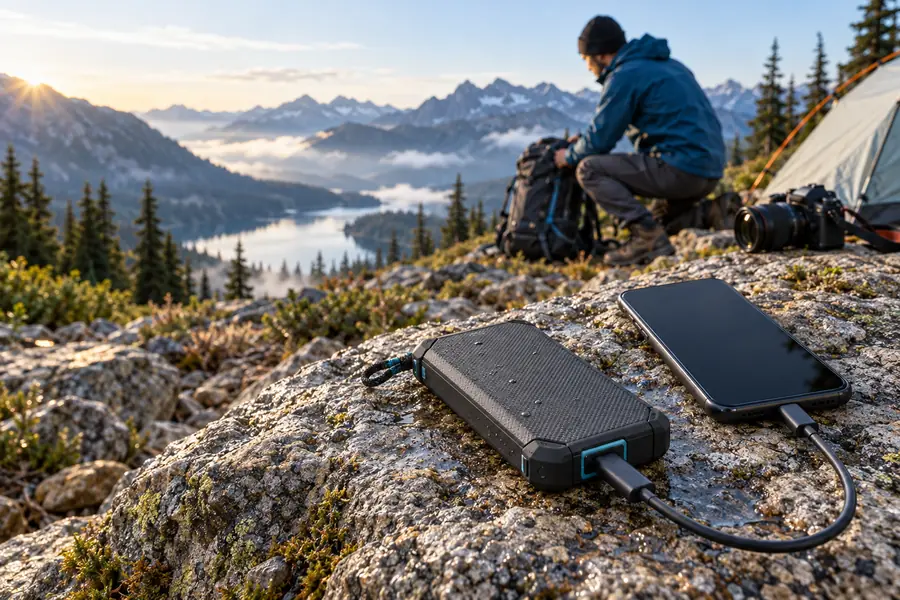
The Nitecore NB10000 Gen4 is one of the best power banks for outdoor use in 2026, especially for hiking and backpacking. It offers 10,000mAh capacity, weighs approximately 143g, and provides IPX7 water resistance. The Goal Zero Venture 75 is better for rugged camping, while larger INIU and UGREEN models suit longer trips or higher-power devices.
I believe choosing an outdoor power bank requires a different approach from buying a regular portable charger. Battery capacity matters, but weight, waterproof protection, charging efficiency, and temperature performance can be equally important. The best option should provide enough usable energy for the trip without adding unnecessary weight or creating reliability problems.
Which Power Bank Is Best for Camping, Hiking, and Backpacking?
Outdoor activities place different demands on portable batteries. A lightweight power bank may be ideal for a long hike, while a camping trip with several electronic devices may require more battery capacity.
The Nitecore NB10000 Gen4 is an excellent choice for lightweight hiking and backpacking. The Goal Zero Venture 75 offers stronger dust and water protection for rugged camping. The INIU P512 20000 provides affordable extended capacity, while the UGREEN 145W 25000mAh is better suited to outdoor laptop charging.
Best Outdoor Power Banks Compared
I compare these products by their main outdoor advantages rather than ranking them by battery capacity alone.
| Power Bank | Capacity | Key Feature | Best Outdoor Application |
|---|---|---|---|
| Nitecore NB10000 Gen4 | 10,000mAh | 143g, IPX7, 22.5W | Hiking and ultralight backpacking |
| Nitecore NB Plus | 10,000mAh | 155g, IPX7 | Hiking and wet-weather travel |
| Goal Zero Venture 75 | 19,200mAh | IP67, 60W USB-C | Rugged camping and outdoor travel |
| INIU P512 20000 | 20,000mAh | Large capacity, competitive weight | Multi-day backpacking |
| UGREEN 145W Power Bank | 25,000mAh | 90Wh, up to 140W single-port output | Outdoor work and laptop charging |
The table uses manufacturer specifications and independent product evaluations. Some products do not have a published ingress-protection rating, so I would not assume they are waterproof.
Nitecore NB10000 Gen4: Best for Lightweight Backpacking
I consider the Nitecore NB10000 Gen4 one of the strongest options for hikers who prioritize low weight.
Its 10,000mAh battery provides 39Wh of stored energy in a compact body weighing approximately 143g.
The power bank supports up to 22.5W USB-C charging and features an IPX7 water-resistance rating.
It also includes a lanyard charging cable and an illuminated port design that can be useful in low-light environments.
CleverHiker selected the NB10000 Gen4 as its best overall backpacking power bank in July 2026.
Its field testing highlighted the model's energy efficiency relative to weight.
However, I would not assume that lightweight construction makes the product suitable for every environment. The NB10000 Gen4 has no published dust-protection rating, and independent testing found reduced efficiency in cold conditions.
Goal Zero Venture 75: Best for Rugged Camping
For outdoor users who prioritize weather protection, I would evaluate the Goal Zero Venture 75.
It offers a 19,200mAh battery with approximately 71Wh of stored energy.
Its IP67 enclosure rating provides dust-tight protection and water-ingress resistance under specified test conditions when the protective port cover is properly closed.
The power bank also supports 60W USB-C Power Delivery and includes a built-in flashlight.
I consider these features useful for camping, outdoor photography, and emergency travel equipment.
However, its approximately 577g weight makes it much heavier than the Nitecore NB10000 Gen4.
I would choose it for rugged outdoor applications rather than ultralight backpacking.
INIU P512 20000: Best for Extended Battery Capacity
The INIU P512 20000 is worth considering when a longer trip requires additional stored energy.
Its 20,000mAh capacity can support multiple smartphone charging sessions, depending on device battery size and conversion efficiency.
CleverHiker selected it as its best 20,000mAh backpacking power bank in its 2026 comparison.
The testing also highlighted its competitive energy efficiency and useful battery display.
I would consider this model for weekend camping, multi-day hiking, and travelers carrying several USB-powered devices.
However, its larger size and reduced performance in cold conditions should be considered before taking it into demanding environments.
UGREEN 145W: Best for Outdoor Laptop Charging
Some outdoor users need more than smartphone charging.
Photographers, drone operators, remote workers, and mobile content creators may need to charge laptops or higher-power electronics.
The UGREEN 145W 25,000mAh power bank offers approximately 90Wh of battery energy and supports up to 140W from its primary USB-C port.
I would consider it when charging performance matters more than minimizing weight.
However, I would protect it from rain, dust, and direct environmental exposure because the manufacturer does not specify a waterproof IP rating for this model.
How Much Battery Capacity Do You Need for Outdoor Activities?
Outdoor battery capacity depends on trip duration, device consumption, and access to charging facilities. A larger power bank can store more electricity, but it also increases the weight carried during travel.
A 10,000mAh power bank is often sufficient for day hikes and short overnight trips. A 20,000mAh model is generally more suitable for multi-day camping or charging several devices. Higher-capacity power banks may be useful for laptops, cameras, and extended off-grid travel, provided their output ratings match the equipment.
What Is the Difference Between mAh and Wh?
Power bank manufacturers commonly advertise capacity in milliamp-hours.
However, I prefer using watt-hours when comparing batteries with different configurations.
Milliamp-hours measure electric charge, while watt-hours measure stored electrical energy.
The relationship is:
Battery Energy (Wh) = Battery Capacity (Ah) × Nominal Voltage (V)
For example, a 10,000mAh battery operating at a nominal cell voltage of 3.7V stores approximately 37Wh.
A 20,000mAh battery using the same nominal voltage stores approximately 74Wh.
These numbers describe stored battery energy, not the amount guaranteed to reach a connected device.
Charging circuits and voltage conversion consume some electricity.
How Many Times Can an Outdoor Power Bank Charge a Phone?
The number of smartphone charges depends on the phone's battery capacity, charging efficiency, and the power bank's usable energy.
The following examples assume a nominal 3.7V power bank configuration, an illustrative 75% overall energy-delivery factor, and a smartphone battery storing approximately 15Wh.
| Power Bank Capacity | Approximate Stored Energy | Illustrative Full Phone Charges |
|---|---|---|
| 5,000mAh | 18.5Wh | 0.9 |
| 10,000mAh | 37Wh | 1.9 |
| 15,000mAh | 55.5Wh | 2.8 |
| 20,000mAh | 74Wh | 3.7 |
| 25,000mAh | 92.5Wh | 4.6 |
These are calculation examples rather than guaranteed charging results.
Actual performance varies by the power bank's cell voltage, output efficiency, charging method, device battery capacity, and operating temperature.
I would also remember that smartphones use electricity while charging.
Navigation applications, camera recording, cellular communication, and high screen brightness can reduce the number of complete charges available during a trip.
How Much Capacity Is Best for Each Outdoor Activity?
I would organize battery capacity requirements around the expected trip.
Day Hiking
A 5,000–10,000mAh power bank may be sufficient for a smartphone, GPS watch, or headlamp.
Weekend Camping
A 10,000–20,000mAh power bank offers greater flexibility when several devices require charging.
Multi-Day Backpacking
A 20,000mAh battery may be useful when electrical outlets are unavailable for several days.
However, hikers who prioritize low pack weight may prefer a smaller battery combined with strict energy management.
Outdoor Photography
Photographers should calculate the charging needs of cameras, smartphones, drones, and other equipment.
Some camera batteries can charge through USB-C, while others require a separate charger.
Outdoor Laptop Work
A power bank with 65W or higher USB-C output may be necessary for some laptops.
I would verify the device's charging specifications before buying a high-output model.
What Features Make a Power Bank Reliable for Outdoor Use?
Outdoor electronics face challenges that do not normally occur during indoor charging. Rain, dust, temperature changes, and accidental impacts can affect reliability and battery performance.
A reliable outdoor power bank should provide suitable water and dust protection, a durable enclosure, dependable battery cells, efficient charging, and adequate electrical protection. Buyers should also evaluate weight, USB-C output, operating temperature limits, charging-port protection, and product testing before choosing a model for outdoor use.
Is a Waterproof Power Bank Better for Camping?
Water protection can be especially valuable during hiking, boating, fishing, and camping.
However, I would distinguish between water resistance and complete waterproofing.
An IP rating consists of two protection categories.
The first digit describes protection against solid objects and dust.
The second digit describes protection against water ingress.
The letter X means that a protection rating has not been specified for that category.
| IP Rating | Protection Meaning |
|---|---|
| IPX4 | Protection against splashing water |
| IPX5 | Protection against water jets |
| IPX7 | Protection against temporary immersion under specified conditions |
| IP65 | Dust-tight and protected against water jets |
| IP67 | Dust-tight and protected against temporary immersion |
I would not assume that an IPX7 product is officially dustproof.
For example, the Nitecore NB10000 Gen4 carries an IPX7 rating.
The Goal Zero Venture 75 carries an IP67 rating.
These products have different published levels of environmental protection.
I would also check whether the rating applies only when protective charging-port covers are closed.
Does Cold Weather Reduce Power Bank Performance?
Yes.
Lithium-ion batteries can deliver less usable energy in low-temperature conditions.
Cold temperatures increase internal resistance and can reduce available power.
I consider this especially important for winter camping, mountain hiking, and outdoor expeditions.
A power bank that performs well at room temperature may provide less usable energy in freezing conditions.
The 2026 CleverHiker testing found that some power banks experienced measurable efficiency losses under cold test conditions.
I would store a power bank inside an insulated pouch or protected pocket when practical, while following the manufacturer's temperature limits.
I would also avoid charging lithium-ion batteries below their permitted charging temperature.
Many conventional lithium-ion products restrict charging below approximately 0°C unless specific low-temperature charging protection or heating is provided.
Why Do Battery Cells and Protection Circuits Matter?
The battery cell is the main energy storage component.
However, cell chemistry alone does not determine product safety.
A power bank also requires charging control, protection circuits, and suitable thermal design.
Important protection functions include overcharge protection, over-discharge protection, overcurrent protection, short-circuit protection, and temperature monitoring.
I would verify product-level testing rather than assume every power bank contains the same protective features.
For B2B sourcing, I would also evaluate battery cell traceability and production quality control.
Reliable outdoor products need consistent performance across production batches, not only attractive specifications.
Should I Choose LiFePO4 or Conventional Lithium-Ion?
I generally prefer evaluating the complete product rather than selecting an outdoor power bank based on chemistry alone.
Many lightweight power banks use conventional lithium-ion chemistries because energy density is important for portability.
LiFePO4 batteries offer strong thermal stability and long cycle-life potential, but they generally have lower gravimetric energy density than many nickel-rich lithium-ion chemistries.
This means an LFP battery may be heavier for a given amount of stored energy.
I would consider LiFePO4 when long-term cycling and stationary use are priorities.
For lightweight hiking, I would prioritize verified usable energy, safe operation, waterproof protection, and energy-to-weight performance.
Are Solar Power Banks Better Than Regular Power Banks for Camping?
Solar charging can help outdoor users recharge electronic devices away from electrical outlets. However, solar power bank performance depends on panel size, sunlight intensity, and charging efficiency.
A solar power bank can be useful for extended camping, but a conventional power bank paired with a larger portable solar panel is often more practical. Small solar panels built into power banks usually produce limited charging power. For longer trips, a separate foldable solar charger offers greater flexibility when sufficient sunlight is available.
How Does a Solar Power Bank Work?
A solar power bank stores electrical energy in a rechargeable battery.
When exposed to sunlight, an integrated or external solar panel generates DC electricity.
A charging circuit regulates that electricity before supplying it to the battery.
The stored energy can later charge smartphones and other USB-powered devices.
I consider this useful when traveling without reliable access to grid electricity.
However, not every power bank with a small solar panel can recharge quickly enough to replace daily energy consumption.
Why Are Small Built-In Solar Panels Often Limited?
Solar energy production depends heavily on the surface area of the solar cells.
A compact power bank has limited space for solar panels.
As a result, small integrated panels may generate only a small amount of electricity, especially when conditions are cloudy or the panel is not positioned toward the sun.
I would not rely on a small built-in solar panel as the only charging source for a long outdoor trip.
A separate foldable solar charger can provide a larger collection area.
OutdoorGearLab's August 2026 evaluation of portable solar chargers found substantial differences in panel output and practical charging performance.
I would evaluate the charger's actual output, portability, USB compatibility, and field performance rather than relying only on its advertised wattage.
Portable Solar Panel vs. Integrated Solar Power Bank
| Feature | Integrated Solar Power Bank | Power Bank With External Solar Panel |
|---|---|---|
| Solar collection area | Usually small | Can be much larger |
| Charging speed | Often slow | Potentially faster |
| Portability | Convenient single device | Requires separate equipment |
| Outdoor flexibility | Limited orientation options | More flexible panel placement |
| Best application | Supplemental charging | Longer off-grid trips |
| Cloudy weather | Limited output | Also reduced output |
I would select a separate solar panel when the goal is to replace significant daily battery consumption.
However, a solar charging setup should still include enough battery reserve for cloudy weather or unexpected charging interruptions.
When Do You Need a Portable Power Station Instead?
A power bank and a portable power station serve different purposes.
A conventional power bank usually provides USB charging for phones, tablets, cameras, and compatible laptops.
A portable power station typically includes a much larger battery and may provide AC outlets, higher output power, and more charging options.
I would choose a power station when an outdoor application requires electrical equipment such as a portable refrigerator, cooking appliance, or higher-power workstation.
However, larger power stations are heavier and less convenient for hiking.
For backpacking, a properly selected USB power bank is usually the more practical solution.
My Insights: What Is the Best Power Bank for Outdoor Use
I believe the best outdoor power bank is the one that balances usable battery energy, weight, environmental protection, and charging compatibility for the intended activity.
I would not automatically choose the model with the highest advertised capacity.
My Overall Choice for Outdoor Hiking
For lightweight hiking and backpacking, I would place the Nitecore NB10000 Gen4 near the top of my list.
Its approximately 143g weight and 39Wh battery energy offer a useful combination of portability and stored electricity.
The IPX7 rating provides additional water-ingress protection compared with power banks that have no declared rating.
Independent testing also supports its strong energy efficiency relative to weight.
However, its limited capacity and cold-weather performance mean it is not the best solution for every trip.
My Choice for Rugged Camping
For camping environments with rain, dust, and rough handling, I would evaluate the Goal Zero Venture 75.
Its IP67 rating, protective construction, and 60W USB-C output provide useful features for outdoor travel.
The main drawback is its weight.
I would choose this type of power bank when environmental protection matters more than minimizing backpack weight.
More Capacity Is Not Always Better
I believe outdoor users should calculate their energy needs before purchasing a large-capacity battery.
A person carrying one smartphone and a rechargeable headlamp may not need a 25,000mAh power bank.
A photographer carrying several devices may require substantially more energy.
I would estimate the total daily energy requirement and include an appropriate reserve.
I would also compare the real amount of usable energy delivered by each product.
Advertised battery capacity alone does not account for conversion losses, temperature effects, or charging behavior.
Safety and Product Reliability Deserve More Attention
I consider battery safety particularly important for outdoor activities.
A defective battery is inconvenient anywhere, but it can create a more serious problem when the user is far from help.
I would select products with suitable electrical protection, clear operating temperature limits, and reliable manufacturing quality.
For suppliers and distributors, I would also request applicable safety test reports, transport documentation, and product traceability records.
International travelers should check airline power bank requirements.
IATA's 2026 guidance limits passengers to a maximum of two qualifying power banks, with each generally limited to 100Wh. Power banks must be carried in cabin baggage, and airline-specific restrictions should also be checked.
Match the Battery to the Outdoor Application
My recommendations depend on the activity.
For lightweight hiking, I would prioritize the Nitecore NB10000 Gen4.
For wet-weather and rugged camping, I would consider the Goal Zero Venture 75.
For longer trips requiring more stored energy, I would compare 20,000mAh models such as the INIU P512.
For outdoor laptop charging, I would evaluate a high-output model such as the UGREEN 145W 25,000mAh power bank.
For equipment requiring AC electricity, I would move beyond conventional power banks and consider a suitably sized portable power station.
Conclusion
The best outdoor power bank balances capacity, weight, weather protection, and charging performance. Nitecore, Goal Zero, INIU, and UGREEN offer strong options for different outdoor activities.
](https://voltcrave-battery.com/wp-content/uploads/2026/08/How-to-Choose-a-High-Voltage-Battery-for-Home-Energy-Storage-768x512.webp)
](https://voltcrave-battery.com/wp-content/uploads/2026/09/How-to-Choose-a-Complete-Solar-Energy-System-for-Home-and-Business-768x512.webp)







































