

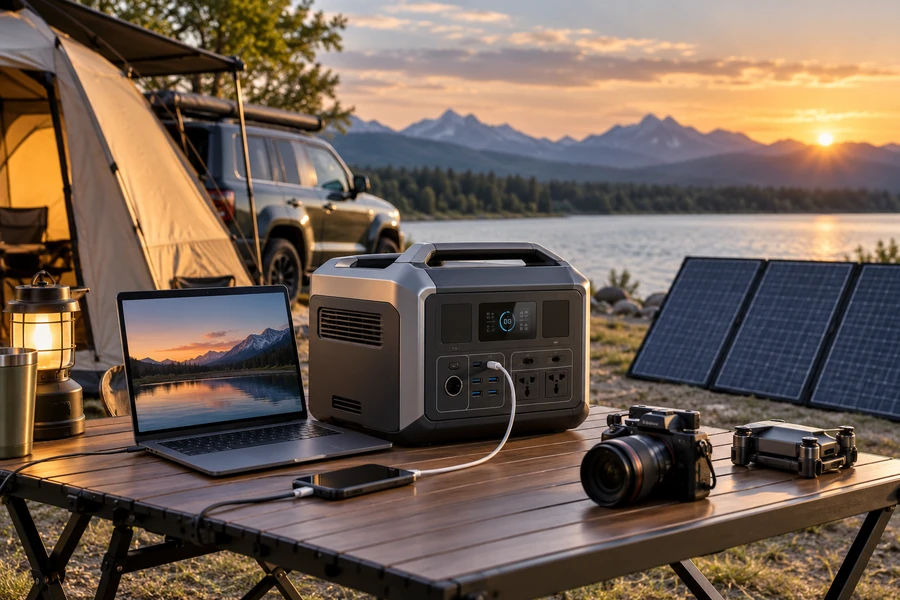
](https://voltcrave-battery.com/wp-content/uploads/2026/09/Portable-Power-Station-Lithium-Ion-Battery-Storage-Containers-for-Reliable-Energy-On-the-Go.webp)
Grid power is not always available where energy is needed. Camping, remote work, emergencies, and mobile equipment all create the same problem: electricity must travel with us.
A portable power station is a rechargeable battery-based power system that stores electrical energy and delivers it through AC, USB, and DC outputs. Most modern units combine lithium-ion battery storage, a battery management system, inverter, charging electronics, controls, and protective components inside one portable enclosure for reliable off-grid or backup electricity.
I think of a portable power station as a small, movable energy-storage system. Instead of installing separate batteries, an inverter, charger, BMS, outlets, and controls, these components are integrated into a single enclosure that can be transported to where power is needed.
What Is a Portable Power Station?
A portable power station bridges the gap between a small power bank and a larger stationary battery-storage system.
A portable power station stores electricity in an internal rechargeable battery and supplies that energy to external devices when grid power is unavailable or inconvenient. Depending on its design, it may provide AC receptacles, USB ports, USB-C power delivery, DC outputs, vehicle-style sockets, solar charging, and other functions in one integrated portable enclosure.
UL describes portable power packs as battery-containing devices intended to provide portable power when normal grid electricity is unavailable, including camping and emergency situations. Their outputs can include receptacles, USB connections, DC jacks, induction power transmitters, and vehicle sockets.
A simplified architecture looks like:
Charging Source → Battery → Inverter / DC Conversion → Devices
The charging source could be:
Grid AC
Solar panels
Vehicle charging
or another compatible DC source.
Energy is stored electrochemically inside the battery. DOE explains that rechargeable batteries accept electrical energy, store it through chemical processes, and release electricity when connected to an external circuit.
The complete portable station usually adds the electronics necessary to make that stored energy useful.
That integration is what makes the product different from simply buying a lithium battery.
What Is Inside a Portable Power Station?
The enclosure may look simple from the outside, but internally it contains a complete DC and AC power architecture.
A typical portable power station contains rechargeable lithium battery cells, battery modules or packs, a BMS, AC inverter, DC/DC converters, charging electronics, thermal-management components, electrical protection, monitoring controls, communications, and multiple output interfaces. Together, these components store, protect, convert, and distribute electrical energy.
A simplified internal energy path is:
Battery Cells → Battery Pack → BMS → Power Electronics → AC/DC Outputs
The battery stores energy.
The BMS monitors and protects it.
The inverter converts battery DC into AC electricity.
DC/DC electronics provide appropriate voltage for USB and other DC outputs.
Charging electronics manage incoming electricity.
Thermal systems help control operating temperature.
Protection components respond to abnormal electrical conditions.
The enclosure brings everything together into one transportable product.
This integration is important because battery storage is more than the cells themselves. In larger ESS applications, DOE procurement guidance similarly treats lithium-ion storage as a complete system rather than merely a collection of cells.
For portable products, the engineering objective is different: the system must deliver useful energy while remaining sufficiently compact and manageable to move.
Why Are Lithium-Ion Batteries Used in Portable Power Stations?
Portable energy storage needs a strong balance between energy capacity, weight, rechargeability, and cycle performance.
Lithium-ion batteries are well suited to portable power stations because they can store substantial electrical energy in a relatively compact rechargeable package. Modern portable stations commonly use lithium-ion chemistries, with lithium iron phosphate, or LiFePO4, increasingly used where manufacturers prioritize cycling capability, thermal characteristics, and long-term battery use.
The basic challenge is:
more energy usually means more battery material.
For a portable product, that creates tension between:
capacity
and:
weight.
A small station might be easy to carry but unable to support large appliances for long.
A large station may contain several kilowatt-hours of energy but become much heavier.
This is why portable power stations exist across many capacity classes.
Rather than asking only:
“Is it lithium?”
I look at:
battery chemistry,
usable energy,
cycle-life specification,
BMS,
temperature limits,
warranty,
and:
maximum charge/discharge capability.
Lithium-ion is a broad technology family. Battery chemistry alone does not tell me how well the complete portable power station will perform.
What Is the Difference Between LiFePO4 and Other Lithium-Ion Portable Batteries?
Battery chemistry influences energy density, cycling behavior, thermal performance, and product design.
LiFePO4, also called LFP, is a lithium-ion chemistry widely used in modern energy-storage products. For portable power stations, it can be attractive where cycle life and thermal stability are important. Other lithium-ion chemistries may offer different energy-density advantages, so the best chemistry depends on the station's weight, capacity, performance, and lifecycle targets.
A common mistake is treating:
lithium-ion
and:
LiFePO4
as opposites.
LiFePO4 is itself a lithium-ion chemistry.
The better comparison is:
LFP vs. other lithium-ion chemistries.
For a portable station, higher energy density can help reduce:
weight
and:
volume.
But a product designed for frequent cycling may place greater value on:
cycle durability,
thermal behavior,
and:
service life.
This is one reason chemistry selection should be connected to intended use.
A station used twice per year for emergencies has a different operating profile from one charged and discharged almost every day in:
a van,
RV,
mobile office,
or:
off-grid cabin.
I therefore avoid selecting a portable station based on chemistry alone.
The complete battery system matters more.
How Much Power Can a Portable Power Station Provide?
Capacity and output power are different specifications, and confusing them is one of the most common portable-power mistakes.
Portable power station output ranges from small electronic-device loads to several kilowatts in larger models. The inverter's watt rating determines how much AC power can be supplied at one time, while battery watt-hours determine how much energy is stored. A high-watt inverter cannot compensate for insufficient battery capacity.
The distinction is:
W = power
Wh = energy
Suppose a station has:
1000Wh battery capacity
and:
1000W inverter output.
A 100W device theoretically represents:
1000Wh ÷ 100W = 10 hours
before losses and usable-capacity limitations.
A 500W appliance:
1000 ÷ 500 = 2 hours
A 1000W appliance:
1000 ÷ 1000 = 1 hour
Again, these are idealized calculations.
Real runtime is lower because of:
inverter losses,
battery reserve,
temperature,
standby consumption,
and:
other system losses.
This gives me a useful rule:
Watts tell me what I can run.
Watt-hours tell me how long I can run it.
What Appliances Can a Portable Power Station Run?
The answer depends primarily on inverter output, surge capability, and stored energy.
A portable power station can run devices ranging from phones, laptops, cameras, lights, routers, and TVs to refrigerators, microwaves, power tools, CPAP equipment, and some air conditioners when its output and battery capacity are sufficient. High-wattage heating appliances and motor startup surges can require significantly more power.
Consider these example planning loads:
| Device | Example Power |
|---|---|
| Smartphone charging | 5–30W |
| LED light | 5–20W |
| Router | 10–30W |
| Laptop | 40–100W |
| TV | 50–200W |
| Fan | 30–100W |
| Refrigerator | 100–800W running |
| CPAP | Device-dependent |
| Microwave | 1000–1800W input |
| Coffee maker | 800–1500W |
| Power tool | 500–2000W+ |
| Small air conditioner | 500–1500W+ running |
These are illustrative ranges, not specifications for every appliance.
The actual device nameplate should be checked.
Motor-driven equipment also introduces:
startup surge.
A refrigerator may consume relatively little energy after its compressor starts but briefly require substantially more power during startup.
Therefore, both continuous and surge ratings matter.
How Long Will a Portable Power Station Run?
Runtime is determined by stored usable energy divided by average load, with losses taken into account.
Portable power station runtime can range from hours or days for small electronics to less than an hour for high-wattage appliances. A simplified estimate divides usable battery watt-hours by appliance watts and then accounts for conversion losses. Lower-power devices run much longer than heaters, microwaves, kettles, or air conditioners.
A useful simplified formula is:
Runtime ≈ Battery Wh × Usable Fraction × Efficiency ÷ Load Watts
Suppose:
Battery = 2000Wh
Usable fraction = 90%
Conversion efficiency = 90%
Usable AC energy becomes:
2000 × 0.90 × 0.90 = 1620Wh
Approximate runtime:
100W load:
1620 ÷ 100 = 16.2 hours
300W:
1620 ÷ 300 = 5.4 hours
500W:
1620 ÷ 500 = 3.24 hours
1000W:
1620 ÷ 1000 = 1.62 hours
1500W:
1620 ÷ 1500 ≈ 1.08 hours
Actual performance depends on the specific station and load.
Some appliances also cycle rather than operate continuously.
For example, refrigerator runtime should ideally be estimated from average energy consumption rather than maximum compressor wattage.
Can You Charge a Portable Power Station With Solar Panels?
Many modern portable stations support solar charging, making them useful for mobile and off-grid energy systems.
A solar-compatible portable power station can receive DC electricity from photovoltaic panels through its supported solar input. Charging time depends on solar-panel wattage, sunlight, orientation, weather, battery state of charge, input limits, and conversion losses. The station's maximum solar-input voltage, current, and power specifications must match the solar array.
The basic architecture is:
Solar Panels → Charging Controller/Electronics → Battery
Then:
Battery → Inverter → AC Appliance
This creates a small solar-plus-storage system.
Energy storage is valuable because solar generation and electricity consumption do not always occur at the same time. DOE describes energy storage broadly as capturing energy when available and releasing it later when demand rises or supply is limited.
Suppose a station has:
2000Wh
of battery capacity.
A hypothetical:
500W solar input
would suggest:
2000Wh ÷ 500W = 4 hours
under ideal conditions.
Real charging normally takes longer because solar panels rarely produce their nameplate output continuously and conversion losses occur.
Solar charging should therefore be estimated from:
real available solar energy
rather than panel wattage alone.
Can You Use a Portable Power Station for Camping?
Camping is one of the applications specifically associated with portable battery power packs.
Portable power stations are well suited to camping because they can supply electricity without operating a fuel-powered generator at the point of use. Depending on capacity, they can support lights, phones, laptops, cameras, portable refrigerators, fans, communications equipment, and other campsite devices, while compatible solar panels can provide daytime recharging.
UL specifically describes portable power packs as products intended for situations where normal grid power is unavailable, including camping and emergency use.
For camping, I focus on:
weight,
battery capacity,
solar input,
DC outputs,
USB-C power,
AC inverter rating,
and:
nighttime consumption.
Suppose camping loads are:
portable refrigerator = 0.8kWh/day
lights = 0.2kWh/day
phones = 0.1kWh/day
laptop = 0.3kWh/day
other electronics = 0.2kWh/day
Total:
1.6kWh/day
A station with around 2kWh of usable storage could potentially cover roughly one day of this example load before solar recharge and losses are considered.
The important step is building an energy budget before choosing capacity.
Can a Portable Power Station Be Used for Emergency Backup?
Yes, emergency backup is another major use case, but capacity should be allocated to essential loads.
A portable power station can provide emergency electricity for communication devices, lighting, refrigeration, medical or accessibility equipment where compatible, internet equipment, laptops, and other essential loads. Backup duration depends on battery capacity and total consumption, so nonessential high-wattage appliances should usually be minimized during extended outages.
Imagine a:
2kWh
station.
During an outage, it could be used for:
router,
lights,
phones,
refrigerator,
and:
selected electronics.
Using the same station for a:
1500W heater
would consume stored energy much faster.
This illustrates an important backup strategy:
load management can be as valuable as additional battery capacity.
A portable station can also be easier to deploy than a permanently installed system because it is self-contained.
However, it should not automatically be treated as a substitute for a code-compliant stationary home ESS.
UL explicitly distinguishes portable power packs covered by UL 2743 from stationary residential energy-storage systems, for which UL 9540 is the relevant system standard in the context described by UL.
Is a Portable Power Station the Same as a Home Battery Storage System?
No. Although both store electricity, their intended applications and installation requirements are different.
A portable power station is a transportable, typically cord-and-plug-connected source intended to supply portable loads when normal power is unavailable. A stationary residential ESS is installed as part of a building energy system and may interact with solar, household circuits, transfer equipment, and the grid. Their applicable safety and installation requirements can therefore differ substantially.
This distinction matters.
A portable power station may look like:
Battery + Inverter + Outlets + Handle/Wheels
A residential ESS may include:
Battery + Inverter/PCS + Controls + Transfer Equipment + Building Wiring + Grid/Solar Integration
UL states that UL 2743 covers portable power packs, while UL 9540 addresses energy storage systems and equipment. UL also warns that combining separately certified portable products in the field does not automatically create a certified stationary ESS.
Therefore, I would not assume that a portable product can simply be permanently wired into a home because it contains a large lithium battery.
Intended use matters.
What Should You Look for When Choosing a Portable Power Station?
The best station is not necessarily the model with the largest battery or highest inverter rating.
When choosing a portable power station, compare usable battery capacity, continuous and surge output, battery chemistry, cycle-life specification, AC and DC outputs, USB-C capability, charging speed, solar-input limits, weight, thermal management, warranty, expansion options, and safety certification appropriate to the product's intended use.
I start with:
What must it power?
Then:
For how long?
Suppose the target loads require:
800Wh/day.
Buying a:
500Wh station
may be too small.
But buying:
5000Wh
may add unnecessary:
cost,
weight,
and:
charging time.
Next I calculate peak power.
If the largest simultaneous load is:
1200W,
a station limited to:
1000W continuous output
is not suitable even if its battery contains several kWh.
Finally, I check charging.
A large battery with very limited solar input can take a long time to replenish off-grid.
The complete system needs balance.
Are Lithium-Ion Portable Power Stations Safe?
Battery safety depends on cell design, system engineering, protection, thermal control, certification, installation, and correct use.
Lithium-ion portable power stations require protection against electrical, thermal, charging, and battery-related hazards. A well-designed unit combines battery management, electrical protection, temperature monitoring, charging controls, and an appropriate enclosure. Buyers should also verify relevant product certification rather than assuming that a safety logo or individual component certification covers every intended application.
UL 2743 addresses portable power packs consisting of batteries housed in an enclosure and intended to provide portable power when grid electricity is unavailable. UL emphasizes that product certification should correspond to the product's intended use.
This is especially important when portable power products become larger.
A high-capacity station stores substantial energy.
It should be operated according to manufacturer instructions concerning:
temperature,
ventilation,
charging,
storage,
water exposure,
and:
connected loads.
I also distinguish between:
portable power certification
and:
stationary ESS certification.
They are not interchangeable categories simply because both products use lithium-ion batteries. UL lists separate standards and testing areas for portable power packs, batteries, and stationary energy-storage systems.
My Insights: Portable Power Station — Lithium-Ion Battery Storage for Reliable Energy On-the-Go
Portable power stations are becoming more capable, but their real value comes from integration rather than battery capacity alone.
A portable power station combines rechargeable lithium-ion battery storage, power conversion, charging electronics, BMS protection, controls, and multiple outputs in one transportable enclosure. Its usefulness depends on balancing battery Wh, inverter W, surge capability, charging speed, solar input, weight, safety, and the energy requirements of the devices it must support.
My First Insight: Portable Power Is Really an Integrated Energy System
The battery gets most of the attention.
But the complete station also depends on:
inverter,
BMS,
charging electronics,
thermal management,
outputs,
and:
protection.
A large battery with a weak inverter cannot run large AC loads.
A powerful inverter with a small battery cannot run them for long.
Good design balances both.
My Second Insight: Wh and W Answer Different Questions
This distinction solves many portable-power sizing problems.
Wh = how much energy is stored.
W = how much power can be delivered.
A:
2000Wh / 500W
station
and a:
2000Wh / 2000W
station
contain similar nominal energy but support very different maximum loads.
Capacity and power should always be evaluated together.
My Third Insight: Solar Charging Changes Portable Storage Into a Small Energy Ecosystem
Without recharging, a portable station is a finite reservoir.
Add solar and the architecture becomes:
Sun → Solar Panel → Battery → Load
Now the important question changes from:
“How big is the battery?”
to:
“Can generation replace the energy I consume each day?”
That is the foundation of mobile off-grid energy management.
My Fourth Insight: Portable Power and Stationary ESS Should Not Be Confused
Both contain batteries.
Both can contain inverters and sophisticated controls.
But they are designed for different use cases.
Portable systems emphasize:
mobility,
plug-and-play outputs,
compact integration,
and:
temporary power.
Stationary ESS emphasizes:
building integration,
larger-scale energy management,
permanent electrical architecture,
and:
stationary-system requirements.
UL's distinction between portable power packs and stationary ESS reinforces why intended use and certification category matter.
My Fifth Insight: Portable Power Station — Lithium-Ion Battery Storage Containers for Reliable Energy On-the-Go
This directly addresses the main article title.
A modern portable power station can be understood as a compact lithium-ion battery storage container with integrated power electronics, designed to move stored electricity to wherever compatible loads need it.
| Component | Main Function |
|---|---|
| Lithium-ion battery | Stores electrical energy |
| BMS | Monitors and protects the battery |
| Pure sine wave inverter | Converts DC into usable AC |
| DC/DC converter | Provides regulated DC outputs |
| Charging electronics | Controls incoming energy |
| Solar input | Enables off-grid recharging |
| USB/USB-C outputs | Powers electronics |
| AC outlets | Powers household-style loads |
| Thermal management | Controls operating temperature |
| Protection system | Responds to abnormal conditions |
| Display/monitoring | Shows energy and operating data |
| Enclosure | Integrates and protects components |
The energy flow is straightforward:
Grid / Solar / Vehicle → Portable Power Station → AC / USB / DC Loads
But selecting the right system requires four different questions.
How much energy do I need?
That determines:
Wh or kWh.
How much power do I need at one time?
That determines:
continuous inverter watts.
Do any appliances have large startup loads?
That determines:
surge requirements.
How will I replace the energy after using it?
That determines:
AC charging, solar input, vehicle charging, and recharge time.
For example, a user running:
a refrigerator,
laptop,
router,
lights,
and:
phones
has a very different requirement from someone operating:
an air conditioner,
microwave,
coffee maker,
or:
power tools.
This is why I do not define the best portable station simply as:
the biggest battery available.
A better definition is:
the smallest practical integrated energy-storage system that can reliably meet the required load, runtime, surge, and recharge requirements.
That balance is what makes lithium-ion portable power useful for:
camping,
RV travel,
remote work,
photography,
outdoor events,
emergency preparedness,
mobile equipment,
and:
temporary off-grid electricity.
Portable power stations essentially turn stored battery energy into a movable electrical resource.
That is what makes them reliable energy on-the-go.
Conclusion
Portable power stations integrate lithium-ion storage, conversion, charging, and protection into one mobile system, providing flexible electricity for travel, emergencies, remote work, and off-grid applications.
](https://voltcrave-battery.com/wp-content/uploads/2026/08/What-Is-a-Battery-Management-System-BMS-and-Why-Does-It-Matter-in-a-Battery-Energy-Storage-System-768x512.webp)
](https://voltcrave-battery.com/wp-content/uploads/2026/06/What-is-BESS-A-Comprehensive-Overview-of-Battery-Energy-Storage-Systems-768x512.jpg)
](https://voltcrave-battery.com/wp-content/uploads/2026/08/Who-Is-the-Leader-in-Energy-Storage-768x512.webp)