
](https://voltcrave-battery.com/wp-content/uploads/2026/08/What-Are-Some-Common-Problems-With-Solar-Inverters.webp)
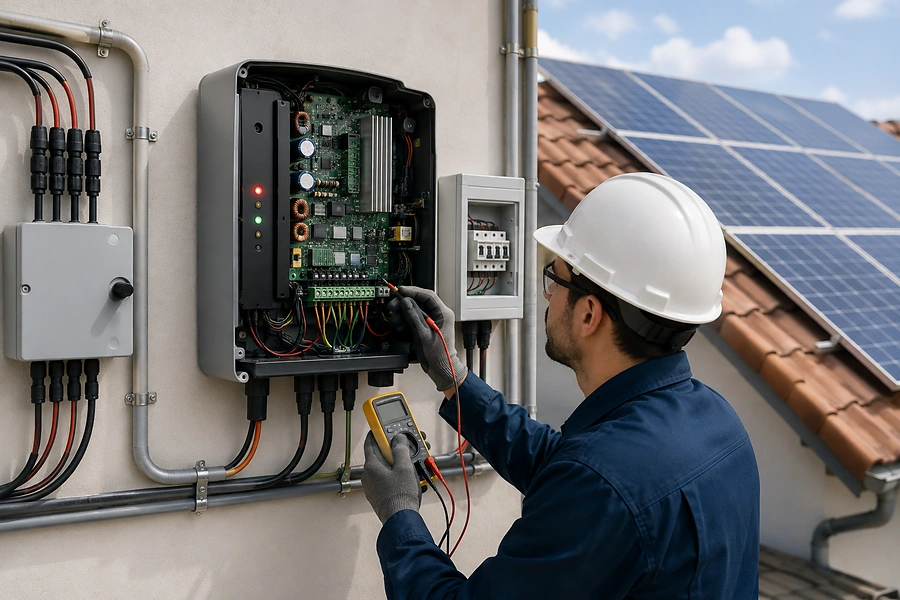
A solar inverter can stop producing power even when the solar panels themselves are working normally, which makes inverter faults especially frustrating.
The most common solar inverter problems I see include grid voltage or frequency faults, overheating, isolation or ground faults, incorrect DC input, damaged wiring, communication failures, cooling problems, and aging electronic components. Some faults only reduce production, while others force the inverter to shut down until the underlying problem is corrected.
I find inverter troubleshooting easier when I separate the problem into three areas: the solar DC side, the inverter itself, and the AC grid side. An error message does not always mean the inverter has failed. Sometimes the inverter is correctly shutting itself down because it has detected an unsafe condition somewhere else in the solar system.
Why Does a Solar Inverter Stop Producing Power?
When a solar inverter shows no output, I do not immediately assume that the inverter is broken. Loss of production can come from the PV array, electrical wiring, grid connection, protection equipment, or the inverter itself.
A solar inverter may stop producing power when there is insufficient DC voltage, an open breaker, a wiring fault, abnormal grid voltage or frequency, an isolation fault, overheating, or an internal hardware error. Grid-tied inverters also stop when the utility grid is unavailable unless the system has suitable backup or grid-forming equipment.
I First Check Whether the Problem Is Really the Inverter
Solar production naturally changes during the day.
At night, the inverter will not receive enough solar power to produce AC electricity.
Early in the morning, the PV voltage may also be below the inverter's startup requirement.
Clouds, heavy shading, snow, and other environmental conditions can reduce production without creating an inverter fault.
SolarEdge specifically notes that weather, shading, the utility grid, and other system conditions can affect production. It also separates production problems from communication problems. An inverter can be producing normally even if monitoring data are temporarily unavailable.
I therefore look at several indicators before diagnosing a failure:
| What I Check | What It Can Tell Me |
|---|---|
| Solar irradiance | Whether enough sunlight is available |
| Inverter status light | Whether the inverter is producing or in standby |
| DC voltage | Whether the PV array is reaching the inverter |
| AC grid voltage | Whether the utility supply is present |
| Circuit breakers | Whether a protective device has opened |
| Error code | Which protection function has activated |
| Monitoring portal | Whether production has fallen or communication alone is missing |
Enphase troubleshooting guidance gives a similar process. If none of its microinverters are producing, it recommends checking grid voltage and frequency, breakers, wiring, AC connectors, and whether the PV modules provide enough startup voltage.
This is why I treat “no solar production” as a symptom, not a diagnosis.
How Do Grid Voltage and Frequency Problems Affect Solar Inverters?
Grid problems are among the most confusing inverter faults because the solar equipment may be completely healthy.
A grid-tied inverter continuously monitors utility voltage and frequency. If these values move outside permitted limits, the inverter can reduce output or disconnect from the grid. High grid voltage is especially common in areas with significant rooftop solar, weak distribution networks, or long AC cable runs with excessive voltage rise.
High Grid Voltage Can Cause Repeated Shutdowns
A grid-tied inverter must synchronize with the electrical grid.
It cannot simply create any AC voltage it wants.
If grid voltage rises above the permitted range, the inverter may disconnect.
SolarEdge's troubleshooting documentation lists AC-voltage-too-high errors and recommends checking the grid voltage, inverter country settings, AC cable size, distance to the grid connection point, and utility conditions.
This gives me several possible causes:
- Utility voltage is genuinely too high
- AC cable is too small
- Cable run is too long
- Too much voltage rise occurs during high solar export
- Inverter grid settings are incorrect
- Local network conditions are unstable
I do not simply increase inverter protection limits to make the error disappear.
Those settings normally have to follow local grid rules.
Low Voltage and Frequency Errors Also Matter
The opposite can happen.
The inverter can see voltage below its permitted range.
It can also detect grid frequency that is too high or too low.
DOE explains that smart inverters monitor grid voltage and frequency and may remain connected through small disturbances while disconnecting when disturbances become sufficiently large or long-lasting.
That behavior is a protection feature.
It does not necessarily mean the inverter needs replacement.
| Grid Problem | Possible Inverter Response |
|---|---|
| Voltage too high | Reduce output or disconnect |
| Voltage too low | Disconnect |
| Frequency too high | Grid protection event |
| Frequency too low | Grid protection event |
| Complete outage | Anti-islanding shutdown |
| Unstable grid | Repeated connection and disconnection |
If a grid fault disappears after a short period and the inverter automatically resumes production, I first investigate the electrical supply conditions before blaming the inverter hardware.
What Causes Isolation and Ground Faults in Solar Inverters?
Isolation faults are another common category because a solar inverter continuously checks whether the DC solar circuit remains safely insulated from ground.
An isolation or ground fault happens when unwanted electrical leakage develops between the PV DC circuit and ground. Possible causes include damaged DC cables, moisture, defective connectors, module damage, pinched insulation, wiring errors, or deteriorated components. The inverter may refuse to start because continuing operation could create an electrical safety risk.
Moisture Can Make the Fault Intermittent
One difficult feature of isolation problems is that they can appear and disappear.
SolarEdge notes that an isolation fault may disappear after a short time, especially when morning moisture contributes to the problem. Its inverter checks resistance between ground and the DC current-carrying conductors when it begins operation.
That explains a problem I might see like this:
Morning: isolation error appears.
Later: sunlight heats and dries the system.
Midday: error disappears.
The fact that the inverter starts working again does not mean the underlying fault should be ignored.
Moisture entering a damaged connector or cable can return the next morning.
Common Physical Sources
When an isolation fault appears, I think about the complete DC path:
PV module → connector → cable → junction box → DC isolator → inverter
Any damaged insulation along this path can matter.
Common examples include:
- Cracked cable insulation
- Cables rubbing against roof surfaces
- Water inside connectors
- Poorly assembled DC connectors
- Damaged module junction boxes
- Pinched wires
- Rodent damage
- Water ingress
- Incorrect grounding
SMA also explains that modern transformerless inverters check PV-array insulation resistance before connecting to the grid because excessive leakage can create safety risks.
I do not recommend repeatedly resetting an isolation fault.
High-voltage PV strings can remain energized whenever sunlight is present.
I would have a qualified solar technician locate and repair the actual insulation problem.
Can Solar Inverters Overheat?
Yes. Inverters naturally create heat while converting DC electricity to AC electricity, and excessive temperature can cause output reduction or shutdown.
Solar inverter overheating can result from high ambient temperature, direct sunlight, blocked airflow, dirty heat sinks, inadequate installation clearance, failed cooling fans, or sustained high-power operation. Modern inverters normally protect themselves by reducing output through thermal derating before temperature reaches a damaging level.
Thermal Derating Is Not Always a Failure
If the inverter becomes too hot, it may intentionally reduce power.
SMA describes temperature derating as a condition where the inverter lowers its power output because of excessive temperature. Its recommended checks include cleaning cooling fins and air ducts, ensuring adequate ventilation, checking ambient temperature, and avoiding direct solar exposure.
Fronius also lists temperature-related derating and recommends checking cooling openings and heat sinks.
I therefore separate two situations:
Normal thermal protection:
The inverter gets too hot and temporarily reduces power.
Cooling-system failure:
A blocked vent, fan problem, sensor problem, or other fault prevents correct temperature control.
Installation Location Has a Long-Term Effect
I pay attention to heat when choosing where to install a string inverter.
Poor locations include small sealed cabinets with little ventilation or areas exposed to strong direct afternoon sun when the manufacturer does not permit those conditions.
I check:
- Manufacturer clearance
- Maximum ambient temperature
- Ventilation requirements
- Direct-sun recommendations
- Cooling fan condition
- Heat-sink cleanliness
- Dust accumulation
Heat can affect both immediate production and long-term electronic life.
DOE notes that inverter downtime and maintenance represent a significant part of PV system maintenance and identifies capacitors and printed circuit boards as common sources of inverter problems.
This is one reason I take repeated overheating seriously even if the inverter continues operating afterward.
What DC Wiring and Solar String Problems Affect an Inverter?
Sometimes an inverter error begins outside the inverter enclosure. Incorrect PV string voltage, loose connectors, damaged cables, open circuits, or reversed polarity can prevent normal operation.
Solar inverter DC-side problems include PV voltage outside the MPPT range, excessive input voltage, insufficient startup voltage, loose or damaged connectors, open strings, wiring faults, and module problems. These conditions can reduce production, prevent startup, or trigger protection depending on the severity of the fault.
String Voltage Must Match the Inverter
A solar inverter has several important DC limits:
- Maximum DC voltage
- MPPT operating range
- Startup voltage
- Maximum input current
- Maximum short-circuit current
- Permitted number of strings
If string voltage is too low, the inverter may not start or may operate outside its best MPPT range.
If voltage is too high, the condition is more serious.
SolarEdge's troubleshooting documentation includes DC-voltage-too-high faults and tells installers to check malfunctioning strings and connections.
I therefore do not design a string using only panel wattage.
Panel voltage changes with temperature.
Cold weather can increase PV open-circuit voltage, which means string design must account for the lowest expected site temperature.
Wiring Faults Can Look Like Inverter Problems
DOE lists wiring damage such as short circuits, open circuits, and ground faults among typical PV system failures. It also warns that technicians should identify the actual cause rather than simply replacing fuses or resetting protective equipment.
This is a useful principle.
Imagine one solar string stops producing.
Possible causes include:
| Symptom | Possible Cause |
|---|---|
| No DC voltage | Open circuit or disconnected string |
| Lower-than-expected voltage | Missing modules or wiring problem |
| Correct voltage but low current | Shading, module fault, connector issue |
| Intermittent production | Loose connector or damaged cable |
| Isolation error | Leakage between DC circuit and ground |
| DC overvoltage | Incorrect string length or wiring |
The inverter is often the device that detects the problem, so it receives the error message even when it is not the defective component.
Are Communication Problems Common With Solar Inverters?
Modern solar systems depend on communications for monitoring, remote diagnostics, firmware updates, export control, and sometimes energy-management functions.
Communication problems can occur when an inverter or gateway loses Wi-Fi, Ethernet, cellular, or power-line communication. The solar system may continue generating electricity in some cases, but production data can disappear. In systems that depend on communications for control functions, lost communication can also cause power limitation or other protective behavior.
No Monitoring Does Not Always Mean No Production
This distinction saves me a lot of unnecessary troubleshooting.
SolarEdge specifically states that production and communication are separate. A communication issue does not automatically stop power production.
I may see:
Monitoring portal: offline.
Inverter: still producing normally.
Possible causes include:
- Router replacement
- Changed Wi-Fi password
- Weak wireless signal
- Internet outage
- Ethernet cable fault
- Gateway problem
- Cellular connection issue
- Power-line communication interference
Enphase also documents device communication problems in which microinverters or the gateway stop exchanging data correctly.
Some Control Functions Depend More Heavily on Communication
Communication becomes more important when the inverter is part of an export-limited system or another coordinated control architecture.
Enphase's current commercial export-limit guidance states that communication loss between microinverters and the gateway can cause the affected equipment to reduce output to a defined safe limit.
So I ask two separate questions:
Is the inverter producing electricity?
and
Is the inverter communicating correctly?
The answers can be different.
What Internal Components Commonly Fail in an Aging Solar Inverter?
If the external wiring, grid conditions, temperature, and PV input are all normal, an older inverter may have an internal hardware problem.
Solar inverters contain semiconductors, capacitors, relays, circuit boards, sensors, filters, and sometimes cooling fans. These components experience electrical and thermal stress throughout operation. Capacitors and printed circuit boards are among the inverter components DOE identifies as common sources of problems in PV system maintenance records.
Capacitors Are a Common Aging Component
Capacitors help smooth and stabilize electrical energy inside an inverter.
They operate for thousands of hours and are affected by temperature.
As they age, their electrical characteristics can change.
This does not mean every inverter failure is caused by a capacitor, but capacitor condition is one reason inverter lifetime can differ from solar-panel lifetime.
DOE states that inverters account for much of PV system downtime and maintenance. Small string inverters and microinverters are often replaced, while larger central inverters may be repaired by replacing individual components.
Relays, Sensors, and Circuit Boards Can Also Fail
SolarEdge troubleshooting material includes hardware errors, temperature sensor faults, AC relay faults, and residual-current sensor errors among inverter fault conditions.
Fronius documentation similarly lists grid-relay, insulation-test measurement, and internal electronic errors.
This is when error codes become useful.
A repeated internal hardware code under normal external conditions is different from an occasional grid-voltage warning.
I look at:
- Exact error code
- Frequency of the fault
- Whether the inverter automatically recovers
- Whether production is affected
- Equipment age
- Warranty status
- Manufacturer diagnostic guidance
If the problem points to internal high-voltage electronics, I do not open or repair the inverter myself.
Manufacturers such as SolarEdge specifically advise system owners to use qualified installers or electricians for inverter repairs.
My Insights: What Are Some Common Problems With Solar Inverters?
I think the biggest mistake in solar inverter troubleshooting is assuming that every inverter error means the inverter itself has failed.
The common problems I see with solar inverters include grid voltage and frequency faults, isolation and ground leakage, overheating, incorrect DC string conditions, damaged wiring, communication failures, cooling problems, and aging internal electronics. The key is to identify whether the fault comes from the PV array, inverter, AC wiring, utility grid, or monitoring system before replacing equipment.
I Group Inverter Problems Into Four Categories
I use this troubleshooting structure:
| Fault Category | Typical Examples | Likely Effect |
|---|---|---|
| PV/DC side | String voltage, connectors, insulation, wiring | Low production or shutdown |
| Inverter hardware | Capacitors, relay, sensor, PCB, fan | Error, derating, or shutdown |
| Grid/AC side | High voltage, low voltage, frequency, wiring | Disconnect or repeated trips |
| Communication | Wi-Fi, gateway, Ethernet, software | Missing data or control limitations |
This prevents me from replacing an expensive inverter when the actual problem is a cable, connector, utility voltage condition, or network connection.
The Most Visible Fault Is Not Always the Root Cause
Consider a high-grid-voltage error.
The inverter is the device showing the error.
But the cause could be:
Utility voltage + long AC cable + voltage rise
Replacing the inverter may not change anything.
The new inverter can detect the same voltage problem and disconnect again.
The same logic applies to an isolation error.
The inverter may be operating correctly by refusing to connect because a damaged PV cable is leaking current to ground.
In that case, the inverter's shutdown is evidence that its protection system is working.
Repeated Resetting Is Not Troubleshooting
I also avoid repeatedly resetting an inverter without knowing why it stopped.
DOE's latest PV operation and maintenance guidance describes inverter tripping and wiring faults as failure conditions that require proper assessment and corrective action.
A reset can remove an error message temporarily.
It does not repair:
- Damaged insulation
- Loose wiring
- High grid voltage
- Water ingress
- Failed cooling hardware
- Internal electronics
- Incorrect PV string design
If an error repeatedly returns, I investigate the root cause.
Monitoring History Gives Me Useful Evidence
Modern inverter monitoring can show when production fell and whether the problem is continuous or intermittent.
I compare:
Today versus yesterday
Current month versus the same season previously
One string versus another
One inverter versus other inverters at the same site
If one inverter repeatedly shuts down at the hottest part of every afternoon, I investigate temperature.
If several inverters disconnect simultaneously, I investigate grid conditions.
If one string loses production after rain, I consider moisture or insulation problems.
If the monitoring portal is offline but the inverter's AC power is normal, I investigate communication instead of energy production.
That pattern-based troubleshooting is much more efficient than guessing from a single error screen.
My Practical Troubleshooting Order
When I see a solar inverter problem, I follow a simple order:
- Confirm sunlight and expected solar production.
- Read the exact inverter status or error code.
- Check whether AC grid voltage and frequency are normal.
- Check breakers and visible electrical connections.
- Compare PV string voltage and current with expected values.
- Check for isolation or ground-fault warnings.
- Look for heat, blocked airflow, or thermal derating.
- Separate monitoring faults from actual production faults.
- Review warranty and equipment age if an internal hardware error remains.
- Use a qualified solar technician for electrical or internal inverter faults.
The order matters because many apparently serious inverter problems have external causes.
At the same time, I do not ignore repeated hardware codes or unusual behavior.
An inverter is one of the most complex electronic components in a PV system. DOE notes that inverter issues account for a large share of PV downtime and maintenance, so I consider inverter monitoring and service planning an important part of long-term solar ownership.
My final view is simple: the inverter often detects the problem, but it is not always the problem.
That distinction helps me diagnose solar systems faster, avoid unnecessary equipment replacement, and keep the PV system producing safely.
Conclusion
The most common solar inverter problems involve grid conditions, overheating, isolation faults, DC wiring, communications, and aging electronics. I diagnose the source first instead of assuming every inverter warning means inverter failure.
](https://voltcrave-battery.com/wp-content/uploads/2026/08/What-Are-the-Two-Types-of-Energy-Storage-Systems-768x512.webp)
](https://voltcrave-battery.com/wp-content/uploads/2026/08/What-Is-Used-for-Long-Term-Energy-Storage-768x512.webp)
](https://voltcrave-battery.com/wp-content/uploads/2026/06/Commercial-Energy-Storage-Systems-The-Future-of-Reliable-Power-for-Businesses-768x512.jpg)