

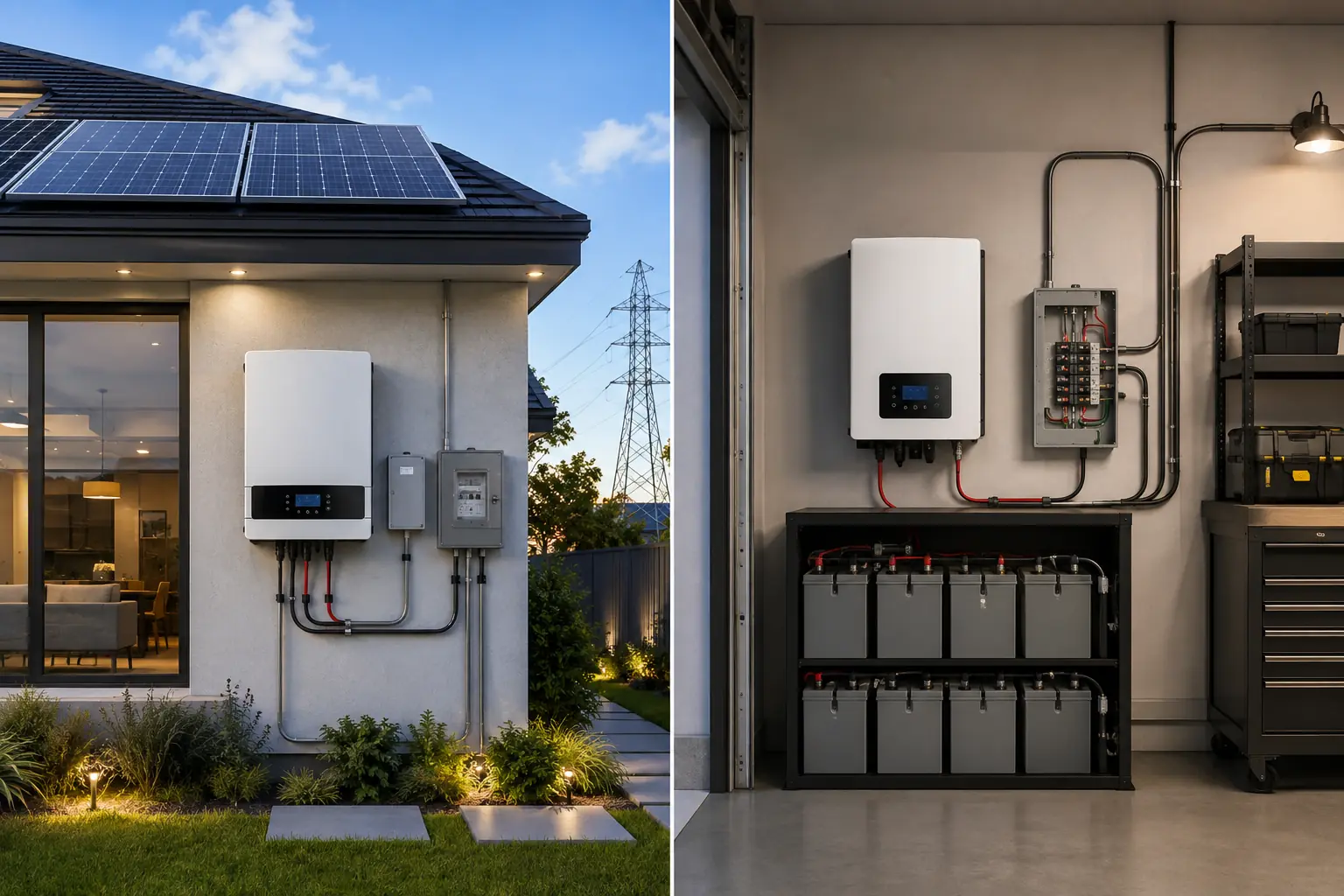
](https://voltcrave-battery.com/wp-content/uploads/2026/08/Which-Is-Better-a-Solar-Inverter-or-a-Regular-Inverter.webp)
Choosing between a solar inverter and a regular inverter can be confusing because both produce AC electricity, but they are designed around different energy sources.
I choose a solar inverter when I want to use solar panels, export solar energy to the grid, or manage solar generation efficiently. I choose a regular battery inverter when I mainly need simple backup power from batteries. For solar plus battery storage, I usually prefer a hybrid solar inverter because it combines more functions in one system.
I do not consider one inverter universally better. I first look at where the DC electricity comes from, whether I need solar MPPT, whether the system connects to the utility grid, whether I need batteries, and whether backup power is required. Once I define those needs, the better inverter becomes much easier to identify.
What Is the Difference Between a Solar Inverter and a Regular Inverter?
Both devices convert DC electricity into AC electricity, but they are normally designed for different DC sources and different system functions.
A solar inverter is designed to work directly with photovoltaic panels and usually includes solar-specific functions such as Maximum Power Point Tracking, grid synchronization, monitoring, and PV protection. A regular inverter normally converts DC electricity from a battery into AC electricity for appliances and may not include the control functions required to connect solar panels directly.
I Start With the Energy Source
The biggest difference is what I connect to the DC input.
A solar inverter receives DC electricity from photovoltaic modules.
A conventional battery inverter normally receives DC electricity from a battery bank.
These sources behave differently.
A battery normally provides DC voltage within a relatively controlled range.
Solar panel voltage and current change throughout the day because of:
- Sunlight intensity
- Module temperature
- Shading
- Cloud cover
- Panel orientation
- String configuration
That changing PV output is why solar inverters need additional control functions.
The U.S. Department of Energy explains that a solar inverter converts PV-generated DC electricity into AC electricity and also controls voltage and current to maximize solar power output while matching the AC output to the utility network.
I can summarize the main difference like this:
| Feature | Solar Inverter | Regular Battery Inverter |
|---|---|---|
| Main DC source | Solar panels | Battery |
| DC-to-AC conversion | Yes | Yes |
| Solar MPPT | Usually yes | Usually no |
| Grid synchronization | Common in grid-tied models | Not always |
| PV string input | Yes | Usually no |
| Battery input | Only on hybrid/battery-ready models | Yes |
| Solar monitoring | Common | Limited or absent |
| Backup operation | Depends on model | Common battery use |
| Grid export | Common where supported | Usually not the main purpose |
The term regular inverter is also broad.
Some regular inverters are simple standalone battery inverters.
Others are inverter/chargers that can charge a battery from the grid or generator and provide AC backup when the external supply disappears.
Victron describes an inverter/charger as a bidirectional device that can charge batteries from an external AC source and then convert battery DC back into AC when needed.
So I never select equipment from the word “inverter” alone.
I check its actual architecture.
Why Is a Solar Inverter Better for Solar Panels?
If solar panels are my main energy source, I normally choose equipment specifically designed to manage PV power.
A solar inverter is better for a photovoltaic system because it can continuously adjust the PV operating voltage and current to obtain high power output, convert the resulting DC energy to grid-compatible AC, monitor grid conditions, and provide solar-specific electrical protection. A normal battery inverter usually cannot perform these functions directly from a PV string.
MPPT Is One of the Biggest Differences
Solar modules do not have one fixed power output.
Their maximum available power changes with temperature and sunlight.
A solar inverter uses Maximum Power Point Tracking, or MPPT, to find an operating combination of PV voltage and current that produces high available power.
Fronius describes MPPT as the function that adjusts PV operation so the inverter can obtain the maximum possible output from the modules as sunlight conditions change.
SMA describes the same principle. The inverter continuously changes the PV operating point so the modules remain close to their Maximum Power Point.
I think of MPPT like this:
Solar irradiance changes → PV voltage/current characteristics change → MPPT adjusts operating point → inverter extracts available solar power
A regular battery inverter normally does not need to perform this job because the battery behaves differently from a PV array.
Multiple MPPT Inputs Can Help With Complex Roofs
Some solar inverters contain more than one MPPT.
This becomes useful when my roof has:
- East-facing panels
- West-facing panels
- Different roof angles
- Partial shading
- Different PV sub-arrays
Fronius, for example, describes residential inverters with multiple independent MPPT inputs so different module orientations can be managed separately.
This is a solar-specific advantage.
Solar Inverters Also Manage the Grid Connection
A grid-tied solar inverter does more than produce AC electricity.
It needs to synchronize its output with the utility grid.
The inverter monitors grid voltage and frequency and controls the AC waveform before exporting energy.
DOE explains that smart solar inverters can also respond to changes in grid voltage and frequency and provide functions that support grid stability.
That makes a solar inverter the clear choice when my main goal is:
PV panels → building loads → utility grid
A basic regular inverter was not designed for that job.
When Is a Regular Inverter Better?
Solar-specific functions are unnecessary if my main goal is simply to convert stored battery energy into AC electricity.
A regular inverter can be the better choice when I need a simple battery backup, off-grid AC supply, RV or marine power, telecom backup, or another system where the battery is the main DC source and solar integration is not required. It can offer a simpler architecture when PV input and grid export are unnecessary.
A Regular Inverter Can Be Simpler
Suppose I already have a 48 V LiFePO4 battery.
My only requirement is to operate several appliances during a utility outage.
My energy path is:
Battery → inverter → AC appliances
I do not need PV string MPPT.
I do not need a grid-export function.
I may not need solar monitoring.
In this application, a regular battery inverter can be completely appropriate.
If I also want the grid or generator to recharge the battery, I can use an inverter/charger.
Victron describes this architecture as one in which external AC can power the loads and charge the battery, while loss of external AC makes the unit switch to battery inverter operation.
Backup Power Is a Different Requirement From Solar Production
This distinction is important.
A standard grid-tied solar inverter may work very well while the utility grid is operating.
But when the grid goes down, conventional grid-following solar systems normally disconnect for safety.
DOE explains that residential solar panels alone generally cannot keep a home powered during an outage. Solar backup normally requires a properly configured inverter and energy storage system capable of islanded operation.
This means a regular battery inverter can actually be more useful than a basic grid-tied solar inverter when my number-one goal is backup power.
| Application | Better Starting Choice |
|---|---|
| Simple battery backup | Regular inverter |
| RV or camper battery system | Regular inverter |
| Battery-powered workshop | Regular inverter |
| Generator + battery backup | Inverter/charger |
| Solar without grid export | Solar or hybrid inverter |
| Grid-connected PV | Solar inverter |
| Solar + battery + backup | Hybrid inverter |
So I do not say solar inverters are more advanced and therefore always better.
The extra solar functions only create value when I actually need them.
Is a Hybrid Solar Inverter Better Than Both?
For many modern home energy storage projects, I think the more useful comparison is not solar inverter versus regular inverter. It is whether a hybrid inverter can replace several separate devices.
A hybrid solar inverter can be better when I need solar generation, battery storage, grid interaction, and backup within one coordinated system. It can manage PV input, battery charging and discharging, AC loads, and grid power. However, I still need to verify battery compatibility, backup capability, power ratings, and local grid approval.
A Hybrid Inverter Manages Several Energy Paths
A conventional solar inverter might follow this path:
Solar → inverter → AC loads/grid
A battery inverter might follow this path:
Battery → inverter → AC loads
A hybrid system may need to control:
Solar → loads
Solar → battery
Solar → grid
Grid → loads
Grid → battery
Battery → loads
That is a much more complex energy-management problem.
Modern hybrid inverters are designed around these multiple energy flows.
Fronius, for example, describes its storage-capable inverter technology as being able to control multiple energy flows in parallel within a storage system.
I Prefer Hybrid When Storage Is Part of the Original Plan
If I am designing a new home with:
- Solar panels
- LiFePO4 battery storage
- Grid connection
- Time-of-use tariffs
- Backup power
I would normally evaluate a hybrid inverter first.
It can reduce the need for separate solar and battery conversion equipment.
But this does not mean every hybrid inverter works with every battery.
I still check:
- Battery voltage range
- BMS communication
- Continuous charge power
- Continuous discharge power
- Backup power
- PV MPPT range
- Number of MPPTs
- Grid certification
- Approved batteries
- Firmware compatibility
I consider inverter and battery compatibility especially important with high-voltage home storage.
A battery may operate at 200–500 V while another operates over a completely different voltage window.
The phrase high-voltage battery compatible does not tell me enough.
Hybrid Is Not Automatically the Cheapest Choice
If I only need a small battery backup system and have no solar panels, buying an advanced hybrid inverter may add functions I never use.
Likewise, if I already have a working grid-tied solar system, replacing the original inverter just to add storage is not always necessary. An AC-coupled battery system may be another option.
I therefore choose hybrid when its combined functions match the project.
I do not choose it simply because it has the most features.
Which Inverter Is Better for Power Outages?
If outages are important, I focus on whether the inverter can create and maintain an AC supply when the utility grid disappears.
For outages, a battery inverter or backup-capable hybrid inverter is generally more useful than a standard grid-tied solar inverter. Conventional grid-following solar inverters shut down when the grid fails. A backup-capable system needs battery storage, grid isolation, and an inverter that can supply loads without depending on the utility's voltage and frequency reference.
Grid-Tied Solar Does Not Automatically Mean Backup
This surprises many solar owners.
I can have:
- Bright sunlight
- Working solar panels
- A healthy solar inverter
and still have no household electricity during a blackout.
Why?
The grid-tied inverter is normally designed to stop exporting electricity when the utility grid disappears.
This protects utility personnel and electrical equipment.
DOE distinguishes conventional grid-following inverters from grid-forming equipment. Grid-following equipment needs an existing grid voltage and frequency reference. Grid-forming equipment can establish that reference itself.
A Battery Gives the System a Stable Energy Source
Solar power changes rapidly.
A cloud can reduce PV output.
Loads can increase suddenly.
A battery helps maintain the balance between generation and consumption during islanded operation.
DOE explains that solar-plus-storage systems can provide resilience during outages when they have the required inverter and storage configuration.
So if backup is my goal, I ask:
Can the inverter operate off-grid?
Can it form an AC grid?
Does it have an automatic transfer function?
How much backup power can it supply?
Can it start large motors or air conditioners?
Can solar continue operating during the outage?
Can solar recharge the battery while the grid is down?
These questions are much more useful than simply asking whether it is called a solar inverter.
Which Is More Efficient and Cost-Effective?
I do not assume one inverter category always has higher efficiency or lower total cost because system architecture matters more than the label.
A regular inverter can be more cost-effective for simple battery backup because I am not paying for unused PV and grid-management functions. A solar inverter is more cost-effective for direct PV applications because MPPT and solar controls are already integrated. A hybrid inverter can reduce system complexity when I need both solar and battery storage.
I Compare Total System Cost
Suppose I want only backup from a battery.
A basic architecture could be:
Battery + inverter/charger
Adding a sophisticated grid-tied solar inverter makes little sense if I have no solar array.
Now suppose I have solar but no battery.
I may only need:
PV array + solar inverter
Again, adding battery-specific conversion equipment creates no immediate value.
If I need both:
PV + battery + grid + backup
a hybrid inverter can potentially integrate these requirements in one platform.
The lowest equipment price is not always the lowest complete-system price.
I also include:
- Installation labor
- Additional electrical panels
- MPPT controllers
- Transfer switches
- Communication equipment
- Battery chargers
- Monitoring
- Maintenance
- Replacement cost
More Conversion Stages Can Create More Losses
Every power conversion stage has some loss.
DOE explains that power electronics are used to convert PV DC into AC and battery systems may use bidirectional conversion between battery DC and AC.
If energy has to move through several conversion steps, total losses can increase.
For example, some AC-coupled storage architectures may involve:
PV DC → AC → battery DC → AC
A more integrated DC-coupled system may use a different path.
That does not mean DC coupling is always more efficient in every real installation. Load profile, converter design, battery voltage, and operating conditions matter.
I therefore compare manufacturer efficiency data for the exact models.
I Also Think About Lifetime Cost
DOE notes that PV inverters may need replacement during the long operating life of a solar array.
That means my cost comparison should include:
purchase price + installation + operating losses + maintenance + possible replacement
rather than only the price on the inverter box.
The better inverter is the one that performs the required functions with reasonable total lifetime cost.
How Do I Choose Between a Solar Inverter and a Regular Inverter?
I choose by defining the energy system first and the inverter second.
I choose a solar inverter if my main source is photovoltaic panels. I choose a regular inverter if my main source is a battery and I only need AC backup or off-grid power. I choose a hybrid solar inverter when I need solar, battery storage, grid interaction, and backup in one coordinated energy system.
I Use the Source-and-Load Method
My first question is:
Where does the electricity come from?
If the answer is solar panels, I need solar-compatible power electronics.
If the answer is a battery, I need battery-compatible power conversion.
If the answer is both solar and battery, hybrid equipment deserves serious consideration.
My second question is:
Where must the electricity go?
Possible answers include:
- Household appliances
- Commercial loads
- Battery storage
- Utility grid
- Backup panel
- Off-grid loads
Then I check the required power.
My Basic Selection Table
| Requirement | Solar Inverter | Regular Inverter | Hybrid Solar Inverter |
|---|---|---|---|
| Direct PV input | Excellent | Poor | Excellent |
| MPPT | Yes | Usually no | Yes |
| Basic battery backup | Limited/model dependent | Excellent | Excellent |
| Grid export | Excellent | Usually limited | Excellent |
| Battery charging | Model dependent | Inverter/charger models | Excellent |
| Solar + battery integration | Limited without extra equipment | Requires solar controller | Excellent |
| Simple off-grid battery use | More features than needed | Excellent | Good |
| Time-of-use energy management | Model dependent | Limited | Excellent |
| Future battery expansion | Depends on model | Depends on model | Often strong |
| System simplicity for solar + storage | Good to moderate | Moderate | Often strongest |
I use this table as a starting point.
Then I compare actual models.
I Never Skip Voltage and Power Matching
For solar input, I check:
- Maximum PV voltage
- MPPT voltage range
- PV current limit
- Number of MPPTs
- Maximum solar power
For battery input, I check:
- Battery voltage
- Battery chemistry
- BMS communication
- Maximum charge current
- Maximum discharge current
- Battery compatibility
For AC output, I check:
- Continuous power
- Surge power
- Single-phase or three-phase output
- Grid voltage
- Grid frequency
- Backup rating
DOE notes that inverter designs vary significantly according to the PV architecture and whether they are central, string, microinverter, grid-following, or grid-forming systems.
This is why I never make the choice from the product name alone.
My Insights: Which Is Better, a Solar Inverter or a Regular Inverter
My main insight is that the better inverter is determined by the energy architecture, not by which product has more features.
If I use solar panels as my main energy source, a solar inverter is better because it manages variable PV power through MPPT and can synchronize with the grid. If I only need battery-powered AC backup, a regular inverter is usually simpler. If I need solar, batteries, grid power, and backup together, a hybrid inverter is often the most practical choice.
I Do Not Compare Them as Direct Replacements
The phrase solar inverter versus regular inverter makes the products sound like competing versions of the same device.
They overlap in one function:
DC → AC conversion
But their complete jobs are different.
A regular battery inverter asks:
“How do I turn stored battery DC electricity into AC power?”
A solar inverter asks:
“How do I continuously extract useful energy from a changing PV source and safely convert it into AC?”
A hybrid inverter asks:
“How do I coordinate PV, battery, grid, and loads?”
That difference changes everything.
Solar Inverters Win for Solar Harvesting
For a solar array, I want MPPT.
Fronius and SMA both describe MPPT as a core solar-inverter function that continually adjusts the operating point of the PV array to obtain the available maximum power as conditions change.
A conventional battery inverter does not provide the same direct PV management unless an MPPT solar charger or other solar electronics are added.
So for direct solar integration:
Solar inverter wins.
Regular Inverters Win for Simple Battery Backup
If my project is:
48 V LiFePO4 battery → 230 V appliances
I may not need MPPT, PV string protection, grid-export controls, or solar monitoring.
A regular inverter or inverter/charger can be simpler.
Victron's inverter/charger architecture shows this clearly. Battery DC can supply AC loads, while an external AC source can also charge the battery and serve the loads when available.
So for simple battery backup:
Regular inverter wins.
Hybrid Inverters Win When the System Does Several Jobs
For modern home energy storage, my architecture might be:
Solar panels
↓
Hybrid inverter ↔ battery
↓
Home loads ↔ utility grid
Now the inverter needs to manage several energy directions.
During midday:
Solar → home + battery
During the evening:
Battery → home
When solar is insufficient:
Grid → home
During an outage:
Solar + battery → backup loads, if the system supports islanded operation.
DOE confirms that solar-plus-storage can maintain electricity during outages when properly configured with the required inverter and storage architecture.
For this application:
Hybrid inverter usually wins.
I Use This Final Decision Rule
| My Situation | My Preferred Inverter Type |
|---|---|
| I only have a battery | Regular inverter |
| I have battery + grid/generator | Inverter/charger |
| I only have grid-connected solar | Solar inverter |
| I have solar + battery | Hybrid solar inverter |
| I want solar + battery + backup | Backup-capable hybrid inverter |
| I need simple off-grid battery AC | Regular inverter |
| I need off-grid solar + battery | Hybrid or inverter/charger + MPPT |
| I need utility-scale solar export | Grid-connected solar inverter |
This makes the choice much clearer.
I Also Plan for Future Energy Storage
One final factor changes my decision.
I ask what I may want in five years.
If I install a basic solar inverter today but know that I will probably add a high-voltage home battery later, I investigate whether the inverter has a supported storage path.
Replacing a relatively new inverter when I add batteries can increase project cost.
On the other hand, I do not buy an expensive hybrid inverter if I know I will never install batteries.
I therefore plan around:
Today's electrical needs + realistic future needs
rather than buying the product with the longest feature list.
My Final Answer
If someone asks me, “Which is better, a solar inverter or a regular inverter?”, my answer is:
A solar inverter is better for solar power. A regular inverter is better for simple battery backup. A hybrid solar inverter is usually better when I want solar generation, battery storage, grid interaction, and backup power in one system.
The important word is better for what.
Once I define the energy source, loads, grid connection, battery requirements, and backup goals, the correct inverter architecture becomes much easier to choose.
Conclusion
I choose a solar inverter for PV, a regular inverter for simple battery backup, and a hybrid inverter when solar, batteries, grid power, and backup must work together.
](https://voltcrave-battery.com/wp-content/uploads/2026/08/How-to-Choose-the-Right-High-Voltage-LiFePO4-Battery-for-Your-Needs-768x512.webp)
](https://voltcrave-battery.com/wp-content/uploads/2026/08/Who-Are-the-Top-10-Energy-Storage-Battery-Manufacturers-in-the-USA-768x512.webp)
](https://voltcrave-battery.com/wp-content/uploads/2026/08/Why-More-Businesses-Are-Investing-in-Commercial-Energy-Storage-768x512.webp)