

](https://voltcrave-battery.com/wp-content/uploads/2026/09/The-Power-of-Commercial-and-Industrial-Energy-Storage.webp)
Rising electricity costs, grid constraints, and power interruptions can directly affect business operations. Without flexible energy resources, companies have limited control over when and how they consume electricity.
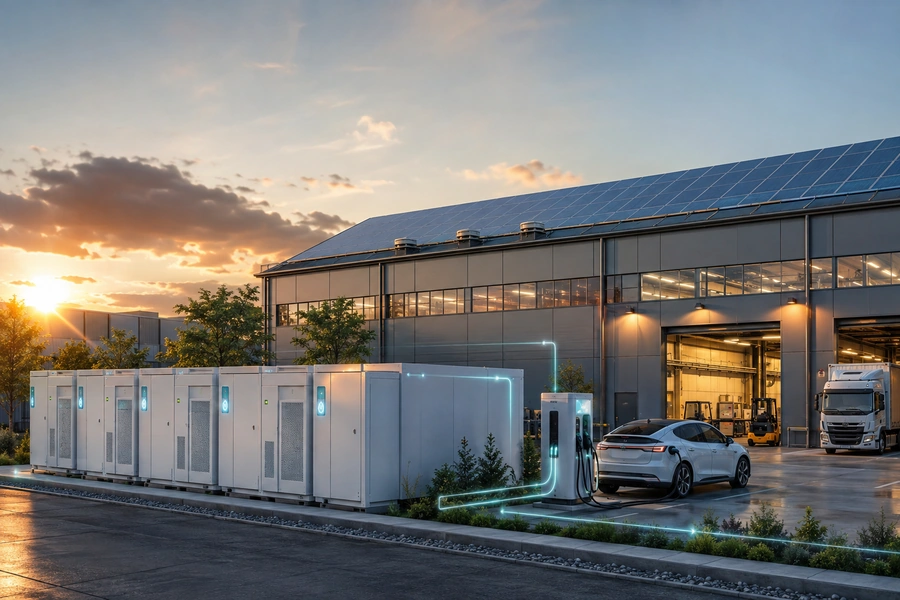
Commercial and industrial energy storage gives businesses the ability to store electricity and use it when it creates the most value. A well-designed C&I BESS can reduce peak demand, increase solar self-consumption, provide backup power, support EV charging, improve energy flexibility, and help businesses manage electricity costs while strengthening operational resilience.
I see the real power of commercial and industrial energy storage in one idea: control. A business no longer has to consume every kilowatt-hour exactly when it arrives from the grid or solar system. It can shift energy across time and use battery power according to operational and economic priorities.
What Is Commercial and Industrial Energy Storage?
Commercial and industrial energy storage is a battery-based system designed to store electricity for businesses, factories, warehouses, offices, retail sites, data centers, farms, charging stations, and other non-residential facilities.
A commercial and industrial energy storage system, often called a C&I BESS, combines battery modules with a battery management system, power conversion system, energy management system, thermal management, electrical protection, and controls. It stores electricity from the grid or onsite generation and releases that energy later according to cost, power, resilience, or operational requirements.
Modern stationary storage is increasingly based on lithium iron phosphate. The IEA reports that LFP accounted for around 90% of battery-storage deployments in 2025, reflecting its strong position in stationary applications that require frequent cycling and competitive costs.
What Is Inside a C&I BESS?
A complete commercial storage project involves much more than battery cells.
| Component | Main Function |
|---|---|
| Battery cells/modules | Store electrical energy |
| Battery racks | Organize and mechanically support modules |
| BMS | Monitor voltage, current, temperature, SOC, and faults |
| PCS/inverter | Convert electricity between DC and AC |
| EMS | Decide when and how the battery operates |
| HVAC/liquid cooling | Control battery temperature |
| Switchgear | Connect, isolate, and protect electrical circuits |
| Transformer | Match system and facility/grid voltage |
| Fire/gas system | Detect and manage abnormal conditions |
| Metering | Measure loads, generation, and grid exchange |
NREL's commercial battery model treats the battery pack, inverter, and balance-of-system equipment as separate major cost components. This distinction matters because buying a BESS is not the same as buying a battery pack.
The complete system determines how safely and effectively stored energy can be converted into business value.
How Can C&I Energy Storage Reduce Electricity Costs?
For many businesses, electricity cost depends on more than total monthly kWh consumption. High power demand during short periods can also have a major financial impact.
C&I battery storage can reduce electricity costs through peak shaving, load shifting, time-of-use optimization, and better use of onsite solar generation. The EMS charges the battery when electricity is less valuable and discharges it during expensive periods or demand peaks, helping a business reshape its grid-consumption profile instead of simply reducing total electricity use.
Peak Shaving Changes the Load Profile
Imagine a manufacturing facility normally consumes:
500 kW
but reaches:
700 kW
for two hours every afternoon.
If the goal is to limit grid demand to:
550 kW
the battery must provide approximately:
700 kW − 550 kW = 150 kW.
If the peak lasts two hours:
150 kW × 2 hours = 300 kWh
of theoretical battery energy is needed.
A practical system would require additional capacity for efficiency losses, usable SOC limits, degradation, and operating reserve.
This example shows why I always separate:
kW = power
from:
kWh = energy.
NREL models commercial battery storage across roughly 100–2,000 kW and durations of one to eight hours, demonstrating that C&I systems can be configured around very different load profiles. NREL also stresses that accurately determining duration is critical to total system cost.
A business with short peaks may need high kW but relatively little kWh.
A facility with sustained afternoon demand may need the same power but several times more energy capacity.
That difference can dramatically change project economics.
How Does Energy Storage Make Commercial Solar More Powerful?
Solar generation and business electricity consumption do not always happen at the same time.
Commercial energy storage makes solar more flexible by storing excess daytime generation and releasing it when facility demand rises or solar output falls. This can increase solar self-consumption, reduce grid imports, limit unwanted exports, support evening loads, and allow a business to use solar energy according to operational needs rather than only when sunlight is available.
Solar Generation Becomes Dispatchable
Without storage, the basic energy flow is:
Sunlight → PV → immediate consumption or grid export
With storage:
Sunlight → PV → battery → later consumption
This changes the value of the solar system.
Consider a warehouse that produces substantial solar energy between:
10 a.m. and 3 p.m.
but experiences its largest load between:
4 p.m. and 8 p.m.
Without a battery, much of the midday solar may be exported.
With storage, part of that electricity can be shifted into the evening load period.
The battery does not create additional solar energy. Instead, it changes when the solar electricity is available to the business.
This distinction becomes increasingly important as renewable generation expands. The IEA reported that global battery-storage additions reached 108 GW in 2025, 40% higher than in 2024. It also notes that storage duration is gradually increasing as electricity systems place more value on flexibility alongside growing PV deployment.
For a C&I project, I therefore evaluate solar and storage together when their operating profiles overlap economically.
Can Commercial Energy Storage Improve Business Resilience?
Electricity savings may justify a battery financially, but resilience can justify it operationally.
A properly designed C&I BESS can provide backup power during grid outages, but backup capability is not automatic. The system must have sufficient discharge power, usable battery energy, transfer and isolation equipment, appropriate protection, and controls capable of operating critical loads when the utility grid is unavailable.
Critical Loads Should Drive Backup Sizing
Suppose a factory normally consumes:
600 kW.
During an outage, however, only the following equipment must remain operational:
| Critical Load | Power |
|---|---|
| Production controls | 60 kW |
| IT/network | 20 kW |
| Safety systems | 15 kW |
| Essential lighting | 20 kW |
| Cooling/refrigeration | 85 kW |
| Total | 200 kW |
If these loads must operate for:
four hours
the theoretical energy requirement becomes:
200 kW × 4 h = 800 kWh.
The actual battery would normally require more nominal capacity because I also need to account for conversion losses, battery reserve, usable SOC range, aging, and environmental conditions.
This approach can be much more economical than designing the battery to support the entire 600 kW facility.
Resilience Has a Hidden Trade-Off
Backup reserve occupies battery capacity.
If I reserve:
40% SOC
for unexpected outages, that portion cannot always be used aggressively for daily peak shaving or energy arbitrage.
The EMS must therefore balance:
economic optimization
against:
energy security.
This is where commercial energy storage becomes more than battery hardware. The control strategy determines which objective receives priority at any particular moment.
How Can C&I Battery Storage Support EV Charging?
High-power EV charging can add substantial new demand to commercial electrical infrastructure.
C&I energy storage can support EV charging by supplying temporary high-power demand, smoothing charging peaks, coordinating charging schedules, and potentially reducing the amount of power that must be drawn from the grid at one moment. This can be particularly valuable at fleet depots, logistics centers, workplaces, retail sites, and DC fast-charging locations.
High Power Does Not Always Require Huge Energy Capacity
Imagine a charging site with four:
150 kW DC fast chargers.
Maximum simultaneous charging demand could reach:
600 kW.
Suppose the site's preferred grid limit is:
400 kW.
The battery may need to provide:
200 kW
during periods of maximum charging.
If the additional power is needed for 30 minutes:
200 kW × 0.5 h = 100 kWh.
That creates a very different BESS design from a solar-shifting project.
The EV charging application may prioritize:
high kW + moderate kWh
while a four-hour solar-shifting project may prioritize:
much more kWh relative to kW.
This is why I would not specify a C&I battery simply by saying:
“We need a 500 kWh battery.”
I first determine the required power, duration, cycling frequency, and recharge opportunity.
Why Is the Energy Management System So Important?
Battery cells store energy, but software determines when that energy becomes valuable.
The energy management system is one of the most important parts of a commercial BESS because it controls charging, discharging, peak shaving, solar utilization, backup reserve, EV charging coordination, and other operating priorities. A sophisticated battery with a poor control strategy can produce weak financial results because energy may be discharged at the wrong time.
The EMS Turns Data Into Dispatch
A useful EMS may monitor:
facility load
battery SOC
solar production
electricity tariff
grid import/export
EV charging demand
and:
backup reserve requirements.
Imagine that a facility experiences a temporary peak at:
1 p.m.
The battery could discharge immediately.
But suppose a much larger peak arrives at:
5 p.m.
If the battery is already empty, it may fail to reduce the period that actually determines the site's monthly demand charge.
The battery hardware worked correctly.
The control strategy failed economically.
This is why I think of a C&I BESS as:
battery + power electronics + intelligence.
Without effective control, the battery is only stored electricity.
With effective control, it becomes a flexible energy asset.
Why Are LFP Batteries So Important for C&I Energy Storage?
Commercial batteries may cycle frequently, so chemistry affects lifetime, thermal behavior, cost, and system design.
LFP has become the dominant chemistry in stationary battery storage because it offers a useful combination of cycle capability, cost, material characteristics, and thermal stability. However, chemistry alone does not determine system quality. Cell consistency, BMS design, thermal management, electrical protection, enclosure engineering, and system-level safety remain essential.
The IEA reports that LFP now represents around 90% of battery-storage deployments, up from well below half of deployments only five years earlier. It notes that LFP is generally less energy-dense than chemistries commonly used in EVs but is typically cheaper and well suited to frequent cycling.
C&I Storage Has Different Priorities From EV Batteries
An electric vehicle places a very high value on:
energy per kilogram.
A stationary C&I battery does not move.
Its priorities are more likely to include:
cost per usable kWh
cycle life
thermal behavior
safety
serviceability
and:
long-term reliability.
This helps explain why LFP is so well aligned with stationary energy storage.
But I would never choose a commercial system based only on the phrase:
“LiFePO4 battery.”
I would also evaluate its operating voltage, BMS, cooling architecture, cycle-test conditions, warranty, system certification, PCS compatibility, and safety documentation.
How Does C&I Storage Support Energy Flexibility?
The greatest strategic value of storage is its ability to separate electricity consumption from electricity availability.
Commercial energy storage provides flexibility because a business can charge when electricity is abundant or inexpensive and discharge when electricity is scarce, expensive, or operationally important. This ability allows one battery to support several applications, including peak shaving, solar shifting, backup, EV charging, demand response, and potentially grid services.
One Battery Can Have Several Jobs
Consider a commercial battery during a normal day.
In the morning, it may maintain reserve capacity.
At midday, it may charge from excess solar.
During the afternoon, it may discharge to reduce a demand peak.
In the evening, it may shift remaining solar energy into facility loads.
During an outage, it may support critical equipment.
This is often called:
value stacking.
However, I do not assume every value stream can be maximized simultaneously.
A battery cannot dedicate the same kWh at the same moment to:
backup + peak shaving + energy arbitrage.
The EMS must assign priorities.
This makes battery capacity an economic resource that needs to be allocated, not simply filled and emptied.
Global deployment trends support the increasing value placed on this flexibility. Battery storage is currently the fastest-growing power technology, according to the IEA, and deployment is expanding across major markets as power systems integrate more variable renewable generation.
What Is the Difference Between a 2-Hour and 4-Hour Commercial BESS?
Duration is one of the most important C&I storage design variables.
A two-hour battery can discharge at rated power for approximately two hours, while a four-hour system contains roughly twice the energy for the same nominal power rating. Short-duration systems can suit brief demand peaks and some charging applications, while longer-duration systems can better support sustained peaks, solar shifting, and longer backup requirements.
For a:
250 kW
system:
| Configuration | Power | Energy | Nominal Duration |
|---|---|---|---|
| System A | 250 kW | 250 kWh | 1 hour |
| System B | 250 kW | 500 kWh | 2 hours |
| System C | 250 kW | 1,000 kWh | 4 hours |
| System D | 250 kW | 2,000 kWh | 8 hours |
The power is identical.
The amount of energy is not.
NREL's commercial storage benchmark explicitly models 1–8 hour systems and notes that installed cost per kWh falls substantially as duration increases because some inverter and balance-of-system costs are associated with power rather than stored energy.
That does not mean longer duration is always better.
An oversized four-hour battery used only for a 30-minute peak may have poor utilization.
A one-hour battery used for a four-hour evening load may run out long before the economic problem ends.
The correct duration follows the load profile.
What Determines the ROI of Commercial and Industrial Energy Storage?
C&I storage becomes powerful only when its technical performance produces measurable business value.
The ROI of a commercial energy storage project depends on installed cost, electricity tariffs, demand savings, energy-price differences, solar utilization, backup value, operating strategy, round-trip efficiency, degradation, maintenance, financing, and possible additional revenue streams. I therefore model the battery against actual interval load data instead of relying on a generic cost-per-kWh calculation.
NREL's commercial-storage framework separates battery energy costs from inverter and balance-of-system power costs. It also uses a representative 85% round-trip efficiency in its 2024 modeling and accounts for degradation-related costs over the modeled system life.
Start With the Load Curve
Before selecting the battery, I want at least:
12 months of facility electricity data
where possible.
I study:
peak magnitude
peak duration
time-of-use prices
seasonal changes
solar production
planned load growth
and:
critical-load requirements.
Then I model battery dispatch.
A simplified economic relationship is:
Annual Battery Value = Demand Savings + Energy Savings + Solar Value + Resilience Value + Other Revenue − Operating Costs
A more complete investment analysis should consider:
NPV, IRR, payback, degradation, augmentation, financing, and replacement risk.
This is why two businesses buying identical 500 kWh batteries can receive very different financial returns.
Their load curves and tariffs may be completely different.
How Important Is Safety in Commercial and Industrial Energy Storage?
C&I BESS equipment contains substantial stored energy and high electrical power, so safety must be designed at system level.
Commercial energy storage safety depends on cell design, BMS protection, thermal management, electrical isolation, enclosure design, fire and gas management, installation layout, emergency planning, and system-level testing. In the U.S. context, UL 9540 and UL 9540A are important parts of the safety framework, while NFPA 855 addresses ESS installation requirements.
UL reports that the 2026 edition of NFPA 855 and the 2024 International Fire Code require fire and large-scale fire testing in certain situations. UL 9540A is the referenced test method for evaluating thermal runaway fire propagation in representative energy-storage systems.
The sixth edition of UL 9540A was published on March 13, 2026, reflecting continued development of large-scale ESS fire-testing practices.
UL also notes that the 2026 NFPA 855 framework increases attention to fire propagation, explosion prevention, deflagration protection, large-scale testing, and technical documentation.
Safety Can Affect Project Economics
Safety is not separate from ROI.
Poorly planned safety compliance can lead to:
design changes
additional equipment
permitting delays
site-layout changes
and:
project resubmissions.
UL reports that evolving requirements can increase technical documentation and contribute to longer AHJ review cycles.
I therefore involve safety and permitting requirements early in the design process.
My Insights: What Is the Power of Commercial and Industrial Energy Storage
The real power of C&I storage is not simply its ability to hold electricity. Its value comes from giving businesses control over the timing, power, and purpose of energy use.
The power of commercial and industrial energy storage lies in its ability to turn electricity from a fixed operating expense into a controllable resource. A properly designed BESS can reduce demand peaks, shift solar generation, support critical loads, manage EV charging, respond to electricity prices, and combine several energy strategies through one flexible platform.
My First Insight: Energy Storage Gives Businesses Control Over Time
Electricity traditionally has to be consumed when it is generated or delivered.
Storage changes that relationship.
The business can effectively move electricity from:
one time period
to:
another time period.
That simple capability creates peak shaving, solar shifting, arbitrage, and backup value.
My Second Insight: The Best BESS Is Defined by the Load, Not the Battery
I would never begin a commercial project with:
“We need a 1 MWh battery.”
I would begin with:
What does the load curve look like?
Then I calculate:
required kW + required duration = required kWh.
This avoids unnecessary capacity and helps match capital spending to the actual business problem.
My Third Insight: Software Creates a Large Part of the Economic Value
Battery chemistry determines how energy can be stored.
The EMS determines when it should be used.
That distinction becomes critical in facilities with:
solar + demand charges + EV charging + backup requirements.
A smart dispatch strategy can allocate battery capacity to the highest-value periods.
A poor strategy can waste the same hardware.
My Fourth Insight: Storage Is Becoming a Core Part of Modern Energy Infrastructure
The growth rate of global battery deployment is significant. The IEA reports 108 GW of new battery-storage capacity in 2025, 40% above 2024, with total installed capacity reaching eleven times its 2021 level.
This growth reflects a broader change.
Electricity systems increasingly need flexibility alongside renewable generation, electrification, data centers, EV charging, and changing load patterns.
C&I facilities can participate in that transition from behind the meter.
My Fifth Insight: What Is the Power of Commercial and Industrial Energy Storage?
This directly addresses The Power of Commercial and Industrial Energy Storage.
I summarize its business value this way:
| C&I Challenge | Storage Response |
|---|---|
| High demand peaks | Peak shaving |
| Expensive peak-period electricity | Load shifting |
| Excess daytime solar | Solar energy shifting |
| Grid outage | Critical-load backup |
| EV charging peaks | High-power battery support |
| Limited grid capacity | Flexible load support |
| Variable energy prices | Smart charging/discharging |
| Renewable variability | Energy balancing |
| Need for multiple energy strategies | EMS-based value stacking |
| Future load growth | Modular energy flexibility |
The most important change is not technical.
It is operational.
Without storage, a business largely reacts to the electricity system.
It consumes power when equipment needs it. It exports solar when production exceeds demand. It pays for peaks when they occur. It loses grid power when an outage happens.
With storage, the business gains another option.
It can decide:
when to buy electricity
when to store electricity
when to use solar
when to reduce grid demand
and:
when to preserve energy for resilience.
That is the real power of commercial and industrial energy storage.
I do not see a C&I BESS simply as a large battery.
I see it as a controllable energy asset.
Its value comes from combining the correct battery size, PCS power, duration, thermal design, EMS strategy, safety architecture, and economic use case.
When those elements are matched correctly, commercial and industrial energy storage can do more than reduce an electricity bill. It can make a business more flexible, more resilient, and better prepared for an electricity system increasingly shaped by solar generation, electrification, variable loads, and the need for rapid energy control.
Conclusion
Commercial and industrial energy storage gives businesses greater control over cost, solar energy, peak demand, backup power, EV charging, and long-term energy flexibility.
](https://voltcrave-battery.com/wp-content/uploads/2026/08/Benefits-of-Energy-Storage-Systems-for-Industrial-and-Commercial-Users-768x512.webp)
](https://voltcrave-battery.com/wp-content/uploads/2026/08/What-Are-the-Two-Types-of-Energy-Storage-Systems-768x512.webp)
](https://voltcrave-battery.com/wp-content/uploads/2026/08/Why-More-Businesses-Are-Investing-in-Commercial-Energy-Storage-768x512.webp)