
](https://voltcrave-battery.com/wp-content/uploads/2026/08/What-Is-a-Battery-Management-System-BMS-and-Why-Does-It-Matter-in-a-Battery-Energy-Storage-System.webp)
A battery may appear healthy from the outside while one weak cell, failed sensor, or incorrect control command creates a serious internal risk.
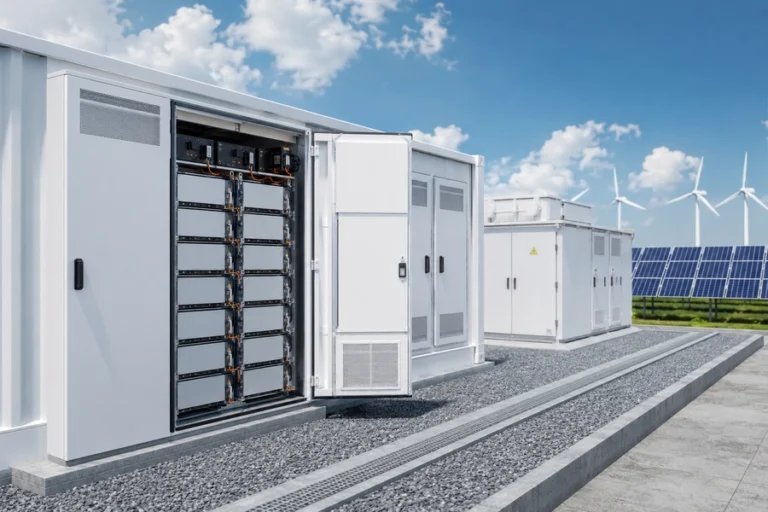
A battery management system is the hardware and software that monitors, protects, and controls the batteries inside a battery energy storage system. It tracks voltage, current, temperature, state of charge, and battery health. It matters because it prevents unsafe operation, supports accurate dispatch, limits degradation, and helps the BESS remain available.
I view the BMS as the battery system’s local safety controller. It does not replace the energy management system, inverter, cooling equipment, or fire controls. It coordinates with these components and keeps the battery inside its approved operating limits.
What Does a Battery Management System Do in a BESS?
A large BESS may contain thousands of cells connected into modules, racks, and containers. The overall battery voltage can look normal even when one cell is too hot, overcharged, or weaker than the rest.
The BMS measures battery conditions, estimates available energy, balances cells, sets charge and discharge limits, reports alarms, and isolates unsafe equipment. It communicates these limits to higher-level controllers and the power conversion system. Its main purpose is to protect battery safety and longevity while making stored energy available for the required application.
It Measures the Battery at Several Levels
I do not rely on one total system reading. I need measurements close to the individual cells because local problems can remain hidden inside an average value.
A typical BMS monitors:
- Individual or grouped cell voltage
- Module and rack temperature
- Battery current
- Pack and rack voltage
- Insulation condition
- Contactor position
- Cooling-system status
- Communication status
- Alarm and fault history
These measurements support control of charging, discharging, thermal conditions, fault isolation, and battery protection. The U.S. Department of Energy identifies state of charge, temperature, voltage, and current as critical BESS measurements used by the control system.
| Measurement | What it tells the BMS | Possible BMS response |
|---|---|---|
| Cell voltage | Whether a cell is approaching a limit | Reduce or stop charging or discharging |
| Battery current | How quickly energy is entering or leaving | Apply current limits or open contactors |
| Cell temperature | Whether local heating is developing | Derate power, start cooling, or shut down |
| Insulation resistance | Whether current may be leaking to ground | Generate an alarm and isolate equipment |
| Contactor feedback | Whether the electrical disconnect operated | Block operation or trigger a fault |
| Communication status | Whether required data remains available | Enter a restricted or fail-safe mode |
I also check measurement quality. A BMS can make a poor decision when a sensor is inaccurate, incorrectly placed, disconnected, or affected by electrical noise. IEEE 2686-2024 addresses sensor placement, BMS configuration, communication, and state-reporting practices for stationary energy storage.
It Estimates State of Charge
State of charge, or SOC, describes the battery’s available charge relative to its defined operating range.
I cannot measure SOC with one direct sensor in the way that I measure voltage. The BMS estimates it by using current, voltage, temperature, battery models, and previous operating data.
Accurate SOC is important because the BESS uses it to decide:
- How much energy can be discharged
- How much charging space remains
- Whether a backup reserve is available
- Whether the system can provide a promised grid service
- When charging or discharging should stop
- How several racks should share power
A false high SOC estimate may cause the system to promise energy that is not available. A false low estimate may leave useful energy unused.
I therefore treat SOC accuracy as both a performance issue and an operating-risk issue. Sandia notes that accurate battery models support safe control and longer battery life, although detailed models can be difficult to run inside a real-time BMS.
It Estimates State of Health
State of health, or SOH, describes how battery capability has changed with age and use.
I use SOH to understand remaining capacity, internal resistance, power capability, cell imbalance, and other signs of degradation. The exact definition depends on the manufacturer and battery chemistry.
A new battery may meet its full energy and power rating. After years of cycling, it may store less energy or produce more heat at the same current. The BMS can use operating data to identify this change.
SOH information helps the operator plan:
- Capacity augmentation
- Module replacement
- Warranty claims
- Maintenance
- Dispatch limits
- End-of-life timing
A BMS does not stop electrochemical aging. It can reduce avoidable aging by keeping the battery away from damaging voltage, current, temperature, and state-of-charge conditions.
It Balances Cells
Cells do not age at exactly the same rate. Small differences in capacity, resistance, temperature, and self-discharge can grow over time.
I use cell balancing to reduce these differences. Without balancing, the strongest cells may still contain usable capacity when the weakest cell reaches its voltage limit. The BMS must then stop the full string to protect that weak cell.
Passive balancing removes a small amount of energy from higher-voltage cells, usually as heat. Active balancing moves energy between cells or groups. The selected method affects cost, efficiency, heat generation, and control complexity.
IEEE guidance for stationary BMS design includes balancing methods and configuration practices because imbalance affects usable capacity, safety limits, and long-term performance.
How Does a BMS Protect Battery Safety?
Battery safety depends on more than avoiding fire. I also need to prevent electric shock, damaged cells, insulation faults, uncontrolled current, unexpected energization, and unsafe maintenance conditions.
The BMS protects safety by enforcing voltage, current, and temperature limits. It can reduce power, stop charging, stop discharging, open electrical contactors, activate alarms, and request emergency action. It also shares data with cooling, fire, inverter, and site-control systems so that several safety layers can respond to the same developing fault.
It Prevents Overcharge and Overdischarge
Overcharging can increase battery degradation and create serious safety risks. Deep overdischarge can also damage cells and make later charging unsafe.
I set BMS limits below the chemistry’s absolute failure points. These operating limits create a protective margin.
The BMS may use several thresholds:
- A warning threshold
- A power-reduction threshold
- A charge or discharge stop
- A rack-isolation threshold
- An emergency shutdown threshold
This staged response allows the system to act early. It can reduce power before a condition becomes critical.
DOE’s energy storage safety strategy notes that the BMS must limit charging current to safe levels under conditions that could promote harmful lithium deposition.
It Controls Excessive Current
High current creates heat in cells, cables, busbars, contactors, and electrical connections.
The BMS compares measured current with limits that may change according to temperature, SOC, battery age, and operating mode.
For example, the BMS may permit high discharge power when the battery is warm and near the middle of its SOC range. It may reduce the limit when the cells are cold, hot, nearly empty, or nearly full.
I call these limits dynamic because one fixed current rating may not be safe or practical under every condition.
It Responds to Abnormal Temperature
Temperature strongly affects battery performance and safety.
The BMS monitors cell or module temperatures and communicates with the thermal management system. It may request cooling, heating, power reduction, or shutdown.
I also compare temperature differences. One module may be significantly hotter than the system average even when the average temperature appears acceptable.
| Temperature condition | Possible interpretation | Typical protective response |
|---|---|---|
| Battery too cold | Charging may damage some lithium-ion cells | Limit or stop charging |
| Battery too hot | Degradation and failure risk are increasing | Reduce power and increase cooling |
| One module hotter than others | Local fault or weak cooling may exist | Alarm and isolate the affected section |
| Temperature rising rapidly | A serious internal fault may be developing | Emergency shutdown and incident response |
| Sensor data missing | Safe temperature cannot be confirmed | Enter a restricted or fail-safe state |
DOE identifies failed temperature monitoring, poor heat management, and inadequate overcharge protection as conditions that can reduce life or contribute to severe failures.
It Is Not a Fire-Suppression System
I do not describe the BMS as a complete fire-protection solution.
The BMS may detect an electrical or thermal warning and initiate shutdown. It may communicate with gas, smoke, cooling, ventilation, or fire-control systems. However, it cannot guarantee that an internally damaged cell will stop reacting.
A complete BESS therefore needs layered protection. UL 9540 evaluates the energy storage system as an integrated product, including charging, discharging, controls, protection, and communication. UL 9540A is used to evaluate thermal-runaway fire propagation.
How Is a BMS Organized Inside a Battery Energy Storage System?
A small residential battery and a utility-scale battery plant do not need the same control structure. A large BESS normally uses a distributed, hierarchical architecture.
A BESS commonly uses cell- or module-level monitoring boards, rack controllers, and a higher-level battery system controller. Lower levels collect local measurements and perform fast protection. Higher levels combine data, calculate system limits, coordinate racks, and communicate with the PCS, EMS, human-machine interface, and safety systems.
A Hierarchical Structure Improves Scalability
I use a hierarchical BMS because one controller cannot efficiently handle every measurement in a large battery plant.
A typical structure may include:
| BMS level | Typical scope | Main responsibilities |
|---|---|---|
| Cell-monitoring unit | Cells within one module | Voltage and temperature measurement, local balancing |
| Module or slave controller | One or several modules | Data collection and local fault reporting |
| Rack BMS | One battery rack | Current measurement, contactor control, rack SOC and limits |
| Master BMS | Several racks or one container | System limits, coordination, alarms, communication |
| Site controller or EMS | Full BESS | Dispatch, grid services, operating schedules |
This structure is representative rather than universal. Manufacturers use different names and assign functions in different ways.
IEEE 2686-2024 treats the BMS as a functionally distinct BESS component and provides recommendations for hardware architecture, software architecture, configuration, interoperability, and communication.
Hardware and Software Must Work Together
The BMS is both hardware and software.
BMS hardware may include sensors, measurement circuits, processors, communication interfaces, isolation components, power supplies, contactor drivers, and data storage.
BMS software may include:
- SOC algorithms
- SOH algorithms
- Cell-balancing logic
- Alarm thresholds
- Derating curves
- Fault classification
- Communication protocols
- Event logging
- Contactor sequences
- Startup and shutdown logic
I do not judge the BMS only by the number of sensors. A strong hardware design can still fail when software thresholds are wrong or commissioning data are entered incorrectly.
The DOE BESS architecture report describes the BMS as a combined hardware-and-software component connected to the EMS and PCS. It also links BMS faults and control problems with serious BESS performance and safety consequences.
Redundancy and Fail-Safe Behavior Matter
A safe BMS should define what happens when information or control capability is lost.
I check several failure cases:
- A temperature sensor stops reporting.
- A voltage reading becomes unrealistic.
- A communication network fails.
- A controller restarts unexpectedly.
- A contactor does not open.
- The cooling system becomes unavailable.
- The auxiliary power supply fails.
- Data from two controllers conflict.
The safest response is not always an immediate full-site shutdown. However, the system should never continue unrestricted operation when it cannot confirm critical safety conditions.
I expect plausibility checks, watchdog timers, fault latching, controlled restart procedures, and a defined safe state.
What Is the Difference Between a BMS, EMS, and PCS?
BMS, EMS, and PCS are often discussed together, but they do not perform the same job.
The BMS protects and manages the battery. The EMS decides how the overall storage asset should operate. The PCS converts electrical power and controls power exchange between the battery and AC system. The EMS may request a power level, but the BMS defines whether the battery can safely accept or deliver that power.
| Component | Main question it answers | Typical functions |
|---|---|---|
| BMS | What can the battery safely do now? | Cell monitoring, SOC, SOH, balancing, limits, protection |
| EMS | What should the site do now? | Scheduling, optimization, peak shaving, market dispatch |
| PCS | How will electrical power be converted and delivered? | DC-AC conversion, current control, voltage and frequency support |
| SCADA/HMI | What does the operator need to see or control? | Monitoring, alarms, commands, event review |
| Thermal controller | How will battery temperature be maintained? | Cooling, heating, fans, pumps, HVAC control |
The BMS Provides the Safe Operating Envelope
I think of the BMS as defining a safe operating envelope.
The EMS may request a 2 MW discharge because electricity prices are high. The BMS may report that only 1.2 MW is currently available because the battery is hot, nearly empty, or affected by a weak rack.
The PCS should follow the more restrictive safe limit.
This control relationship prevents a commercial or grid request from overriding battery protection. A well-integrated system uses clear priorities so that safety limits remain above dispatch goals.
The EMS Optimizes the Site
The EMS works at a higher level.
It may use electricity prices, solar forecasts, building demand, grid commands, backup-reserve requirements, and battery availability to select an operating schedule.
The EMS normally does not measure every cell. It depends on battery information and operating limits supplied by the BMS.
DOE describes the EMS or site controller as the central hub that coordinates BESS components and communicates with battery units, the grid, and higher-level fleet systems.
The PCS Controls Power Flow
The PCS converts DC battery power into AC power for the grid or loads. During charging, it converts power in the other direction.
It also regulates current and may support voltage, frequency, reactive power, and grid-forming functions.
The PCS needs reliable BMS limits. A PCS that charges beyond the battery’s safe current or voltage limit can create degradation or safety problems. The BMS and PCS must therefore exchange data with low delay and a clearly defined response to lost communication.
Why Does the BMS Matter to Battery Life and Performance?
A BESS is purchased to deliver usable energy and power over many years. Poor control can reduce both.
The BMS matters to battery life because it limits stressful conditions, balances cells, manages temperature-dependent power, and records how the battery has been used. It matters to performance because its SOC and SOH estimates determine usable capacity, reserve energy, charge acceptance, power capability, and whether the BESS can meet its contracted services.
It Reduces Avoidable Degradation
Battery aging cannot be eliminated. It can be managed.
I use the BMS to reduce exposure to:
- Excessive voltage
- Very low voltage
- High temperature
- Charging at unsafe low temperatures
- Excessive current
- Deep cycling
- Long periods at stressful SOC
- Large cell imbalance
The best operating range depends on chemistry and application. A backup system may remain at a high SOC for readiness. A daily energy-shifting system may cycle through a wider range.
The BMS must support the real use case rather than applying one generic strategy.
It Protects Usable Capacity
A battery string is often limited by its weakest cell or module.
When one cell reaches the upper voltage limit first, charging must stop. When one cell reaches the lower limit first, discharging must stop.
Cell balancing and accurate measurement allow more of the installed capacity to remain usable without crossing safety limits.
I therefore treat balancing quality, sensor accuracy, and calibration as financial issues. A BESS may contain the expected physical capacity but fail to deliver it because the BMS cannot use the cells evenly.
It Supports Warranty Evidence
BESS warranties often depend on operating conditions.
The BMS records temperature, voltage, current, SOC, alarms, cycles, and energy throughput. These records may show whether the battery remained within the manufacturer’s approved limits.
I check who owns this data and how long it is retained. I also check whether the owner can export raw or summarized records.
A warranty becomes harder to enforce when important battery history is unavailable, stored only in a vendor cloud, or presented without enough detail.
What Happens When a BMS Fails?
A BMS failure may cause a safe shutdown, loss of capacity, repeated alarms, incorrect dispatch, or a serious safety event. The result depends on which function fails and how the wider system responds.
When a BMS fails, the battery may lose accurate monitoring, exceed safe limits, report incorrect SOC, isolate healthy equipment, or fail to isolate damaged equipment. A strong BESS detects sensor and communication failures, enters a defined safe state, records the event, and prevents automatic restart until critical conditions are verified.
Common BMS Failure Modes
| Failure mode | Possible consequence |
|---|---|
| Incorrect voltage reading | Overcharge, early shutdown, or lost capacity |
| Failed temperature sensor | Undetected heating or unnecessary derating |
| Incorrect SOC estimate | Missed dispatch target or inadequate backup reserve |
| Communication loss | PCS or EMS cannot receive safe power limits |
| Contactor-control failure | Battery cannot connect or disconnect correctly |
| Software configuration error | Incorrect thresholds or unstable operation |
| Cell-balancing failure | Growing imbalance and reduced usable capacity |
| Auxiliary power loss | Monitoring and protection become unavailable |
| Cyber compromise | Unauthorized settings, commands, or data manipulation |
DOE analysis identifies the BMS, PCS, and inverter as high-priority digital components because their misoperation can affect battery health, safety, power flow, and wider BESS performance.
Cybersecurity Is Part of BMS Safety
Modern BMS units use firmware, software, digital communications, and sometimes remote vendor access.
This connection improves monitoring and service, but it also creates cyber risk. Incorrect settings, unauthorized commands, vulnerable update processes, and compromised communication can affect physical equipment.
IEEE 2686 includes recommended communication structures and data models intended to support interoperability and cybersecurity.
I check:
- User access levels
- Password and credential management
- Network segmentation
- Secure update procedures
- Signed firmware
- Audit logs
- Remote-access control
- Vulnerability reporting
- Backup configurations
- Recovery procedures
I do not allow a cybersecurity discussion to remain separate from safety engineering. A digital fault can create a physical consequence.
What Should I Check When Selecting a BMS for a BESS?
I do not buy a BMS by comparing the dashboard appearance. I evaluate its protection capability, accuracy, compatibility, data access, service support, and failure behavior.
I check whether the BMS matches the battery chemistry, cell configuration, voltage, current, temperature range, inverter, EMS, cooling system, and safety architecture. I also review measurement accuracy, SOC performance, communication protocols, alarm logic, cybersecurity, certification evidence, event logging, commissioning tools, and long-term software support.
My BMS Procurement Checklist
| Evaluation area | Questions I ask |
|---|---|
| Battery compatibility | Was the BMS configured and validated for the exact cell and module? |
| Measurements | What voltage, current, and temperature accuracy is guaranteed? |
| SOC and SOH | How are estimates validated across temperature and aging? |
| Protection | Which faults trigger warning, derating, isolation, and shutdown? |
| Balancing | Is balancing passive or active, and at what current? |
| Communications | Which protocols connect the BMS, PCS, EMS, and HMI? |
| Data | Can the owner access cell, rack, alarm, and event history? |
| Cybersecurity | How are firmware, access, and remote support secured? |
| Fail-safe operation | What happens after sensor, power, or communication loss? |
| Serviceability | Can boards, sensors, and contactors be replaced locally? |
| Standards | Does the complete system have relevant certification evidence? |
| Support | Who maintains algorithms, firmware, and spare parts over the project life? |
UL 9540 covers the complete energy storage system and references standards such as UL 1973 for stationary batteries and UL 1741 for inverters and interconnection equipment. IEEE 2686-2024 provides BMS-specific recommendations for stationary applications.
I Verify the Tested Configuration
A BMS may work correctly with one cell chemistry and poorly with another.
I verify the exact cell model, module design, series and parallel arrangement, sensor placement, firmware version, contactor configuration, inverter interface, and thermal system.
A major component change can affect SOC accuracy, protection thresholds, fault behavior, and system certification.
I also require commissioning tests. These should verify sensor readings, alarm thresholds, contactor operation, communication loss behavior, emergency stops, charging limits, discharging limits, and data logging.
My Insights: What Is a Battery Management System, and Why Does It Matter in a Battery Energy Storage System
I believe the BMS matters because a BESS cannot be managed safely by looking only at total voltage, total power, or total energy.
A battery management system is the local intelligence and protection layer of a battery energy storage system. It turns cell-level measurements into safe operating limits, usable energy estimates, alarms, and control actions. It matters because every BESS business goal—safety, availability, efficiency, warranty compliance, backup readiness, and grid performance—depends on trustworthy battery information.
The BMS Converts Cell Conditions Into System Decisions
A cell provides chemical energy. It does not tell the inverter how much power is safe.
The BMS creates that link.
It receives local measurements. It interprets the battery condition. It then sends power limits, alarms, and availability information to the PCS and EMS.
This process allows a large BESS to operate as one controllable asset while still respecting the limits of individual cells and racks.
A Better BMS Does Not Simply Allow More Power
I do not judge a BMS by how aggressively it uses the battery.
A strong BMS may reduce power when conditions become stressful. This action may appear to reduce performance in the short term. It can protect capacity, prevent failure, and improve long-term availability.
The best BMS provides as much usable performance as the battery can safely deliver. It does not maximize one dispatch event at the expense of the full project life.
BMS Accuracy Has Direct Financial Value
A small SOC error can become important in a large battery plant.
A 2% error in a 100 MWh BESS represents 2 MWh of uncertain energy. That uncertainty can affect market bids, backup reserves, charging plans, and performance guarantees.
This example is a mathematical illustration rather than a claim about typical BMS accuracy. It shows why measurement, models, calibration, and data quality matter at scale.
The BMS Must Remain Independent Enough to Protect the Battery
The EMS may pursue revenue. The PCS may follow a power command. The BMS must maintain the battery’s safe limits.
I therefore want clear control priority. A higher-level dispatch request should not override a critical battery protection threshold.
The BMS should also remain capable of local protective action when communication with the site controller or cloud platform is lost.
Long-Term Support Matters as Much as Initial Design
A BESS may remain in operation for ten years or longer. The BMS must continue supporting aging batteries, replacement modules, firmware updates, new operating strategies, and cybersecurity changes.
I examine whether the supplier can provide:
- Firmware maintenance
- Algorithm updates
- Replacement control boards
- Compatible sensors
- Technical documentation
- Local commissioning support
- Data-export tools
- Cybersecurity notices
- Configuration backups
- Root-cause analysis after faults
A battery can remain physically usable while obsolete control hardware or unsupported software makes the complete system difficult to operate.
For this reason, I treat the BMS as a lifecycle platform rather than a small electronic accessory.
Conclusion
A BMS protects, measures, and controls the battery. I rely on it to turn stored energy into safe, reliable, and commercially usable BESS performance.
](https://voltcrave-battery.com/wp-content/uploads/2026/08/How-Much-Does-a-100kWh-Battery-Storage-System-Cost-768x512.webp)
](https://voltcrave-battery.com/wp-content/uploads/2026/06/Energy-Storage-in-Telecom-Base-Stations-Innovations-Trends-768x512.jpg)