

](https://voltcrave-battery.com/wp-content/uploads/2026/08/How-to-Pick-the-Right-Portable-Power-Station.webp)
Choosing a portable power station becomes confusing quickly because a bigger battery, higher wattage, faster charger, or longer feature list does not automatically make one model better.
To pick the right portable power station, I first calculate the wattage of the devices I need to run and the watt-hours required for the desired runtime. Then I compare continuous and surge output, battery chemistry, recharge speed, solar input, ports, weight, safety certification, and backup features. The best unit is the smallest system that reliably meets those requirements.
I treat a portable power station as a compact battery energy storage system, not just a large power bank. Consumer Reports similarly recommends starting with the appliances that need power and then determining the capacity and output required.
What Is a Portable Power Station?
Portable power stations are sometimes marketed as “solar generators,” which can make their actual function less obvious.
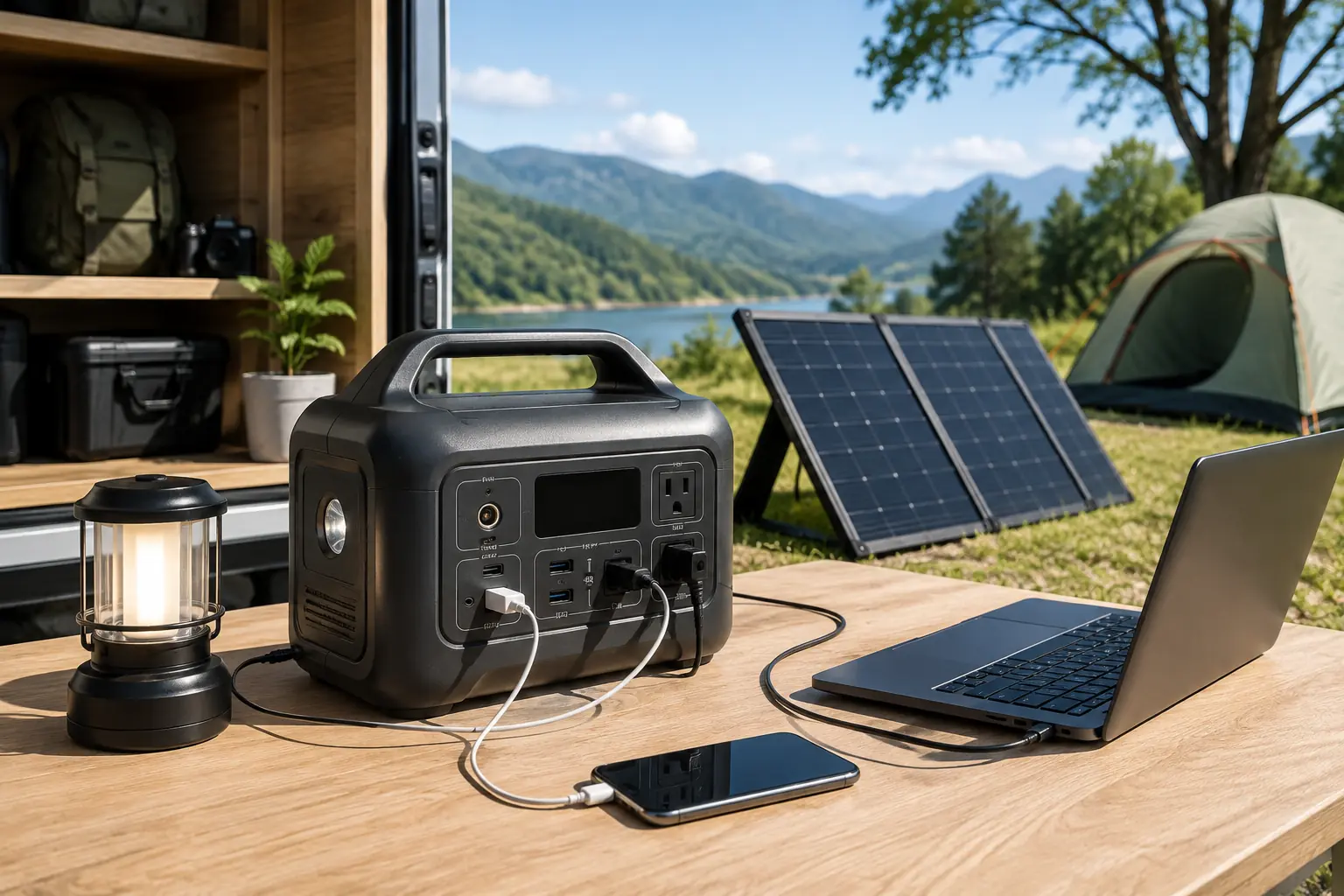
A portable power station is a rechargeable battery-powered device that stores electricity and supplies it through outputs such as AC receptacles, USB ports, and DC connections. It normally combines a battery, battery-management electronics, charging equipment, and an inverter in one movable enclosure, allowing electronics and appliances to operate when normal grid electricity is unavailable.
It Stores Electricity Rather Than Generating Fuel-Based Power
A conventional generator works roughly like this:
Fuel → engine → generator → electricity
A portable power station works differently:
Grid / solar / vehicle charging
↓
Battery stores electricity
↓
Inverter converts DC to AC
↓
Appliances and electronics
That distinction has practical consequences.
Portable power stations generally operate quietly and do not produce combustion exhaust during use. Consumer Reports notes that, unlike fuel-powered generators, battery power stations have no engine and do not produce carbon monoxide from combustion.
But the battery eventually runs out.
I therefore need to know two numbers before selecting one:
Watts (W) tell me how much power it can supply.
Watt-hours (Wh) tell me how much energy it can store.
Understanding that difference solves much of the confusion around portable power station specifications.
How Much Portable Power Station Capacity Do I Need?
Battery capacity should be calculated from the devices I plan to operate rather than selected from a generic recommendation.
I calculate portable power station capacity by multiplying each device's power consumption in watts by the number of hours I expect to use it. Adding those energy requirements gives an approximate watt-hour requirement. I then add a reasonable margin for inverter losses, load variation, battery operating limits, and unexpected additional use.
Start With Watt-Hours
The basic calculation is:
Energy (Wh) = Power (W) × Time (hours)
Suppose I need to power:
| Device | Average Power | Usage | Energy |
|---|---|---|---|
| Laptop | 60 W | 5 h | 300 Wh |
| LED lights | 20 W | 6 h | 120 Wh |
| Phone charging | 15 W | 4 h | 60 Wh |
| Small fan | 40 W | 5 h | 200 Wh |
| Total | 680 Wh |
My basic requirement is therefore:
680 Wh
I would not automatically buy a 680 Wh battery.
The advertised battery capacity is not necessarily identical to the AC energy I can actually deliver to appliances.
Energy is consumed by:
- Inverter conversion
- Internal electronics
- Cooling
- Standby operation
I also want some reserve capacity.
For planning, I might therefore look above the calculated requirement rather than choosing a unit whose advertised capacity exactly equals 680 Wh.
Runtime Is Only an Estimate
Suppose I have a:
1,024 Wh power station
and a constant:
100 W load
The ideal mathematical runtime is:
1,024 Wh ÷ 100 W = 10.24 hours
But I should not promise 10.24 hours of real AC runtime.
Actual runtime depends on:
- Conversion efficiency
- Battery temperature
- Battery age
- Standby consumption
- Load behavior
- Battery protection limits
A better formula is:
Estimated runtime ≈ usable battery energy ÷ average load
For products I am seriously considering, I look for independent runtime testing rather than relying entirely on marketing estimates.
Consumer Reports specifically notes that its portable power station evaluations consider factors such as power delivery, recharge speed, power quality, and usability rather than simply accepting advertised runtime claims.
How Many Watts Should a Portable Power Station Have?
Capacity tells me how long the battery might last, but wattage determines whether the power station can operate my equipment in the first place.
I choose inverter output by adding the power requirements of devices that may operate simultaneously and ensuring that total remains below the power station's continuous AC output. I also check surge output because refrigerators, compressors, pumps, and motor-driven tools can temporarily require substantially more power when starting than they consume during normal operation.
Continuous Watts Matter
Suppose I want to operate simultaneously:
Refrigerator: 150 W
Laptop: 70 W
Lights: 40 W
Television: 120 W
Total running load:
150 + 70 + 40 + 120 = 380 W
A 500 W inverter may appear sufficient.
But I still need to consider startup demand.
Surge Watts Matter Too
A refrigerator compressor or power tool can temporarily draw much more power when starting.
Consumer Reports recommends leaving headroom between appliance requirements and the power station's maximum output because appliances such as refrigerators can produce startup surges.
This gives me two separate questions:
Continuous output: Can it keep my devices running?
Surge output: Can it start them?
A power station with:
1,500 W continuous
and:
3,000 W surge
does not mean I can continuously operate a 2,500 W appliance.
The higher number normally applies only to temporary surge conditions according to the manufacturer's specified limits.
Watts and Watt-Hours Must Be Evaluated Together
Consider two imaginary power stations:
| Specification | Station A | Station B |
|---|---|---|
| Capacity | 2,000 Wh | 1,000 Wh |
| AC output | 800 W | 1,800 W |
Station A stores more energy.
Station B supplies more power.
For running a:
1,200 W appliance
Station B may be suitable while Station A is not.
For operating a:
200 W appliance for many hours
Station A may be more useful.
This is why I never rank portable power stations by one specification.
Should I Choose a LiFePO4 Portable Power Station?
Battery chemistry affects lifespan, weight, energy density, thermal behavior, and the number of charge-discharge cycles a product can tolerate.
LiFePO4, or lithium iron phosphate, has become a common choice for modern portable power stations, particularly when frequent cycling and long service life are priorities. Other lithium-ion chemistries can provide high energy density and lower weight. I compare chemistry together with the manufacturer's cycle-life conditions, warranty, BMS, physical weight, and safety certification.
Cycle-Life Claims Need Context
A manufacturer may advertise:
3,000 cycles
or:
4,000 cycles
But I want to know what that actually means.
Questions include:
- At what depth of discharge?
- At what temperature?
- At what charge rate?
- What capacity remains after those cycles?
- What test procedure was used?
For example, a statement such as:
3,000 cycles to 80% capacity
is much more informative than:
“3,000-cycle battery.”
Battery aging also occurs with time, even when the battery is not cycling heavily.
Therefore, I compare both:
cycle warranty
and:
calendar warranty.
The BMS Is Equally Important
Battery chemistry is only one part of battery safety.
The battery-management system may monitor:
- Cell voltage
- Temperature
- Charge current
- Discharge current
- State of charge
- Fault conditions
UL notes that lithium-ion battery failures can enter thermal runaway, creating high temperatures, smoke, fire, toxic gases, and potentially explosive behavior. It recommends purchasing appropriately certified battery products.
So I would rather buy a well-engineered, independently certified product with transparent specifications than choose solely because “LiFePO4” appears on the product page.
How Important Is Solar Charging?
Solar charging can dramatically increase the usefulness of a portable power station for camping and extended outages, but solar compatibility needs to be checked carefully.
Solar charging is especially valuable when I need power away from the grid for extended periods. I check the power station's maximum solar-input wattage, supported input-voltage range, connector requirements, and MPPT charging capability. I also estimate charging time from realistic solar production rather than assuming a panel will continuously deliver its nameplate wattage.
Solar Input Determines Potential Charging Speed
Suppose a battery stores:
1,000 Wh
and supports:
200 W maximum solar input.
Ignoring losses, the theoretical minimum charging time at a constant 200 W would be:
1,000 Wh ÷ 200 W = 5 hours
But solar panels rarely maintain nameplate output continuously.
Real production changes with:
- Time of day
- Clouds
- Panel orientation
- Temperature
- Shading
- Season
Therefore, real charging may take significantly longer.
Consumer Reports found solar recharging could be slow and particularly dependent on weather, describing solar panels as useful for extending battery operation even when conditions make full recharging difficult.
More Solar Panels Do Not Automatically Mean Faster Charging
If a power station accepts a maximum of:
500 W solar input
connecting a theoretical:
1,000 W array
does not mean it will charge at 1,000 W.
I also need to respect the manufacturer's:
- Maximum input voltage
- Maximum current
- Maximum input power
- Approved wiring configuration
Voltage limits are particularly important.
I never assume that two solar panels can safely be connected in series simply because their combined wattage is below the input-power limit.
Solar Turns Stored Power Into Renewable Off-Grid Power
Without solar:
Battery → loads → battery empties
With sufficient solar:
Sunlight → solar panels → battery → loads
This makes solar charging especially valuable for:
- Camping
- RV travel
- Remote work
- Emergency preparedness
- Off-grid cabins
But for short outages, fast AC charging may matter more than solar input.
The right priority depends on the application.
How Fast Should a Portable Power Station Recharge?
Capacity is only useful if I can refill it in a reasonable amount of time.
I compare recharge time alongside battery capacity because two power stations with the same watt-hours may require very different amounts of time to recharge. Fast AC charging is useful between outages or trips, while high solar-input capability matters more for extended off-grid operation. Vehicle charging can provide another option, but its available power may be considerably lower.
Compare Charging Power With Battery Capacity
Suppose two 1,000 Wh products have:
Station A: 200 W charging
Station B: 800 W charging
Theoretical charging times are dramatically different.
Real charging is not perfectly linear because charging power may taper near full SOC, but the input rating still gives me a useful comparison.
Consumer Reports testing found major differences in recharge speed among portable power stations, with its faster tested products reaching useful charge levels much sooner than slower models.
I Consider How the Power Station Will Be Recharged
Common methods include:
| Charging Method | Best Use |
|---|---|
| AC wall charging | Fast routine recharge |
| Solar charging | Camping and off-grid use |
| Vehicle charging | Road trips |
| AC + solar | Faster recharge where supported |
| Generator charging | Extended emergency scenarios |
A camper may prioritize solar input.
A homeowner preparing for short blackouts may prioritize rapid AC recharge.
A road traveler may care more about vehicle charging.
I therefore treat recharge flexibility as part of the application rather than a bonus specification.
Which Ports and Features Should I Look For?
A power station can have impressive battery specifications and still be inconvenient if it cannot connect efficiently to the devices I actually use.
I check the number and type of outputs before buying, including AC receptacles, USB-A, USB-C Power Delivery, and 12 V DC outputs. I also consider display quality, app monitoring, wireless connectivity, built-in lighting, expandable batteries, and UPS-style operation only when those features solve a real requirement.
USB-C Can Reduce Conversion Steps
If my laptop accepts USB-C Power Delivery, direct USB-C output can be useful.
Instead of:
Battery DC → AC inverter → laptop charger → DC
I may use:
Battery → USB-C DC → laptop
The practical efficiency depends on the hardware, but eliminating unnecessary conversion stages can be advantageous.
Check the Actual USB-C Power Rating
A USB-C port is not automatically a high-power laptop port.
One model might provide:
30 W
while another provides:
100 W or more.
Therefore, I check the actual output rating rather than merely counting USB-C connectors.
Count Simultaneous Loads
I also ask:
How many devices will I connect at once?
For example:
- Refrigerator
- Router
- Laptop
- Phone
- Light
I need enough physical ports and enough total inverter power to support that combination.
Six AC outlets on a 500 W inverter do not mean I can operate six 500 W appliances.
The total power limit still applies.
Is UPS Functionality Important in a Portable Power Station?
Many portable power stations advertise UPS or EPS functions, but those terms should not be treated as identical across every product.
UPS-style functionality can be valuable when a power station remains connected between the grid and critical equipment and automatically switches to battery power during an outage. However, I check the manufacturer's specified transfer time, supported load, operating mode, and certification before relying on it for computers, networking equipment, medical equipment, or other interruption-sensitive loads.
Transfer Time Matters
Imagine:
Grid electricity → power station → computer
When the grid fails:
battery inverter → computer
The switch needs to happen quickly enough for the connected device.
Some electronics can tolerate a short interruption.
Others cannot.
I therefore do not assume that a product described as:
“backup power”
is equivalent to a dedicated online UPS.
Home Backup Is Another Level of Integration
A portable power station with AC outlets is not automatically suitable for permanent connection to a home's electrical panel.
UL distinguishes portable power packs under UL 2743 from stationary residential ESS installations. It notes that portable power packs are intended for applications such as camping and emergency power, while stationary ESS applications are subject to different requirements such as UL 9540.
This distinction is important.
If I need:
plug-in refrigerator backup
a portable station may be appropriate.
If I need:
whole-home electrical-panel backup
I verify that the specific equipment and installation method are designed, listed, and approved for that application.
I never improvise a connection that could backfeed the electrical system.
How Important Are Safety Certifications?
Portable power stations contain substantial stored electrical energy, so safety should be part of product selection rather than an afterthought.
I prioritize products with credible third-party safety certification applicable to portable power equipment and verify the certification when possible. In North America, UL 2743 covers portable power packs containing batteries and intended as portable power sources when normal grid power is unavailable. Certification does not eliminate every risk, but it provides evidence that the product has been evaluated against applicable safety requirements.
Look Beyond a Certification Logo
A product page may show multiple logos.
I prefer to verify:
- Certification standard
- Certification organization
- Exact product/model
- Whether the certification applies to the complete unit
UL provides its Product iQ database specifically for verifying certification information.
Use the Correct Charger
UL's current battery-safety guidance recommends using the charger supplied by the manufacturer or one specifically designed for the device and watching for warning signs such as unusual heat, smoke, or swelling.
I also follow manufacturer requirements for:
- Charging temperature
- Storage temperature
- Ventilation
- Water exposure
- Long-term storage SOC
A cheap portable power station is not a bargain if basic battery safety is uncertain.
How Portable Should a Portable Power Station Be?
“Portable” can describe everything from a small unit carried in one hand to a large wheeled battery that is difficult to lift into a vehicle.
I choose portability according to how often the power station will actually move. For hiking or light camping, weight may matter more than maximum capacity. For RV use or emergency home backup, I may accept substantially greater weight in exchange for higher energy capacity, inverter output, and expandable batteries.
Capacity Has a Physical Cost
More battery capacity generally means:
more cells → more weight → larger enclosure
Consumer Reports found a large weight range among the power stations it tested, including high-capacity products that required wheels for practical movement.
This is why I define portable according to my use.
For example:
| Use Case | My Priority |
|---|---|
| Backpacking | Very low weight |
| Car camping | Moderate capacity and portability |
| Photography | Compact size + USB-C |
| RV | Capacity + solar charging |
| Jobsite | High output + ruggedness |
| Emergency home backup | Capacity + output + fast recharge |
A 3 kWh battery may be excellent for home backup.
It may be terrible for someone who needs to carry it 500 meters from a vehicle to a campsite.
What Size Portable Power Station Is Best for Different Uses?
There is no universal capacity category that works for everyone, but rough ranges can help narrow the search.
Small portable power stations are generally best for electronics and short trips, medium units can support laptops, communications equipment, CPAP-type loads, and some small appliances, while larger systems are better suited to refrigerators, heavier appliances, RVs, and emergency backup. I still calculate actual wattage and runtime instead of selecting solely from these categories.
Practical Selection Framework
| Application | Approximate Capacity to Investigate | Key Feature |
|---|---|---|
| Phones/cameras | 200–500 Wh | Low weight |
| Laptop/remote work | 300–700 Wh | USB-C PD |
| Weekend camping | 500–1,000 Wh | Solar input |
| Small fridge + electronics | 1,000–2,000 Wh | Surge capability |
| RV | 1,500–3,000+ Wh | Solar + expandability |
| Emergency essentials | 2,000+ Wh | High output + fast charging |
These are starting ranges, not sizing guarantees.
A refrigerator, for example, cycles on and off rather than drawing constant rated power.
A CPAP machine's energy use can change when a heated humidifier is enabled.
A power tool can have large starting demand.
Actual equipment measurements are therefore better than assumptions.
A Plug-In Power Meter Can Improve Sizing
If possible, I measure appliance energy use over several hours or a full day.
Suppose my refrigerator consumes:
1.2 kWh per day
rather than estimating runtime from its nameplate wattage.
If I want approximately one day of refrigerator backup, I know the battery must deliver at least that amount of usable AC energy, plus whatever margin I consider appropriate.
That produces a much better sizing decision.
My Insights: How to Pick the Right Portable Power Station
After comparing portable power station specifications, safety requirements, and real-world operating considerations, I think the biggest purchasing mistake is starting with a brand, capacity number, or advertised feature rather than the electrical load.
To pick the right portable power station, I first identify the devices I need to operate, calculate their simultaneous wattage and total watt-hours, and add appropriate headroom. I then choose a unit with sufficient continuous and surge output, suitable battery chemistry, practical recharge speed, compatible solar input, useful ports, manageable weight, and credible safety certification.
My First Insight: Calculate Wh Before Shopping
My preferred sequence is:
Device → watts → hours → Wh
not:
Product → advertised capacity → find something to power
Suppose my essential loads consume:
750 Wh per day
If I want two days without recharging:
750 × 2 = 1,500 Wh
I then account for conversion losses and reserve.
Now I have a meaningful target.
My Second Insight: Watts and Watt-Hours Solve Different Problems
This distinction is critical:
Wh = how much energy I have
W = how fast I can deliver it
A power station can have plenty of energy but insufficient inverter power.
Or it can have a powerful inverter but too little battery capacity to operate the load for long.
The correct product needs both.
Consumer Reports similarly evaluates portable stations using separate measures for power delivery and stored-energy/runtime-related capability.
My Third Insight: Recharge Speed Is Almost as Important as Battery Capacity
Consider:
2,000 Wh battery + very slow charging
versus:
1,500 Wh battery + rapid AC and strong solar charging
For repeated daily use, the smaller system may sometimes be more useful because I can replenish it faster.
I therefore think in terms of:
usable energy per day
rather than only:
stored energy at one moment.
My Fourth Insight: Buy Features for the Application
I prioritize different specifications for different users.
For camping:
weight + solar input + quiet operation
For remote work:
USB-C + power quality + runtime
For RV use:
capacity + DC output + solar input + expansion
For emergency backup:
capacity + surge output + recharge speed + safety
For sensitive electronics:
power quality + transfer behavior
There is no single “best” portable power station because these priorities conflict.
My Fifth Insight: The Right Portable Power Station Is the One That Matches the Load
This directly answers How to Pick the Right Portable Power Station?
I use this checklist:
| Question | Why It Matters |
|---|---|
| What devices will I power? | Defines the application |
| What is their combined running wattage? | Determines inverter size |
| What is their startup surge? | Determines surge requirement |
| How many hours must they run? | Determines Wh requirement |
| How often will I cycle the battery? | Influences chemistry/longevity priority |
| How quickly must I recharge? | Determines charging-power requirement |
| Will I use solar? | Determines PV input requirements |
| Which ports do I need? | Determines device compatibility |
| Must I carry it frequently? | Determines acceptable weight |
| Do I need UPS-style operation? | Determines transfer requirements |
| Is it independently certified? | Helps assess safety |
| Do I need future expansion? | Determines system flexibility |
My final sizing logic is therefore:
Step 1: Calculate running watts.
Step 2: Check startup surge.
Step 3: Calculate required watt-hours.
Step 4: Add reasonable operating headroom.
Step 5: Select battery chemistry and cycle-life requirements.
Step 6: Evaluate AC, solar, and vehicle charging.
Step 7: Check ports, weight, and physical size.
Step 8: Verify safety certification and warranty.
Step 9: Compare price only after the technical requirements are satisfied.
That last point is important.
The cheapest product may not provide enough output.
The largest product may be unnecessarily heavy and expensive.
The highest-wattage product may not provide enough runtime.
The product with the most features may include functions I never use.
So I do not ask:
“Which portable power station has the biggest specifications?”
I ask:
“Which portable power station can safely run my required devices for the required time, recharge in the way I need, and remain practical to transport?”
That is the most reliable way to choose the right one.
Conclusion
Pick a portable power station by matching its watt-hours, continuous and surge power, charging capability, battery design, safety certification, and portability to the devices you actually need to run.
](https://voltcrave-battery.com/wp-content/uploads/2026/09/Off-Grid-Solar-Battery-Storage-How-Do-You-Build-a-Reliable-Power-System-768x512.webp)
](https://voltcrave-battery.com/wp-content/uploads/2026/06/What-Are-the-Conditions-Necessary-for-Energy-Storage-768x512.jpg)
](https://voltcrave-battery.com/wp-content/uploads/2026/08/Stackable-Battery-vs-Rack-Mounted-Battery-Which-Is-Better-768x512.webp)