

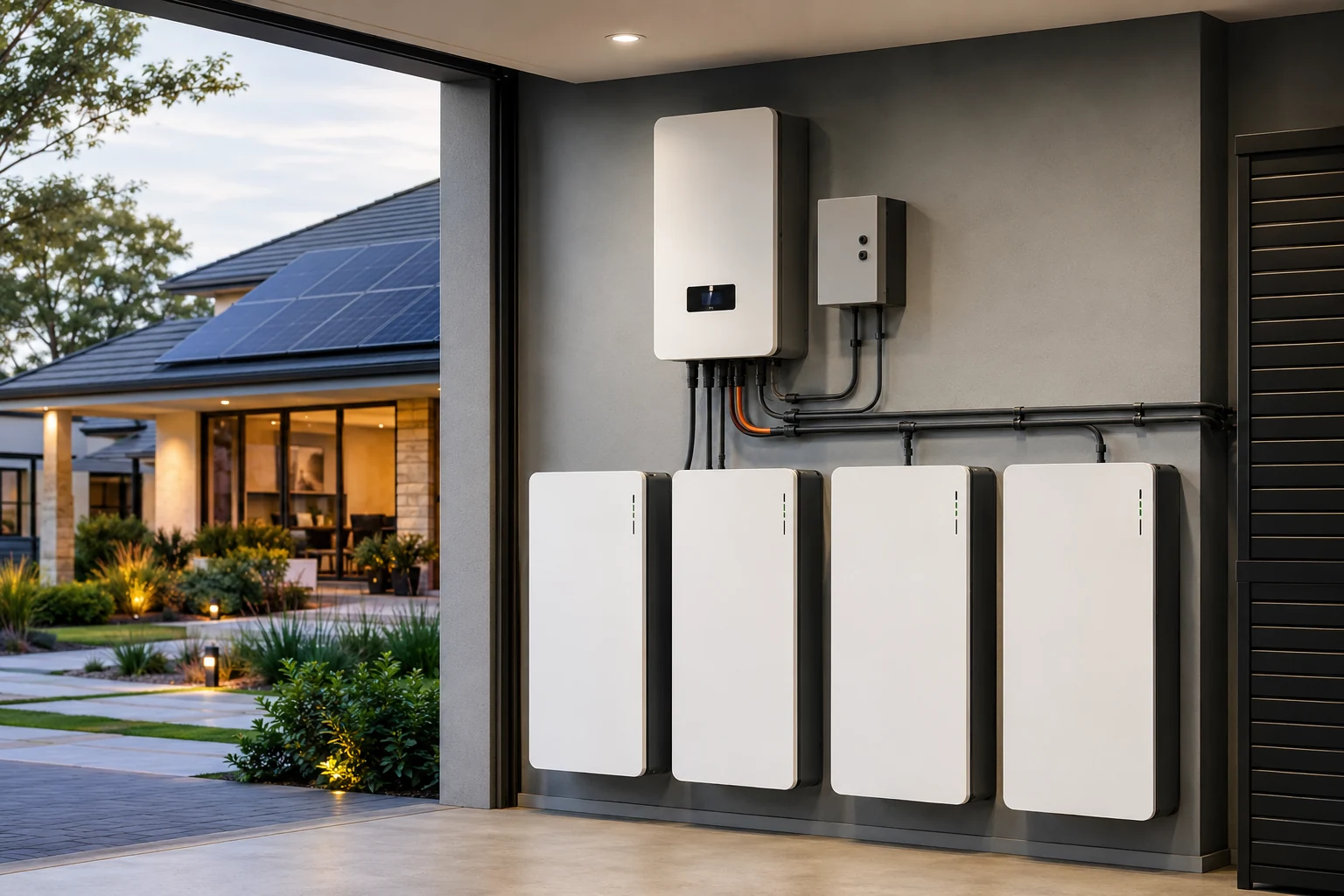
](https://voltcrave-battery.com/wp-content/uploads/2026/08/What-Is-the-Typical-Cycle-Life-for-Residential-ESS-Batteries.webp)
A home battery may cycle almost every day, so cycle life directly affects how long the system can provide useful storage before capacity declines.
For modern residential ESS batteries, I use roughly 6,000–10,000 cycles as a useful benchmark for high-quality LFP systems, although warranty terms vary widely. Enphase currently covers IQ Battery 10C for up to 6,000 discharged cycles, while sonnen offers certain residential systems with warranties reaching 10,000 cycles.
The cycle number alone does not tell me how long a home battery will last. I also look at calendar age, depth of discharge, temperature, charging rate, chemistry, energy throughput, and the capacity-retention level used to define end of life.
What Does Battery Cycle Life Mean?
Many homeowners assume one cycle means charging a battery once, but battery cycle accounting is more precise.
Battery cycle life is the number of charge-and-discharge cycles a battery can complete before its usable capacity falls to a defined level. One equivalent full cycle represents approximately 100% of the battery's usable capacity being discharged in total, even if that energy is used through several smaller partial discharges rather than one full discharge.
A Cycle Does Not Always Mean 100% to 0%
Suppose I have a residential battery with 10 kWh of usable capacity.
On Monday, I discharge:
5 kWh
On Tuesday, I discharge another:
5 kWh
Together, those two partial discharges represent approximately one equivalent full cycle.
Another example:
- Morning discharge: 20%
- Evening discharge: 30%
- Next-day discharge: 50%
The accumulated energy use is approximately:
20% + 30% + 50% = 100%
That is roughly one equivalent full cycle.
FranklinWH explains cycle limits in warranty terms as a way of measuring full charge-and-discharge use, closely related to energy throughput.
I think this distinction matters because residential ESS operation is rarely a perfect daily:
100% → 0% → 100%
A solar battery may instead move between:
90% SOC → 45% SOC → 80% SOC → 35% SOC
depending on weather, electricity prices, backup reserve, and household consumption.
Cycle life also needs an end-of-life definition.
A battery is not normally considered dead when it reaches its specified cycle count. It may still work but store less energy than when it was new.
Current residential warranties commonly guarantee a minimum remaining capacity after a defined period or usage level. Tesla, for example, states that Powerwall is designed to retain at least 70% of its original capacity after ten years under its applicable warranty terms.
I therefore read a cycle specification as:
“How much use can I expect before meaningful degradation?”
not:
“When will the battery suddenly stop working?”
How Many Cycles Do Residential LFP Batteries Typically Last?
LFP has become particularly important for residential storage because it combines long cycling capability with strong thermal stability.
I consider approximately 6,000–10,000 cycles a practical benchmark for many premium residential LFP energy storage systems today, but there is no universal number. Current warranties illustrate the range: Enphase specifies 6,000 cycles for IQ Battery 10C, while sonnen specifies up to 10,000 cycles for several residential systems.
Current Residential Products Show Why One Number Is Misleading
Consider several current warranty structures:
| Residential ESS | Current usage-related warranty structure | Time warranty |
|---|---|---|
| Enphase IQ Battery 10C | Up to 6,000 discharged cycles | 15 years |
| sonnenHome Battery 11 | Up to 10,000 cycles | 10 years |
| Tesla Powerwall 3 | Unlimited cycles under applicable residential use terms | 10 years |
| FranklinWH aPower 2 | 60 MWh energy throughput | 15 years |
Enphase currently states that its IQ Battery 10C warranty ends at the earlier applicable warranty limit, including 15 years or 6,000 discharged cycles.
sonnen currently advertises residential systems with a 10-year or 10,000-cycle warranty, whichever applicable limit is reached first. Its warranty documentation confirms 10,000-cycle limits for several LFP residential products.
Tesla takes another approach. Its current U.S. Powerwall warranty provides a ten-year term, and Tesla describes Powerwall as having unlimited-cycle warranty coverage for qualifying residential energy applications.
FranklinWH uses energy throughput rather than a simple cycle count for its newer products. Its aPower 2 has a 15-year or 60 MWh throughput warranty.
These differences are why I do not compare batteries from the advertised cycle figure alone.
A 10,000-cycle warranty may expire after ten calendar years before the homeowner actually reaches 10,000 cycles.
A 6,000-cycle battery with a 15-year warranty may provide a longer calendar warranty for a typical household.
The useful question is therefore:
How much energy can the battery deliver during the years I plan to own it?
How Many Years Is 6,000 Battery Cycles?
A cycle count becomes easier to understand when I convert it into years of household use.
At one equivalent full cycle per day, 6,000 cycles equal about 16.4 years mathematically. At 10,000 cycles, the theoretical period is about 27.4 years. In practice, residential batteries are also limited by calendar aging and warranty periods, so these calculations should not be interpreted as guaranteed operating lifetimes.
Daily Cycling Makes the Math Simple
If I cycle a battery once every day:
365 cycles per year
For 6,000 cycles:
6,000 ÷ 365 ≈ 16.4 years
For 8,000 cycles:
8,000 ÷ 365 ≈ 21.9 years
For 10,000 cycles:
10,000 ÷ 365 ≈ 27.4 years
| Cycle rating | One full cycle per day | Approximate mathematical period |
|---|---|---|
| 3,000 | 365/year | 8.2 years |
| 4,000 | 365/year | 11.0 years |
| 6,000 | 365/year | 16.4 years |
| 8,000 | 365/year | 21.9 years |
| 10,000 | 365/year | 27.4 years |
However, I would never tell a homeowner that a 10,000-cycle battery is guaranteed to operate for 27 years.
Calendar aging continues even when the battery is not cycling. Battery materials gradually change with time, temperature, state of charge, and other operating conditions. NREL battery-aging research distinguishes calendar aging from cycle aging and models battery degradation across different operating conditions.
Warranty terms also create practical limits.
For example, sonnen's current residential warranty may allow up to 10,000 cycles, but the applicable warranty period is generally ten years for the cited residential products.
Enphase takes the opposite-looking combination:
15 years or 6,000 discharged cycles
for IQ Battery 10C under its current U.S. warranty conditions.
For me, this shows why cycle life and calendar life must always be read together.
Why Does LFP Usually Have a Long Cycle Life in Residential ESS?
Residential batteries increasingly use lithium iron phosphate because stationary storage values durability and safety more than extremely high energy density.
LFP is widely used in residential storage because its chemistry is well suited to repeated stationary cycling. Current LFP-based home systems demonstrate warranty structures ranging from 6,000 to 10,000 cycles, while some manufacturers use long energy-throughput guarantees instead. Battery design, cooling, BMS settings, and operating limits still matter as much as chemistry.
Chemistry Does Not Determine Cycle Life by Itself
I often see statements such as:
“LFP lasts 10,000 cycles.”
I consider that too simple.
An LFP battery's actual cycle performance depends on:
- Cell design
- Electrode formulation
- Manufacturing quality
- Depth of discharge
- Charge rate
- Discharge rate
- Cell temperature
- SOC window
- BMS limits
- Cooling system
sonnen states that its current residential products use LFP and explicitly links the chemistry with durability for stationary storage. Its current residential portfolio includes products with warranty limits reaching 10,000 cycles.
Enphase also currently backs its IQ Battery 10C with a 15-year limited warranty tied to 6,000 discharged cycles.
The difference between these two figures does not automatically mean one cell chemistry is better than the other.
Their manufacturers may define:
- Cycle accounting differently
- Usable SOC differently
- Capacity-retention guarantees differently
- Warranty conditions differently
I therefore prefer a battery with strong real system engineering rather than the highest cycle number on a sales sheet.
For residential ESS procurement, I ask:
- Is the battery LFP?
- What is the warranted cycle or throughput limit?
- What capacity remains at the end of the warranty?
- What temperature range applies?
- Does daily tariff cycling remain covered?
- Does VPP participation change the warranty?
These questions reveal more about real lifetime value than chemistry alone.
How Does Depth of Discharge Affect Residential Battery Cycle Life?
A battery experiences different stress when it uses only part of its stored energy compared with repeatedly operating across its entire capacity range.
Depth of discharge affects battery aging because deeper cycling moves more energy and lithium through the cell during each cycle. In general, controlling the usable SOC window can reduce stress, although the exact effect depends on cell chemistry and design. Modern residential ESS uses BMS and EMS controls to manage these limits automatically.
A Smaller Daily Cycle Can Be Easier on the Battery
Suppose I have a 15 kWh home battery.
Household A uses:
3 kWh each night
That is approximately:
20% depth of discharge
Household B uses:
12 kWh each night
That is approximately:
80% depth of discharge
The second battery delivers much more energy during each daily cycle.
That higher energy throughput contributes to cycle aging.
This does not mean deep cycling is always wrong.
A battery exists to be used.
If electricity prices make daily deep discharge economically attractive, the savings may justify faster degradation.
The important point is that I include battery degradation in the operating strategy.
Modern residential ESS usually protects the cells with software-controlled SOC limits.
For example, the homeowner may see 100% usable SOC in an app while the manufacturer's internal control system maintains hidden electrochemical buffers above or below the displayed range.
This is one reason I do not try to manually “protect” a modern battery without understanding the manufacturer's control strategy.
I instead use the settings provided for:
- Backup reserve
- Time-of-use operation
- Solar self-consumption
- VPP participation
Then I check whether those operating modes remain within warranty terms.
A high-quality BMS should prevent the homeowner from routinely pushing the cells beyond validated operating limits.
Does Temperature Reduce Home Battery Cycle Life?
Temperature can have a major influence on both cycle aging and calendar aging.
High battery temperature can accelerate degradation reactions, while very low temperature can restrict charging and power performance. I therefore consider thermal management an important part of residential ESS life. A battery installed outdoors in a harsh climate may experience different aging from the same battery operating in a temperature-controlled location.
Installation Location Can Affect Long-Term Performance
A home battery may be installed in:
- Garage
- Basement
- Exterior wall
- Utility room
- Outdoor equipment area
These locations can experience very different temperatures.
A garage in a hot climate may become much hotter than the home's indoor temperature.
An outdoor battery in a cold region may need internal heating before high-rate charging.
Manufacturers therefore design residential systems with thermal controls.
Tesla, for example, states that Powerwall can operate in harsh environmental conditions and uses an intelligent Heat Mode to support cold-weather charging and discharging.
This does not mean temperature no longer matters.
Thermal control itself has limits and consumes energy.
I still prefer installation conditions that avoid unnecessary extreme heat whenever the product instructions and electrical code allow it.
Temperature uniformity also matters inside the battery.
If one module or cell remains hotter than the others, it can age more quickly.
Eventually, the weaker part of the pack can restrict the usable capacity of the full system.
That is why I evaluate:
- Battery thermal architecture
- Installation clearances
- Ventilation requirements
- Direct sunlight exposure
- Manufacturer temperature limits
along with cycle specifications.
A battery advertised for 8,000 cycles under controlled conditions may not deliver the same degradation profile if it spends years near its maximum permitted temperature.
Is Battery Warranty More Important Than Advertised Cycle Life?
For a homeowner, I usually consider the warranty more useful than a laboratory cycle-life claim.
Yes. I place more weight on the residential ESS warranty because it defines what the manufacturer actually guarantees. A strong warranty specifies years, cycles or energy throughput, remaining capacity, approved applications, and operating conditions. The advertised cell cycle life may describe laboratory performance that is not equivalent to the warranty on the complete installed battery system.
Different Manufacturers Use Different Warranty Metrics
The current residential market provides good examples.
Tesla Powerwall
Tesla's current U.S. warranty covers Powerwall for ten years. Tesla also describes Powerwall as carrying unlimited-cycle coverage for qualifying residential applications and states that it is designed to retain at least 70% capacity after ten years under applicable conditions.
Enphase IQ Battery 10C
Enphase currently specifies a 15-year limited warranty with a limit of 6,000 discharged cycles. Its warranty documentation also includes capacity-retention requirements.
sonnen
Current sonnen residential products include warranties reaching 10,000 cycles or ten years, depending on the applicable product and whichever warranty limit is reached first.
FranklinWH
FranklinWH aPower 2 uses a different metric: 15 years or 60 MWh of throughput.
| Warranty metric | What it tells me |
|---|---|
| Years | Calendar coverage |
| Cycles | Number of equivalent battery uses |
| MWh throughput | Total energy delivered over life |
| Capacity retention | Remaining storage at warranty milestone |
| Application limits | Which operating modes are covered |
I therefore never compare “6,000 cycles” with “60 MWh” without converting them into the actual battery size and expected household operating profile.
How Can I Extend the Cycle Life of a Residential ESS Battery?
A homeowner cannot stop battery aging, but good system design and operating conditions can avoid unnecessary degradation.
I extend residential ESS life by avoiding excessive heat, using manufacturer-approved SOC settings, maintaining reasonable backup reserves, keeping firmware and battery controls current, avoiding unsupported operating modes, and sizing the battery large enough that it does not need extreme cycling every day. The BMS should remain responsible for protecting cell-level voltage and temperature limits.
I Start With Correct Battery Sizing
An undersized battery may cycle very deeply every day.
Suppose a home consumes:
15 kWh every evening
A 10 kWh battery may be heavily utilized each night.
A 20 or 30 kWh system may use a smaller percentage of its total capacity for the same household load.
That does not automatically mean a larger battery provides better economics.
It does mean battery sizing influences cycling stress.
I Avoid Unnecessary Heat
I follow the manufacturer's installation requirements and avoid adding thermal stress through poor placement.
I consider:
- Shade
- Required clearances
- Garage temperatures
- Outdoor exposure
- Ventilation
I Use Backup Reserve Strategically
Keeping a very high backup reserve means the battery spends more time at a higher SOC and provides less capacity for energy savings.
Keeping almost no reserve may reduce outage protection.
I choose a reserve based on actual outage risk rather than leaving it at an arbitrary setting.
I Let the BMS Control the Cells
I do not bypass:
- Charge limits
- Temperature controls
- Firmware protections
- Communication interfaces
Modern residential batteries rely on these systems to keep individual cells within acceptable operating conditions.
NREL research shows that battery degradation depends on both calendar and cycling conditions, reinforcing why operating environment and usage pattern matter alongside nominal cycle specifications.
My Insights: What Is the Typical Cycle Life for Residential ESS Batteries?
I would not judge residential battery longevity from one advertised number. Current products show that cycle warranties, calendar warranties, and throughput guarantees are increasingly used together.
The typical cycle-life benchmark I use for a modern residential LFP ESS is about 6,000–10,000 cycles, but warranty-backed performance is more important than the headline number. Current products range from Enphase's 6,000-cycle limit to sonnen's 10,000-cycle coverage, while Tesla uses unlimited-cycle terms and FranklinWH uses energy throughput.
I Would Treat 6,000 Cycles as a Strong Residential Baseline
At one equivalent full cycle per day:
6,000 cycles ≈ 16.4 years
That already exceeds the ten-year calendar warranty common to many home batteries.
It also approaches Enphase's current 15-year calendar warranty for IQ Battery 10C.
For a homeowner performing daily solar shifting, I therefore see 6,000 warranty-backed cycles as a meaningful level.
Ten Thousand Cycles Provides More Cycling Headroom
sonnen demonstrates that residential LFP systems can be sold with cycle warranty limits reaching 10,000 cycles.
At one cycle per day, a homeowner is unlikely to reach 10,000 cycles within a ten-year warranty period.
That means calendar time may become the controlling warranty limit before cycling does.
This is why an extremely high cycle figure does not automatically mean a longer warranty.
Throughput May Be a Better Metric
I increasingly like throughput warranties because they connect degradation directly with energy delivered.
FranklinWH's aPower 2, for example, provides a 15 kWh battery and a warranty of 15 years or 60 MWh throughput.
A simple theoretical calculation gives:
60,000 kWh ÷ 15 kWh = 4,000 nominal full-capacity equivalents
However, I would not label that directly as a 4,000-cycle warranty because warranty throughput accounting and changing usable capacity can differ from this simplified calculation.
The important point is that the manufacturer limits total energy use rather than counting only cycles.
Calendar Life Can Matter More Than Cycle Life
Tesla's approach illustrates the same lesson from another direction.
Tesla currently provides a ten-year Powerwall warranty and describes qualifying residential use as unlimited-cycle coverage.
In that case, the homeowner does not need to count daily cycles in the same way.
Time becomes the clearer warranty boundary.
My Practical Residential ESS Benchmark
When I evaluate a new LFP home battery, I look for:
| Metric | What I want to see |
|---|---|
| Cycle capability | Roughly 6,000+ cycles as a strong benchmark |
| Calendar warranty | 10–15 years |
| Capacity retention | Clearly defined |
| Throughput | Clearly disclosed where applicable |
| Chemistry | LFP preferred for many residential applications |
| Daily cycling | Explicitly allowed |
| Backup use | Covered |
| VPP use | Warranty terms clearly defined |
The best residential battery is not necessarily the one with the largest cycle number.
I prefer the system with a transparent warranty, suitable chemistry, effective thermal management, good BMS control, and enough usable capacity to meet the homeowner's energy needs without unnecessary stress.
Conclusion
A modern residential LFP ESS commonly targets thousands of cycles, with roughly 6,000–10,000 cycles a useful benchmark. Actual lifetime depends on warranty, temperature, usage, and degradation.
](https://voltcrave-battery.com/wp-content/uploads/2026/08/All-in-One-Three-Phase-Hybrid-Residential-Battery-Energy-Storage-System-768x512.webp)
](https://voltcrave-battery.com/wp-content/uploads/2026/08/What-Country-Makes-the-Most-Batteries-768x512.webp)
](https://voltcrave-battery.com/wp-content/uploads/2026/09/Is-a-Pure-Sine-Wave-Inverter-Better-768x512.webp)