

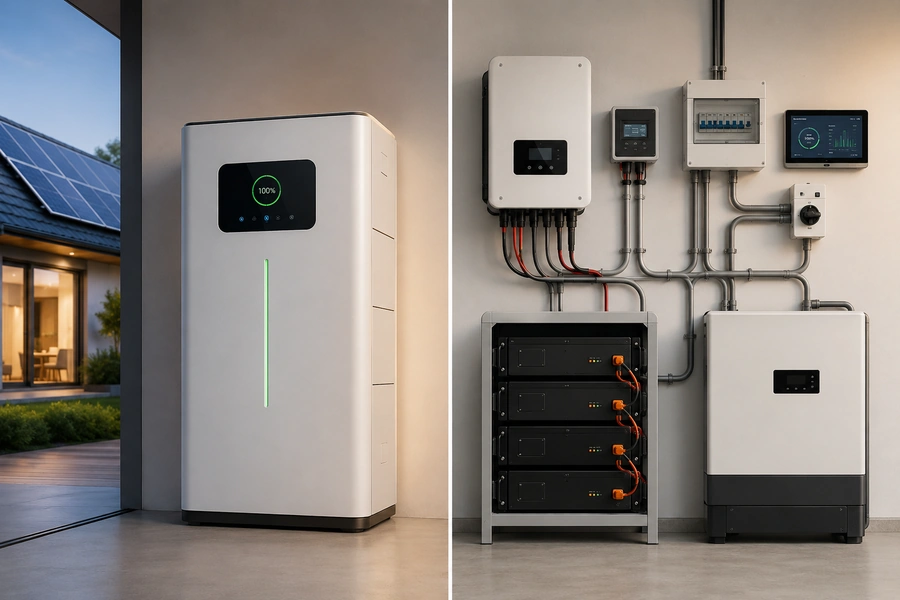
](https://voltcrave-battery.com/wp-content/uploads/2026/08/The-Ultimate-Guide-to-Energy-Storage-All-in-One-vs.-Split-Systems-Which-Is-Right-for-You.webp)
Choosing the wrong storage architecture can increase installation complexity, restrict future expansion, and leave you with expensive components that are difficult to replace or upgrade.
An all-in-one energy storage system integrates the battery, inverter, controls, and related functions into a coordinated platform, while a split system uses separately installed components. I prefer all-in-one systems for simplicity and faster deployment, but split systems are often better when I need maximum flexibility, component-level serviceability, or customized system sizing.
I do not choose between them based on appearance. I compare electrical architecture, battery capacity, inverter power, solar compatibility, expansion, maintenance, certification, backup requirements, and total lifecycle cost.
What Is the Difference Between an All-in-One and a Split Energy Storage System?
The biggest difference is how tightly the battery, inverter, management system, and other power components are integrated before installation.
An all-in-one ESS combines most major storage and power-conversion functions into one factory-engineered system. A split energy storage system uses separate battery, inverter, control, and sometimes charge-controller components. The all-in-one approach prioritizes integration and simplicity, while the split approach gives me more freedom to select, replace, expand, and optimize individual components.
How an All-in-One ESS Is Structured
A simplified all-in-one residential system may contain:
Battery cells
↓
BMS
↓
Bidirectional or hybrid inverter
↓
Energy-management controls
↓
Monitoring and protection
These components may be installed inside one enclosure or delivered as closely integrated modules belonging to one product ecosystem.
A basic energy flow could look like:
Solar PV → integrated inverter → home
Solar PV → battery
Battery → integrated inverter → home
Grid ↔ integrated system
This type of integration reduces the amount of system engineering that must happen at the installation site.
How a Split ESS Is Structured
A split system may instead look like:
Solar array → separate solar/hybrid inverter
Separate battery bank ↔ inverter
Separate controller / gateway → loads and grid
In some designs, the battery manufacturer and inverter manufacturer are different.
That gives me additional freedom, but it also creates more interfaces that need to be verified.
The U.S. Department of Energy explains that solar-plus-storage systems can use different inverter arrangements. In a DC-coupled system, PV and battery storage can share a bidirectional inverter, while an AC-coupled architecture uses both a PV inverter and a bidirectional battery inverter.
There is an important distinction here:
All-in-one vs. split describes system integration.
AC-coupled vs. DC-coupled describes electrical topology.
They are related, but they are not the same question.
| Feature | All-in-One ESS | Split ESS |
|---|---|---|
| Battery | Integrated or matched | Separate |
| Inverter | Usually integrated | Separate |
| BMS | Factory-integrated | Battery-specific |
| EMS/controller | Usually integrated | May be separate |
| Installation | Simpler | More engineering |
| Component choice | More limited | Greater |
| Expansion | Product-dependent | Often more configurable |
| Replacement | Ecosystem-dependent | Easier component-level replacement |
| Appearance | Usually compact | Multiple devices |
| Best fit | Standardized projects | Customized projects |
I therefore see these two architectures as different ways to solve the same energy-storage problem rather than competing technologies where one is always superior.
What Are the Advantages of an All-in-One Energy Storage System?
All-in-one systems are attractive because many compatibility decisions are solved before the product reaches the installation site.
The main advantages of an all-in-one ESS are simplified installation, fewer component interfaces, compact design, centralized monitoring, easier commissioning, and factory-validated communication between the battery and power-conversion system. I usually prefer this architecture for new residential solar projects, repeatable installations, and customers who value simplicity over maximum component-level customization.
Integration Reduces Compatibility Work
Battery storage depends on communication between several systems.
The battery management system may communicate:
- State of charge
- Battery voltage
- Temperature
- Maximum charge current
- Maximum discharge current
- Fault status
The inverter needs to respond correctly to those limits.
In a split system using products from different manufacturers, I need to verify communication compatibility carefully.
That may involve:
- CAN communication
- RS485
- Supported battery lists
- Firmware versions
- Charge profiles
- Voltage limits
With a well-designed all-in-one ESS, the manufacturer has already engineered those relationships.
That can reduce commissioning problems.
Installation Can Be Cleaner
Imagine a traditional system that requires:
- One battery cabinet
- One hybrid inverter
- One energy controller
- Multiple DC disconnects
- Communication wiring
- Several cable routes
An integrated system can consolidate many of those functions.
That can be particularly valuable in:
- Garages
- Utility rooms
- Small commercial buildings
- Apartments
- Space-constrained installations
I also value the simpler appearance.
Home energy storage is increasingly becoming permanent household infrastructure. A compact integrated unit is often easier to place than several unrelated electrical boxes.
System-Level Safety Matters
Integration also matters from a certification perspective.
UL explains that UL 9540 evaluates an energy storage system as a complete system and references standards covering batteries, inverters, converters, controllers, and related equipment.
UL has also emphasized that pairing a certified battery with an inverter does not automatically mean the combination has been evaluated as a complete UL 9540 energy storage system.
That is an important reason I value factory-matched architecture.
I do not only ask:
“Is the battery certified?”
I ask:
“Has the complete battery-and-inverter configuration been evaluated for the intended installation?”
One Monitoring Platform Is Convenient
Integrated systems also tend to consolidate data.
Instead of using one application for solar and another for the battery, I may see:
- Solar generation
- Household load
- Battery SOC
- Grid import
- Grid export
- Backup reserve
inside one interface.
For many homeowners, that simplicity is more valuable than the freedom to mix brands.
What Are the Disadvantages of an All-in-One Energy Storage System?
Integration solves many installation problems, but it can create long-term dependence on one platform.
The main disadvantages of an all-in-one ESS are vendor lock-in, limited component choice, fixed battery-to-inverter combinations, restricted expansion paths, and greater dependence on the original manufacturer for replacement hardware and software. If I expect frequent upgrades or highly customized sizing, I usually investigate split architecture before committing to an integrated platform.
One Failed Component Can Affect the Whole Platform
Suppose I have a separate:
15 kWh battery + 8 kW inverter
If the inverter fails, I may be able to replace the inverter while keeping the battery.
In a tightly integrated ESS, the replacement may need to come from the same product ecosystem.
That does not necessarily mean the whole system must physically be discarded.
Modern integrated systems often use replaceable internal components.
But my choices can be narrower.
I therefore check:
- Replacement-parts policy
- Installer access
- Warranty process
- Firmware support
- Product lifecycle
- Expansion-battery compatibility
before I buy.
Expansion Can Be Restricted
Imagine that my home starts with:
10 kWh
Five years later, I install:
- An EV
- Heat-pump heating
- Electric water heating
Now I want:
30 kWh
A modular all-in-one system may support this easily.
Another product may only allow two battery modules.
A split design can often let me configure energy and power more independently.
For me, this is one of the largest differences.
I want to know not only:
“How much storage does the system have today?”
but:
“What can this system become in ten years?”
Vendor Lock-In Is a Lifecycle Question
A battery system can remain installed for a decade or longer.
That means I care about the manufacturer supporting the platform throughout its useful life.
If the inverter, battery, BMS, gateway, and software all rely on one proprietary ecosystem, the manufacturer's long-term service capability becomes especially important.
This is not unique to storage.
The same issue exists with:
- Smart-home platforms
- EV chargers
- HVAC controls
- Solar monitoring
The more integrated the system becomes, the more valuable ecosystem stability becomes.
So I view all-in-one architecture as exchanging some flexibility for convenience.
That can be an excellent trade for a typical home.
It is not automatically the best trade for every project.
What Are the Advantages of a Split Energy Storage System?
Split systems require more engineering, but that is also their strength.
I choose a split ESS when I want independent control over battery capacity, inverter power, solar architecture, component brand, service strategy, and future expansion. Split systems are especially useful for custom solar installations, off-grid projects, larger residential systems, commercial sites, and projects where individual components may need to be upgraded without replacing the complete storage platform.
I Can Size kWh and kW Independently
Battery systems have two key dimensions:
kWh = energy
kW = power
Suppose I need long backup but relatively low peak power.
I might want:
30 kWh battery + 6 kW inverter
Another home might need:
15 kWh battery + 12 kW inverter
The second home stores half as much energy but can supply twice as much instantaneous power.
A split architecture can make these combinations easier to build.
This is particularly useful for projects with unusual requirements.
I Can Select Components by Strength
One company may make an excellent inverter.
Another may specialize in LFP batteries.
A split design allows me to select both.
I might choose equipment based on:
- Battery warranty
- Inverter efficiency
- Local service
- Solar MPPT design
- Generator compatibility
- Off-grid performance
- Communication protocols
This creates a much larger design space.
Component-Level Replacement Can Be Easier
Suppose the battery is healthy after ten years but inverter technology has improved.
With the right modular architecture, I may be able to replace only the inverter.
Or the opposite may happen.
The inverter may still be working while the original batteries are ready for replacement.
A split system gives me a better chance of handling those lifecycle changes independently, although actual compatibility still must be verified.
Split Systems Work Well for Advanced Projects
I particularly like modular architecture when I am designing:
- Large off-grid homes
- Farms
- Workshops
- Telecom sites
- Commercial buildings
- Generator-hybrid systems
- Large multi-inverter projects
These installations often need much more customization than a standard suburban solar-plus-storage installation.
In those cases, the extra engineering is not necessarily a disadvantage.
It is what allows the system to match the load.
What Are the Disadvantages of a Split Energy Storage System?
More flexibility also means more responsibility for system integration.
Split energy storage systems can require more design work, wiring, wall or floor space, commissioning, compatibility testing, and troubleshooting. I must verify that batteries, inverters, controllers, and protection devices can safely communicate and operate together. A flexible system becomes a poor system if its components have not been properly engineered as one complete installation.
Compatibility Is My Biggest Concern
A battery may appear electrically compatible because its voltage falls within an inverter's DC range.
That is not enough.
I also need compatible:
- Communication
- BMS commands
- Charge limits
- Discharge limits
- Fault behavior
- Firmware
A communication failure could cause the inverter to lose accurate battery information.
A properly engineered system should fail safely, but it may shut down or operate with reduced functionality.
I therefore never assume that two components are compatible because their plugs fit.
More Equipment Means More Installation Work
A split system can involve more:
- Mounting
- Cabling
- Disconnects
- Protection
- Configuration
That can increase labor.
It can also increase the number of points that technicians need to inspect during troubleshooting.
The U.S. Department of Energy notes that solar-plus-storage systems can use either DC-coupled or AC-coupled configurations. AC-coupled designs generally involve both a solar inverter and a separate bidirectional storage inverter, while DC-coupled systems can share conversion equipment.
That additional conversion equipment can be very useful for retrofits, but it also illustrates why some split architectures contain more hardware.
Safety and Certification Need Careful Review
UL's guidance is particularly relevant here.
UL 9540 evaluates energy storage as a system, including the interaction between batteries and power-conversion equipment.
This means I do not want to create an improvised combination simply because the individual components appear suitable.
For a professionally installed ESS, I verify the applicable listing, local electrical requirements, fire requirements, and manufacturer-approved configuration.
Flexibility should not come at the expense of a validated system design.
Is All-in-One vs. Split the Same as DC-Coupled vs. AC-Coupled?
No. This is one of the most important distinctions in energy storage design.
All-in-one versus split describes how the hardware is packaged and integrated. AC coupling versus DC coupling describes how solar, batteries, and the electrical system exchange energy. An all-in-one product can use a DC-coupled architecture, while a split system can be AC-coupled or DC-coupled depending on the equipment configuration.
What Is DC Coupling?
Solar panels generate DC electricity.
Batteries store DC electricity.
A DC-coupled system can therefore connect PV and battery storage on the DC side before electricity is converted into AC.
DOE explains that a DC-coupled PV-plus-storage system can use a bidirectional inverter connecting the battery and PV system to the AC network.
A simplified path is:
PV DC → battery DC
and:
PV/battery DC → inverter → home AC
The potential advantage is fewer conversion stages when storing solar energy directly.
What Is AC Coupling?
An AC-coupled retrofit may look like:
PV → existing solar inverter → AC bus
Battery ↔ separate battery inverter ↔ AC bus
DOE notes that an AC-coupled configuration uses a PV inverter plus a bidirectional inverter for battery storage.
This can be attractive when the home already has solar.
I may be able to add storage without replacing a perfectly functional solar inverter.
Why the Distinction Matters
Consider two scenarios.
New solar installation
I am designing everything at once.
A tightly integrated DC-coupled all-in-one system may be attractive.
Existing five-year-old solar system
The PV inverter works well.
Now I want storage.
An AC-coupled battery system may be easier because I can retain the existing solar equipment.
That is why I ask two separate questions:
- Do I want an all-in-one or split product architecture?
- Do I want an AC-coupled or DC-coupled electrical architecture?
Answering only one does not fully define the system.
Is an All-in-One or Split System Better for Backup Power?
Neither architecture automatically provides better backup. The inverter, battery capacity, switching equipment, and load design determine backup performance.
For backup power, I compare usable kWh, continuous kW, surge capability, transfer method, solar operation during outages, load management, and expansion. An all-in-one system can make backup easier to engineer, while a split system can give me more freedom to build very large or specialized backup configurations. The correct system must also support intentional islanding.
Solar Alone Does Not Guarantee Outage Power
This surprises many homeowners.
A standard grid-connected solar system usually shuts down during a utility outage unless it is specifically designed to operate in an islanded backup configuration.
DOE explains that solar-plus-storage systems need advanced inverter capabilities to operate without grid support during an outage when designed for that purpose.
DOE also notes that solar plus storage can provide resilience and backup during electrical disruptions.
So I check the complete backup architecture.
I Compare Energy and Power Separately
Suppose Home A needs essential backup:
- Refrigerator
- Lights
- Internet
- Some outlets
The average load might remain relatively small.
An all-in-one battery could be ideal.
Now consider Home B:
- Two air conditioners
- Well pump
- Electric water heater
- Workshop
- EV charger
That house may require a more customized inverter and battery configuration.
A split system could become more attractive.
Load Management Can Change the Answer
I do not always need a larger battery.
Sometimes I need smarter load control.
During an outage, the system might temporarily disable:
- EV charging
- Pool heater
- Electric dryer
while maintaining:
- Refrigerator
- HVAC
- Well pump
- Lighting
- Communications
A well-integrated all-in-one system can make this process easier when its ecosystem includes smart load management.
A customized split system can also achieve it with separate control equipment.
Again, integration determines convenience.
Engineering determines performance.
Which Is More Cost-Effective: All-in-One or Split Energy Storage?
There is no universal winner because hardware cost is only one part of the installed system cost.
All-in-one systems can reduce labor, wiring, commissioning, and integration costs, while split systems can let me choose lower-cost components and replace individual equipment later. I compare total installed and lifecycle cost rather than battery price alone. The less expensive architecture depends on system size, labor rates, existing solar equipment, expansion plans, and maintenance strategy.
All-in-One Can Reduce Soft Costs
A pre-integrated platform may require less:
- Design time
- Communication configuration
- Field wiring
- Wall space
- Commissioning
This matters because residential energy storage is not priced only by the battery cells.
Installation can involve:
- Electrician labor
- Permits
- Backup gateway
- Panel modifications
- Disconnect equipment
- Commissioning
Reducing field complexity can therefore create real value.
Split Systems Can Avoid Unnecessary Replacement
Suppose I already have a five-year-old solar inverter that works perfectly.
Replacing it simply because I want a battery may not be economical.
A split AC-coupled storage system could allow me to keep the existing PV system.
That can reduce retrofit cost even if the new system contains more separate hardware.
Lifecycle Cost Can Reverse the Decision
Now look ten years forward.
If one component in an all-in-one system needs replacement, I may have fewer compatible options.
A modular system could allow a more targeted replacement.
So I calculate:
Total lifecycle cost = purchase + installation + maintenance + replacement + expansion
not:
Battery price = total cost
The cheapest system on installation day is not necessarily the cheapest system to own.
How Do I Choose Between an All-in-One and Split Energy Storage System?
I choose architecture after defining the project rather than selecting hardware first.
I choose an all-in-one ESS when I value simple installation, compact design, factory integration, centralized monitoring, and predictable compatibility. I choose a split ESS when I need customized inverter-to-battery sizing, independent component selection, easier future upgrades, unusual solar or generator integration, or large-scale expansion beyond the limits of a standardized residential platform.
My Decision Table
| Situation | My preferred starting point |
|---|---|
| New residential solar + battery | All-in-one |
| Simple whole-home backup | All-in-one |
| Limited installation space | All-in-one |
| Homeowner wants simple monitoring | All-in-one |
| Existing solar retrofit | Split or AC-coupled integrated battery |
| Large off-grid home | Split |
| Generator-heavy hybrid system | Split |
| Highly customized battery capacity | Split |
| Frequent future upgrades expected | Split |
| Large commercial project | Split/modular architecture |
Questions I Ask Before Buying
I start with the load.
How many kW must the system supply?
Then energy:
How many kWh of backup do I need?
Then solar:
Do I already have solar, or am I installing it now?
Then expansion:
Will I add EVs, heat pumps, or more batteries later?
Then maintenance:
Do I want component-level replacement flexibility?
Finally, certification and support:
Is this exact system configuration approved and supported in my market?
UL's system-level approach to ESS certification reinforces why I consider the complete battery-and-power-conversion configuration rather than treating each component independently.
For many new residential installations, my answer will be all-in-one.
For complex technical projects, split architecture often becomes more attractive.
My Insights: The Ultimate Guide to Energy Storage: All-in-One vs. Split Systems | Which Is Right for You
I do not believe the real choice is between “modern” all-in-one systems and “old-fashioned” split systems. Both architectures remain useful because they optimize different priorities.
For most new residential solar-plus-storage projects, I prefer an all-in-one ESS because it reduces integration complexity and creates a cleaner installation. I choose a split system when flexibility, custom sizing, independent component replacement, or future expansion matters more. The right choice depends on the project's lifecycle, not simply the number of equipment boxes.
I Prefer All-in-One for Standard Residential Projects
For a homeowner installing solar and storage at the same time, I usually want:
- One coordinated ecosystem
- Factory-matched battery and inverter
- Simple monitoring
- Predictable backup operation
- Clear warranty responsibility
An all-in-one platform fits this requirement well.
It also reduces the number of interfaces where problems can develop.
UL's approach to energy storage safety supports this system-level thinking because UL 9540 evaluates storage as a complete system involving battery and power-conversion equipment rather than viewing those elements in isolation.
I Prefer Split Systems When the Project Is Unusual
A large off-grid house is different.
I may want:
60 kWh battery + 15 kW inverter + generator + large solar array
A standard all-in-one product may not offer exactly that ratio.
A split architecture lets me build around the actual requirement.
The same logic applies to:
- Farms
- Telecom sites
- Workshops
- Commercial facilities
These projects often need engineering flexibility more than consumer simplicity.
Existing Solar Can Completely Change My Recommendation
This is one of the most important practical points.
If I am building a new system, shared power electronics and tight DC integration can make sense.
If I already have solar, retaining the existing PV inverter can be more economical.
DOE explains the difference clearly: a DC-coupled system can use a bidirectional inverter for the combined PV-battery architecture, while an AC-coupled system uses both a PV inverter and a bidirectional storage inverter.
So I do not automatically recommend replacing working equipment just to achieve a visually cleaner all-in-one installation.
Serviceability Is the Hidden Long-Term Tradeoff
The all-in-one system wins on:
Integration
The split system wins on:
Independence
That is the central tradeoff.
If an integrated platform remains supported for its full operating life, its simplicity can be extremely valuable.
If the owner expects repeated upgrades and component changes, modularity becomes more useful.
My final choice therefore depends on what I value most:
Choose all-in-one if you want simplicity.
Choose split if you want flexibility.
For the average new residential solar-plus-storage project, I would begin with an all-in-one system. For a customized, expandable, off-grid, or complex installation, I would begin with a split architecture.
Conclusion
All-in-one ESS offers simplicity, compact integration, and easier deployment. Split systems offer flexibility, serviceability, and customization. The right choice depends on your loads, solar design, expansion, and lifecycle needs.
](https://voltcrave-battery.com/wp-content/uploads/2026/08/The-All-in-One-Energy-Storage-System-Revolutionizing-the-Storage-of-Renewable-Energy-768x512.webp)
](https://voltcrave-battery.com/wp-content/uploads/2026/09/What-Is-the-Best-Portable-Jump-Starter-for-2026-768x512.webp)
](https://voltcrave-battery.com/wp-content/uploads/2026/08/What-Are-Some-Common-Problems-With-Solar-Inverters-768x512.webp)