](https://voltcrave-battery.com/wp-content/uploads/2026/11/Why-More-Solar-Projects-Are-Choosing-Containerized-Energy-Storage-Solutions.webp)
Solar power generation changes throughout the day, creating challenges for electricity supply and grid integration. Without storage, valuable solar energy may be curtailed or sold at unfavorable times.
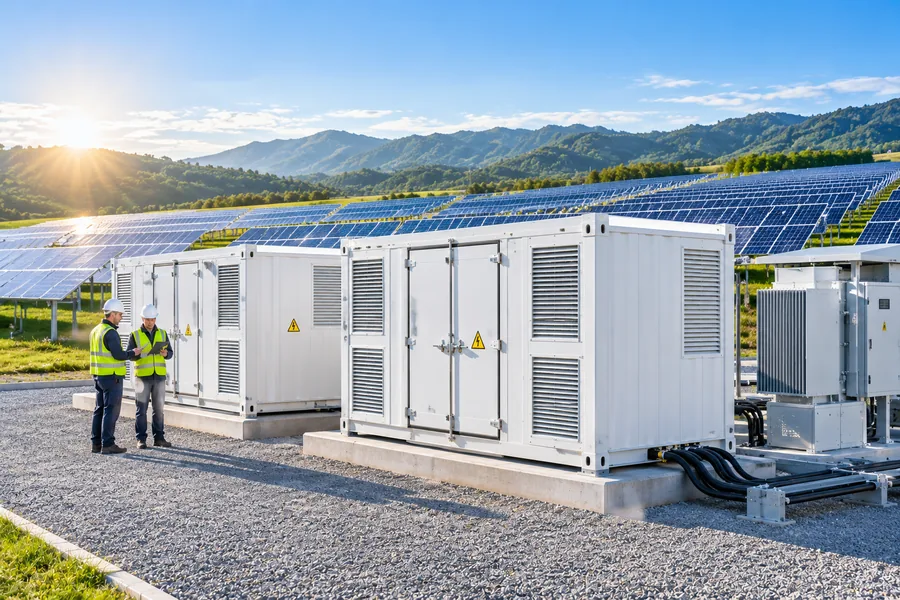
More solar projects are choosing containerized energy storage solutions because they provide modular battery capacity, integrated electrical equipment, and flexible deployment. These systems help store excess solar electricity, support peak demand, improve grid integration, and simplify certain installation activities compared with custom-built energy storage facilities.
As utility-scale solar installations expand, battery energy storage systems (BESS) are becoming an important part of project development. Containerized solutions offer a practical way to combine batteries, power conversion, thermal management, and system controls within a standardized enclosure.
Why Do Solar Projects Need Containerized Battery Energy Storage Systems?
Solar photovoltaic systems generate electricity when sunlight is available. However, electricity demand does not always match solar generation, creating challenges for project operators and grid managers.
Solar projects need battery energy storage systems to store electricity during periods of high generation and release it when demand increases. Containerized BESS provides a packaged solution for this application, helping solar farms manage energy output, reduce some curtailment, support grid services, and improve the flexibility of renewable electricity delivery.
Managing Solar Energy Variability
Solar electricity production changes throughout the day.
Generation usually increases after sunrise, reaches higher levels around midday, and decreases toward sunset.
Cloud cover, seasonal changes, and weather conditions also affect solar output.
I consider this variability one of the main reasons that energy storage has become important for solar projects.
Without storage, a solar installation must generally consume, export, or curtail the electricity it produces.
A battery energy storage system provides another option.
The system can store available electricity and discharge it when the power is more useful or valuable.
Reducing Solar Energy Curtailment
Curtailment occurs when available electricity generation is intentionally reduced.
Solar curtailment can result from grid congestion, limited transmission capacity, low demand, or other operational restrictions.
A properly designed BESS can absorb some electricity that would otherwise be curtailed.
For example, a solar farm may experience excess electricity production during the middle of the day.
If battery capacity is available and charging is permitted, part of this electricity can be stored instead of exported immediately.
The stored energy can later be discharged during an approved operating period.
However, storage cannot eliminate every curtailment event.
The benefit depends on battery capacity, charging power, grid constraints, and the project's dispatch strategy.
Supporting Evening Electricity Demand
Electricity consumption often remains significant after solar production begins to decline.
Energy storage helps shift some daytime solar generation into the evening.
This application is commonly called energy time shifting.
I believe time shifting is one of the most practical applications for solar-plus-storage projects because it directly addresses differences between generation and consumption patterns.
Common Solar-Plus-Storage Applications
| Application | Main Benefit |
|---|---|
| Energy Time Shifting | Delivers stored solar energy during later periods |
| Curtailment Reduction | Captures some otherwise unused solar generation |
| Peak Shaving | Reduces electricity demand during selected peak periods |
| Frequency Response | Supports grid frequency control when technically qualified |
| Microgrid Support | Helps balance generation and demand |
| Backup Power | Supplies selected loads during outages when properly configured |
I recommend identifying the main application before selecting battery capacity.
A system designed for short-duration power support may have very different requirements from one intended to discharge for several hours.
What Makes Containerized Energy Storage Solutions Attractive to Solar Developers?
Solar developers often need storage equipment that is practical to transport, install, commission, and maintain. Containerized systems provide a standardized equipment arrangement that can simplify parts of this process.
Containerized energy storage solutions are attractive because they combine battery modules, monitoring systems, thermal management, and safety equipment inside factory-assembled enclosures. Their modular design can improve installation planning, support capacity expansion, and reduce certain on-site integration activities when compared with custom-designed battery rooms.
Modular and Scalable Design
A containerized BESS usually contains several connected battery modules or racks.
These components operate through a battery management system (BMS).
Depending on the product, the enclosure may also include:
- Battery packs and racks
- Battery management system
- Cooling and thermal management equipment
- Fire detection and protection systems
- Electrical protection devices
- Communication and monitoring equipment
- Power conversion equipment, where integrated
Some containerized systems include the power conversion system (PCS), while others require an external PCS and transformer.
I recommend verifying the supplier's actual scope of supply rather than assuming that every container includes identical equipment.
Factory Integration and Testing
One major advantage of containerized storage is the opportunity to integrate equipment before shipment.
Manufacturers can assemble battery racks, connect internal electrical systems, install cooling equipment, and perform defined factory tests.
This approach may reduce the amount of assembly required at the project site.
For EPC contractors, factory integration can also improve documentation and interface management.
However, factory testing does not eliminate the need for site acceptance testing.
The completed installation must still be checked for electrical connections, grounding, control communication, protection coordination, and actual operating performance.
Easier Project Expansion
Modular BESS installations can support staged project development.
For example, a solar farm may initially require a smaller energy storage system.
If future demand increases, the operator may add compatible energy storage units.
This can provide flexibility compared with building all planned battery capacity during the first project phase.
However, expansion is subject to technical limitations.
The PCS, transformer, switchgear, grid connection, and energy management system must support the additional capacity.
I consider future expansion requirements worth including in the original project design.
Containerized vs. Custom-Built Energy Storage
| Feature | Containerized BESS | Custom-Built Battery Facility |
|---|---|---|
| Equipment Arrangement | Standardized modules or enclosures | Site-specific layout |
| Factory Assembly | Usually substantial | Depends on project design |
| On-Site Integration | Can be reduced | May require more field integration |
| Expansion | Modular options may be available | Depends on original design |
| Transport | Requires suitable transportation planning | Often assembled at the site |
| Customization | Limited by enclosure and system architecture | Greater layout flexibility |
Containerized storage is not automatically the best option for every project.
Site restrictions, very large system capacities, environmental conditions, and specific technical requirements may favor alternative layouts.
I believe the main advantage of containerization is greater standardization, not the complete elimination of engineering work.
How Can Containerized BESS Improve Solar Project Economics and Grid Performance?
Battery energy storage can improve the operational flexibility of solar projects. However, financial performance depends on electricity prices, grid requirements, equipment costs, and the project's operating strategy.
Containerized BESS can improve solar project economics by shifting electricity sales to higher-value periods, reducing selected demand charges, capturing some curtailed solar generation, and providing eligible grid services. Standardized equipment may also reduce certain installation costs, but overall profitability depends on system efficiency, degradation, financing, and market conditions.
Improving the Value of Solar Electricity
Solar electricity prices can vary significantly during the day.
In markets with substantial solar generation, electricity prices may be relatively low during periods of high production.
Battery storage allows an operator to store part of the electricity and sell or use it later.
I consider this an important opportunity for solar-plus-storage projects.
For example, a solar farm might charge its battery during the afternoon and discharge during the evening.
The financial benefit depends on the difference between the charging-period and discharging-period electricity values.
Battery losses, degradation, operating costs, and market rules must also be considered.
Example: Understanding Battery Storage Duration
Battery capacity is measured in kilowatt-hours or megawatt-hours.
Discharge power is measured in kilowatts or megawatts.
Consider a hypothetical containerized BESS with:
- Rated energy capacity: 2 MWh
- Rated discharge power: 1 MW
The simplified nominal discharge duration is:
2 MWh ÷ 1 MW = 2 hours
This means the system has a nominal two-hour energy-to-power ratio.
Actual full-power discharge time may be shorter because of usable state-of-charge limits, conversion losses, auxiliary consumption, temperature, and battery condition.
This calculation also illustrates why project engineers must evaluate power and energy capacity separately.
Supporting Grid Services
Battery storage can provide several electricity grid services when the system is technically qualified and the market allows participation.
These may include frequency response, voltage support, energy balancing, and other ancillary services.
Some services require rapid power changes, while others require longer discharge durations.
I recommend defining the intended services before selecting the battery and PCS configuration.
A system optimized for energy arbitrage may not have the same operating priorities as one designed primarily for fast frequency response.
Energy Storage Costs and Long-Term Value
Battery energy storage costs have decreased substantially over the past decade.
IRENA's 2024 renewable cost analysis reports that the total installed cost of utility-scale battery storage declined by approximately 93% between 2010 and 2024.
This trend has helped improve the economic feasibility of storage projects.
However, I do not believe declining battery prices guarantee that every solar-plus-storage project will be profitable.
Project developers should evaluate the full investment.
| Financial Factor | Why It Matters |
|---|---|
| Battery and PCS Cost | Determines major equipment investment |
| Installation and Grid Connection | Affects total project capital expenditure |
| Round-Trip Efficiency | Determines energy lost during charging and discharging |
| Battery Degradation | Influences future usable capacity |
| Maintenance and Augmentation | Affects long-term operating expenditure |
| Electricity Price Structure | Determines revenue opportunities |
| Financing and Warranty | Influences lifetime project economics |
I recommend using hourly generation and price modeling when evaluating large solar-plus-storage investments.
A realistic financial model should include battery degradation, operating restrictions, and potential equipment replacement costs.
AC-Coupled vs. DC-Coupled Solar Storage
Solar-plus-storage systems can use AC-coupled or DC-coupled architectures.
In an AC-coupled system, solar and storage typically use separate power conversion equipment connected on the AC side.
In a DC-coupled system, batteries and solar generation share a DC-side connection and may use a common inverter architecture.
DC coupling can offer opportunities to capture some solar energy that would otherwise be clipped by the PV inverter.
AC coupling can provide useful flexibility, particularly when adding storage to existing solar installations.
Neither configuration is universally superior.
The correct choice depends on electrical design, project economics, operating requirements, and interconnection constraints.
What Should EPC Teams Consider Before Choosing Containerized Energy Storage?
Containerized BESS can simplify equipment packaging, but successful solar integration still requires careful engineering. EPC contractors must evaluate electrical compatibility, installation safety, environmental conditions, and long-term operating requirements.
EPC teams should assess battery capacity, PCS compatibility, grid connection requirements, thermal management, fire safety, communication protocols, and project lifecycle costs before selecting containerized storage. They should also verify manufacturer testing, certification scope, installation conditions, commissioning procedures, and available technical support.
Define the System Requirements
I recommend starting with the required power and energy ratings.
The battery must provide enough usable energy for the intended operating duration.
The PCS must also support the required charging and discharging power.
Important specifications include:
Battery Capacity (MWh)
Determines the amount of electricity the system can store.
Power Output (MW)
Determines the rate of electricity delivery.
Round-Trip Efficiency
Indicates the proportion of energy returned after charging and discharging, measured across a defined system boundary.
Operating Temperature
Defines the environmental conditions under which the equipment can operate.
Battery Cycle Life
Provides an indication of long-term battery durability under specified testing conditions.
Verify Electrical Integration
The battery, PCS, and EMS must operate together correctly.
I recommend reviewing the electrical single-line diagram and communication interface documentation before procurement.
Important integration requirements include:
- AC voltage and frequency
- Battery DC operating range
- Charging and discharging limits
- Grid-connected operating modes
- Grounding and protection coordination
- BMS, PCS, and EMS communication
- Supervisory control and monitoring
- Utility interconnection requirements
Communication compatibility is particularly important when equipment is supplied by different manufacturers.
I believe unclear supplier responsibilities can create unnecessary delays during commissioning.
Evaluate Fire Safety and Certification
Lithium-ion battery systems require appropriate electrical and thermal protection.
Many containerized systems use LiFePO4 technology because of its cycle life and thermal stability.
However, LiFePO4 batteries can still experience hazardous failure conditions.
In the United States, relevant standards may include:
| Standard | Main Purpose |
|---|---|
| UL 9540 | Energy storage system safety certification |
| UL 9540A | Thermal runaway and fire propagation testing |
| NFPA 855 | Stationary energy storage installation requirements |
| NFPA 70 | Electrical installation requirements |
| IEEE 1547 | Applicable distributed energy resource interconnection requirements |
The latest published NFPA 855 edition is 2026, although the edition legally applicable to an installation depends on local adoption.
UL 9540A testing is not the same as complete system certification under UL 9540.
I recommend checking the manufacturer's certification records, test reports, installation instructions, and approved configurations.
Review Site and Environmental Conditions
Containerized systems require suitable placement and access.
The EPC team should evaluate ground conditions, drainage, ventilation, access roads, fire protection arrangements, and maintenance space.
High ambient temperatures may increase cooling demand.
Cold environments may reduce battery charging capability or require additional thermal management.
I recommend evaluating annual operating conditions rather than only the temperature expected during installation.
Confirm Factory and Site Acceptance Testing
Factory acceptance testing (FAT) can verify key equipment functions before shipment.
Site acceptance testing (SAT) checks whether the installed system operates correctly under actual project conditions.
Testing should include control communication, protection functions, operating limits, thermal management, alarms, and approved load conditions.
I also recommend requesting complete technical documentation and an agreed troubleshooting process from suppliers.
For long-term projects, warranty conditions, spare parts availability, remote monitoring, and after-sales support can be as important as the initial equipment price.
My Insight: Why Are More Solar Projects Choosing Containerized Energy Storage Solutions
I believe more solar projects are choosing containerized energy storage because standardized equipment makes renewable energy storage easier to plan, integrate, and expand.
However, the strongest reason for combining solar and battery storage is not the container itself.
It is the ability to manage when electricity is delivered.
Solar generation follows available sunlight, but electricity demand and market value follow different patterns.
A properly designed BESS helps solar project operators manage this difference.
Containerized equipment provides a practical way to package the necessary battery and control technology.
I also believe project developers should avoid treating containerized BESS as a completely interchangeable product.
Two systems with the same advertised battery capacity may have different usable energy, cooling requirements, electrical interfaces, safety documentation, and warranty conditions.
For EPC teams and project investors, I recommend focusing on five priorities.
1. Define the Operating Strategy
Determine whether the main application is energy shifting, curtailment reduction, peak shaving, backup power, or grid services.
2. Evaluate System Compatibility
Verify the interaction between the battery, PCS, EMS, solar inverters, and electrical infrastructure.
3. Consider Future Expansion
Check whether additional battery units can be installed without major changes to the existing electrical system.
4. Verify Safety and Testing
Review system-level certification, fire testing evidence, commissioning procedures, and site-specific safety requirements.
5. Analyze Lifetime Project Economics
Compare capital expenditure, operating costs, degradation, energy losses, financing, and expected revenue.
I believe these factors provide a more reliable basis for equipment selection than battery capacity or purchase price alone.
For example, a lower-cost storage container may create additional project expenses if it requires extensive electrical modifications or lacks suitable technical support.
Likewise, a highly integrated system may provide installation advantages but still fail to meet the project's expected financial return.
I also see modular battery storage as a practical option for phased solar development.
A project can begin with an approved storage configuration and expand as future requirements become clearer, provided the original electrical and safety architecture supports that expansion.
For commercial solar developers, EPC contractors, and energy storage system integrators, I recommend selecting suppliers with proven equipment compatibility, reliable manufacturing quality, technical documentation, and responsive engineering support.
The best containerized energy storage solution is not necessarily the one with the largest battery capacity.
It is the system that provides reliable energy delivery, safe operation, suitable integration, and sustainable economic value throughout the project lifecycle.
Conclusion
Containerized energy storage helps solar projects manage generation, improve flexibility, and simplify certain deployment activities. Successful investment depends on system integration, safety, and lifetime economics.

](https://voltcrave-battery.com/wp-content/uploads/2026/08/Industrial-Energy-Storage-Smarter-Systems-and-Better-Power-768x512.webp)
](https://voltcrave-battery.com/wp-content/uploads/2026/06/How-Can-You-Build-Reliable-Base-Station-Power-Solutions-for-Telecom-Networks-768x512.jpg)