

](https://voltcrave-battery.com/wp-content/uploads/2026/08/Industrial-Energy-Storage-Smarter-Systems-and-Better-Power.webp)
Industrial facilities need reliable electricity, but demand peaks, renewable variability, outages, electrification, and expanding production can make conventional power management increasingly expensive and inflexible.
Industrial energy storage combines batteries, power conversion, intelligent controls, protection, and energy-management software to give factories greater control over electricity. I use these systems to reduce peaks, store renewable energy, protect critical operations, manage grid constraints, improve power flexibility, and coordinate solar, generators, EV charging, and industrial loads as one smarter energy system.
The technology is moving quickly into mainstream power infrastructure. The IEA reported 108 GW of new battery-storage capacity worldwide in 2025, 40% more than in 2024, while installed battery-storage capacity reached eleven times its 2021 level. LFP batteries represented around 90% of deployments.
What Is Industrial Energy Storage?
Industrial energy storage is broader than putting batteries beside a factory. It is an electrical platform designed around the operating requirements of an industrial facility.
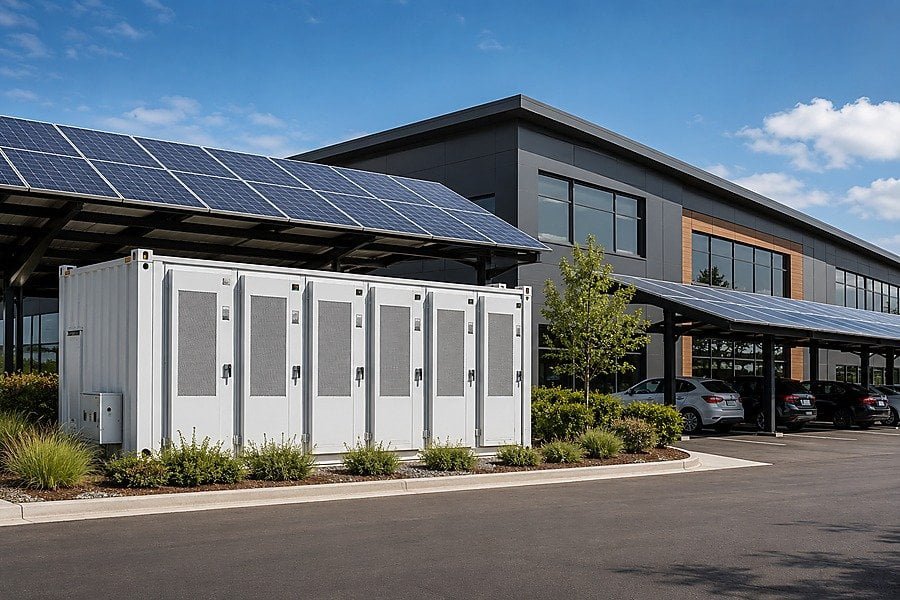
An industrial energy storage system stores electricity and releases it according to production demand, electricity prices, renewable generation, grid conditions, or resilience requirements. A modern industrial BESS normally integrates battery modules, BMS, PCS, EMS, thermal management, switchgear, metering, protection, communications, and sometimes transformers or microgrid controls.
Industrial BESS Is a Complete Power System
I separate the word battery from BESS.
The battery stores electrochemical energy.
The BESS determines how that energy interacts with the factory.
A typical architecture includes:
| Component | Main function |
|---|---|
| Battery cells/modules | Store electrical energy |
| BMS | Protect and monitor batteries |
| PCS | Convert AC and DC power |
| EMS | Optimize charging and discharging |
| Thermal management | Control battery temperature |
| Switchgear/protection | Connect and isolate equipment |
| Metering | Measure load and energy flows |
| SCADA/communications | Connect storage to plant controls |
| Transformer | Interface with plant or grid voltage |
DOE's BESS procurement guidance treats commercial-scale battery storage as a complete development and procurement process rather than a battery-only purchase. The checklist covers project-definition tasks and technical questions that need to be addressed early in development.
This system-level approach is even more important in industrial facilities because storage may interact with:
- Large motors
- Production equipment
- Solar PV
- EV charging
- Generators
- Plant transformers
- Critical control systems
- Medium-voltage distribution
The storage system therefore becomes part of the factory's electrical infrastructure.
I think that distinction explains the title smarter systems and better power.
The value does not come from storing electricity alone.
It comes from controlling industrial electricity more intelligently.
How Does an Industrial Battery Energy Storage System Work?
An industrial BESS continuously monitors facility demand and decides whether charging, discharging, or maintaining reserve capacity creates the most value.
The battery stores DC energy, the PCS moves power between the DC battery and the facility’s AC network, and the EMS determines when that exchange should occur. The BMS protects the cells, while higher-level controls can respond to production demand, solar generation, tariffs, grid limits, backup requirements, and microgrid operating conditions.
BMS, PCS, and EMS Have Different Jobs
I use this simple model:
BMS = battery intelligence
PCS = power interface
EMS = site strategy
The BMS monitors parameters such as:
- Cell voltage
- Current
- Temperature
- State of charge
- Fault status
The PCS performs:
AC → DC
during charging and:
DC → AC
during discharge.
The EMS decides why and when those conversions should happen.
For example, imagine a factory normally draws:
1.5 MW
At 2:00 p.m., several production processes increase site demand to:
2 MW
If the facility wants to limit grid import to:
1.6 MW
the battery could provide approximately:
400 kW
during the peak.
The facility still uses 2 MW.
However, the grid supplies:
1.6 MW
while the BESS supplies:
0.4 MW
NREL has studied battery storage for peak shaving and load shifting, including the use of batteries to reduce peaks seen by the distribution network.
The EMS could also make a completely different decision an hour later.
If rooftop solar begins producing more electricity than the factory needs, the system might switch from discharge to charge.
That flexibility is what makes industrial BESS fundamentally different from conventional emergency batteries.
How Does Energy Storage Make Industrial Power Systems Smarter?
The intelligence of a modern storage system comes from coordination rather than from the battery cells themselves.
A smart industrial energy storage system combines real-time metering, EMS algorithms, battery controls, PCS commands, forecasting, and plant communications. It can automatically coordinate grid power, stored energy, solar generation, generators, and flexible loads. I see this ability to make site-wide decisions as the most important difference between basic battery backup and modern industrial energy management.
The EMS Can Optimize an Entire Industrial Site
A simple backup battery may wait for the grid to fail.
A smart industrial BESS can operate continuously.
For example:
02:00 — electricity inexpensive → charge
09:00 — production increases → maintain reserve
12:00 — solar surplus → charge from PV
15:00 — site peak → discharge
18:00 — production falls → rebuild backup reserve
The same battery performs several tasks without physically changing.
This is often called value stacking.
The challenge is that these uses compete for the same stored energy.
If I discharge the battery aggressively for cost savings, less energy may remain for an unexpected outage.
A smarter system therefore needs priorities.
For example:
Priority 1: maintain 25% emergency reserve
Priority 2: keep grid import below 2 MW
Priority 3: maximize solar self-consumption
Priority 4: optimize tariff savings
The EMS can enforce this hierarchy automatically.
DOE's microgrid-development guidance emphasizes coordinated planning, design, procurement, and implementation when multiple distributed energy resources need to operate together.
This becomes particularly important at industrial sites where the battery may interact with production operations rather than simply household consumption.
The future industrial ESS is therefore increasingly a control platform with a battery attached, rather than only an energy reservoir.
How Can Industrial Energy Storage Reduce Peak Demand?
Industrial facilities frequently have large, short-duration power peaks that are expensive or difficult for the electrical network to support.
Industrial BESS can reduce peak demand by discharging precisely when facility load rises above a chosen threshold. I size PCS power according to the magnitude of the peak and battery energy according to how long the peak lasts. This can reduce grid demand without requiring production equipment to stop or reduce output.
kW and kWh Must Be Sized Separately
Suppose a factory has:
Normal grid demand = 2 MW
Maximum demand = 2.8 MW
The company wants to keep demand below:
2.2 MW
Required BESS power is approximately:
2.8 MW − 2.2 MW = 0.6 MW
or:
600 kW
Now suppose that peak lasts for one hour.
The theoretical battery energy requirement is:
600 kW × 1 hour = 600 kWh
If it lasts for three hours:
600 kW × 3 hours = 1.8 MWh
The PCS requirement is still roughly 600 kW.
The battery-energy requirement changes dramatically.
That is why I separate:
kW/MW = how much power
from:
kWh/MWh = for how long
NREL describes peak shaving as a form of load shifting in which battery storage supplies demand during peak periods.
Industrial peak management can be particularly valuable when peaks come from:
- Compressors
- Pumps
- Chillers
- Furnaces
- Production-line starts
- EV charging
- Batch processes
Storage gives operators another option besides permanently increasing grid capacity or reducing production.
The BESS can supply only the temporary difference.
That is a much more precise use of electrical infrastructure.
How Does Industrial Storage Improve Solar and Renewable Energy Use?
Factories often have large roofs, parking areas, and available land for solar, but renewable production does not always match production schedules.
Industrial energy storage can capture excess solar or other renewable electricity and move it to a later period. This increases onsite renewable utilization and can reduce curtailment or low-value exports. I find solar-plus-storage particularly useful when midday PV generation is strong but industrial demand or electricity value is higher later in the day.
Storage Changes Renewable Electricity From Time-Dependent to Flexible
Suppose a manufacturing site has:
3 MW solar
At midday:
Solar output = 2.5 MW
Factory demand = 1.8 MW
Surplus solar:
700 kW
Without storage:
700 kW → export or curtailment
With storage:
700 kW → BESS
Later, suppose solar falls while the factory remains at 2 MW.
The stored solar electricity can return:
BESS → factory
This turns renewable power into a more controllable industrial resource.
The IEA notes that battery storage is increasingly supporting electricity systems as renewable penetration rises, with utility and distributed battery capacity scaling rapidly.
Storage can also help when grid export capacity is constrained.
A factory might install more solar than its connection allows it to export at one moment.
Instead of curtailing every excess kilowatt, the BESS can absorb some of that energy.
The result can be:
more renewable generation used onsite
and:
less dependence on the timing of grid exports
I do not assume storing every solar kWh is always financially optimal.
The EMS should compare:
- Export value
- Later electricity value
- Round-trip losses
- Battery degradation
- Available capacity
A smart system stores energy only when doing so creates sufficient value.
Can Industrial BESS Improve Reliability and Backup Power?
Industrial outages can be much more expensive than ordinary commercial interruptions because production equipment and continuous processes may require controlled shutdown and restart.
A properly designed industrial BESS can maintain critical electrical loads during grid interruptions, bridge short outages, support generators, or operate inside a microgrid. I use storage to protect the loads whose interruption creates the greatest operational or financial damage rather than automatically trying to operate every industrial load during an outage.
Backup Is an Engineering Problem, Not a Marketing Label
Suppose a factory normally consumes:
5 MW
Trying to operate the entire facility from batteries could require very large storage capacity.
But perhaps only these loads are critical:
- Control systems
- Communications
- Pumps
- Process cooling
- Safety equipment
Together they may require:
800 kW
If the target backup duration is four hours:
800 kW × 4 hours = 3.2 MWh
before allowing for reserve, efficiency, and degradation.
That is much more practical than trying to support the full 5 MW facility.
DOE identifies batteries and other distributed energy resources as tools for resilience and microgrid applications.
A BESS can also work with generators.
Instead of operating a generator alone, the architecture might become:
Grid + solar + BESS + generator
During an outage:
BESS responds immediately
then:
generator starts if longer-duration energy is required
The battery can handle fast changes while the generator provides extended energy.
DOE's current work on microgrids and large electric loads highlights microgrids as a way to support reliability and rapidly growing high-power facilities, including manufacturing-related loads.
This hybrid approach is often more flexible than expecting one technology to solve every resilience problem.
Can Energy Storage Improve Industrial Power Quality?
Not every electrical problem is measured in kWh. Industrial facilities also care about voltage, power quality, rapid load changes, and stable operation.
Because battery PCS equipment responds electronically, an industrial BESS can provide fast power control and may support applications such as reactive-power management, voltage regulation, renewable smoothing, and rapid load balancing when the system and interconnection are designed for those functions. I therefore evaluate PCS capability separately from battery energy capacity.
Better Power Is About More Than Backup
Consider a large motor starting.
Its load may change quickly.
Or imagine rooftop solar output falls rapidly as clouds pass.
A responsive power-conversion system can change BESS output much faster than many mechanical generation sources.
NREL research on storage applications identifies functions including reactive-power support, voltage regulation, peak shaving, load leveling, and renewable-energy integration.
This makes the PCS extremely important.
Two BESS products could contain:
2 MWh
of identical battery energy but have very different:
- PCS ratings
- Reactive-power capability
- Response characteristics
- Grid controls
If an industrial site primarily needs peak shaving, one PCS architecture may be sufficient.
If the facility needs microgrid or advanced grid-support behavior, the inverter requirements can become more sophisticated.
This is why I never compare industrial storage systems using only:
$/kWh
I also evaluate:
$/kW + PCS capability + controls
Battery energy determines duration.
Power electronics determine how effectively that energy can interact with the electrical system.
How Can Industrial Storage Support Microgrids and Large Loads?
Industrial electrification is increasing the value of coordinated onsite power systems.
Industrial BESS can act as the flexible center of a microgrid by balancing generation and loads, maintaining reserve energy, supporting transitions between grid-connected and islanded operation, and coordinating solar, generators, and high-power demand. This is particularly relevant for manufacturing facilities and other large electric loads where reliability and grid capacity are critical.
A Microgrid Coordinates Multiple Energy Assets
A simplified industrial microgrid could contain:
Utility grid
*
Solar PV
*
Battery storage
*
Generator
↓
Industrial loads
The microgrid controller decides how these resources work together.
For example:
Normal operation: solar + grid + BESS optimization.
Grid constraint: BESS reduces import.
Outage: microgrid disconnects from utility and serves critical loads.
Extended outage: generator provides energy while BESS handles fast fluctuations.
DOE's July 2026 guidance specifically identifies microgrids as a solution for rapidly growing large electric loads and discusses their potential to support both customers and utilities.
This matters as factories add:
- Electrified heating
- EV fleets
- Automated production
- Data infrastructure
- High-power charging
The grid connection may not need to provide every new peak if onsite resources can be coordinated intelligently.
The BESS becomes a buffer between:
industrial demand
and:
available grid capacity
This does not mean storage automatically avoids a utility upgrade.
Detailed load, interconnection, protection, and financial studies are still necessary.
But it gives industrial operators another design option.
Why Is LFP Common in Modern Industrial Energy Storage?
Industrial storage does not need the same battery characteristics as a vehicle.
LFP is now the dominant stationary battery-storage chemistry. The IEA reports that lithium iron phosphate represented around 90% of storage deployments in 2025. I consider LFP well suited to industrial BESS because stationary applications prioritize cost, frequent cycling, durability, and system safety more heavily than extremely high energy density by weight.
Stationary Storage Has Different Priorities
An EV needs to carry its battery.
A factory does not.
This means industrial storage can prioritize:
- Cost per usable kWh
- Cycle performance
- Warranty
- Thermal management
- Footprint
- Maintainability
rather than minimum mass.
The IEA notes that LFP is generally cheaper than competing lithium-ion chemistries and better suited to frequent cycling, although its energy density is lower than some chemistries commonly used in EVs.
I still do not call LFP fireproof.
A safe industrial storage system requires multiple protective layers:
cell design
↓
BMS
↓
thermal management
↓
electrical protection
↓
system controls
↓
site design
The complete BESS matters more than chemistry alone.
Industrial projects also need to consider:
- Fire requirements
- Installation environment
- Cooling
- Emergency access
- Local permitting
This is why I evaluate battery technology as part of a complete system architecture.
How Do I Size an Industrial Energy Storage System?
The correct battery is determined by the industrial problem, not by a standard kWh package.
I size industrial energy storage from interval load data, required peak reduction, critical loads, backup duration, solar generation, electricity tariffs, grid constraints, production schedules, and future growth. PCS power should match the required kW or MW response, while battery energy should match the number of hours that response must be sustained.
Step 1: Define the Objective
I first decide whether the BESS is primarily for:
- Peak shaving
- Solar storage
- Backup
- Microgrid operation
- Grid-capacity management
- Multiple services
Step 2: Analyze Actual Load Data
I prefer interval data rather than only monthly electricity totals.
For example, two factories may each consume:
1,000 MWh per month
but one has a nearly constant load while the other has large production peaks.
Their storage requirements will be completely different.
Step 3: Determine PCS Power
If site demand reaches:
4 MW
and I need to limit grid import to:
3 MW
the battery needs approximately:
1 MW
of discharge capability.
Step 4: Determine Energy Duration
If the peak lasts:
2 hours
basic energy requirement:
1 MW × 2 h = 2 MWh
If it lasts four hours:
4 MWh
DOE's current procurement checklist encourages BESS developers to define project needs and technical requirements before equipment procurement.
Step 5: Add Real-World Factors
I then consider:
- SOC reserve
- Efficiency
- Degradation
- Temperature
- Future loads
- Expansion
- Backup requirements
The resulting system might therefore be larger than the simple theoretical calculation.
For industrial projects, I also evaluate whether the battery can be expanded later.
A factory may add production equipment five years after the original BESS is commissioned.
Modularity can protect the initial investment.
What Should I Look for in a Smarter Industrial Energy Storage System?
A smart industrial BESS needs more than competitive battery cells.
I look for a balanced system with appropriate usable energy, PCS power, BMS protection, EMS functionality, thermal management, communications, safety engineering, expansion capability, warranty, and local service. For advanced industrial sites, I also examine SCADA integration, microgrid controls, APIs, generator coordination, and support for future electrification.
My Industrial ESS Checklist
| Requirement | Why I check it |
|---|---|
| Usable kWh/MWh | Determines usable duration |
| PCS kW/MW | Determines power response |
| BMS | Protects battery operation |
| EMS | Optimizes energy use |
| SCADA interface | Connects to industrial controls |
| Efficiency | Affects lifetime value |
| Thermal management | Protects performance and life |
| Expansion | Supports production growth |
| Backup capability | Improves resilience |
| Grid compatibility | Supports interconnection |
| Communications | Enables automation |
| Warranty | Defines long-term protection |
| Local service | Reduces downtime |
DOE's BESS procurement resources provide structured tasks and questions for commercial-scale storage development, while its distributed-energy interconnection checklist emphasizes early utility coordination for grid-connected distributed energy resources.
I consider these non-battery issues just as important as cell specifications.
An industrial BESS may operate for many years.
During that period, the facility needs:
- Firmware support
- Replacement parts
- Remote diagnostics
- Service technicians
- Battery augmentation
The smartest system is not necessarily the one with the most complicated algorithm.
It is the one that remains usable, maintainable, and adaptable throughout the industrial site's changing energy needs.
My Insights: Industrial Energy Storage: Smarter Systems and Better Power
I believe the most important change in industrial energy storage is the transition from stand-alone battery backup toward continuously optimized electrical infrastructure.
Industrial Energy Storage: Smarter Systems and Better Power means using storage not simply to hold electricity, but to actively improve how an industrial facility produces, purchases, distributes, and consumes power. The strongest systems combine batteries, PCS, BMS, EMS, SCADA, renewable generation, backup resources, and smart controls to reduce costs while improving flexibility and resilience.
Smarter Means Coordinated
A battery alone knows very little about the factory.
A smart system understands:
load + solar + grid + tariff + battery SOC + production priorities
That data allows it to make better decisions.
I expect industrial storage to become increasingly integrated with plant-level control.
The BESS may know when:
- Production shifts begin
- Solar output will rise
- EV fleets return
- Grid prices change
- A critical process needs reserve power
That is much more valuable than a fixed charge-and-discharge schedule.
Better Power Means Control Over Both kW and kWh
Industrial energy problems are not always about total energy.
Sometimes the challenge is:
too much power for 20 minutes
Other times it is:
not enough energy for four hours
BESS can be engineered for either problem.
That is why I always separate:
power
from:
energy
The correct balance can reduce both overbuilding and underperformance.
Industrial Storage Is Becoming Part of the Microgrid
DOE's current work on microgrids for large electric loads reinforces this direction. As high-power facilities grow, coordinated onsite resources can help address reliability and grid-capacity challenges.
I therefore expect future industrial power systems to look increasingly like:
grid + renewable generation + BESS + flexible loads + backup generation + intelligent controller
rather than:
grid → factory
The factory becomes an active energy system.
Storage Economics Are Improving
Global battery storage is expanding rapidly. The IEA reports 108 GW of additions in 2025 and installed capacity eleven times higher than in 2021.
That scale is helping storage move from specialist projects toward mainstream power infrastructure.
For industrial users, the correct response is not automatically to install a battery.
It is to analyze where flexibility has value.
I begin with:
- Where are the load peaks?
- What does downtime cost?
- How much renewable electricity is available?
- Is the grid connection constrained?
- Which loads are genuinely critical?
- How will production grow?
- Can one battery provide several value streams?
When several answers point in the same direction, industrial BESS can become more than an energy-saving technology.
It can become strategic infrastructure.
For me, that is the real meaning of smarter systems and better power: storage gives industrial operators greater control over electricity at exactly the moment when factories are becoming more electrified, automated, renewable-powered, and dependent on reliable energy.
Conclusion
Industrial energy storage combines intelligent controls with flexible battery power to reduce peaks, integrate renewables, improve resilience, and give factories greater control over increasingly complex electrical systems.
](https://voltcrave-battery.com/wp-content/uploads/2026/06/Commercial-Energy-Storage-Systems-The-Future-of-Reliable-Power-for-Businesses-768x512.jpg)
](https://voltcrave-battery.com/wp-content/uploads/2026/08/What-Is-the-Overview-of-BESS-768x512.webp)
](https://voltcrave-battery.com/wp-content/uploads/2026/08/The-All-in-One-Energy-Storage-System-Revolutionizing-the-Storage-of-Renewable-Energy-768x512.webp)