

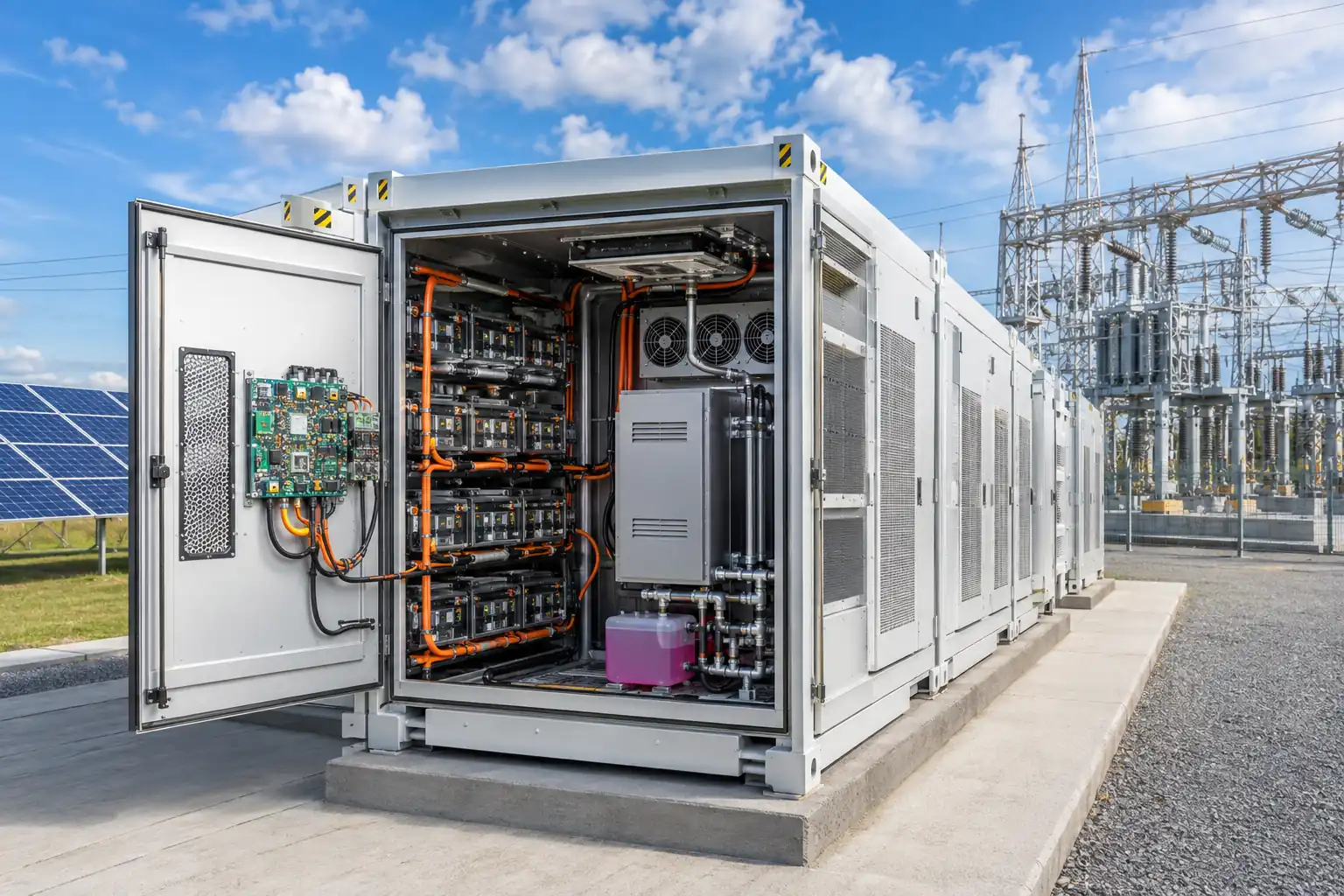
](https://voltcrave-battery.com/wp-content/uploads/2026/08/What-Determines-the-Lifespan-of-a-BESS-Battery.webp)
A BESS battery can last for years, but its real lifespan depends much more on how I operate it than on one cycle-life number printed on a datasheet.
The lifespan of a BESS battery is mainly determined by battery chemistry, temperature, depth of discharge, state-of-charge range, charge and discharge rate, cycling frequency, calendar aging, cell balance, thermal management, and control strategy. These factors interact, so two identical batteries can reach very different lifespans under different operating conditions.
I find it more useful to think about BESS lifespan as a combination of time aging and use-related aging. A battery loses performance while it sits, and it also loses performance when I cycle it. The BMS and EMS can reduce unnecessary stress, but they cannot completely stop electrochemical aging.
What Are the Main Factors That Determine BESS Battery Lifespan?
I do not use one variable to predict battery life because lithium-ion degradation happens through several mechanisms at the same time.
The main factors that determine BESS battery lifespan are chemistry, temperature, depth of discharge, SOC, C-rate, cycle frequency, storage conditions, and battery-management strategy. NREL models battery life using variables such as temperature, operating window, charge and discharge rate, storage environment, and cycling pattern because these factors combine to determine real degradation.
I Separate Battery Aging Into Two Main Categories
The first is calendar aging.
Calendar aging happens as time passes, even if I do not use the battery heavily.
The second is cycle aging.
Cycle aging happens when I repeatedly charge and discharge the battery.
Sandia describes battery lifespan through these same two paths: aging while equipment is at rest and aging while equipment is used.
I can summarize the main factors like this:
| Lifespan Factor | Why It Matters |
|---|---|
| Battery chemistry | Different electrode materials age differently |
| Temperature | Heat and extreme cold can accelerate degradation |
| Depth of discharge | Deeper cycling usually increases stress per cycle |
| State of charge | Long periods at extreme SOC can increase aging |
| C-rate | Faster charging and discharging can increase heat and stress |
| Cycle frequency | More energy throughput generally creates more cycling wear |
| Cell balance | Weak or unbalanced cells can limit the whole battery string |
| Thermal management | Keeps cells within a controlled temperature range |
| BMS strategy | Protects cells from voltage, current, and temperature extremes |
| EMS dispatch | Determines when and how aggressively the BESS cycles |
I do not expect every chemistry to respond to these factors in exactly the same way.
Sandia tested commercial LFP, NCA, and NMC lithium-ion cells across different discharge rates, depths of discharge, and temperatures. Even when the cells remained within manufacturer specifications, operating conditions had a major effect on degradation. Time to reach 80% remaining capacity differed by thousands of hours and cycles.
That is one of the most important lessons for me.
A battery specification can tell me what the battery can do.
The operating strategy determines how often I ask it to do it.
How Does Temperature Affect BESS Battery Lifespan?
Temperature is one of the first variables I examine when I want to understand why one BESS ages faster than another.
Temperature affects BESS lifespan because lithium-ion cells depend on temperature-sensitive chemical reactions. High temperatures generally accelerate unwanted side reactions and calendar aging, while very low temperatures can create different degradation risks, especially during charging. A good thermal-management system keeps cells within a controlled and relatively uniform operating range.
High Temperature Can Accelerate Calendar Aging
Lithium-ion cells continue to experience internal chemical reactions even while they are sitting idle.
At higher temperatures, many of these reactions proceed faster.
Sandia's lithium-ion battery guidance explains that calendar aging is strongly influenced by both SOC and temperature, with aging rates increasing as temperature increases.
This means I do not judge battery temperature only by asking:
“Is it hot enough to trigger a shutdown?”
The battery may remain well below an emergency temperature and still experience faster long-term degradation than the same cells operating in a more moderate environment.
Very Low Temperature Creates a Different Problem
Colder is not automatically better.
Low temperatures slow lithium transport inside the cell.
If I charge aggressively under cold conditions, lithium can have difficulty moving into the graphite anode fast enough.
Sandia notes that excessive charging under cold conditions can contribute to lithium plating, which reduces capacity, increases resistance, and can create additional safety concerns.
So I avoid the simplistic rule:
Lower temperature = longer life.
Instead, I want a suitable operating window.
Temperature Uniformity Also Matters
A large BESS contains many cells, modules, and racks.
The average container temperature can look acceptable while individual modules operate several degrees hotter than others.
That creates uneven aging.
The hotter modules may lose capacity more quickly.
Then the weaker modules can begin limiting the usable capacity of the entire battery string.
I therefore look at:
- Cell temperatures
- Module temperature spread
- Cooling airflow
- Liquid cooling performance
- HVAC redundancy
- Filter cleanliness
- Ambient temperature
- Rack position
- Sensor accuracy
A good thermal-management system does not only prevent overheating.
It also tries to keep cells operating under similar conditions.
For a BESS expected to operate for ten or fifteen years, that temperature consistency can be as important as peak cooling capacity.
How Does Depth of Discharge Affect BESS Lifespan?
I use depth of discharge, or DoD, as one of the main operating controls for balancing usable energy with degradation.
Deeper discharge cycles generally increase cycling stress because the battery moves through a larger electrochemical operating range. Shallower cycling can often increase cycle count, but it delivers less energy in each cycle. I therefore compare depth of discharge with lifetime energy throughput rather than assuming that the highest cycle count always gives the longest useful BESS life.
A Deep Cycle Uses More of the Battery
If I discharge a battery from:
100% SOC to 20% SOC
I have used an 80-percentage-point operating window.
If I cycle from:
80% SOC to 40% SOC
I have used a 40-percentage-point window.
The deeper cycle gives me more energy in that single discharge.
It can also create more cycling stress.
DOE's energy-storage technology assessment states that conventional battery cycle life is a function of depth of discharge.
More Cycles Do Not Automatically Mean More Lifetime Energy
Suppose I compare two hypothetical 1 MWh batteries.
Battery A:
- 80% DoD
- 6,000 cycles
- 0.8 MWh per cycle
Simplified lifetime throughput:
0.8 MWh × 6,000 = 4,800 MWh
Battery B:
- 50% DoD
- 8,000 cycles
- 0.5 MWh per cycle
Simplified lifetime throughput:
0.5 MWh × 8,000 = 4,000 MWh
Battery B completes more cycles.
Battery A delivers more total energy in this simplified example.
These are illustrative numbers, not a real battery specification.
The point is that I look at both:
cycle life
and
lifetime MWh throughput.
Chemistry Changes DoD Sensitivity
I also avoid applying one DoD rule to every lithium-ion chemistry.
NREL research comparing commercial cells found that electrode chemistry affects sensitivity to depth of discharge. The tested LFP cell was relatively insensitive to some cycling conditions compared with the tested NMC cells.
So I do not automatically tell a BESS owner:
“Always use 80% DoD.”
I use manufacturer-specific degradation data, warranty limits, and project requirements instead.
How Do State of Charge and Calendar Aging Affect Battery Life?
A battery can lose capacity even if it completes very few cycles, which is why I never estimate BESS life from cycle count alone.
Calendar aging occurs as a battery gets older regardless of how many cycles it completes. Temperature and state of charge strongly influence this process. Lithium-ion batteries held for long periods at high SOC can experience faster capacity fade, so the best operating strategy may avoid keeping the battery completely full when the application does not require it.
High SOC Can Increase Calendar Stress
The Department of Energy identifies maintaining lithium-ion batteries at high SOC for extended periods as an important driver of capacity fade in calendar-life applications.
This becomes particularly important for backup applications.
Imagine a BESS designed only for emergency power.
The operator might naturally want it to stay at 100% SOC every hour of every day.
That provides the maximum possible backup energy.
But it may also increase calendar-aging stress compared with operating at a slightly lower SOC.
Now compare that with an energy-arbitrage system.
That battery may spend much more time moving between different SOC levels.
Its dominant degradation mechanism may include much more cycling stress.
The best strategy depends on the service.
Average SOC Matters, Not Just DoD
Two batteries can have the same depth of discharge but use different SOC windows.
For example:
90% → 50%
and
60% → 20%
are both 40-percentage-point cycles.
But their average SOC is different.
NREL's battery-lifetime models include SOC history as one of the factors influencing degradation because the battery can age differently at different operating voltages.
This means an EMS can influence battery life without physically changing the battery.
It can control:
- Maximum SOC
- Minimum SOC
- Reserve SOC
- Charging times
- Discharge times
- Average SOC
- Duration at high SOC
That control strategy becomes especially valuable in commercial BESS projects where I can trade a small amount of available energy today for better capacity retention years later.
How Do Charge and Discharge Rates Affect BESS Lifespan?
C-rate tells me how quickly I am asking the battery to move energy.
Higher charge and discharge rates can increase BESS degradation by creating more electrical, thermal, and mechanical stress. Fast charging is often particularly important because lithium must move into the electrode structure quickly. The lifespan effect depends on chemistry, temperature, SOC, and cell design, so I evaluate C-rate together with the complete operating profile.
I Use C-Rate to Compare Power With Capacity
For a 100 Ah battery cell:
1C = approximately 100 A
0.5C = approximately 50 A
For a 1 MWh battery system, a simplified 1C discharge would theoretically use the full energy in around one hour.
A 0.25C discharge corresponds approximately to a four-hour discharge.
This is why a 1 MW / 1 MWh BESS and a 1 MW / 4 MWh BESS may place very different demands on their cells.
The one-hour battery needs to deliver much more power relative to its stored energy.
Fast Charging Can Be More Stressful
Sandia explains that higher rates increase mechanical stress and resistive heating, while aggressive charging can become especially important because lithium must move through the SEI and into the graphite electrode.
I therefore do not assume that:
1 MWh discharged = same degradation under every power profile.
One system may deliver that energy slowly.
Another may deliver it very quickly.
The lifetime effect can be different.
High C-Rate and High Temperature Can Combine
Operating variables can reinforce each other.
High current generates more heat.
High temperature can then accelerate degradation.
A strong cooling system may reduce that effect, but it also consumes auxiliary energy.
This is why BESS lifetime is a system-level problem.
Cell selection, PCS sizing, thermal management, and dispatch strategy need to work together.
Why Do Cell Quality and Battery Chemistry Matter?
Operating conditions matter, but I cannot control my way out of weak cell design or poor manufacturing quality.
Battery chemistry and cell design determine the basic degradation behavior of a BESS. LFP, NMC, NCA, and other lithium-ion chemistries respond differently to temperature, DoD, SOC, and C-rate. Cell manufacturing consistency, electrode design, internal resistance, and material quality also affect how evenly a large battery system ages.
Chemistry Changes the Aging Mechanism
Sandia's multi-year testing of LFP, NCA, and NMC cells found major differences in degradation across chemistry and cycling conditions.
NREL has also found that chemistry, cell size, and design can change sensitivity to temperature and depth of discharge. In simulated residential and grid-storage applications, predicted cell life across the tested designs ranged from about seven years to more than twenty years, although all tested cells reached at least ten years under some conditions.
That range shows why I cannot say:
“All lithium-ion BESS batteries last 15 years.”
Cell Consistency Becomes Important at System Scale
A grid-scale BESS can contain thousands of cells.
If cell manufacturing is inconsistent, the weakest cells can reach voltage or temperature limits before the rest.
The BMS then has to protect the complete string based on those weaker cells.
That can reduce usable energy.
I therefore care about:
- Cell consistency
- Capacity matching
- Internal resistance matching
- Module design
- Welding quality
- Busbar resistance
- Temperature distribution
- Cell balancing
A good cell is important.
A large number of well-matched cells is even more important.
How Do the BMS, EMS, and Thermal System Affect Lifespan?
I see the BMS and EMS as active lifespan-management tools rather than simple monitoring software.
A BMS protects cells from voltage, current, and temperature extremes, while an EMS determines when and how deeply the BESS cycles. Thermal management controls cell temperature. Together, these systems can reduce avoidable degradation by limiting DoD, C-rate, SOC extremes, heat, and cell imbalance while still meeting the project's power and energy requirements.
The BMS Protects the Battery in Real Time
The BMS can monitor:
- Individual cell voltage
- Module voltage
- Current
- Temperature
- SOC
- State of health
- Cell imbalance
- Fault conditions
If one cell approaches an unsafe limit, the BMS can reduce available charging or discharging power.
It can also stop operation when necessary.
This protects safety, but it also supports long-term life.
Sandia specifically notes that tight BMS control of the battery operating window is important because degradation depends on operating conditions.
The EMS Controls Economic Stress
The EMS works at a different level.
It decides whether the battery should charge now, discharge now, or remain idle.
A basic EMS may focus mainly on electricity prices or load.
A more advanced strategy can also account for degradation.
I think of the decision like this:
Additional operating revenue − additional degradation cost = real value of cycling
If one extra deep cycle earns very little money but creates meaningful long-term wear, I may skip it.
If market prices are unusually attractive, the additional degradation may be economically justified.
NREL specifically develops health-aware battery dispatch methods that optimize performance requirements while minimizing degradation.
This changes BESS lifespan from a fixed characteristic into something I can partly manage.
How Should I Measure the End of a BESS Battery's Life?
I do not consider a battery dead simply because it has lost 20% of its original capacity.
BESS end of life is normally defined by the point at which the battery no longer meets the project's required energy, power, efficiency, reliability, or warranty threshold. Capacity retention is commonly used, but recent Sandia research shows that energy fade can provide a more accurate system-level lifespan measure than capacity fade alone.
Capacity Fade Has Been the Traditional Metric
A battery might begin with:
100% capacity
and gradually decline to:
95% → 90% → 85% → 80%
Many battery studies use 80% remaining capacity as a reference end-of-life point.
But that does not mean the battery suddenly stops working at 79%.
It can still store and release energy.
The issue is whether it continues meeting the project requirement.
Energy Fade Can Tell Me More
Sandia reported on August 10, 2026 that relying only on cell capacity fade can create errors when predicting full energy-storage-system life.
Its research found that using energy fade instead can improve lifetime estimates, with differences producing errors of up to 15% in some cases.
I think this matters greatly for BESS owners.
A commercial BESS is usually paid for delivering energy.
If my system was designed to provide 20 MWh, I want to know:
How many usable MWh can it still deliver?
That can be more meaningful than asking only how many amp-hours remain in individual cells.
End of Life Can Lead to Augmentation, Not Immediate Retirement
If a BESS loses part of its original energy capacity, I may be able to add new battery modules or racks.
This is commonly called augmentation.
The original cells keep operating while additional capacity helps restore the required project energy.
DOE's storage cost assessments include augmentation and battery replacement as part of long-term storage economics.
This means the useful life of the BESS project can be longer than the untouched life of its original battery cells.
My Insights: What Determines the Lifespan of a BESS Battery?
My main insight is that BESS lifespan is not a fixed battery specification. It is the result of battery chemistry interacting with years of operating decisions.
What determines the lifespan of a BESS battery is the combined effect of chemistry, temperature, DoD, SOC, C-rate, cycling frequency, calendar aging, cell consistency, thermal management, BMS protection, and EMS dispatch. I get the longest useful life when these factors are managed together instead of optimizing any single variable in isolation.
I Think of BESS Life as a Stress Budget
Every battery begins with a finite ability to tolerate chemical and mechanical aging.
Time consumes part of that budget.
Heat consumes part.
Cycling consumes part.
Deep discharge can consume more.
Aggressive charging can consume more.
High SOC storage can consume more.
The exact size of each effect changes with chemistry and cell design.
That is why I do not believe one cycle-life number can predict real BESS performance.
A system advertised for 8,000 cycles may not achieve the expected years of life if those cycles occur under hotter, deeper, or faster conditions than the manufacturer's test.
At the same time, a battery with a lower advertised cycle count may perform very well if it operates under moderate conditions.
I Rank the Main Lifespan Variables This Way
| Factor | My Main Concern |
|---|---|
| Chemistry and cell quality | Sets the basic degradation behavior |
| Temperature | Controls both calendar and cycling stress |
| SOC | High or extreme SOC can increase aging |
| DoD | Determines how deeply the battery cycles |
| C-rate | Determines how aggressively energy moves |
| Cycle frequency | Determines annual energy throughput |
| BMS | Keeps cells inside safe operating limits |
| Thermal management | Maintains stable and uniform temperature |
| EMS | Controls daily battery usage |
| Maintenance | Keeps cooling, electrical, and monitoring systems working |
I do not claim that this ranking is identical for every BESS.
For a backup battery that rarely cycles, calendar aging and high SOC may dominate.
For an arbitrage battery cycling deeply every day, DoD and throughput may become more important.
For a frequency-regulation battery, thousands of shallow power movements may dominate the operating profile.
The application changes the aging mechanism.
I Evaluate Warranty Conditions Along With Cycle Life
A good BESS warranty tells me much more than how many years the supplier provides coverage.
I check whether it includes limits on:
- Annual cycles
- Lifetime energy throughput
- DoD
- C-rate
- SOC
- Cell temperature
- Operating temperature
- Remaining capacity
- Required maintenance
- Approved operating applications
This helps me understand what the manufacturer considers a reasonable long-term duty cycle.
If my financial model assumes two deep cycles every day but the warranty is based on one cycle per day, I have a problem before the project even begins.
I Optimize Lifetime MWh, Not Maximum Years
I could theoretically reduce battery wear by barely using the battery.
But that would defeat the purpose of installing a BESS.
A commercial battery needs to produce value.
My objective is therefore not:
Maximum battery life at any cost.
It is:
Maximum useful and economic energy delivered over the battery's life.
Suppose aggressive cycling reduces projected life from 15 years to 12 years but generates much more revenue.
That strategy could still be economically better.
Another project may have expensive replacement costs and low daily revenue, making conservative cycling more valuable.
I need to compare both.
I Use Recent Research to Look Beyond Capacity Alone
The 2026 Sandia work on energy fade changes how I think about long-term performance.
Battery owners have traditionally focused heavily on remaining capacity.
But a BESS project ultimately depends on usable energy.
If capacity measurements alone can create as much as a 15% error in certain system-level life estimates, then I want degradation models that track the energy the battery can actually deliver.
So my long-term monitoring priorities become:
usable MWh
round-trip efficiency
available kW
cell temperature distribution
internal resistance
capacity or energy fade
fault and imbalance history
Those metrics tell me much more about remaining useful life than calendar age alone.
My Practical BESS Lifespan Checklist
When I evaluate how long a BESS battery is likely to last, I ask:
- Which battery chemistry and cell design are being used?
- What temperature range will the cells experience?
- What is the normal depth of discharge?
- What SOC window will the EMS maintain?
- How fast will the system normally charge and discharge?
- How many equivalent full cycles will occur each year?
- How long will the battery spend at high SOC?
- How uniform is temperature across modules and racks?
- How well does the BMS control cell imbalance and operating limits?
- Does the EMS include battery degradation in its dispatch strategy?
- What capacity or energy retention does the warranty guarantee?
- Is augmentation planned before the project falls below its required MWh?
If I can answer those questions, I can make a much better lifespan estimate than I can from a statement such as “6,000 cycles” or “15-year battery.”
That is the central point.
BESS battery lifespan is not determined by time alone.
It is determined by how the battery is built, where it operates, and how I use it every day.
Conclusion
BESS lifespan depends on chemistry, heat, SOC, DoD, C-rate, cycling, BMS control, thermal management, and dispatch strategy, so good system operation can materially extend useful battery life.
](https://voltcrave-battery.com/wp-content/uploads/2026/08/Who-Makes-the-Best-Solar-Backup-Battery-768x512.webp)
](https://voltcrave-battery.com/wp-content/uploads/2026/06/What-is-the-Best-Portable-Outdoor-Power-Station-768x512.jpg)
](https://voltcrave-battery.com/wp-content/uploads/2026/06/Energy-Storage-in-Telecom-Base-Stations-Innovations-Trends-768x512.jpg)