

](https://voltcrave-battery.com/wp-content/uploads/2026/08/What-Can-a-1000W-Portable-Power-Station-Run.webp)
A 1000W portable power station sounds powerful, but the number alone does not tell me how long it can run appliances—or whether high-startup devices will work reliably.
A 1000W portable power station can generally run devices whose combined continuous power stays below 1000 watts, such as laptops, TVs, routers, lights, fans, CPAP machines, small refrigerators, and many small appliances. It may also start some refrigerators or tools if its surge rating is high enough, but heaters, kettles, microwaves, hair dryers, and large air conditioners often exceed its limits.
The most important thing I keep in mind is that 1000W means output power, not battery capacity. A 1000W inverter may be paired with a 500Wh, 1000Wh, or even larger battery, and those systems can have very different runtimes.
What Does 1000W Mean on a Portable Power Station?
The 1000W rating normally refers to how much AC power the inverter can deliver continuously.
A 1000W portable power station can usually supply up to about 1000 watts of continuous AC load, provided the manufacturer's operating conditions are met. That does not mean it contains 1000Wh of stored energy. Watts measure power at a moment in time, while watt-hours measure how much energy the battery can store and therefore help determine runtime.
Watts and Watt-Hours Are Different
I separate the two numbers like this:
Watts (W) = what the power station can run
Watt-hours (Wh) = approximately how long it can run it
For example, one well-known 1000W-class portable station, the Jackery Explorer 1000 Pro, is specified with approximately:
1000W rated AC output
2000W peak surge
1002Wh battery capacity.
Those three specifications answer three different questions.
| Specification | What It Tells Me |
|---|---|
| 1000W continuous | Maximum normal load |
| 2000W surge | Short startup capability |
| 1002Wh capacity | Stored battery energy |
So when someone says:
“I have a 1000W power station.”
I still ask:
How many watt-hours does the battery store?
Without that number, I cannot estimate runtime accurately.
What Appliances Can a 1000W Portable Power Station Run?
A 1000W station can support many household electronics and small appliances, but their total simultaneous consumption must normally remain below its rated continuous output.
Common devices that can often run from a 1000W portable power station include smartphones, laptops, Wi-Fi routers, TVs, LED lighting, fans, CPAP machines, small refrigerators, camera equipment, game consoles, and certain low-power kitchen or workshop devices. The exact result depends on each appliance's actual wattage and startup requirements.
Typical Loads Below 1000W
The following are approximate examples rather than guaranteed ratings:
| Device | Typical Running Power | Usually Compatible With 1000W? |
|---|---|---|
| Smartphone charger | 5–30W | Yes |
| Wi-Fi router | 10–30W | Yes |
| LED light | 5–20W | Yes |
| Laptop | 40–100W | Yes |
| Desktop monitor | 20–60W | Yes |
| Television | 60–200W | Usually |
| Fan | 30–100W | Usually |
| CPAP machine | 30–100W | Usually |
| Mini fridge | 50–150W running | Often |
| Full-size refrigerator | 100–300W running | Often, surge dependent |
| Game console + TV | 150–350W | Usually |
| Blender | 300–800W | Often, model dependent |
| Small power tool | 300–900W | Possibly |
| Rice cooker | 300–1000W | Model dependent |
A BLUETTI manual for a 1000W power station states that the connected device's constant load should not exceed the station's maximum AC output. It also warns that motors and compressors can require roughly two to four times their rated running power during startup.
That startup issue is especially important for refrigerators, pumps, and power tools.
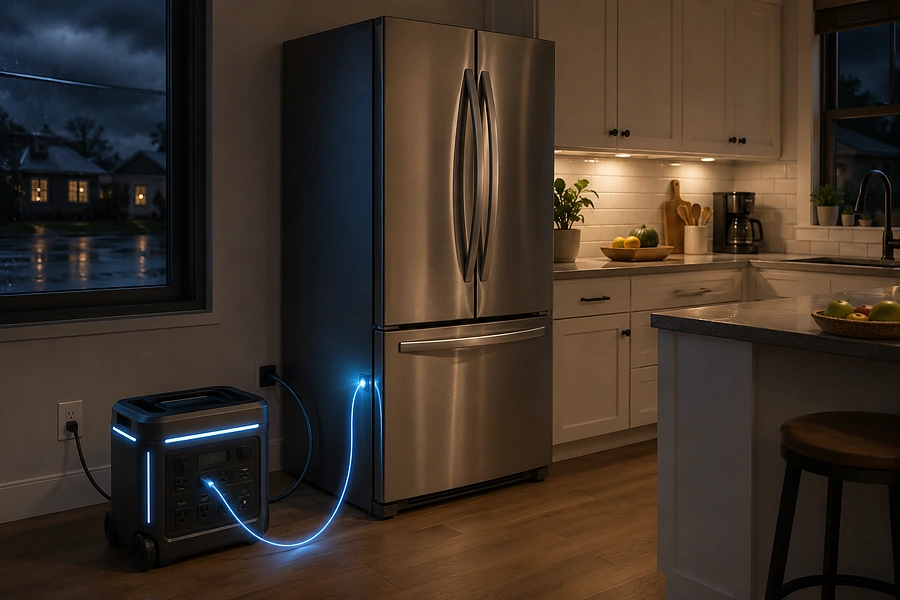
Can a 1000W Portable Power Station Run a Refrigerator?
In many cases, yes—but I check both running watts and startup surge.
A 1000W portable power station can often run a household refrigerator because many refrigerators use only a few hundred watts while operating. However, the compressor may briefly require substantially more power when starting, so the station needs enough surge capacity. A model with a 1000W continuous output and roughly 2000W surge capability has a better chance of starting suitable refrigerators.
Refrigerator Startup Is the Main Concern
Suppose my refrigerator normally draws:
150W
but requires:
900W
for a brief compressor startup.
A 1000W station may handle it.
But another refrigerator may run at:
250W
and briefly demand:
1400W
during startup.
If my power station has only:
1000W continuous and 1000W surge
it may shut down.
Consumer Reports specifically recommends leaving headroom because appliances such as refrigerators can create startup surges.
Runtime Depends on Battery Capacity
Assume the power station has:
1000Wh nominal battery capacity
and the refrigerator averages:
100W over time.
The ideal calculation is:
1000Wh ÷ 100W = 10 hours
But real runtime may be lower because of:
- Inverter losses
- Internal electronics
- Battery reserve
- Temperature
- Compressor cycling
If the refrigerator actually averages only 60W over a full duty cycle, runtime may be longer.
That is why measuring real refrigerator energy consumption with a plug-in energy meter gives me a much better estimate than relying on the refrigerator's label alone.
Can a 1000W Portable Power Station Run a TV and Wi-Fi Router?
Yes, this is usually an easy load for a 1000W system.
A television and Wi-Fi router typically consume far less than 1000W combined, so a 1000W portable power station can normally operate both simultaneously along with additional low-power electronics such as phones, LED lights, and laptops. Runtime will depend mainly on the power station's watt-hour capacity rather than its 1000W inverter rating.
Example Load
Suppose I use:
TV: 120W
Router: 15W
Laptop: 60W
LED light: 10W
Total load:
120 + 15 + 60 + 10 = 205W
That is well below:
1000W
If the battery has approximately:
1000Wh
the theoretical runtime is:
1000Wh ÷ 205W ≈ 4.9 hours
After accounting for losses, actual AC runtime will be lower.
This kind of load is where a 1000W power station makes a lot of sense.
It provides enough inverter headroom without requiring the size and cost of a much larger home backup system.
Can a 1000W Portable Power Station Run a CPAP Machine?
Usually yes, although actual consumption varies by CPAP settings and accessories.
Most CPAP machines consume substantially less than 1000W, so inverter power is normally not the main limitation. Runtime is more important. Heated humidifiers and heated tubing can noticeably increase energy consumption, so I calculate overnight watt-hours using the machine's actual power requirements rather than assuming a fixed CPAP runtime.
Example Overnight Calculation
Suppose the CPAP averages:
50W
for:
8 hours
Energy requirement:
50W × 8h = 400Wh
A 1000Wh-class battery could theoretically support that load comfortably for one night.
If heated accessories increase average consumption to:
90W
then:
90W × 8h = 720Wh
The same battery now has much less reserve.
So for medical-device backup, I focus on:
- Actual device input rating
- Overnight energy consumption
- Battery capacity
- AC conversion loss
- Backup margin
I also verify the CPAP manufacturer's requirements before relying on any battery system.
Can a 1000W Portable Power Station Run a Microwave?
Usually not reliably unless the microwave is unusually low-powered and its actual electrical input remains below the station's limit.
Many microwaves are poor matches for a 1000W portable power station because their electrical input can exceed 1000W even when the advertised cooking power is lower. A microwave labeled “700W” may consume significantly more than 700W from the outlet. I therefore check the appliance's input wattage, not just its cooking-output rating.
Output Watts and Input Watts Are Not the Same
This catches many people by surprise.
A microwave marketed as:
700W
may mean:
700W microwave cooking output
not:
700W electrical consumption.
Its electrical input could be above:
1000W.
If so, a conventional 1000W inverter should not be expected to run it.
Some portable power stations have proprietary high-load modes that alter output voltage to operate certain resistive appliances, but I do not treat those modes as equivalent to a true higher continuous inverter rating.
I always check:
actual appliance input wattage
against:
continuous inverter output.
Can a 1000W Power Station Run an Electric Kettle?
Most full-size electric kettles are too demanding.
Many electric kettles draw roughly 1200–1800W or more, which exceeds the normal continuous output of a 1000W portable power station. Low-power travel kettles may work if their rated consumption stays safely below 1000W, but I would not expect a standard high-speed household kettle to operate normally.
This is a good example of why a device can be simple but still require a lot of power.
An electric kettle contains a resistive heating element.
Heating appliances often draw large amounts of electricity because they convert electrical energy directly into heat.
The same issue applies to:
- Space heaters
- Hair dryers
- Hot plates
- Toasters
- Electric grills
A 1000W portable station is usually better suited to:
electronics and moderate appliances
than:
high-power electric heating.
Can a 1000W Portable Power Station Run a Coffee Maker?
Sometimes.
Small coffee makers may consume less than 1000W and can potentially run from a 1000W portable station, while larger drip machines, espresso machines, or systems with high-powered heaters may exceed the inverter limit. Because heating elements draw substantial power, I verify the label rating before connecting the appliance.
Suppose my coffee maker is rated:
800W.
It appears compatible.
However, I would avoid running other major devices at the same time.
For example:
Coffee maker: 800W
Laptop: 70W
TV: 120W
Total:
990W
That is technically close to the station's limit.
I would prefer more headroom because:
- appliance wattage can fluctuate
- inverter ratings may depend on temperature
- additional small loads may be present
Consumer Reports similarly recommends maintaining some margin between the combined appliance load and the station's maximum output.
Can a 1000W Portable Power Station Run Power Tools?
Some power tools, yes. Others, no.
A 1000W portable power station can run many low- and medium-power tools if their continuous and startup requirements remain within the inverter's ratings. Cordless-tool chargers, drills, small sanders, and some saws may work, while larger compressors, table saws, demolition tools, and high-powered motors can exceed the continuous or surge limit.
Motors Need Special Attention
A BLUETTI 1000W-class manual warns that devices with motors or compressors may require approximately two to four times their rated power at startup.
For example:
A tool may be labeled:
600W running power
but briefly need:
1200–1800W
when starting under load.
If my station offers:
1000W continuous
and:
2000W surge
it might work.
But surge specifications are not all identical.
Manufacturers can define:
- surge duration
- overload duration
- temperature conditions
differently.
I therefore check the manual rather than assuming a “2000W peak” rating guarantees every 2000W startup load will work.
Can a 1000W Power Station Run an Air Conditioner?
Most conventional room air conditioners are challenging for a 1000W station.
Some very small air conditioners may have running consumption near or below 1000W, but compressor startup power can exceed the inverter's surge capability. Larger window units, portable air conditioners, and residential split systems generally require more power than a conventional 1000W portable station is designed to provide.
The issue is similar to a refrigerator but at a larger scale.
An air conditioner may have:
running demand: 800W
but:
startup demand: well above 1000W.
Even if it starts, a 1000Wh battery running an 800W load would have a theoretical maximum runtime of only:
1000Wh ÷ 800W = 1.25 hours
and real runtime would be shorter.
So cooling large spaces is usually not an efficient use of a 1000W-class portable station.
Fans are much easier.
A:
50W fan
can run vastly longer than an:
800W air conditioner.
How Long Will a 1000W Portable Power Station Run Appliances?
There is no single runtime because 1000W tells me inverter output, not battery size.
Runtime depends primarily on battery capacity in watt-hours and the average power consumption of the connected devices. If a 1000W station also contains about 1000Wh of battery capacity, a 100W load might theoretically run for about 10 hours, while a 500W load might run for about two hours. Actual runtime is lower because of conversion losses and system overhead.
Basic Runtime Formula
I use:
Runtime ≈ usable Wh ÷ load W
For simplified comparisons:
| Load | 1000Wh Ideal Runtime |
|---|---|
| 20W | 50 h |
| 50W | 20 h |
| 100W | 10 h |
| 200W | 5 h |
| 500W | 2 h |
| 800W | 1.25 h |
| 1000W | 1 h |
These are theoretical values.
Real-world output through AC outlets is lower because the inverter and electronics consume energy.
Consumer Reports also distinguishes power rating in watts from runtime-related capacity in watt-hours, which is the key distinction when sizing portable stations.
A Better Planning Formula
For rough planning, I might use:
Estimated runtime = battery Wh × usable-efficiency factor ÷ load
Suppose:
Battery = 1000Wh
Planning factor = 0.85
Load = 200W
Then:
1000 × 0.85 ÷ 200 = 4.25 hours
The actual factor varies by product and load.
Low DC loads and high AC loads can behave differently.
So I treat this as planning arithmetic, not a manufacturer guarantee.
What Can You Run at the Same Time With 1000W?
Several devices can run simultaneously as long as their total continuous load stays under the inverter rating and surge demand remains acceptable.
A 1000W portable power station can often operate a group of low-power essentials at the same time—for example, a refrigerator, router, laptop, television, and several LED lights. I add their wattages together and leave operating headroom instead of loading the inverter continuously at exactly 1000W.
Example Emergency Setup
Suppose I want:
| Device | Power |
|---|---|
| Refrigerator | 150W |
| Router | 15W |
| TV | 100W |
| Laptop | 65W |
| 3 LED lights | 30W |
| Phone chargers | 20W |
| Total | 380W |
That is comfortably below 1000W during normal operation.
However, the refrigerator may temporarily increase the total during compressor startup.
If the station has adequate surge capacity, this can be a practical emergency setup.
Example That Does Not Work
Now add:
Electric kettle: 1500W
The total becomes:
1880W
That exceeds the station's continuous rating before considering any startup surge.
The solution is not to unplug one phone charger.
The kettle itself is already too large.
What Appliances Should I Avoid With a 1000W Portable Power Station?
High-power heating equipment and large motors are the main problem.
I generally avoid appliances whose rated input exceeds 1000W, as well as motor-driven equipment with startup demand above the power station's surge rating. Common problem loads include large kettles, space heaters, hair dryers, large microwaves, induction cooktops, air conditioners, compressors, electric ovens, and many heavy-duty power tools.
A simple guide is:
Usually Easy
- Phones
- Tablets
- Laptops
- Routers
- LED lights
- TVs
- Cameras
- Fans
- Small electronics
Often Possible
- Refrigerators
- CPAP machines
- Small freezers
- Small coffee makers
- Small blenders
- Cordless-tool chargers
- Moderate power tools
Often Too Large
- Kettles
- Space heaters
- Hair dryers
- Large microwaves
- Toasters
- Induction cooktops
- Electric ovens
- Large air conditioners
- Large compressors
I always prioritize the appliance's actual nameplate power requirement over generic lists.
Why Does Surge Power Matter on a 1000W Portable Power Station?
Some appliances consume far more electricity for a fraction of a second when their motors start.
Surge power is a portable power station's ability to temporarily supply more than its continuous rating. It matters for refrigerators, pumps, compressors, and tools. For example, some 1000W-class stations are rated around 2000W peak, but the allowed surge duration and operating conditions differ by product, so I verify the manufacturer's specification.
The Jackery Explorer 1000 Pro, for example, lists:
1000W rated output
and:
2000W peak surge.
That does not transform it into a 2000W continuous station.
The distinction is:
1000W = continuous
2000W = temporary peak
I consider both when choosing appliances.
My Insights: What Can a 1000W Portable Power Station Run
The simplest answer is not a fixed list of appliances. It is an electrical rule.
A 1000W portable power station can run one or more devices whose combined continuous consumption stays below 1000 watts, provided their startup surge also stays within the station's peak rating. In practice, that commonly includes refrigerators, TVs, routers, laptops, lights, fans, CPAP machines, and small electronics, while high-power heating appliances and large motors are usually unsuitable.
My First Insight: 1000W Does Not Mean 1000Wh
This is the most common misunderstanding.
Consider:
Station A: 1000W output + 500Wh battery
and:
Station B: 1000W output + 1500Wh battery
They can potentially run similar maximum loads.
But Station B may run those loads much longer.
Therefore:
W tells me what I can run.
Wh tells me how long I can run it.
My Second Insight: The Appliance Label Is More Useful Than an Online List
Generic wattage tables are useful for planning, but actual appliances vary.
Two refrigerators can have completely different:
- compressor sizes
- startup currents
- duty cycles
Two coffee makers may use:
600W
and:
1400W.
So before connecting something, I look for:
Rated Input: ___ W
on the device label or manual.
That is much more reliable than assuming every device in the same category uses the same power.
My Third Insight: A 1000W Station Is Best for Essential Loads, Not Electric Heating
Portable power stations around this output level are particularly useful for:
- Communication
- Lighting
- Refrigeration
- Computing
- Entertainment
- Small medical equipment
- Charging electronics
They are much less suitable for converting large amounts of electricity directly into heat.
For example:
50W laptop × 10 hours = 500Wh
while:
1000W heater × 0.5 hour = 500Wh.
Both consume the same energy in this example.
But the heater uses it twenty times faster.
That is why high-power heating drains portable batteries quickly even when the inverter can technically support the load.
My Fourth Insight: Surge Headroom Is Essential for Refrigerators and Motors
I would not buy a 1000W station for compressor or motor loads without checking its surge specification.
Consumer Reports recommends leaving power headroom because appliances such as refrigerators can draw more current when starting.
For motor loads I therefore check:
running watts + starting watts + surge duration.
That is more useful than simply seeing a large “peak power” number on the box.
My Fifth Insight: What Can a 1000W Portable Power Station Run in Real Life?
This directly answers What Can a 1000W Portable Power Station Run?
My practical decision table is:
| Device | Likely Result With 1000W Station |
|---|---|
| Phone | Easy |
| Laptop | Easy |
| Router | Easy |
| LED lights | Easy |
| TV | Easy |
| Fan | Easy |
| CPAP | Usually easy |
| Refrigerator | Usually possible; check surge |
| Small freezer | Usually possible; check surge |
| Coffee maker under 1000W | Possible |
| Blender under 1000W | Possible; check startup |
| Small power tool | Possible; check surge |
| Microwave | Often too demanding |
| Electric kettle | Usually too demanding |
| Hair dryer | Usually too demanding |
| Space heater | Usually too demanding |
| Large air conditioner | Usually too demanding |
| Induction cooktop | Usually too demanding |
My final rule is even simpler:
Step 1: Find the appliance's running watts.
Step 2: Check its startup surge if it contains a motor or compressor.
Step 3: Add together everything that will run simultaneously.
Step 4: Keep that total below the station's continuous rating with reasonable headroom.
Step 5: Use battery watt-hours to calculate runtime.
For example, if my required loads are:
Fridge: 150W
Router: 15W
Laptop: 65W
Lights: 20W
the running total is:
250W.
A 1000W station has plenty of continuous-output headroom, assuming the refrigerator's startup surge is supported.
If the battery is about:
1000Wh
then a rough planning estimate at 250W could be around:
1000Wh × 0.85 ÷ 250W ≈ 3.4 hours
with actual performance varying by product and appliance behavior.
That is why I describe a 1000W portable power station as a strong choice for essential electronics and moderate appliances, not a replacement for unlimited household electricity.
Conclusion
A 1000W portable power station can run most low- and medium-power essentials, but always check continuous watts, startup surge, and battery watt-hours before estimating compatibility or runtime.
](https://voltcrave-battery.com/wp-content/uploads/2026/06/What-Are-the-Conditions-Necessary-for-Energy-Storage-768x512.jpg)
](https://voltcrave-battery.com/wp-content/uploads/2026/08/The-Ultimate-Guide-to-Energy-Storage-All-in-One-vs.-Split-Systems-Which-Is-Right-for-You-768x512.webp)
](https://voltcrave-battery.com/wp-content/uploads/2026/09/How-Long-Will-a-Power-Station-Power-a-Fridge-768x512.webp)