

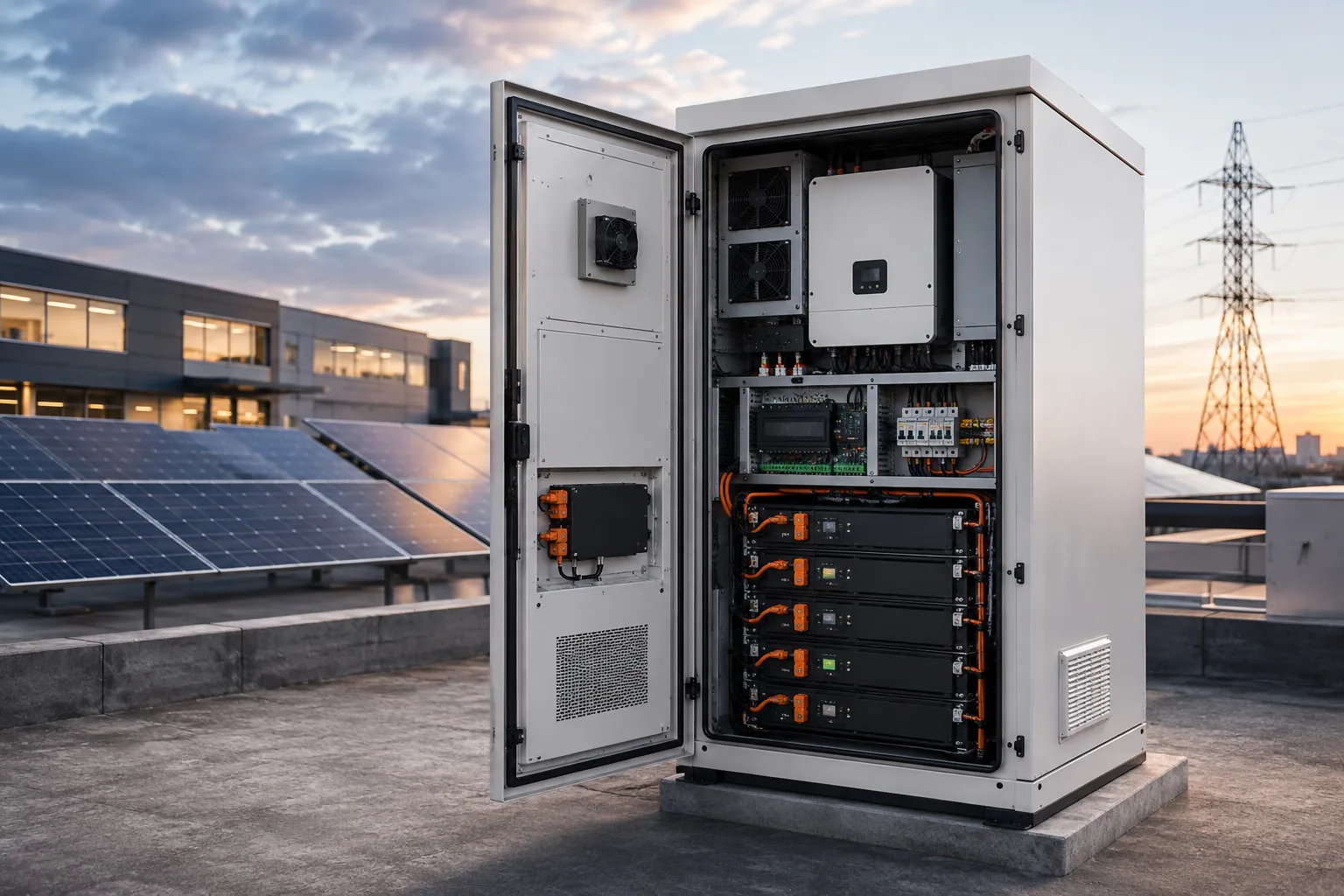
](https://voltcrave-battery.com/wp-content/uploads/2026/08/The-Ultimate-Guide-to-Commercial-Battery-Energy-Storage-Systems-BESS-A-Strategic-Investment-for-Modern-Business.webp)
Electricity costs, demand peaks, outages, solar surplus, and growing electrification can turn energy management into a serious operational and financial challenge for modern businesses.
A commercial Battery Energy Storage System (BESS) stores electricity and releases it when the business gains more value from that energy. I see C&I battery storage as a strategic investment because one system can reduce peak demand, optimize electricity tariffs, increase solar self-consumption, provide backup power, support EV charging, and improve long-term energy resilience.
The business case is becoming increasingly important as battery storage scales globally. The IEA reports that 108 GW of new battery-storage capacity was deployed worldwide in 2025, 40% more than in 2024, while installed capacity reached eleven times its 2021 level.
What Is a Commercial Battery Energy Storage System?
A commercial BESS is not simply a larger version of a household battery. It is an engineered energy asset connected to a facility's electrical system and controlled according to business objectives.
A commercial Battery Energy Storage System is a rechargeable electrical storage system used by offices, factories, warehouses, retail sites, farms, hotels, data centers, EV charging hubs, and other businesses. It combines batteries with power conversion, controls, thermal management, protection, and monitoring so electricity can be stored and dispatched according to facility demand.
A BESS Includes Much More Than Battery Cells
I separate the battery from the battery energy storage system.
The battery cells physically store electrochemical energy.
The complete BESS normally contains:
| BESS component | Main function |
|---|---|
| Battery cells and modules | Store electrical energy |
| BMS | Protects and monitors the battery |
| PCS | Converts power between DC and AC |
| EMS | Controls when the BESS charges or discharges |
| Thermal management | Maintains suitable operating temperatures |
| Switchgear | Connects and isolates electrical equipment |
| Transformer | Matches system and facility voltage where required |
| Metering | Measures load, generation, and energy flow |
| Fire/safety systems | Detect and mitigate abnormal conditions |
| SCADA/cloud monitoring | Provides visibility, alarms, and controls |
The U.S. Department of Energy treats commercial-scale lithium-ion BESS procurement as a complete project-development exercise rather than merely an equipment purchase. Its procurement checklist includes tasks and questions intended for the early stages of commercial-scale BESS development.
That distinction matters.
If I select excellent battery cells but poorly integrate:
PCS + BMS + EMS + protection + site controls
the project can still underperform.
A successful commercial BESS is therefore a system investment, not a battery purchase.
Why Is Commercial BESS Becoming a Strategic Business Investment?
Businesses increasingly depend on electricity for production, communications, cooling, automation, transportation, and customer operations.
Commercial BESS can turn electricity from a fixed operating expense into a resource that the business actively manages. I can store electricity when it is cheaper or abundant and use it when it is expensive, scarce, or operationally critical. This creates potential value through peak shaving, tariff optimization, solar storage, resilience, and flexible load management.
One Battery Can Produce Several Forms of Value
I rarely evaluate a commercial battery using only one use case.
A stronger strategy is value stacking.
The same battery could operate like this:
Midday: store excess solar.
Afternoon: reduce a demand peak.
Evening: avoid high-price electricity.
Night: recharge during a lower-cost period.
Outage: preserve enough stored energy for critical loads.
This means one asset can support:
- Energy-cost reduction
- Demand-charge management
- Solar self-consumption
- Backup power
- Microgrid operation
- EV charging
- Demand response
- Grid flexibility
DOE guidance on on-site storage identifies demand-charge management as one important application, noting that demand charges are typically linked to a customer's peak electricity demand under the applicable utility tariff.
For me, that is why commercial storage is strategically different from simply buying cheaper electricity.
The BESS gives the business control over when it draws electricity from the grid.
How Does a Commercial BESS Work?
A BESS charges when storing energy creates value and discharges when supplying energy creates greater value.
During charging, electricity is stored in the battery as DC energy. During discharge, the PCS converts battery DC into AC electricity for the facility or grid. The BMS controls battery operating limits, while the EMS uses load, tariff, solar, SOC, and operational data to determine when the system should charge or discharge.
I Think of BMS, PCS, and EMS as Three Different Layers
They are often confused.
I use this simple distinction:
BMS = battery protection
PCS = power conversion
EMS = business strategy
The BMS monitors values such as:
- Cell voltage
- Temperature
- Current
- State of charge
- Fault conditions
The PCS handles:
AC → DC
when charging from an AC source.
It handles:
DC → AC
during discharge.
The EMS sits above both.
It may decide:
“Do not let grid demand exceed 800 kW.”
or:
“Charge from solar until 4 p.m., then discharge during the expensive tariff period.”
That makes the EMS particularly important for commercial ROI.
A battery can be technically excellent but economically ineffective if the control strategy does not match the site's tariff and load profile.
What Are the Main Applications of Commercial Battery Storage?
Different businesses install BESS for different reasons, so I define the application before selecting the system.
The main commercial BESS applications are peak shaving, time-of-use energy shifting, solar self-consumption, backup power, demand response, EV charging support, microgrids, and grid-capacity management. I usually prefer projects where several of these applications can be combined because multiple value streams can improve asset utilization and strengthen the investment case.
Peak Shaving
Suppose a manufacturing facility normally consumes:
700 kW
but occasionally reaches:
1,000 kW
for 30 minutes.
If I want the grid meter to remain below:
800 kW
the battery must provide up to:
200 kW
during that peak.
The grid then sees approximately:
800 kW
instead of:
1,000 kW
This can be valuable where the applicable tariff places significant financial weight on peak demand.
Time-of-Use Optimization
Suppose electricity costs less overnight and more during the late afternoon.
The BESS can follow:
Low-price period → charge
High-price period → discharge
I calculate the value from the tariff spread after allowing for:
- Round-trip efficiency
- Battery degradation
- Operating reserve
- Financing cost
A price difference alone does not automatically guarantee profitable arbitrage.
Solar Self-Consumption
Solar and storage work naturally together because generation and demand do not always occur at the same time.
DOE describes storage as being charged when generation is high and demand is lower, then discharged when electricity demand rises or solar production falls.
A commercial building might operate:
Solar → facility loads
then:
Excess solar → battery
and later:
Battery → evening loads
Instead of exporting inexpensive midday energy and later purchasing electricity again, the business keeps more renewable energy on site.
Backup and Resilience
For some businesses, one outage can cost far more than a month of electricity savings.
A BESS can support selected critical loads such as:
- IT infrastructure
- Refrigeration
- Control systems
- Security
- Lighting
- Telecommunications
- Essential production equipment
I calculate the economic value of resilience differently from tariff savings.
Avoiding one major shutdown may justify storage even when the pure energy-arbitrage payback is modest.
What Is the Difference Between kW and kWh in Commercial BESS?
Many storage projects are incorrectly sized because power and energy are treated as the same thing.
In a commercial BESS, kW or MW measures power and determines how much electrical load the battery can support at one moment. kWh or MWh measures energy and determines how long the system can sustain that output. I therefore size battery energy and PCS power separately according to the application's required magnitude and duration.
Power and Duration Must Match the Business Problem
Consider:
500 kW / 1,000 kWh
Its nominal duration is:
1,000 kWh ÷ 500 kW = 2 hours
Now consider:
250 kW / 1,000 kWh
Its nominal duration becomes:
1,000 kWh ÷ 250 kW = 4 hours
The battery energy is identical.
The operating capability is not.
| Configuration | Power | Energy | Nominal duration |
|---|---|---|---|
| 100 kW / 200 kWh | 100 kW | 200 kWh | 2 hours |
| 250 kW / 500 kWh | 250 kW | 500 kWh | 2 hours |
| 250 kW / 1 MWh | 250 kW | 1 MWh | 4 hours |
| 500 kW / 1 MWh | 500 kW | 1 MWh | 2 hours |
| 1 MW / 4 MWh | 1 MW | 4 MWh | 4 hours |
If the site has a short 400 kW demand spike, I may prioritize PCS power.
If the site needs four hours of evening energy shifting, I need substantially more kWh.
For backup, I calculate both.
A facility may require:
300 kW maximum critical load
but consume only:
120 kW average
during a typical outage.
The PCS must support the peak.
The battery capacity must support the required duration.
How Can BESS Reduce Commercial Electricity Costs?
A commercial battery does not reduce electricity consumption automatically. It changes when and how electricity is supplied.
A BESS can reduce commercial electricity costs by lowering grid demand during expensive periods, charging during lower-cost periods, increasing the use of onsite solar, and responding to tariff structures. The financial result depends on the site's load profile, utility rate design, battery efficiency, degradation, dispatch strategy, and whether the battery can generate several value streams.
Peak Demand Can Be More Important Than Monthly kWh
Two facilities can each consume:
100,000 kWh per month
but have very different electricity bills.
Facility A has a flat load.
Facility B has several sharp high-power peaks.
If the tariff penalizes those peaks, Facility B may have a stronger BESS business case.
This is why I do not size commercial storage from monthly utility bills alone.
I prefer:
- 15-minute interval data
- 30-minute interval data
- Higher-resolution demand data when available
That reveals:
- When peaks occur
- How long they last
- Whether they are predictable
- Whether solar overlaps with them
DOE's commercial on-site storage guidance similarly emphasizes the importance of tariff structure and peak demand when assessing battery applications.
Energy Arbitrage Needs Enough Price Spread
Suppose:
Off-peak electricity = $0.10/kWh
Peak electricity = $0.25/kWh
The gross spread is:
$0.15/kWh
But the battery does not return every kWh used to charge it.
If the full AC round-trip efficiency were 90%, I must purchase more than 1 kWh to deliver 1 kWh later.
I also need to account for degradation.
So I calculate:
Net dispatch value = avoided energy cost − charging cost − losses − degradation cost
This gives me a more realistic operating decision.
How Does Solar Plus Commercial BESS Improve the Business Case?
Solar reduces electricity generation cost during daylight, while batteries control when that electricity is used.
Solar-plus-storage can improve commercial energy economics by storing PV production that exceeds immediate facility demand and shifting it into later hours. I find the combination especially attractive when solar export compensation is relatively low, evening electricity is expensive, grid export is constrained, or the business needs backup power from renewable energy.
Storage Can Prevent Solar Value From Falling at Midday
Suppose a warehouse has:
1 MW rooftop solar
At noon, facility demand falls to:
600 kW
Solar produces:
900 kW
Without storage:
300 kW → grid export
With a BESS:
300 kW → battery
Later:
Battery → facility
DOE describes storage as a way to capture solar electricity when production exceeds immediate need and use that energy later.
This also becomes useful where grid export is limited.
Instead of curtailing solar generation, the site may be able to store more of it.
New and Existing Solar Projects May Use Different Architectures
For a new project, I may evaluate DC coupling.
For an existing solar facility, AC coupling can be easier because the current solar inverters remain in service.
The correct architecture depends on:
- Existing equipment
- PV voltage
- PCS sizing
- Interconnection rules
- Backup requirements
- Expansion plans
- Efficiency
I do not choose AC or DC coupling from a general rule.
I model the actual site.
Why Is LFP So Common in Commercial BESS?
Commercial storage prioritizes cost, cycling, durability, and stationary safety more than maximum energy density by weight.
Lithium iron phosphate, or LFP, is now the dominant stationary battery chemistry. The IEA reports that LFP represented around 90% of battery-storage deployments in 2025. I consider LFP well suited to commercial storage because it is generally lower cost than competing lithium-ion chemistries and is well suited to frequent cycling in stationary applications.
Stationary Storage Does Not Have the Same Requirements as an EV
A car carries its battery everywhere.
Weight matters greatly.
A commercial BESS normally remains fixed.
I therefore place greater emphasis on:
- Cost per usable kWh
- Cycle life
- Warranty
- Thermal behavior
- Serviceability
- Lifetime throughput
- Safety architecture
The IEA notes that LFP is less energy-dense than some chemistries commonly used in EVs but is typically cheaper and better suited to frequent cycling.
However, LFP should never be treated as fireproof.
The complete system still requires:
- BMS protection
- Thermal management
- Electrical protection
- Fault detection
- Fire testing
- Appropriate installation
I therefore evaluate battery safety at the system level, not simply from the chemistry name.
What Safety Standards Matter for Commercial BESS?
Safety requirements can affect equipment selection, layout, permitting, insurance, and project cost.
For U.S. commercial BESS projects, I commonly review UL 9540 system certification, UL 9540A thermal-runaway fire testing, NFPA 855, the International Fire Code, and requirements imposed by the local authority having jurisdiction. The exact requirements depend on system size, chemistry, installation location, enclosure design, spacing, and local code adoption.
UL 9540 and UL 9540A Are Different
UL 9540 addresses the complete energy storage system.
UL explains that system evaluation covers charging, discharging, protection, controls, communications, utility-grid interaction, and related equipment.
UL 9540A addresses thermal-runaway fire propagation testing.
It does not mean:
“This battery can never catch fire.”
It provides data used to evaluate fire behavior and installation risk.
Current Fire Requirements Are Becoming More Detailed
UL states that the 2026 edition of NFPA 855 specifies UL 9540A as its fire and explosion test method, and the sixth edition of UL 9540A was published on March 13, 2026 with revised guidance for large-scale fire testing.
For a commercial project, these requirements can influence:
- Cabinet spacing
- Container separation
- Fire barriers
- Sprinkler strategy
- Detection
- Deflagration assessment
- Emergency access
- Site footprint
That is why I never leave fire engineering until the end of the project.
A layout that looks perfect from an electrical perspective may become impractical once safety setbacks and access requirements are included.
How Do I Size a Commercial Battery Energy Storage System?
Correct sizing begins with data, not with an equipment quotation.
I size a commercial BESS by defining the business objective, studying interval electricity demand, modeling solar production, identifying critical loads, checking tariffs and grid limits, and estimating future energy growth. I then select PCS power from the required kW response and battery capacity from the required kWh duration, with allowances for reserve and degradation.
Step 1: Identify the Primary Use Case
I ask:
What problem am I solving?
For example:
- Reduce a 300 kW peak
- Store 1 MWh of excess solar
- Support critical loads for four hours
- Limit grid import
- Support EV charging
- Avoid a transformer upgrade
Step 2: Analyze Interval Load Data
Suppose the facility peak is:
1,200 kW
but the target is:
900 kW
The BESS must supply approximately:
300 kW
during the peak.
Step 3: Measure Duration
If the peak lasts:
2 hours
the basic energy requirement is:
300 kW × 2 h = 600 kWh
I then allow for:
- SOC reserve
- System efficiency
- Degradation
- Forecast errors
So the preliminary system may need more than 600 kWh.
Step 4: Include Future Growth
A business may add:
- New production equipment
- EV chargers
- Heat pumps
- Additional buildings
- More solar
A system sized exactly for today's minimum requirement may become undersized quickly.
I therefore want either design margin or modular expansion.
DOE's procurement checklist reinforces this broader project-development approach by encouraging project owners to define technical and operational requirements early rather than starting with hardware selection.
How Should I Calculate BESS ROI?
I do not calculate BESS ROI from battery cost divided by electricity savings alone.
I calculate commercial BESS return from all available savings and revenue streams, then compare them with installed cost, financing, maintenance, energy losses, degradation, augmentation, software fees, and replacement assumptions. A strong investment case often combines peak shaving, tariff optimization, solar self-consumption, resilience, and other services rather than relying on one benefit.
My Basic Financial Framework
I evaluate:
Annual demand savings
*
Annual energy savings
*
Solar-value improvement
*
Grid-program revenue
*
Estimated resilience value
−
Operating expenses
−
Degradation-related cost
Then I compare those cash flows against total project investment.
I normally calculate:
- Simple payback
- Net present value
- Internal rate of return
- Lifetime cash flow
Resilience Is Difficult but Important to Value
Suppose a factory loses:
$50,000 per hour
during a production outage.
A battery that prevents even one major interruption may create far greater value than its normal annual tariff savings.
That does not mean I assign an unrealistic resilience value.
I estimate:
Probability of outage × expected interruption cost × BESS protection capability
This gives a more disciplined way to include resilience.
Battery Reserve Creates an Opportunity Cost
If I keep:
40% SOC
reserved for backup, that energy cannot always be used for daily peak shaving.
So the EMS needs to balance:
economic savings
against:
operational resilience
This tradeoff is one reason sophisticated controls can materially affect project value.
What Should I Look for When Buying a Commercial BESS?
The lowest equipment price does not necessarily create the lowest lifecycle cost.
When procuring a commercial BESS, I evaluate usable energy, PCS power, chemistry, efficiency, warranty, capacity retention, throughput, cooling, safety testing, EMS functionality, grid compliance, environmental rating, communications, serviceability, augmentation, spare parts, and supplier strength. I also specify performance for the complete system rather than relying on individual cell specifications.
My Commercial BESS Procurement Checklist
| Item | What I check |
|---|---|
| Usable energy | Dispatchable kWh/MWh |
| PCS rating | Continuous charge/discharge kW |
| Duration | Energy divided by power |
| Battery chemistry | Suitable for application |
| AC round-trip efficiency | Real system performance |
| Cycle/throughput warranty | Allowed lifetime usage |
| Capacity retention | Expected degradation |
| Thermal management | Cooling and environmental control |
| BMS | Cell and module protection |
| EMS | Dispatch and tariff optimization |
| Fire testing | Permitting support |
| Grid compliance | Utility requirements |
| Communications | SCADA/API integration |
| Expansion | Future augmentation |
| Service network | Local response capability |
| Warranty provider | Long-term financial strength |
DOE provides both a commercial-scale BESS procurement checklist and customizable lithium-ion BESS technical specifications, reinforcing the need to define complete project and system requirements before procurement.
I Treat Service as Part of the Product
A commercial battery may operate for more than a decade.
I therefore ask:
- Who performs warranty service?
- Are PCS spare parts stocked locally?
- Can battery modules be replaced individually?
- Is remote monitoring included?
- Who updates EMS firmware?
- Can the system be augmented later?
A competitive purchase price has limited value if the business cannot get technical support five years after installation.
What Is the Typical Commercial BESS Project Development Process?
BESS projects become easier when risks are solved in the correct sequence.
I develop a commercial BESS through feasibility analysis, interval-data modeling, site assessment, financial modeling, utility interconnection, system design, safety review, permitting, procurement, installation, commissioning, and operational optimization. I prefer to resolve tariff, grid, safety, and site constraints before manufacturing because late design changes can significantly affect cost and schedule.
My Preferred Project Sequence
1. Collect interval electricity data
I identify peaks and consumption patterns.
2. Define business objectives
I rank peak shaving, backup, solar, tariff optimization, and other services.
3. Model financial value
I test whether the project can justify the investment.
4. Conduct the site survey
I inspect:
- Main switchboard
- Transformer
- Space
- Cable routes
- Fire access
- Environmental exposure
5. Study interconnection
Even a behind-the-meter BESS can require utility coordination depending on export capability and local rules.
6. Complete preliminary engineering
I size:
PCS + battery + transformer + switchgear
7. Review safety and permitting
I incorporate the applicable electrical, fire, and building requirements.
8. Procure equipment
Only after the technical requirements are clear.
9. Install and commission
I verify:
- BMS operation
- PCS control
- EMS dispatch
- Protection
- Metering
- Communications
- Backup functions
10. Optimize after operation begins
DOE also provides dedicated procurement and interconnection checklists for distributed-energy projects, reflecting how these tasks form separate parts of commercial project development.
What Are the Risks of Investing in Commercial BESS?
Battery storage can be a strategic asset, but the investment still needs disciplined risk management.
The main commercial BESS risks include poor sizing, battery degradation, tariff changes, interconnection delays, permitting challenges, fire-safety requirements, insufficient service support, weak EMS optimization, and overestimating future revenue. I reduce these risks by using real load data, conservative financial assumptions, system-level safety design, clear warranties, and suppliers with credible long-term support.
Oversizing Can Destroy Economics
A business may believe:
“More battery is always better.”
That is incorrect.
If a site needs 500 kWh but buys 2 MWh, much of the installed capacity may remain unused.
The business has paid for energy capacity that does not generate proportional value.
Undersizing Can Limit Performance
The opposite is also true.
If the project needs:
500 kW
of peak shaving but the PCS delivers only:
250 kW
the battery cannot solve the problem even if it contains many MWh.
This again shows why:
kW and kWh must be sized independently.
Revenue Forecasts Need Conservative Assumptions
Markets and tariffs change.
I therefore do not build the entire investment thesis around one unusually profitable tariff or grid-service program.
A flexible BESS with several potential applications is more resilient to changing market conditions.
My Insights: The Ultimate Guide to Commercial Battery Energy Storage Systems (BESS)-A Strategic Investment for Modern Business
I see commercial BESS becoming less like optional clean-energy equipment and more like strategic electrical infrastructure for businesses with meaningful power costs, renewable generation, resilience needs, or growing electrification.
The Ultimate Guide to Commercial Battery Energy Storage Systems (BESS): A Strategic Investment for Modern Business comes down to one principle: the battery creates the most value when it solves a measured business problem. I prioritize accurate load analysis, correct kW/kWh sizing, value stacking, system-level safety, intelligent EMS control, modular expansion, and lifecycle economics.
I Invest in the Business Case Before the Battery
The first question I ask is not:
Which BESS manufacturer should I choose?
It is:
Where does the business lose money or face energy risk today?
The answer may be:
- Peak demand
- Expensive tariff periods
- Solar export
- Grid outages
- EV charging
- Transformer constraints
- Production interruptions
Only after identifying the problem do I select storage.
This reverses the common procurement process.
Instead of:
Product → application
I use:
Application → system design → product
DOE's commercial BESS procurement framework supports this project-first approach by emphasizing requirements, tasks, and development questions in the early stages of procurement.
I Prefer Several Value Streams
A battery used only for backup may sit idle most of the year.
A battery used only for arbitrage may provide no resilience.
I prefer a system capable of combining:
solar storage + peak shaving + tariff optimization + backup
when the tariff, interconnection rules, and system design allow it.
That improves utilization.
The EMS becomes critical because it must decide which service has priority at each moment.
I Treat Safety as an Investment Requirement
Commercial batteries can contain hundreds or thousands of kWh.
That energy deserves the same engineering discipline as other major electrical infrastructure.
UL's current guidance reflects a stronger focus on system-level and large-scale fire behavior, including the 2026 NFPA 855 framework and the current UL 9540A test method.
For me, good safety engineering protects:
- People
- Buildings
- Inventory
- Production
- Insurance availability
- Project approval
- Long-term asset value
It is therefore part of the financial case, not simply a compliance cost.
I Expect BESS to Become More Integrated
Battery storage is expanding rapidly. The IEA reports 108 GW of global additions in 2025, with LFP representing around 90% of deployments.
As the market scales, I expect more commercial systems to arrive as pre-engineered platforms combining:
LFP batteries + PCS + BMS + EMS + liquid cooling + fire detection + monitoring
Greater factory integration can reduce field engineering and simplify repeatable deployment across multiple business sites.
I Still Prioritize Modularity
Integration should not create a dead end.
A company might install:
250 kW / 500 kWh
today.
Five years later, it may add:
- More solar
- EV fleets
- New production
- Electric heating
and need:
500 kW / 1.5 MWh
A modular architecture can protect the original investment.
For me, the best commercial BESS combines:
integrated engineering
with:
expandable capacity
The Strategic Value Goes Beyond the Electricity Bill
The most important change is that businesses are becoming more dependent on electricity.
Production is electrifying.
Vehicles are electrifying.
Heating is electrifying.
Digital infrastructure is expanding.
The ability to control when electricity is purchased, stored, and consumed therefore has strategic value.
A commercial BESS can become:
a cost-control asset
a resilience asset
a renewable-energy asset
and:
an electrical-capacity asset
at the same time.
That is why I view commercial BESS as a strategic investment rather than simply a battery installation.
The strongest project is not necessarily the largest battery or the cheapest battery.
It is the system that can reliably deliver the highest lifecycle value for the specific business.
Conclusion
Commercial BESS can reduce costs, strengthen resilience, and improve renewable-energy use. Its strategic value depends on correct sizing, smart controls, safe engineering, and measurable lifecycle returns.
](https://voltcrave-battery.com/wp-content/uploads/2026/08/What-Is-the-Lifespan-of-a-Solar-Inverter-768x512.webp)
](https://voltcrave-battery.com/wp-content/uploads/2026/09/How-to-Choose-the-Best-Lithium-Battery-for-Off-Grid-Solar-Power-768x512.webp)
](https://voltcrave-battery.com/wp-content/uploads/2026/08/What-Is-an-All-in-One-Energy-Storage-System-768x512.webp)