

](https://voltcrave-battery.com/wp-content/uploads/2026/09/Off-Grid-Solar-Battery-Storage-How-Do-You-Build-a-Reliable-Power-System.webp)
Going off-grid sounds simple until several cloudy days, a large appliance, or an undersized battery leaves the system without enough energy when it matters most.
A reliable off-grid solar battery storage system starts with accurate daily-load calculations, enough battery capacity for the required autonomy, sufficient solar generation for the worst season, a correctly sized inverter and MPPT charger, effective battery management, and a backup charging strategy. Reliability comes from balancing generation, storage, power, and redundancy—not simply installing a larger battery.
I approach an off-grid system differently from a normal grid-connected solar project. When there is no utility grid behind the system, every weakness matters. The solar array must produce enough energy, the battery must bridge periods without sun, and the inverter must handle both normal loads and short startup surges. DOE also notes that solar alone does not create resilient power during an outage; properly configured inverters and storage are needed to maintain power independently.
What Does an Off-Grid Solar Battery System Actually Include?
A reliable off-grid system is not simply a solar panel connected to a battery. It is a complete small electrical power system.
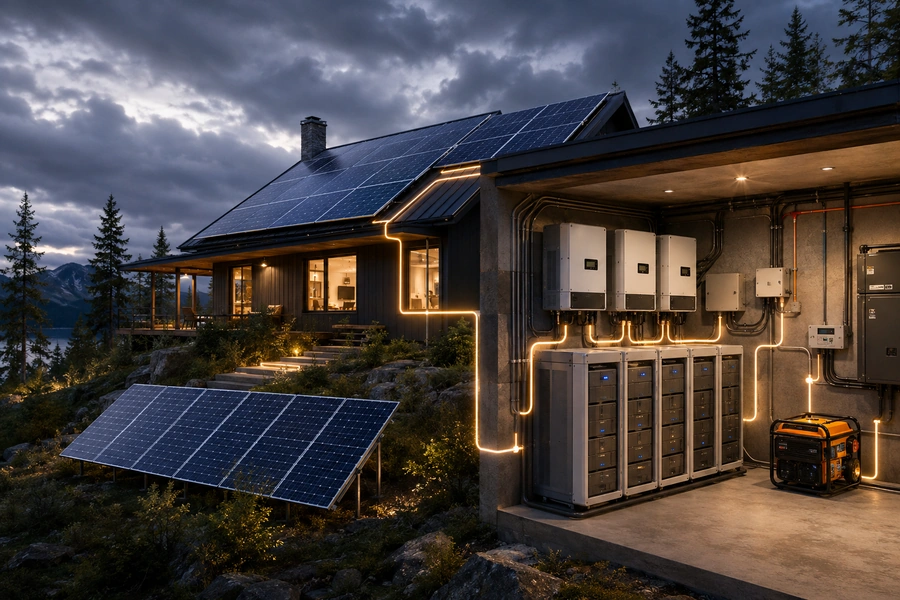
An off-grid solar battery system normally includes PV panels, MPPT charge controllers, a battery bank, BMS, inverter or inverter/charger, electrical protection, monitoring, wiring, and sometimes a generator or other backup source. Each component must be sized around the same load profile because undersizing one part can reduce the reliability of the entire system.
DOE distinguishes battery energy capacity, measured in kWh, from battery power capacity, measured in kW. This distinction is critical because storage must provide both enough total energy and enough instantaneous power.
The Core Energy Path
A simplified off-grid architecture looks like this:
Sunlight → PV array → MPPT charge controller → battery → inverter → AC loads
Some systems combine the MPPT, inverter, and charger into one unit. Others use separate components.
A typical design can be summarized as follows:
| Component | Primary Job |
|---|---|
| Solar array | Generates electrical energy |
| MPPT controller | Converts PV output into controlled battery charging |
| Battery bank | Stores energy for later use |
| BMS | Monitors and protects lithium batteries |
| Inverter | Converts battery DC into usable AC |
| AC/DC protection | Protects cables, equipment, and users |
| Monitoring | Tracks solar, loads, SOC, alarms, and faults |
| Backup generator | Provides energy during extended solar shortages |
The important point is that these components form one energy chain.
A 20kWh battery cannot compensate indefinitely for an undersized solar array.
A 10kW solar array cannot run a 7kW motor if the inverter can supply only 5kW.
And a powerful inverter does not increase the battery's stored energy.
I therefore design the complete system instead of optimizing each component independently.
How Do You Calculate Your Daily Off-Grid Energy Needs?
Load calculation should come before battery or solar-panel selection.
To size an off-grid power system, I calculate the wattage and daily operating time of every important load, convert those values into watt-hours, and add them together. I also separate continuous energy consumption from peak power demand because kWh determines battery duration while kW determines inverter and battery discharge requirements.
Suppose a small off-grid home has these loads:
| Load | Power | Daily Use | Daily Energy |
|---|---|---|---|
| Refrigerator | 80W average | 24 h equivalent cycling | 1.0 kWh |
| Lights | 80W | 5 h | 0.4 kWh |
| Router | 15W | 24 h | 0.36 kWh |
| Laptop/office | 150W | 6 h | 0.9 kWh |
| Water pump | 600W | 1 h | 0.6 kWh |
| TV | 100W | 4 h | 0.4 kWh |
| Other loads | — | — | 1.34 kWh |
| Total | 5.0 kWh/day |
That:
5kWh/day
is the starting point.
It is not yet the battery size.
The system must also account for conversion losses, battery operating limits, future load growth, seasonal changes, and reserve.
Reduce Loads Before Buying More Batteries
Energy efficiency has an unusually large value off-grid.
If I reduce daily consumption from:
10kWh/day
to:
7kWh/day
I can potentially reduce:
battery capacity
solar-array size
charge-controller size
and sometimes:
generator runtime.
That means saving one kWh per day can be cheaper than producing and storing one additional kWh every day for years.
For this reason, I audit refrigerators, water heating, pumps, air conditioning, electric heating, and other large loads before finalizing the battery.
How Big Should an Off-Grid Solar Battery Bank Be?
Battery sizing starts with daily energy consumption but must also account for autonomy.
A practical off-grid battery bank should provide enough usable kWh to meet daily loads through the desired period without adequate solar production. I size storage using daily consumption, target autonomy, usable depth of discharge, conversion losses, temperature, battery aging, and a reserve margin rather than simply multiplying daily use by one day.
A simplified starting formula is:
Required usable battery energy = Daily load × Days of autonomy
If the home consumes:
5kWh/day
and I want:
2 days of battery autonomy
then:
5 × 2 = 10kWh usable
is required before other design margins.
If the battery is operated within a 90% usable energy window:
10kWh ÷ 0.90 ≈ 11.1kWh nominal
Then I may add additional reserve for degradation and uncertainty.
A practical nominal bank might therefore be larger than:
11–12kWh.
Why Autonomy Matters
Autonomy is essentially:
How long can the system operate without useful solar input?
For a remote cabin with occasional occupancy, one day may be adequate.
For a permanent home in a cloudy climate, greater reserve may be important.
For a critical communications or medical facility, the requirement can be much stricter.
There is no universal correct number of autonomy days.
The decision depends on:
weather
criticality
generator availability
budget
and:
acceptable lifestyle changes during poor weather.
This is also where battery economics become important. Increasing storage improves reserve, but every additional kWh raises cost and may spend much of the year unused.
Why Is LiFePO4 So Common in Off-Grid Solar Storage?
Battery chemistry strongly affects the way an off-grid system behaves.
LiFePO4 batteries are widely used in modern off-grid systems because they combine frequent-cycle capability, relatively high usable depth of discharge, low routine maintenance, and strong suitability for stationary storage. However, reliable operation still depends on a compatible BMS, correct charging parameters, temperature management, and inverter communication where required.
The IEA reports that LFP accounted for around 90% of battery-storage deployments in 2025, and describes LFP as typically cheaper and better suited to frequent cycling than several competing lithium-ion chemistries used more heavily in electric vehicles.
Why Frequent Cycling Matters Off-Grid
An off-grid battery may cycle almost every day.
During daylight:
solar produces energy → loads consume some → remaining solar charges battery
After sunset:
battery → loads
Then the process repeats.
The battery is therefore not merely an emergency backup device.
It is a core part of the daily energy supply.
This duty cycle makes cycle performance important.
However, I do not select a battery based only on the words:
“5,000 cycles”
or:
“LiFePO4.”
Cycle-life specifications depend on test conditions such as:
depth of discharge
temperature
charge/discharge rate
and:
end-of-life capacity threshold.
I also check continuous current, peak current, operating-temperature limits, BMS behavior, system voltage, inverter compatibility, warranty conditions, and expansion rules.
Chemistry is only one layer of reliability.
How Much Solar Do You Need for Reliable Off-Grid Battery Charging?
Solar-array sizing must be based on how much energy the system needs to replace, not only on how large the battery is.
The solar array should generate enough daily energy to power daytime loads and recharge the battery after nighttime use. I size the PV array around daily consumption, local solar resource, seasonal variation, system losses, battery recharge requirements, and recovery after cloudy periods. Designing from annual-average sunlight alone can produce poor winter reliability.
DOE notes that solar generation changes with season, time of day, clouds, haze, shadows, rain, snow, dirt, and other environmental factors.
Suppose daily use is:
6kWh/day.
If the site receives:
4 effective peak-sun-hours per day
and I assume a simplified 80% overall solar-system factor:
Required PV ≈ 6kWh ÷ (4h × 0.80)
≈ 1.88kW
Mathematically, that suggests around:
1.9kW of PV.
But I would not necessarily install only 1.9kW.
Why?
Because that calculation leaves little reserve for:
cloudy days
battery recovery
winter conditions
panel temperature
dust
future loads
and:
system aging.
An off-grid array often benefits from deliberate solar oversizing.
Battery Capacity and Solar Capacity Must Be Balanced
Consider two systems.
System A
10kWh battery + 2kW solar
System B
10kWh battery + 5kW solar
Both have the same storage capacity.
But after a cloudy day, System B may restore the battery much faster.
This is one of the most important ideas in off-grid design:
Battery size tells me how long I can survive an energy deficit. Solar size tells me how quickly I can recover from it.
Reliability requires both.
Why Should You Design an Off-Grid System for Winter?
Annual-average solar data can make an off-grid design look much stronger than it really is.
A reliable off-grid system should be checked against the weakest solar period, not only annual-average production. Winter can combine shorter days, lower solar angles, storms, snow, and increased energy demand. If the system works only during average conditions, prolonged poor-weather periods can create recurring battery shortages.
This issue becomes especially important when the home uses more electricity in winter.
Loads may rise because of:
lighting
water pumping
circulation pumps
communications
or even:
electric heating.
At the same time, solar production may fall.
The result is a double problem:
lower generation + higher consumption.
I therefore create at least three operating scenarios:
| Scenario | Solar Production | Load |
|---|---|---|
| Good summer day | High | Normal |
| Typical day | Moderate | Normal |
| Poor winter period | Low | Potentially high |
The system should not necessarily run every optional appliance normally during the worst scenario.
Demand management can be part of the design.
For example, during several cloudy days I may disable:
electric water heating
EV charging
or:
nonessential workshop equipment.
That strategy can be far cheaper than installing enough batteries and solar to support maximum consumption under the worst imaginable weather.
Reliability does not always mean unlimited power.
It means designing predictable responses to limited energy.
How Do You Choose the Right Off-Grid Inverter?
Battery kWh determines how long energy lasts, but the inverter determines what AC loads can operate.
An off-grid inverter must support the maximum simultaneous AC load and the startup surge of motors, compressors, pumps, refrigerators, air conditioners, and other inductive equipment. It should also match the battery voltage and charging architecture. For larger systems, inverter/chargers can integrate generator charging and simplify backup operation.
DOE explains that modern inverters do more than convert DC to AC. Advanced solar-plus-storage inverters can provide monitoring and can enable independent operation when the system has been specifically designed for it.
Continuous Power Is Not Surge Power
Imagine a home has these simultaneous loads:
Refrigerator: 150W
Water pump: 1,200W
Lights: 200W
Computer equipment: 300W
Kitchen appliances: 1,500W
Total running load:
3,350W
A 3kW inverter is already too small.
But the pump may also need several times its normal running power briefly during startup.
That means I may need an inverter in the:
5kW class
or another suitable configuration, depending on actual surge data.
A system can therefore have:
20kWh of battery energy
and still be unable to start a large pump if the inverter or battery cannot supply the required instantaneous power.
This is why I separate:
energy sizing
from:
power sizing.
What Role Does an MPPT Charge Controller Play?
The charge controller manages how PV power reaches the battery.
An MPPT solar charge controller continuously adjusts the PV operating point to extract useful power from the array and convert it into controlled battery charging. In an off-grid system, its voltage limits, current rating, battery settings, and PV-array compatibility are critical because an undersized or incorrectly configured controller can restrict energy harvest or damage system reliability.
Victron's current ESS design documentation notes that MPPT solar chargers can provide a very efficient direct charging path between PV and batteries because energy does not first need to be converted to AC and then back to DC.
The Controller Must Match Both Sides
On the solar side I check:
PV open-circuit voltage
PV operating voltage
maximum PV power
and:
string configuration.
On the battery side I check:
battery voltage
maximum charge current
BMS limits
and:
charging profile.
Suppose the battery can safely accept:
100A
but the charge controller can deliver only:
35A.
The system may recharge much more slowly than expected.
Likewise, adding more solar modules does not necessarily improve recovery speed if the controller is already at its maximum output.
Every major component therefore needs compatible power limits.
Should an Off-Grid Solar System Include a Generator?
For many serious off-grid installations, a generator can be a rational reliability component rather than a design failure.
A backup generator can protect an off-grid system during unusually long cloudy periods, unexpected load growth, maintenance, or battery problems. Instead of installing an extremely large battery bank that is rarely used, a properly integrated generator can provide occasional energy when solar production is insufficient, especially in climates with strong seasonal variation.
I think this is one of the most important cost-versus-reliability decisions.
Imagine a site experiences ten unusually poor solar days per year.
One option is to install enough batteries and PV to survive all ten days without any other energy source.
That could require substantial extra equipment.
Another strategy is:
solar + battery for normal operation
plus:
generator for rare extended deficits.
The inverter/charger can start or request generator support when battery SOC reaches a defined threshold.
For example:
normal operating SOC: 30–100%
generator-start threshold: 25%
generator-stop threshold: 70%
The exact values depend on equipment and operating strategy.
The point is not the specific percentages.
The point is that backup can be automatic and planned.
This creates layered reliability:
solar first → battery second → generator last.
For remote systems where power failure carries high consequences, I usually prefer layered redundancy to a battery-only design pushed to its limits.
How Does Temperature Affect an Off-Grid Battery System?
Temperature affects both batteries and solar generation, so environmental design matters.
An off-grid battery bank should operate within the manufacturer's specified charging and discharging temperature limits. High temperatures can accelerate battery aging, while very low temperatures can reduce available performance and may restrict lithium charging. A reliable system therefore needs appropriate enclosure placement, insulation, heating, cooling, or temperature-aware BMS controls for its climate.
This is especially important in remote installations because the battery may be located in:
an outdoor shed
a garage
a container
or:
an unconditioned utility room.
A battery specification measured under controlled laboratory conditions may not represent performance at:
-10°C
or:
40°C.
I therefore treat thermal management as part of the energy budget.
If battery heating consumes electricity during winter, that load must come from somewhere.
Likewise, active cooling consumes energy during hot periods.
The BMS should monitor battery temperatures and prevent operation outside permitted limits.
For cold climates, I may consider insulated battery rooms or batteries with integrated heating.
For hot climates, I may prioritize shade, ventilation, appropriate HVAC, and equipment designed for high ambient temperatures.
Temperature is not a small installation detail.
It can determine usable capacity, charging availability, lifetime, and system uptime.
How Important Is Monitoring in an Off-Grid Power System?
A grid-connected home can often tolerate a solar-monitoring problem for several days because the grid keeps supplying electricity.
An off-grid home does not have that luxury.
Monitoring is essential in an off-grid system because battery SOC, solar production, load consumption, inverter status, temperature, and alarms provide early warning of an energy deficit or equipment problem. Remote monitoring can be especially valuable at isolated sites where a small fault may otherwise remain unnoticed until the batteries are deeply discharged.
A good monitoring system helps me answer:
How much energy did solar produce today?
How many kWh did the loads consume?
What is the battery SOC?
Did the generator run?
Is one component reporting a fault?
Is tomorrow's energy reserve adequate?
This data also helps improve the system over time.
Suppose I discover that a water pump consumes:
2kWh/day
instead of the expected:
0.8kWh/day.
Without monitoring, I might blame the battery for poor autonomy.
The actual problem may be excessive pumping or a failing pump.
Monitoring turns off-grid energy from guesswork into measurable energy management.
I also set alarms before conditions become critical.
An alert at:
30% SOC
is more useful than discovering the battery has shut down at its low-voltage limit.
What Safety Requirements Matter for Off-Grid Battery Storage?
Going off-grid does not eliminate battery or electrical safety requirements.
A stationary battery system should use properly rated batteries, inverters, disconnects, overcurrent protection, cables, grounding, enclosures, and installation practices. Where applicable, buyers should verify complete ESS certification rather than assuming a cell-level safety claim covers the entire system. Local electrical, building, and fire requirements still apply even when the property is not connected to a utility grid.
UL 9540 covers complete energy storage systems and evaluates charging, discharging, controls, protection, communications, enclosure characteristics, and other system-level functions.
For lithium systems, thermal-runaway testing can also become relevant. UL explains that UL 9540A evaluates hazards progressively at cell, module, unit, and installation levels, including heat release, gas release, propagation, ignition, and deflagration risks depending on test level.
Current U.S. installation requirements also continue to evolve. UL states that the 2026 NFPA 855 and 2024 IFC require fire or large-scale fire testing in certain ESS situations.
I therefore do not treat an off-grid installation as:
“No grid, no rules.”
The system still contains high electrical currents and substantial stored energy.
Proper design remains essential.
My Insights: How Do You Build a Reliable Off Grid Solar Battery Storage Power System
I see reliable off-grid power as an energy-balance problem rather than a battery-shopping problem.
To build a reliable off-grid solar battery storage system, I first reduce and measure daily loads, then size the battery for realistic autonomy, size solar for seasonal recharge requirements, select an inverter for both continuous and surge power, integrate proper MPPT charging and BMS protection, account for temperature and aging, add monitoring, and create a backup plan for extended energy shortages.
My First Insight: Start With kWh per Day, Not Battery Capacity
The first number I want is:
daily electricity consumption.
Not:
battery Ah
and not:
number of solar panels.
If I do not know how much energy the site uses, every major component becomes a guess.
For a system consuming:
8kWh/day
a 5kWh battery is fundamentally different from a 20kWh battery.
For a site consuming:
2kWh/day
the same batteries would produce completely different autonomy.
The load defines the system.
My Second Insight: Battery Capacity Determines Survival, Solar Determines Recovery
I use this mental model:
Battery = bridge
Solar = refill
A large battery lets the site survive longer without generation.
A large solar array lets it recover faster when sunlight returns.
The two must be balanced.
If I install a very large battery but too little solar, the battery may take several good days to recharge after bad weather.
If I install lots of solar but almost no battery, the site may waste daytime production yet run short overnight.
Reliable off-grid systems balance both sides of the equation.
My Third Insight: The Worst Season Matters More Than the Best Month
Summer performance can hide poor design.
An oversized summer solar array may keep the battery full every afternoon.
Then winter arrives.
Solar days become shorter.
Cloud cover lasts longer.
Loads may increase.
The same system suddenly struggles.
I therefore test the design against:
low-solar months
rather than celebrating annual-average production.
DOE specifically notes that solar output varies with season, clouds, snow, shading, dust, and other environmental factors.
My Fourth Insight: Reliability Comes From Layers
I do not rely on one component to solve every problem.
A more reliable architecture has several layers:
efficient loads → adequate PV → battery reserve → intelligent controls → backup charging
If the solar array underperforms for one day, the battery covers the difference.
If poor weather lasts several days, load management reduces demand.
If that is not enough, a generator or other backup source can restore energy.
Monitoring tells me when each layer should respond.
This layered approach is usually more robust than simply buying the largest possible battery.
My Fifth Insight: Off Grid Solar Battery Storage—How Do You Build a Reliable Power System?
This directly answers the main title.
I would build the system in this order:
| Design Question | What I Determine |
|---|---|
| How much energy is used daily? | kWh/day |
| What loads can run together? | Continuous kW |
| Which motors/compressors start? | Surge power |
| How long should the site survive without sun? | Autonomy |
| How much battery energy is usable? | Required nominal kWh |
| How weak is winter solar production? | PV array requirement |
| How quickly must batteries recover? | Solar/charger power |
| What battery chemistry fits daily cycling? | Battery technology |
| What happens in extreme weather? | Thermal strategy |
| What happens after several cloudy days? | Backup strategy |
| How are faults detected early? | Monitoring |
| How is the installation protected? | Electrical and ESS safety |
For example, suppose a remote home consumes:
6kWh/day.
I want:
two days of autonomy.
That creates:
12kWh usable storage.
If the selected battery architecture allows approximately 90% usable energy:
12 ÷ 0.90 ≈ 13.3kWh nominal
before I add degradation and design reserve.
Now assume the site receives four useful equivalent solar hours during the design period and I use a simplified 80% solar-system factor.
To replace 6kWh/day:
6 ÷ (4 × 0.80) ≈ 1.88kW PV
But I may deliberately choose a larger array because the solar system also needs to:
power daytime loads + recover the battery after cloudy weather.
That could push the practical design toward:
3kW, 4kW, or more
depending on the site and required recovery time.
Then I check peak demand.
If simultaneous loads can reach:
4kW
and a water pump has a substantial startup surge, I choose the inverter according to those power requirements rather than the 6kWh daily energy figure.
Finally, I decide what happens after several poor solar days.
If failure is unacceptable, I provide:
generator charging
or another independent source.
That entire process explains my central insight:
The most reliable off-grid system is not the one with the biggest battery. It is the one in which energy consumption, solar generation, storage capacity, inverter power, charging capability, environmental conditions, controls, and backup resources are correctly balanced.
Battery storage makes solar usable after sunset. Solar makes the battery renewable. The inverter makes stored DC energy useful to appliances. The BMS protects the battery. Monitoring reveals problems. Backup generation covers rare energy deficits.
Each component solves a different problem.
Reliability comes from making them work together.
Conclusion
Reliable off-grid solar storage requires balanced loads, PV generation, battery autonomy, inverter power, charging, monitoring, thermal protection, and backup—not simply more battery capacity.
](https://voltcrave-battery.com/wp-content/uploads/2026/06/What-Is-a-Battery-Management-System-BMS-768x512.jpg)
](https://voltcrave-battery.com/wp-content/uploads/2026/08/What-Are-the-Risks-and-Challenges-of-Installing-a-100kW-Solar-Battery-768x512.webp)
](https://voltcrave-battery.com/wp-content/uploads/2026/09/What-Is-the-Best-Portable-Jump-Starter-for-2026-768x512.webp)