

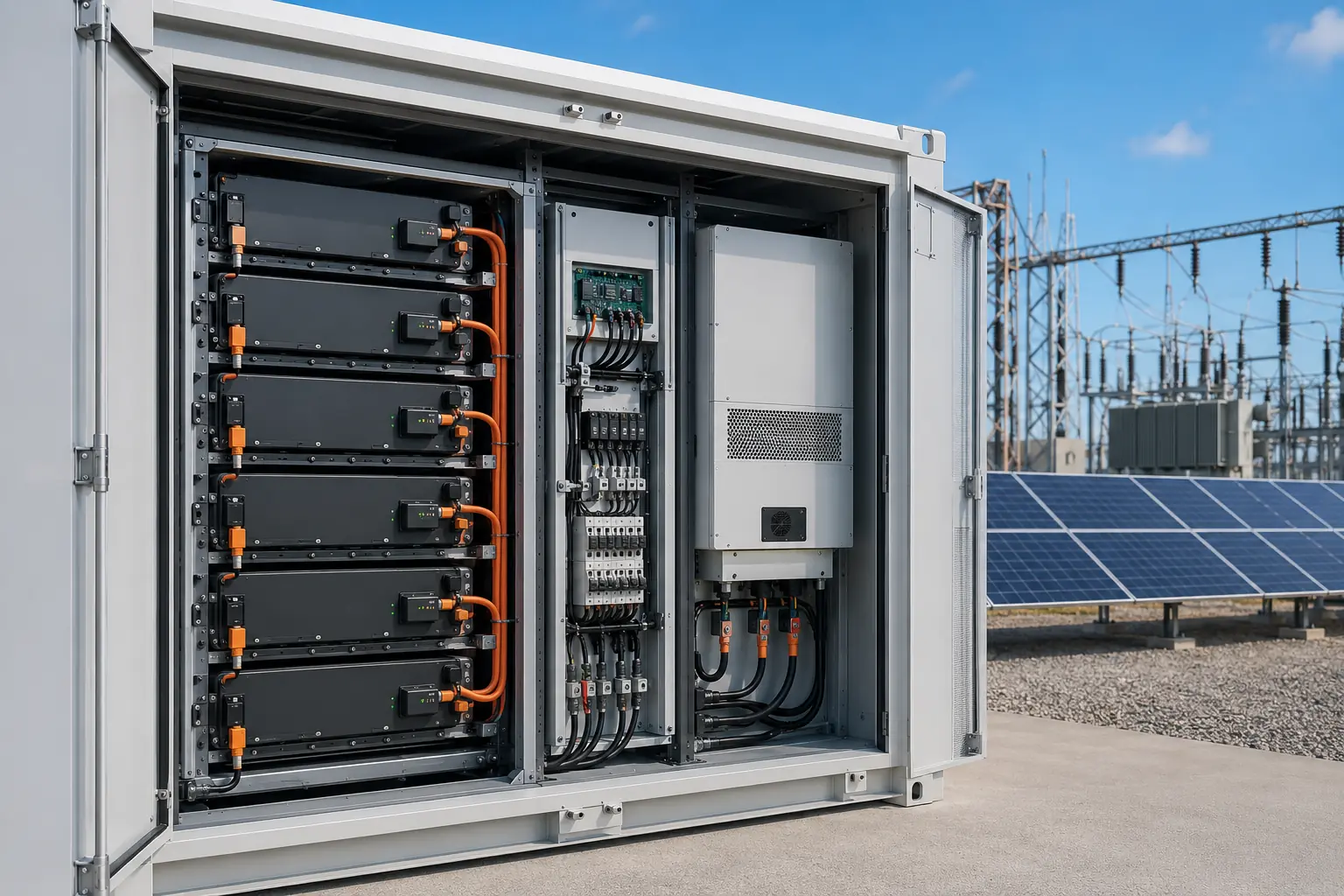
](https://voltcrave-battery.com/wp-content/uploads/2026/08/How-High-Voltage-Battery-Systems-Improve-Power-Efficiency.webp)
Moving large amounts of battery power at low voltage requires very high current, which increases cable losses, heat, conductor size, and stress on electrical components.
High voltage battery systems improve power efficiency mainly by delivering the same power at lower current. Lower current reduces resistive I²R losses and heat in cables, busbars, connectors, and switching devices. High battery voltage can also better match the DC bus of an inverter or PCS, reducing demanding voltage conversion in high-power energy storage systems.
I see the biggest advantage when power requirements become large. A small battery system can work very well at 48 V, but current increases quickly as I ask that system to supply 10 kW, 20 kW, or more. A high voltage battery changes that relationship. It lets me move the same amount of power with less current, which can make the complete electrical path more efficient.
Why Does Higher Battery Voltage Reduce Power Loss?
I start with the basic electrical relationship between power, voltage, and current because it explains most of the efficiency advantage.
For the same output power, increasing battery voltage reduces the current required to move that power. Since resistive loss follows I²R, a lower current can significantly reduce heat and electrical loss in cables, busbars, connectors, contactors, and other current-carrying components. This is one of the main reasons high voltage architecture is used in higher-power systems.
I Use the Power Equation First
The basic equation is:
P = V × I
where:
- P = power
- V = voltage
- I = current
I can rearrange it:
I = P ÷ V
Suppose my battery system needs to supply 10 kW.
| Battery Voltage | Approximate Current at 10 kW |
|---|---|
| 50 V | 200 A |
| 100 V | 100 A |
| 200 V | 50 A |
| 400 V | 25 A |
| 800 V | 12.5 A |
These are simplified values before conversion losses.
The pattern is clear.
At 50 V, I need about 200 A.
At 400 V, I need only about 25 A.
The power is still 10 kW.
I have changed the way that power moves through the system.
Texas Instruments explains the same high-voltage design principle: increasing voltage reduces the current required to deliver a given power level, which helps reduce resistive losses and heat.
Why Current Matters So Much
The next equation is:
Power loss = I² × R
This is where high voltage becomes especially interesting.
Imagine a power path with a total resistance of 0.01 Ω.
At 200 A:
Loss = 200² × 0.01 = 400 W
At 50 A:
Loss = 50² × 0.01 = 25 W
At 25 A:
Loss = 25² × 0.01 = 6.25 W
This example is intentionally simplified, but it shows the effect of the squared current term.
Reducing current does not reduce resistive losses linearly.
It can reduce them much more sharply.
That means less battery energy is converted into unwanted heat before reaching the inverter or load.
Efficiency Is a System Result
I still avoid claiming that increasing voltage automatically guarantees a specific efficiency percentage.
Real losses depend on:
- Cable resistance
- Cable length
- Connector resistance
- Busbar design
- Contactors
- Semiconductor devices
- Switching frequency
- Battery internal resistance
- PCS topology
- Operating temperature
But high voltage gives the designer a fundamental advantage: less current is required for the same power.
That is the starting point for many of the efficiency improvements that follow.
How Does High Voltage Reduce Cable and Busbar Losses?
Battery efficiency is not only about chemistry. I also need to move electricity physically from the cells to the inverter or PCS.
High voltage can reduce cable and busbar losses because lower current creates less resistive heating. This can allow the power path to use smaller conductors for the same power level or give larger conductors more operating margin. Lower current can also reduce stress at terminals, connectors, fuses, and contactor interfaces.
Cables Are Part of the Power Conversion Chain
A battery may have excellent internal efficiency, but I still lose energy if the DC wiring becomes hot.
Imagine a commercial BESS where the battery is several meters away from the PCS.
The electricity may travel through:
Battery modules → rack busbars → main DC bus → fuse → contactor → cable → PCS
Every connection has some resistance.
At high current, even small resistance matters.
I therefore think about high-voltage efficiency as a complete path:
lower current → lower conductor losses → less heat → more battery energy reaches the PCS
Lower Current Can Reduce Conductor Requirements
If I need hundreds of amperes, I may require:
- Thick copper cables
- Large busbars
- High-current connectors
- High-current DC breakers
- Large fuses
- Heavy terminal hardware
This adds material, weight, and installation complexity.
High voltage does not remove these components, but it can reduce the current rating required for the same system power.
TI specifically identifies high voltage as an important architecture for efficient energy transfer at increasing power levels and notes that reduced current helps minimize heat loss.
The Advantage Grows With Power
This becomes increasingly important as BESS power rises.
Consider a 20 kW system.
At 50 V:
20,000 W ÷ 50 V = 400 A
At 400 V:
20,000 W ÷ 400 V = 50 A
At 800 V:
20,000 W ÷ 800 V = 25 A
A 400 A DC path is a very different engineering problem from a 50 A path.
This is why I often see low-voltage battery systems used successfully at smaller power levels, while larger residential, commercial, industrial, and grid systems move toward several hundred volts or even higher.
TI's energy-storage platform supports battery-management and power-conversion architectures extending to 1,500 V for residential through grid-scale applications.
How Does High Voltage Improve Inverter and PCS Efficiency?
The battery does not normally supply AC loads directly. A PCS or inverter sits between the battery and the building or grid, so its conversion architecture matters.
A high voltage battery can improve system-level power conversion because its DC voltage can be closer to the voltage required by the inverter's internal DC bus. This can reduce how aggressively the system must step battery voltage up before producing AC power, while modern high-voltage converters can also use efficient SiC or GaN switching technologies.
Low-Voltage Batteries May Need a Large Voltage Boost
Imagine I have a 48 V battery but an inverter operates internally around a several-hundred-volt DC bus.
The system needs a DC/DC stage that increases the battery voltage substantially.
A simplified path could be:
48 V battery → boost converter → high-voltage DC bus → DC/AC inverter → AC load
That converter can work very efficiently, but it still processes the full battery power.
Texas Instruments provides an example of a 36–60 V battery being boosted to a 380 V DC bus through an isolated bidirectional converter. Its reference design reaches peak efficiency around 95% in boost mode, showing that efficient low-voltage conversion is possible but still requires a dedicated conversion stage.
Now consider a battery already operating at several hundred volts.
The voltage relationship with the inverter DC bus may be closer.
Depending on system topology, the PCS may need a smaller conversion ratio.
I do not say that the DC/DC stage always disappears because some systems still use one for voltage control, isolation, or bidirectional operation.
But the high-voltage architecture can make the power-conversion problem easier.
Modern High-Voltage Power Electronics Add Another Advantage
Modern BESS power stages increasingly use wide-bandgap semiconductors such as:
- Silicon carbide, or SiC
- Gallium nitride, or GaN
TI notes that these devices can reduce switching and conduction losses while improving power density in high-voltage energy-storage conversion systems.
This means system efficiency comes from two layers:
Battery architecture: high voltage lowers current.
Power electronics: advanced switches reduce conversion losses.
When both are designed correctly, I can move large amounts of energy with relatively low losses.
Real Systems Show High Conversion Efficiency
TI's 10 kW solar-plus-storage reference platform accepts battery voltages from 50 V to 500 V and reports total losses below 2% under its design conditions.
SMA has also commercialized battery inverters specifically designed for high-voltage lithium-ion batteries. Its Sunny Boy Storage 2.5 documentation lists 97% inverter efficiency while emphasizing the use of high-voltage battery technology.
I do not compare these numbers directly because they come from different products and test conditions.
They simply demonstrate that high-voltage battery systems can be integrated with very efficient power-conversion architectures.
How Does High Voltage Improve Power Density?
Efficiency and power density are closely related because reducing losses also reduces the amount of heat that the system needs to remove.
High voltage can increase power density because lower current and lower resistive losses reduce conductor and thermal-management demands. Combined with high-efficiency power electronics, designers can move more power through a smaller electrical system. This can reduce the size or weight of cables, busbars, converters, and cooling hardware for a given power rating.
Heat Takes Space to Manage
Every watt lost electrically becomes heat.
If an inverter loses:
500 W
during high-power operation, I need to remove approximately 500 W of heat.
That may require:
- Larger heat sinks
- Cooling fans
- Liquid cooling
- More airflow
- Larger enclosures
If I improve efficiency and lose only 200 W, the thermal problem becomes smaller.
This is why efficiency can indirectly improve equipment size.
Smaller Current Paths Help Packaging
A lower-current DC architecture may also allow:
- Smaller conductor cross-sections
- More compact busbars
- Smaller high-current connections
- Easier rack routing
- Reduced copper mass
TI specifically connects efficient high-voltage conversion with improved power density and supports high-voltage ESS architectures reaching 1,500 V.
For a large containerized BESS, small improvements repeated across many racks and power paths can become significant.
How Does High Voltage Affect Battery Thermal Performance?
I separate electrical-system heating from cell heat because they are not exactly the same problem.
High voltage mainly reduces thermal loss in external current paths by lowering current for a given power. That can reduce heating in cables, connectors, busbars, and switching hardware. However, cell temperature still depends on cell resistance, charge/discharge rate, cooling design, chemistry, and operating conditions, so high voltage does not eliminate the need for thermal management.
Lower Current Does Not Mean the Cells Never Get Hot
Suppose I build a high-voltage battery by connecting more cells in series.
The total pack current flows through all series-connected cells.
If the system can deliver the same power at lower pack current, electrical stress on each series cell can also be lower than in a low-voltage pack delivering the same total power from a comparable cell platform.
But the exact result depends on pack design.
I therefore avoid saying:
High voltage automatically makes every cell cooler.
That is too broad.
What I can say confidently is:
High voltage reduces the current required at system level for the same power.
That reduces I²R losses throughout the power path.
Less Heat Can Improve Overall Efficiency
Cooling itself consumes electricity.
Commercial and utility BESS installations may use:
- Fans
- HVAC
- Pumps
- Liquid cooling loops
- Control electronics
These loads are called auxiliary loads.
If the electrical system generates less unwanted heat, thermal management may have less heat to remove.
The actual auxiliary-energy reduction depends on the complete BESS design, but the relationship is important.
The better I control electrical losses, the less energy I waste both producing and removing heat.
How Does BMS Architecture Support Efficiency in High Voltage Systems?
A high-voltage battery is not efficient simply because it operates at several hundred volts. It also needs accurate measurement and control.
A high-voltage BMS supports efficient operation by accurately measuring cell voltage, pack current, temperature, and system voltage while balancing cells and communicating safe operating limits. Better battery monitoring helps the system use more of the available energy without unnecessarily exceeding voltage, current, or temperature limits.
Accurate Cell Monitoring Protects Usable Capacity
Imagine one cell in a long series string reaches its upper voltage limit earlier than the others.
The battery must stop charging even if many other cells have additional capacity available.
The same happens during discharge if one weak cell reaches its lower limit first.
Cell imbalance can therefore reduce usable battery energy.
A good BMS measures individual cell voltages and supports cell balancing.
TI notes that accurate battery monitoring can improve energy utilization, extending runtime and potentially reducing required battery size and cost.
High Voltage Requires a Hierarchical BMS
Large high-voltage systems can contain many cells.
NXP's current BESS architecture separates management functions into cell-monitoring units, battery-management control, and high-voltage junction monitoring. Its BESS reference design can monitor contactors, DC-link pre-charge, current, and other pack-level functions.
I think of the control hierarchy like this:
Cells → cell monitoring → battery management → PCS/EMS
The battery does not just supply a fixed amount of power.
The BMS can tell the PCS how much charging or discharging power is currently safe.
This allows the system to operate closer to its useful limits without relying on overly conservative fixed settings.
That can improve practical energy utilization even if it does not directly change the theoretical electrical conversion efficiency.
Why Do High Voltage Systems Need Pre-Charge and Contactors?
Higher efficiency does not remove the extra safety requirements that come with high voltage.
High-voltage battery systems commonly need main contactors and a pre-charge circuit. The pre-charge circuit gradually raises the inverter or PCS DC-link voltage before the main contactor closes, limiting inrush current. Contactors then provide controlled connection and disconnection of the high-voltage battery from the external power system.
DC-Link Capacitors Can Draw Large Inrush Current
An inverter contains DC-link capacitance.
If that capacitor is at 0 V and I suddenly connect a 400 V or 800 V battery, the initial current can become extremely large.
That current can damage:
- Contactors
- Connectors
- Fuses
- Capacitors
- Busbars
- Switching devices
A pre-charge path limits this current.
TI's 2026 high-voltage active pre-charge reference design is specifically intended for energy-storage and other high-voltage systems and demonstrates controlled charging of a large DC-link capacitance before normal operation begins.
High Voltage Also Requires Isolation Monitoring
The higher the DC voltage, the more seriously I treat insulation integrity.
NXP's BESS battery-junction architecture measures:
- High voltage
- Battery current
- Contactor connections
- Battery-to-chassis isolation
in systems reaching 1,500 V.
This is an important tradeoff.
I gain efficiency by reducing current.
But I need additional engineering for:
- Insulation
- Creepage and clearance
- Contactors
- Pre-charge
- High-voltage measurement
- Isolation monitoring
- Service procedures
So high voltage is not “free efficiency.”
It exchanges high-current complexity for high-voltage complexity.
Are High Voltage Batteries Always More Efficient Than Low Voltage Batteries?
No. I do not think voltage alone determines which battery system is better.
High voltage usually provides the strongest efficiency advantage when system power is high enough that low-voltage current becomes large. At lower power levels, a 48 V system may already operate efficiently and can offer simpler installation and service. The best architecture depends on power, cable length, inverter topology, battery design, cost, safety, and application requirements.
Low Voltage Can Still Make Sense
A 48 V battery can work very well for:
- Small backup systems
- Small off-grid homes
- Telecom equipment
- RV systems
- Marine systems
- Lower-power solar storage
If my load is only 2 kW:
2,000 W ÷ 50 V = 40 A
That current may be easy to manage.
The added cost and complexity of a 400 V battery might not create enough value.
High Power Changes the Calculation
Now consider 30 kW.
At 50 V:
30,000 W ÷ 50 V = 600 A
At 400 V:
30,000 W ÷ 400 V = 75 A
That is a much larger architectural difference.
At higher power, reducing current affects almost every part of the electrical system.
I therefore see high voltage as particularly attractive for:
- Larger residential ESS
- Three-phase battery storage
- Commercial BESS
- Industrial ESS
- Microgrids
- Utility-scale storage
TI's current energy-storage portfolio reflects this scaling pattern, supporting high-voltage battery-management architectures for residential through grid-scale systems up to 1,500 V.
My Insights: How High Voltage Battery Systems Improve Power Efficiency
My main insight is that high voltage does not create extra energy. It reduces how hard the electrical system has to work to move the energy that is already stored.
High voltage battery systems improve power efficiency by reducing current for the same power output. That lowers I²R losses, cable heating, and conductor stress while helping high-power battery systems interface efficiently with modern inverter and PCS architectures. The greatest benefit appears as system power increases, provided the battery also includes proper BMS control, pre-charge, isolation, and high-voltage protection.
I See the Main Efficiency Chain Like This
The fundamental chain is:
Higher voltage
↓
Lower current for the same kW
↓
Lower I²R losses
↓
Less heat
↓
Lower conductor and thermal stress
↓
More useful battery energy reaches the load
That is the central principle.
Everything else builds on it.
The Benefit Is Larger at High Power
I would not spend money converting every small 48 V battery installation into a high-voltage system.
The advantage becomes more important when power rises.
Consider the same theoretical 20 kW requirement:
| Architecture | Approximate Current |
|---|---|
| 50 V battery | 400 A |
| 100 V battery | 200 A |
| 200 V battery | 100 A |
| 400 V battery | 50 A |
| 800 V battery | 25 A |
This table shows why voltage architecture is closely connected to system power.
At 400 A, cable and switching design becomes a major part of the system.
At 50 A, the same theoretical power can be much easier to move.
I See Four Main Efficiency Advantages
1. Lower Resistive Loss
This is the most direct advantage.
Because:
P_loss = I²R
lower current reduces heat loss in every resistive part of the circuit.
TI specifically identifies reduced I²R losses as a core reason high-voltage power architectures improve efficiency.
2. Better High-Power Conversion Architecture
High-voltage batteries can operate closer to the DC voltage levels used inside modern PCS and inverter systems.
This can reduce extreme conversion ratios and help designers build efficient bidirectional power stages.
TI's energy-storage reference architectures combine high-voltage batteries with high-efficiency AC/DC and DC/DC power conversion and modern GaN and SiC technologies.
3. Higher Power Density
Lower current and lower conversion loss mean less heat and potentially smaller current-carrying hardware.
This can support:
- More compact PCS designs
- Reduced copper use
- Smaller conductors
- Easier rack integration
- Higher kW per unit of equipment volume
TI connects high-voltage conversion with both efficiency and increased power density.
4. Better System-Level Energy Utilization
A high-voltage battery also benefits from advanced monitoring.
Accurate BMS data let the system use available cell capacity while staying inside safe limits.
TI notes that accurate monitoring of voltage, temperature, and current can improve battery energy utilization.
So I do not see efficiency as only an inverter percentage.
I see it across:
Battery → busbars → cables → protection → PCS → AC load
But High Voltage Has a Cost
I consider this part essential.
High voltage introduces stricter requirements.
I need:
- High-voltage-rated insulation
- Appropriate creepage and clearance
- Main contactors
- Pre-charge circuitry
- Isolation monitoring
- High-voltage sensing
- Protected connectors
- Trained installation personnel
- Safe service procedures
NXP's high-voltage BESS architecture includes current measurement, high-voltage measurement, contactor monitoring, pre-charge control, and battery-to-chassis isolation monitoring.
That complexity is not a design mistake.
It is the engineering required to use high voltage safely.
I Choose Voltage From Power Requirements
My practical decision starts with system power.
For a small 3 kW battery installation, low voltage may be completely reasonable.
For a 10–20 kW residential or light-commercial ESS, high voltage begins to offer stronger current advantages.
For a 100 kW, 500 kW, or multi-megawatt BESS, high-voltage architecture becomes much more important because very low battery voltage would require extremely large currents.
That is why modern high-power storage systems commonly use battery stacks operating at several hundred volts, while large commercial and grid-scale architectures can reach much higher DC voltages.
My Final Comparison
| Efficiency Factor | Low-Voltage Battery | High-Voltage Battery |
|---|---|---|
| Current at same power | Higher | Lower |
| I²R loss potential | Higher | Lower |
| Cable requirements at high power | Larger | More manageable |
| Heat in conductors | Higher at comparable resistance | Lower |
| High-power scalability | More difficult | Strong |
| PCS voltage matching | May require larger boost ratio | Often more favorable |
| Safety complexity | Lower | Higher |
| Pre-charge requirement | Less common | Common |
| Isolation requirements | Simpler | More demanding |
| Best use case | Lower-power systems | Medium- and high-power ESS |
So when someone asks me, “How do high voltage battery systems improve power efficiency?”, my shortest useful answer is:
They raise voltage so the same power can move at lower current. Lower current reduces I²R losses and heat, makes high-power conductors easier to manage, and can improve the way the battery interfaces with the inverter or PCS.
That is the main electrical advantage.
The BMS, PCS, thermal system, contactors, pre-charge circuit, and isolation monitoring then make that high-voltage architecture practical and controllable.
Conclusion
High voltage battery systems improve efficiency mainly by reducing current, I²R losses, heat, and high-power conductor demands while supporting efficient inverter and PCS integration.
](https://voltcrave-battery.com/wp-content/uploads/2026/09/12V-vs-24V-vs-48V-Batteries-for-Solar-Systems-Whats-the-Difference-768x512.webp)
](https://voltcrave-battery.com/wp-content/uploads/2026/08/Commercial-vs-Industrial-Energy-Storage-Systems-Whats-the-Difference-and-Which-One-Do-You-Need-768x512.webp)
](https://voltcrave-battery.com/wp-content/uploads/2026/09/BESS-Battery-Energy-Storage-Smart-Solutions-for-Commercial-Power-Efficiency-768x512.webp)