

](https://voltcrave-battery.com/wp-content/uploads/2026/08/What-Are-Industrial-Energy-Storage-Devices-What-Are-Some.webp)
Industrial facilities often face large demand peaks, expensive downtime, renewable-energy fluctuations, and power-quality problems that ordinary backup equipment cannot always solve efficiently.
Industrial energy storage devices are technologies that capture electricity, heat, mechanical energy, or chemical energy and release it later for industrial use. Common examples include lithium-ion battery energy storage systems, flow batteries, lead-acid batteries, flywheels, supercapacitors, thermal energy storage, compressed-air energy storage, and hydrogen-based storage systems.
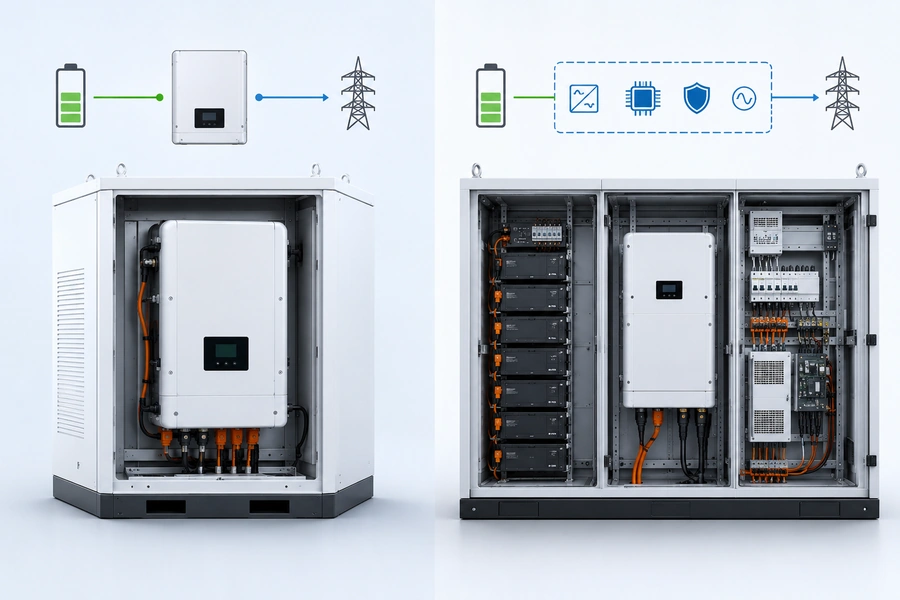
I usually use the term broadly. Some technologies are individual storage devices, while others are complete systems containing batteries, power electronics, controls, cooling, protection, and electrical equipment. The correct technology depends on whether the industrial site needs seconds of power-quality support, several hours of peak shaving, emergency backup, renewable-energy shifting, or much longer-duration energy storage.
What Is an Industrial Energy Storage Device?
An industrial storage device is not limited to batteries. Energy can be stored electrochemically, mechanically, thermally, electrically, or chemically.
An industrial energy storage device stores energy when it is available and releases it when an industrial facility needs power, heat, backup capacity, or grid support. Depending on the technology, the stored energy may take the form of electrochemical energy in batteries, rotational energy in flywheels, compressed air, stored heat, electric charge, or chemical energy such as hydrogen.
Industrial Energy Storage Is a Broad Technology Category
The U.S. Department of Energy groups energy-storage technologies across multiple families, including batteries, mechanical storage such as pumped hydro, flywheels, gravity and compressed air, thermal storage, and chemical technologies.
That means I would not define industrial storage as:
“A large battery used in a factory.”
A better definition is:
“A technology or system that allows an industrial user to separate the time when energy is produced or purchased from the time when that energy is consumed.”
For example, a factory may buy electricity at night and store it in a battery.
Then it can discharge that energy during a high-demand production period.
A food-processing plant may store cooling energy rather than electricity.
A facility with highly sensitive equipment may use a flywheel to deliver immediate short-duration power while another backup source starts.
Different devices therefore solve different problems.
| Storage family | Energy form stored | Typical industrial example |
|---|---|---|
| Electrochemical | Chemical/electrical | Lithium-ion BESS |
| Flow battery | Electrochemical | Vanadium redox flow system |
| Mechanical | Rotational motion | Flywheel |
| Mechanical | Compressed gas | CAES |
| Electrical | Electric charge | Supercapacitor |
| Thermal | Heat or cold | Hot-water, molten-salt, ice storage |
| Chemical | Chemical fuel | Hydrogen |
| Gravitational | Potential energy | Pumped hydro/gravity storage |
DOE's earlier electricity-storage review similarly identifies batteries, flywheels, compressed-air storage and other technologies as important electricity-storage options.
The correct industrial device therefore depends heavily on duration.
Some technologies are excellent for seconds.
Others work for hours.
Others become more attractive when storage must last for days.
What Are Some Common Industrial Energy Storage Devices?
Several storage technologies are commercially relevant, but they have very different power, duration, efficiency, footprint, and operating characteristics.
The most important industrial storage technologies include lithium-ion BESS, flow batteries, lead-acid batteries, flywheels, supercapacitors, thermal storage, compressed-air storage, and hydrogen systems. For most modern behind-the-meter industrial electrical applications, lithium-ion BESS is the technology I would investigate first, while specialized applications may favor another technology.
1. Lithium-Ion Battery Energy Storage Systems
Lithium-ion BESS is the most recognizable industrial storage technology.
A complete industrial BESS normally includes:
- Battery cells
- Battery modules and racks
- Battery Management System
- Power Conversion System
- Energy Management System
- Thermal management
- Switchgear and protection
- Monitoring and communications
The battery stores DC energy.
The PCS allows the system to exchange energy with the facility's AC electrical network.
The EMS determines when charging or discharging should occur.
DOE's 2025 BESS supply-chain report identifies applications including peak shaving, backup support, and power-system stability.
I commonly consider lithium-ion BESS when an industrial facility wants to:
reduce peak grid demand
store excess solar
shift electricity between tariff periods
provide backup
support EV charging
or:
operate as part of a microgrid
Suppose a factory normally draws:
2 MW
but occasionally reaches:
3 MW
If the goal is to limit grid import to 2.5 MW, a battery could contribute approximately:
500 kW
during the peak.
If the peak lasts two hours, the basic theoretical energy requirement is:
500 kW × 2 hours = 1,000 kWh
or:
1 MWh
before I account for reserves, efficiency and degradation.
That combination of high controllability and modularity makes BESS especially useful in industrial facilities.
2. Flow Batteries
Flow batteries store electrochemical energy in liquid electrolytes circulated through a power-conversion stack.
Unlike a conventional lithium-ion battery, a flow-battery system can separate much of its power capacity from its energy capacity.
More electrolyte can increase energy storage.
A larger electrochemical stack can increase power.
DOE includes flow batteries among the technologies being considered for long-duration storage.
I find this architecture particularly interesting when an industrial site wants:
- Long discharge duration
- Frequent cycling
- Large stationary systems
- Independent power/energy scaling
The tradeoff is that a flow battery typically needs tanks, pumps, pipes, and electrolyte-handling equipment.
It therefore occupies a different physical and operational category from a compact lithium-ion cabinet.
What Mechanical Energy Storage Devices Are Used in Industry?
Mechanical storage avoids storing all energy through battery chemistry. Instead, it stores energy using motion, pressure, or gravitational potential.
Important mechanical industrial energy storage technologies include flywheels, compressed-air energy storage, pumped hydro, and gravity-based systems. Flywheels are especially useful for high-power, short-duration applications, while compressed-air and pumped-storage concepts can provide much larger energy capacity when suitable infrastructure and geography are available.
Flywheel Energy Storage
A flywheel stores energy by accelerating a rotor to high rotational speed.
When electricity is needed, the rotor slows and its kinetic energy is converted back into electrical energy.
ARPA-E describes flywheels as storing energy in a rapidly rotating internal rotor and releasing that energy as the rotor slows.
Flywheels have several characteristics I value for industrial applications:
- Very fast response
- High power
- Frequent charge/discharge capability
- Strong short-duration performance
They can be useful for:
- Power-quality correction
- UPS applications
- Short voltage interruptions
- Bridging power before generators start
- Rapid industrial load changes
However, I would not normally choose a flywheel to supply a factory for eight hours.
Its strength is generally power and response, rather than very long energy duration.
Compressed-Air Energy Storage
Compressed-Air Energy Storage, or CAES, uses electricity to compress air and store it under pressure.
The stored air is later expanded to help produce electricity.
DOE includes compressed air among major mechanical energy-storage technologies.
At large scale, this can involve underground formations, large pressure vessels, compressors, expanders, and thermal systems.
That makes CAES very different from a containerized industrial battery.
I would consider it mainly when:
- Large storage capacity is required
- Long duration matters
- Suitable infrastructure exists
- The project scale justifies substantial mechanical equipment
For an ordinary manufacturing plant seeking 500 kWh of peak shaving, CAES would generally be unnecessarily complex.
For a major industrial energy hub, the analysis can be very different.
Pumped Hydro and Gravity Storage
Pumped hydro stores energy by moving water to a higher elevation and later releasing it through turbines.
It remains an important large-scale storage technology globally, although it is much more dependent on geography than battery systems. The IEA treats pumped storage separately from batteries and identifies compressed air, flywheels and thermal storage among other storage technologies.
For most factories, pumped hydro is not a device that can simply be installed beside the production building.
I therefore classify it as an industrial- or grid-scale storage technology, rather than a typical behind-the-meter industrial storage appliance.
Are Supercapacitors Industrial Energy Storage Devices?
Yes. Supercapacitors store electrical charge and are particularly useful where high power and extremely fast cycling matter more than long runtime.
Supercapacitors are industrial energy storage devices designed for rapid charge and discharge. I use them conceptually for applications requiring very high power over short periods, such as regenerative energy capture, voltage support, rapid load changes, and power-quality applications. They store far less energy than typical battery systems, so they are not direct replacements for multi-hour BESS.
Supercapacitors Solve a Different Problem From Batteries
Imagine two requirements.
Requirement A: provide 500 kW for several seconds.
Requirement B: provide 500 kW for four hours.
These are completely different energy-storage problems.
For Requirement B:
500 kW × 4 hours = 2 MWh
A battery is much more natural.
For Requirement A, total energy is small but instantaneous power is large.
This is where supercapacitors can become attractive.
I might use them for:
- Regenerative cranes
- Hoists
- Industrial motion systems
- Rapid acceleration loads
- Short power interruptions
- Voltage stabilization
A hybrid system can also combine technologies.
For example:
Supercapacitor → handles rapid power spikes
Battery → handles longer-duration energy
The advantage is that each technology operates where it performs best.
This is an important principle in industrial storage.
I do not always ask:
“Which storage technology is best?”
I sometimes ask:
“Which combination of technologies best matches the industrial load?”
What Is Industrial Thermal Energy Storage?
Not every industrial energy problem should be solved by storing electricity.
Industrial thermal energy storage stores heat or cold for later use instead of converting all energy back into electricity. Examples include hot-water tanks, molten-salt storage, phase-change materials, packed-bed thermal systems, chilled-water storage, and ice storage. I consider thermal storage especially attractive when the industrial process ultimately needs heating or cooling rather than electrical power.
Sometimes Storing Heat Is More Logical Than Storing Electricity
Suppose an industrial facility needs heat.
One approach is:
Electricity → battery → electricity → electric heater → heat
Another possible architecture is:
Electricity → heater → thermal storage → process heat
If the final requirement is heat, directly storing thermal energy can avoid unnecessary energy conversions.
Industrial thermal storage can support processes such as:
- Hot water
- Steam-related applications
- Drying
- Industrial heating
- Refrigeration
- Process cooling
Cold storage also matters.
A facility can chill water or produce ice during a lower-cost electricity period and use that stored cooling later when electricity is expensive.
DOE includes thermal energy storage among the major families being developed for long-duration storage.
I therefore think thermal storage is often overlooked when people discuss industrial ESS.
They immediately think:
Lithium battery
But if a factory's main energy demand is thermal, the best storage device may not be electrochemical at all.
Is Hydrogen an Industrial Energy Storage Technology?
Hydrogen can function as energy storage when electricity is used to produce hydrogen and the hydrogen is stored for later energy use.
Hydrogen is a chemical energy-storage option. Electricity can power an electrolyzer that produces hydrogen, which can then be stored and later used in fuel cells, turbines, industrial processes, or other applications. I consider hydrogen more relevant for long-duration storage and integrated industrial energy systems than for ordinary short-duration peak shaving.
Hydrogen Can Store Energy for Longer Periods
Battery storage is highly useful for short- and medium-duration applications.
Hydrogen becomes more interesting when energy needs to be stored for much longer periods or used as both:
an energy carrier
and:
an industrial feedstock
The IEA notes that batteries and hydrogen-producing electrolyzers both convert electricity into forms of stored chemical energy, although their end uses and system characteristics differ significantly.
A simplified hydrogen storage chain is:
Electricity
↓
Electrolyzer
↓
Hydrogen
↓
Storage
↓
Fuel cell or other conversion
↓
Electricity/industrial use
Every conversion has losses, so I would not normally choose hydrogen when a lithium-ion battery can perform the same short-duration service efficiently.
Hydrogen becomes more attractive when the project needs characteristics that batteries struggle to provide economically, such as very long-duration storage or integration with an industrial hydrogen requirement.
DOE's long-duration storage work explicitly includes hydrogen among technologies being investigated alongside batteries, thermal storage and other approaches.
Which Industrial Energy Storage Device Is Most Common?
For modern electrical energy management at industrial facilities, battery energy storage is generally the first technology I investigate.
For most modern behind-the-meter industrial electrical applications, lithium-ion BESS is the most practical starting point because it is modular, fast responding, widely deployable, and suitable for peak shaving, renewable-energy shifting, backup, and grid services. Other technologies become more attractive when requirements involve exceptionally short response, thermal energy, specialized cycling, or very long storage duration.
The Best Technology Depends on Duration
I use duration as one of my first filters.
| Industrial requirement | Technology I would investigate |
|---|---|
| Milliseconds to seconds | Supercapacitor |
| Seconds to minutes | Flywheel / supercapacitor |
| 1–4 hours | Lithium-ion BESS |
| Multi-hour frequent cycling | Lithium-ion / flow battery |
| Industrial heating/cooling | Thermal storage |
| Large long-duration site storage | Flow / CAES / thermal |
| Very long chemical storage | Hydrogen |
| Suitable large geographic site | Pumped hydro |
These are general starting points rather than strict technical boundaries.
The actual choice also depends on:
- Power
- Energy
- Efficiency
- Space
- Cost
- Safety
- Cycle frequency
- Temperature
- Maintenance
- Grid connection
This is why I do not recommend choosing industrial storage from a technology name alone.
How Do I Choose an Industrial Energy Storage Device?
The right device is determined by the industrial problem rather than by whichever technology has the most publicity.
I choose an industrial energy storage technology by defining required power, energy, duration, response speed, cycling frequency, final energy form, available space, safety requirements, environmental conditions, and financial objective. A battery is usually strong for multi-purpose electrical storage, while flywheels, thermal systems, flow batteries, CAES, supercapacitors, and hydrogen can outperform it in specialized applications.
I Start With Power and Duration
Suppose an industrial facility needs:
1 MW for 15 minutes
Required energy is:
1 MW × 0.25 hours = 0.25 MWh
That is a high-power, relatively short-duration problem.
Now suppose the facility needs:
1 MW for eight hours
Required energy becomes:
8 MWh
That is a completely different system.
Then I Ask What Type of Energy Is Needed
If the facility needs electricity, I consider:
- BESS
- Flywheels
- Flow batteries
- Supercapacitors
- CAES
If the facility ultimately needs heat, I investigate thermal storage.
If it requires long-term chemical energy or hydrogen as a process input, hydrogen storage may make more sense.
My Industrial Storage Selection Checklist
| Question | Why it matters |
|---|---|
| Required kW/MW? | Determines power capability |
| Required kWh/MWh? | Determines stored energy |
| Required duration? | Narrows technology choice |
| Response time? | Important for power quality |
| Daily cycling? | Affects technology and degradation |
| Electricity or heat? | Determines storage form |
| Backup required? | Affects reserve strategy |
| Available footprint? | Limits physical systems |
| Existing solar? | Can increase BESS value |
| Process-critical loads? | Changes resilience requirements |
| Safety constraints? | Affects technology and site design |
| Future expansion? | Favors modular systems |
DOE's energy-storage technology work emphasizes matching storage technologies to specific use cases rather than assuming one technology is suitable for every application.
That is the approach I use as well.
My Insights: What Are Industrial Energy Storage Devices? What Are Some
Industrial energy storage should be understood as a portfolio of technologies rather than as another name for lithium batteries.
Industrial energy storage devices capture energy and make it available later for electricity, thermal loads, power quality, resilience, or process requirements. Examples include lithium-ion BESS, flow batteries, lead-acid systems, flywheels, supercapacitors, thermal storage, compressed-air storage, pumped hydro, gravity storage, and hydrogen. I would choose among them according to power, duration, response speed, and end use.
I Would Start With BESS for Most Electrical Applications
If a factory tells me:
“I want to reduce my 2 MW afternoon peak.”
I start with BESS.
If it says:
“I have excess rooftop solar at noon and need the energy at 7 p.m.”
I start with BESS.
If it says:
“I need several hours of backup for critical electrical loads.”
I also investigate BESS.
DOE's current BESS work identifies exactly these types of use cases, including peak shaving and backup support.
I Would Not Use Batteries for Every Problem
If an industrial process needs heat for several hours, thermal storage may make more sense.
If the problem lasts only seconds and repeats extremely frequently, a flywheel or supercapacitor may be more appropriate.
If the project requires much longer storage duration at very large scale, flow batteries, compressed air, thermal storage, hydrogen, or other long-duration technologies deserve analysis. DOE's long-duration storage portfolio explicitly spans batteries, hydrogen, supercapacitors, hydropower and thermal approaches.
The Most Important Distinction Is Power vs. Energy
I always separate:
Power = kW or MW
from:
Energy = kWh or MWh
A device capable of supplying 2 MW for 10 seconds solves a very different industrial problem from one capable of supplying 2 MW for ten hours.
That single distinction can eliminate many unsuitable technologies before detailed engineering begins.
Industrial Storage Is Increasingly Becoming a System, Not a Device
I also think the word device will become less useful over time.
Modern industrial storage is increasingly integrated with:
solar + grid + generators + EV charging + production loads + EMS + SCADA
The storage technology may be the core energy reservoir, but software and power electronics determine how effectively the asset supports the industrial facility.
For that reason, the better procurement question is often not:
“Which industrial storage device should I buy?”
It is:
“Which complete energy-storage architecture solves my operational problem at the lowest lifecycle cost?”
That question leads to a much stronger industrial energy strategy.
Conclusion
Industrial energy storage includes batteries, flywheels, supercapacitors, thermal storage, compressed air, flow batteries, and hydrogen. Lithium-ion BESS is the leading starting point for many electrical applications.
](https://voltcrave-battery.com/wp-content/uploads/2026/08/What-Are-the-Best-Solar-Battery-Storage-Systems-768x512.webp)
](https://voltcrave-battery.com/wp-content/uploads/2026/08/What-Are-the-Disadvantages-of-a-Solar-Inverter-768x512.webp)
](https://voltcrave-battery.com/wp-content/uploads/2026/08/What-Is-the-Difference-Between-a-PCS-and-an-Inverter-768x512.webp)