
](https://voltcrave-battery.com/wp-content/uploads/2026/08/How-Can-We-Make-Energy-Storage-Systems-Denser.webp)
More energy in less space can reduce land, containers, cabling, and construction costs, but simply packing battery cells closer together can create serious thermal and safety problems.
We can make energy storage systems denser by improving cell energy density, reducing inactive materials, using larger cells, eliminating unnecessary module structures, improving liquid cooling, raising system voltage, integrating power electronics, and optimizing container layouts. The best designs increase usable kWh per cubic meter or square meter without sacrificing safety, lifetime, efficiency, or serviceability.
I see energy-storage density as a system-engineering problem rather than simply a battery-chemistry problem. Higher-energy cells help, but architecture, cooling, electrical design, safety equipment, and site layout determine how much usable energy actually fits into a complete BESS.
What Does a Denser Energy Storage System Mean?
Energy density can describe several different measurements. A battery cell can have excellent Wh/kg performance while the complete energy storage station still occupies a large amount of land.
A denser energy storage system stores more usable energy within the same weight, volume, container, or site footprint. Engineers therefore evaluate gravimetric density in Wh/kg, volumetric density in Wh/L, container density in MWh per enclosure, and site density in kWh/m² or MWh per acre. System-level density is usually the most important metric for stationary BESS projects.
We Need to Separate Four Density Levels
I normally distinguish these metrics:
| Density metric | Typical unit | What it measures |
|---|---|---|
| Gravimetric energy density | Wh/kg | Energy relative to weight |
| Volumetric energy density | Wh/L | Energy relative to physical volume |
| Container energy density | MWh/container | Energy inside each enclosure |
| Site energy density | kWh/m² or MWh/acre | Energy stored across the complete project |
For an electric vehicle, Wh/kg is extremely important because the vehicle must carry the battery.
For stationary energy storage, weight is often less important.
I care more about:
- MWh per container
- MWh per square meter
- Number of containers required
- Cooling-system footprint
- PCS footprint
- Transformer footprint
- Required spacing
- Maintenance access
A battery project can therefore become substantially denser without dramatically changing the chemistry of the individual cells.
CATL's TENER system provides a useful real-world example. Its 20-foot enclosure stores 6.25 MWh, using LFP cells rated by CATL at 430 Wh/L. CATL says the design increased energy density per unit area by 30% and reduced station footprint by 20% compared with its previous reference architecture.
That shows why I treat cell density and system density as different engineering problems.
How Can Higher-Energy Battery Cells Increase Storage Density?
Improving the electrochemistry is the most direct way to put more energy into the same cell volume.
Cell energy density can be increased through higher-capacity cathodes, silicon-rich anodes, lithium-metal anodes, higher operating voltages, improved electrolytes, thicker active-material electrodes, and eventually advanced solid-state or lithium-based chemistries. However, every gain must be balanced against cycle life, thermal stability, power capability, manufacturing yield, and cost.
Increase Active Material Capacity
A lithium-ion cell contains both energy-storing materials and inactive materials.
Energy is mainly stored in the:
- Cathode
- Anode
- Electrolyte system
Other materials are necessary but do not contribute directly to stored energy:
- Current collectors
- Separator
- Tabs
- Cell casing
- Structural supports
One route to higher density is therefore to store more charge in the same quantity of active material.
Silicon is especially interesting for anodes because it can hold substantially more lithium than conventional graphite. Argonne research notes that silicon-based anodes can potentially carry considerably more energy within the same volume, although expansion and degradation remain major technical challenges.
DOE-supported research is also examining high-energy lithium-metal systems. ARPA-E describes lithium metal as a particularly high-energy-density anode pathway and is supporting projects targeting cells around 450 Wh/kg.
These technologies could eventually reduce the amount of cell volume required for a given MWh.
Operate Cells at Higher Voltage
Battery energy is related to both capacity and voltage.
In simplified terms:
Energy ≈ Capacity × Voltage
If engineers can safely increase the operating-voltage window while maintaining cycle life, more energy can be stored without proportionally enlarging the battery.
Argonne's BatPaC work specifically identifies higher-voltage operation as a pathway for increasing battery energy storage capacity, while noting that higher voltage requires electrolytes capable of remaining stable under more demanding conditions.
This illustrates an important principle.
Increasing voltage sounds simple mathematically.
Electrochemically, it is difficult.
Higher voltages can increase:
- Electrolyte decomposition
- Cathode degradation
- Gas generation
- Thermal stress
- Capacity fade
I therefore consider higher voltage useful only when materials, electrolyte, and battery management improve together.
How Can We Reduce Inactive Material Inside Battery Cells?
Increasing chemistry performance is only one approach. Another is reducing the fraction of each cell occupied by materials that do not store energy.
Battery cells become denser when engineers increase electrode loading and reduce unnecessary current collector, separator, casing, tab, and packaging material. Thicker high-loading electrodes can place more active material into each cell, although ion transport, heat transfer, charging speed, and manufacturing quality become harder to control as electrode thickness increases.
Higher Areal Loading Reduces Packaging Overhead
Imagine two cells storing the same total energy.
One uses many thin electrode layers.
The other uses fewer, thicker layers.
The first design may require more:
- Separator area
- Current-collector material
- Layer interfaces
- Packaging
If thicker electrodes can maintain acceptable electrochemical performance, more of the cell volume can become active material.
DOE-supported research has specifically examined high-areal-capacity electrodes as a way to reduce the amount of non-energy-storing materials such as separators and current collectors.
However, I would not simply make electrodes as thick as possible.
Very thick electrodes can produce:
- Poor ion transport
- Higher internal resistance
- Temperature gradients
- Slower charging
- Uneven aging
Density must therefore be optimized together with power and lifetime.
How Does Cell-to-Pack Architecture Make BESS Denser?
One of the fastest ways to improve practical energy density is to remove packaging layers between the cell and the final system.
Cell-to-pack architecture increases energy density by reducing or eliminating intermediate battery modules. Fewer module housings, connectors, busbars, brackets, and structural components allow more of the enclosure volume to contain actual battery cells. Large-format cells can further reduce the number of connections and repeated packaging components.
Traditional Battery Architecture Has Multiple Layers
A conventional system may follow:
Cell → Module → Rack → Container → Energy storage station
Every layer adds something.
Modules may require:
- Metal frames
- Side plates
- Covers
- Connectors
- Wiring
- Fasteners
Racks require additional structures.
Containers require cooling and protection.
All of this equipment is necessary, but it reduces the percentage of total system volume devoted to active battery material.
Cell-to-Pack Removes an Intermediate Layer
Cell-to-pack, or CTP, reduces this packaging penalty.
CATL reports that its CTP architecture increased battery-pack volumetric utilization from about 55% in its first-generation CTP design to 72% in its third-generation architecture.
Those figures come from CATL's battery-platform development rather than a universal BESS standard, but the engineering principle transfers directly to stationary systems:
Use less inactive structure between cells and the final enclosure.
The potential benefits include:
- More kWh per cabinet
- Fewer components
- Less wiring
- Fewer electrical connections
- Lower structural mass
- Easier automated assembly
The challenge is that removing modules can also reduce physical separation between cells.
That makes thermal propagation control more important.
Can Larger Battery Cells Make Energy Storage Systems Denser?
Large-format cells are becoming increasingly important in stationary energy storage because they reduce repeated hardware.
Larger battery cells can increase system density by reducing the number of cells, busbars, electrical joints, sensors, module structures, and manufacturing operations required for each MWh. However, larger cells also contain more energy individually, so thermal management, mechanical design, internal uniformity, and failure containment become more demanding.
Fewer Cells Mean Fewer Repeated Components
Consider a simplified 5 MWh system.
If each cell stores relatively little energy, thousands of cells may be required.
Higher-capacity cells reduce that cell count.
That can reduce:
- Busbar length
- Welded connections
- Harnesses
- Sensors
- Fasteners
- Structural parts
CATL reported in its 2026 interim disclosure that it had begun scaled deliveries of 587 Ah cells designed specifically for energy storage and was mass-producing 6.25 MWh TENER enclosures built around its latest storage platforms.
The trend toward larger stationary cells is therefore closely connected with the industry's push toward higher container-level energy density.
Larger Is Not Automatically Better
Cell size introduces tradeoffs.
As cell dimensions increase, it can become more difficult to maintain uniform:
- Temperature
- Current distribution
- Internal pressure
- State of charge
- Aging
Research on lithium-ion module configuration shows that poor thermal management and non-uniform cell temperatures can accelerate degradation and reduce pack lifetime.
I therefore judge a large cell by the quality of the complete system around it, not its Ah rating alone.
How Can Better Cooling Increase BESS Energy Density?
Battery cooling consumes space. Improving heat transfer can allow engineers to control temperature with less bulky thermal-management equipment.
More effective thermal management can increase BESS density by removing heat with smaller cooling channels, plates, pumps, and airflow spaces. Liquid cooling usually supports tighter packaging than conventional air cooling because heat can be extracted closer to the cells. However, denser packaging also increases the importance of temperature uniformity and thermal-runaway containment.
Air Cooling Requires Space
Air-cooled racks need space for:
- Air channels
- Fans
- Intake paths
- Exhaust paths
- Temperature mixing
As cells are packed more tightly, airflow can become difficult.
Liquid cooling can place cooling plates or channels directly alongside cells or battery modules.
This gives engineers more control over heat transfer and can reduce large air passages.
Better Heat Transfer Could Enable Further Densification
NREL-supported research on high-heat-transfer lithium-ion battery designs reported heat-removal rates up to 20 times greater than conventional reference designs in its research configuration. The researchers identified improved thermal transfer as a potential enabler for higher battery energy density, better reliability, and reduced thermal stress.
This does not mean every stationary battery can immediately become twenty times denser.
It demonstrates the relationship:
Better heat removal → less thermal limitation → more design freedom
Thermal engineering is therefore one of the hidden technologies behind increasing system density.
How Can Container Design Make Utility BESS Denser?
For grid-scale projects, the biggest density improvement may come from redesigning the complete enclosure rather than changing battery chemistry.
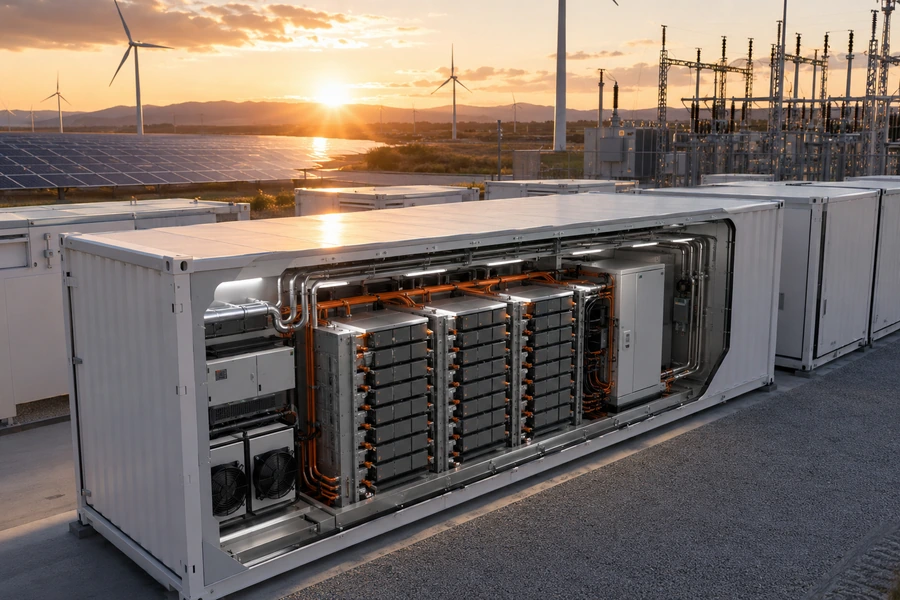
Container-level density can be increased through larger cells, moduleless architecture, better cooling, optimized rack spacing, integrated busbars, compact control electronics, and taller or differently shaped enclosures. A denser container reduces the number of enclosures, foundations, cable runs, PCS connections, and internal roads needed for the same project capacity.
6.25MWh and 9MWh Systems Show the Direction
CATL's TENER platform demonstrates how quickly container density is increasing.
The 2024 TENER platform placed 6.25 MWh in a 20-foot enclosure. CATL reported a 30% increase in energy density per unit area and a 20% reduction in overall station footprint.
In 2025, CATL introduced TENER Stack with nearly 9 MWh of capacity per system configuration.
For an 800 MWh project, CATL says the platform can use almost one-third fewer storage containers compared with conventional 6 MWh systems and improve land-use efficiency by approximately 40%.
These are manufacturer claims for specific products, not universal industry averages.
However, they demonstrate where BESS architecture is moving:
More MWh from fewer physical units.
Fewer Containers Create Secondary Density Benefits
Higher container density also reduces infrastructure around the batteries.
For a fixed MWh target, fewer units may mean fewer:
- Concrete pads
- Internal cables
- Communication links
- Auxiliary systems
- Container-to-PCS connections
- Access corridors
This creates a multiplier effect.
The battery enclosure becomes denser, and the entire station can become denser.
Can Higher System Voltage Make Energy Storage Denser?
Electrical architecture also affects physical density.
Higher DC system voltage can indirectly improve energy storage density because the same power can be transmitted at lower current. Lower current can reduce conductor size, resistive losses, busbar requirements, and some power-electronics burden. However, higher voltage also demands stronger insulation, protection, clearance, and switching equipment.
The basic relationship is:
Power = Voltage × Current
For the same power:
Higher voltage → lower current
Lower current can reduce copper requirements and electrical losses.
However, there is no free density gain.
Higher-voltage systems require engineering for:
- Insulation coordination
- Arc protection
- DC breaking
- Creepage and clearance
- Connector safety
- Isolation monitoring
I therefore see higher voltage as an optimization tool rather than simply a way to shrink everything.
The densest electrical architecture is the one that minimizes unnecessary conductors and conversion equipment while maintaining appropriate electrical protection.
Can Integrated PCS and Transformers Increase Site Density?
Battery containers are only part of a BESS site.
Site density can be improved by integrating battery enclosures with PCS equipment, transformers, switchgear, controls, and prefabricated electrical assemblies. Reducing the physical separation and duplicated infrastructure between these components can increase MWh per acre even when the battery container itself does not change.
A utility BESS often includes:
Battery → DC bus → PCS → transformer → medium-voltage network
If every component is placed in a separate large enclosure with generous spacing, the project footprint grows.
Modern systems increasingly use:
- Compact PCS blocks
- Skid-mounted transformers
- Prefabricated MV stations
- Integrated controls
- Shared auxiliary systems
Fluence's current Smartstack platform, for example, specifically emphasizes maximizing MWh capacity within constrained sites through higher site density and modular integrated architecture.
I consider this the next stage of densification.
The goal is no longer only:
How many kWh fit into the battery container?
It becomes:
How many usable MWh can the complete operating power plant fit onto the site?
Why Can't We Simply Pack Battery Cells Closer Together?
Safety creates a hard limit to uncontrolled densification.
Cells should not simply be packed closer together because a denser arrangement can make heat transfer, gas management, maintenance, electrical isolation, and thermal-runaway propagation more difficult. Higher energy density increases the amount of stored energy within a small space, so thermal barriers, cooling, detection, venting, BMS protection, and validated propagation behavior become more important—not less.
A Dense System Must Still Contain Failures
DOE's Energy Storage Safety Strategic Plan warns that where cell-to-cell thermal-runaway propagation is possible, extinguishing visible flames may not cool surrounding cells sufficiently to prevent continued propagation. It also highlights risks from accumulated gases inside enclosures.
This means removing every physical gap is not good engineering.
A safe high-density design may need to use its space for:
- Thermal barriers
- Pressure relief
- Vent paths
- Cooling channels
- Sensors
- Electrical isolation
- Fire detection
These components technically reduce raw packing density.
But they may allow the system to safely use higher-capacity cells or reduce external spacing.
I therefore distinguish between maximum cell packing and maximum safe site density.
The second metric matters more.
Which Improvements Can Increase Energy Storage Density the Most?
There is no single solution. The strongest gains come from combining improvements across several engineering levels.
The largest practical density gains come from combining better cell chemistry with larger cells, higher electrode loading, cell-to-pack architecture, compact liquid cooling, optimized high-voltage electrical systems, and integrated container and PCS design. Improving only one layer often moves unused volume somewhere else rather than maximizing the density of the complete BESS.
My Density Improvement Roadmap
| Engineering level | Main improvement | Density benefit |
|---|---|---|
| Materials | Higher-capacity cathode/anode | More Wh per cell |
| Electrodes | Higher active-material loading | Less inactive material per kWh |
| Cell | Larger optimized cell format | Fewer repeated components |
| Module | Cell-to-pack/moduleless design | Less structural overhead |
| Thermal | Efficient liquid cooling | Tighter safe packaging |
| Rack | Optimized busbars and spacing | Higher rack utilization |
| Container | High-MWh integrated enclosure | Fewer containers |
| Electrical | Higher-voltage architecture | Less conductor/infrastructure burden |
| Site | Integrated PCS/MV blocks | More MWh per acre |
| Software | Better BMS and thermal monitoring | Safely uses available capacity |
The important word is system.
If I improve cell energy density by 20% but require twice as much cooling space or larger fire separation, the actual site-density gain may be small.
If I keep the same cell but eliminate redundant packaging and reduce container count, the practical site improvement may be much larger.
My Insights: How Can We Make Energy Storage Systems Denser
I believe the next major gains in stationary energy-storage density will come as much from system architecture as from breakthroughs in battery chemistry.
We can make energy storage systems denser by increasing cell energy density while simultaneously reducing inactive packaging, adopting larger cells and cell-to-pack structures, improving liquid cooling, optimizing electrical architecture, and integrating containers with power-conversion equipment. The objective should be maximum safe usable MWh per unit of land—not simply the maximum number of cells packed together.
I Would Optimize From the Site Back to the Cell
Many density discussions begin with Wh/kg.
For stationary storage, I would reverse the process.
I start with:
How many usable MWh must fit on this site?
Then I examine:
- Required container count
- Required safety spacing
- PCS and transformer footprint
- Internal access roads
- Cooling architecture
- Rack density
- Cell format
- Cell chemistry
This prevents the project from optimizing a cell-level specification that creates little practical value at station level.
Architecture Can Deliver Immediate Gains
Next-generation chemistry may eventually produce major improvements.
However, system architecture is already producing significant increases today.
CATL moved from its 6.25 MWh TENER configuration to a nearly 9 MWh TENER Stack architecture and reports that an 800 MWh installation can use almost one-third fewer containers than a conventional 6 MWh design.
That is a meaningful density improvement without waiting for lithium-air or other laboratory-stage chemistry to become commercially mature.
Chemistry Still Sets the Long-Term Ceiling
Architecture can only remove so much inactive material.
Eventually, further improvement requires storing more energy in the electrochemical materials themselves.
I therefore see several longer-term pathways:
- Silicon-rich anodes
- Higher-energy cathodes
- High-voltage electrolytes
- Lithium-metal systems
- Solid-state batteries
- Other advanced lithium chemistries
DOE and national-laboratory programs continue researching these approaches because increasing active-material capacity can raise the fundamental amount of energy stored within a fixed cell volume.
Safety Will Determine the Useful Density Limit
The densest possible battery is not necessarily the best BESS.
A commercial system must survive:
- Normal cycling
- Cell failures
- Thermal events
- Electrical faults
- Manufacturing variation
- Years of aging
As energy becomes concentrated into fewer containers, each enclosure also represents a larger energy inventory.
I therefore expect cooling, fault detection, thermal barriers, venting, BMS analytics, and propagation testing to become increasingly important as BESS density rises. DOE's safety work reinforces that thermal propagation and gas accumulation must remain core system-design concerns.
For me, the real target is not maximum energy density.
It is:
maximum safe, usable, reliable, economically valuable energy density.
Conclusion
We make energy storage systems denser through better cells, less inactive packaging, CTP architecture, improved cooling, larger cells, higher-voltage designs, and tighter system integration—without compromising safety.
](https://voltcrave-battery.com/wp-content/uploads/2026/08/What-Is-an-All-in-One-ESS-and-How-Can-It-Benefit-Your-Solar-System-768x512.webp)
](https://voltcrave-battery.com/wp-content/uploads/2026/08/What-Is-an-All-in-One-Energy-Storage-System-768x512.webp)