

Home energy is becoming more complicated. Solar panels, batteries, EVs, backup loads, and changing electricity prices all need to work together efficiently.
All-in-one energy storage is becoming an important direction for home energy management because it integrates battery storage, power conversion, BMS, EMS, monitoring, and backup functions into a coordinated system. This simplifies installation while allowing households to store solar energy, manage electricity consumption, reduce peak grid demand, and maintain power during outages.
I see the biggest change as integration. Traditional home energy systems connect multiple independent devices. An all-in-one system turns those components into one coordinated energy platform.
What Is an All-In-One Energy Storage System?
An all-in-one energy storage system combines the major components required to store, convert, manage, and distribute household electricity.
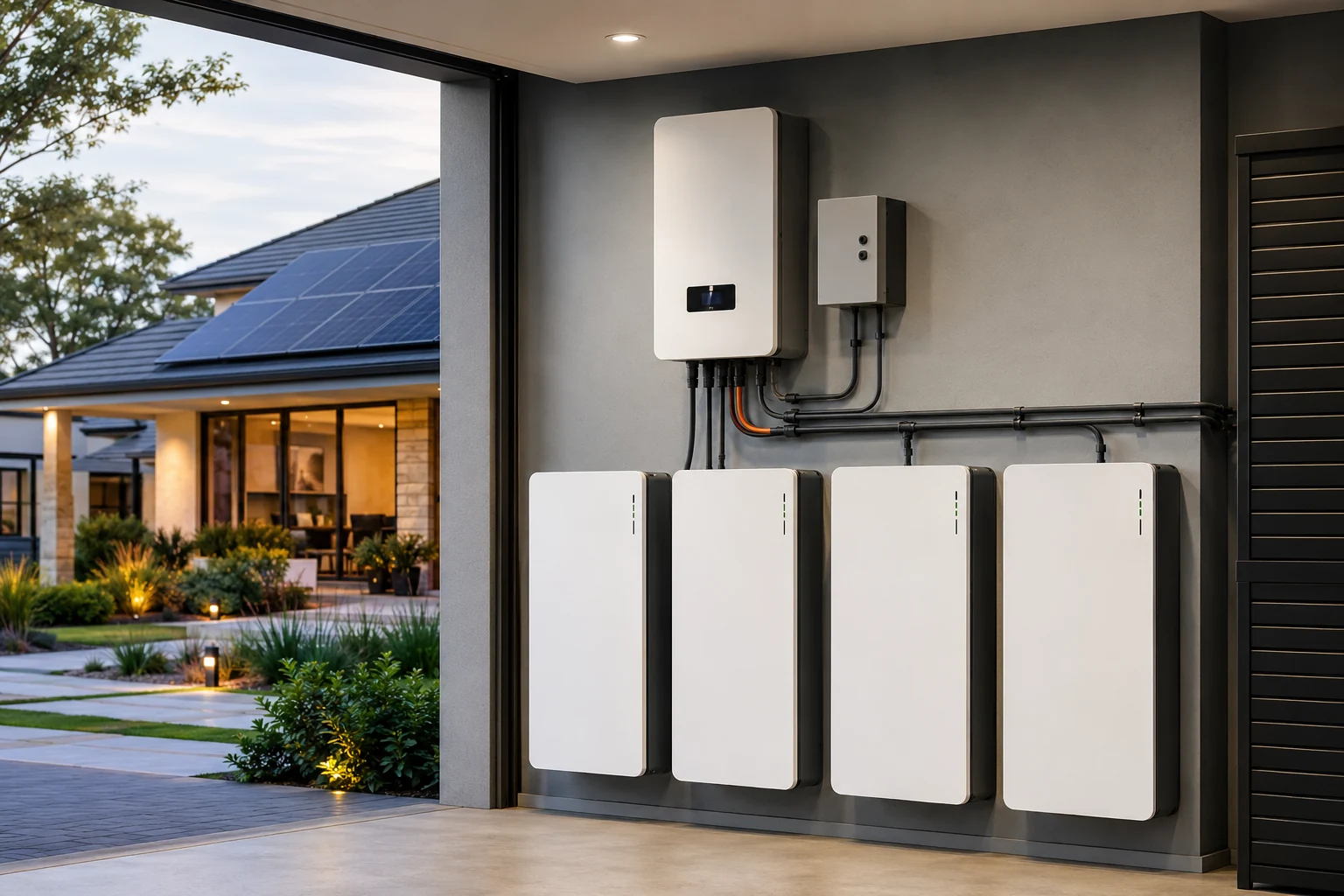
An all-in-one home energy storage system typically integrates rechargeable batteries, a battery management system, inverter or hybrid inverter, energy management controls, monitoring, electrical protection, and backup functionality into one coordinated platform. Depending on the design, it can connect solar PV, the utility grid, household loads, and sometimes EV charging or other smart-energy equipment.
A simplified architecture is:
Solar PV + Grid → All-In-One ESS → Home Loads
Inside the system, the architecture may include:
Battery + BMS + Inverter + EMS + Protection + Monitoring
These components have different responsibilities.
The battery stores energy.
The BMS monitors and protects battery operation.
The inverter converts electricity between battery DC and household AC.
The EMS determines when energy should be stored or used.
Monitoring allows homeowners to understand:
solar production,
battery SOC,
home consumption,
and:
grid import/export.
Instead of designing each function separately, an integrated system coordinates them as one energy-management platform.
How Does an All-In-One Home Energy Storage System Work?
The operating principle is based on controlling where household electricity comes from and where excess electricity goes.
An all-in-one home energy storage system monitors solar generation, battery state of charge, household demand, and grid conditions. It can store surplus solar electricity during the day, discharge the battery when household demand rises, maintain a backup reserve, and adjust charging or discharging according to the system's programmed energy-management strategy.
Consider a solar-equipped home.
In the morning:
Solar → Home Loads
As solar production increases:
Solar → Home Loads + Battery
If the battery reaches its charging target and export is permitted:
Solar → Home Loads + Battery + Grid
In the evening:
Battery → Home Loads
If battery energy becomes insufficient:
Grid → Home Loads
During a suitable outage configuration:
Battery + Solar → Backup Loads
The exact operating sequence depends on system design, local rules, settings, and available energy.
But the central principle is straightforward:
Generate → Store → Manage → Use
The system attempts to place electricity where it creates the greatest practical value.
Why Is All-In-One Energy Storage Better for Home Energy Management?
Home energy management becomes more difficult as the number of distributed energy devices increases.
All-in-one energy storage can simplify home energy management by placing battery storage, power conversion, protection, controls, and monitoring within a coordinated architecture. This reduces the need to manage multiple independent systems and makes it easier to optimize solar self-consumption, battery charging, backup reserve, peak demand, and grid interaction from one platform.
Imagine a conventional installation containing:
solar inverter,
separate battery,
battery inverter,
external monitoring,
backup equipment,
and:
independent control systems.
Each component may need its own:
communication,
configuration,
compatibility verification,
installation,
and:
maintenance process.
An all-in-one architecture aims to reduce that fragmentation.
Instead of:
Device A + Device B + Device C + Device D
the homeowner gets a more coordinated:
Home Energy Platform
This does not mean every all-in-one product is automatically simpler in every installation.
Electrical codes, solar configuration, backup architecture, service-panel requirements, and local interconnection rules still matter.
The advantage is primarily system integration, not the elimination of electrical engineering.
How Does All-In-One Energy Storage Increase Solar Self-Consumption?
Without a battery, surplus rooftop solar may be exported when household demand is low.
All-in-one energy storage can increase solar self-consumption by storing excess daytime PV electricity and releasing it later when household demand exceeds solar production. Instead of relying entirely on immediate solar consumption or grid export, the home can shift some of its own renewable energy from midday into evening or nighttime hours.
Suppose a home produces:
25kWh of solar electricity per day.
During solar hours, the home directly consumes:
12kWh.
Potential surplus:
25 – 12 = 13kWh
Without storage, much of that surplus may be exported, curtailed, or otherwise handled according to the local system.
With a battery, some energy can follow:
Solar → Battery
Then later:
Battery → Home
Suppose the battery captures:
10kWh
of the daytime surplus.
That stored energy can offset part of the home's evening grid consumption.
This is known as:
solar energy shifting
or:
time shifting.
The battery does not produce more solar electricity.
It changes when solar electricity can be consumed.
Can All-In-One Energy Storage Reduce Electricity Bills?
Battery storage can change the timing of grid electricity consumption, although financial savings depend strongly on the local tariff and system economics.
An all-in-one energy storage system may reduce electricity costs by increasing solar self-consumption, shifting grid charging or battery discharge between lower- and higher-cost periods, and reducing peak demand where tariffs reward these behaviors. Actual savings depend on electricity prices, export compensation, battery efficiency, cycling, system cost, and local tariff rules.
Consider a simplified time-of-use tariff.
Off-peak electricity:
$0.15/kWh
Peak electricity:
$0.40/kWh
A battery might charge during a lower-cost period and discharge during the higher-cost period where permitted and economically appropriate.
The gross price difference is:
$0.40 – $0.15 = $0.25/kWh
But this is not the same as:
$0.25/kWh profit.
Real economics must consider:
round-trip losses,
battery degradation,
tariff structure,
export rules,
system cost,
and:
other charges.
For a solar home, the comparison may instead involve:
value of self-consuming stored solar
versus:
value of exporting solar and later buying electricity from the grid.
Therefore, battery economics are highly location- and tariff-specific.
How Does All-In-One Energy Storage Provide Backup Power?
A home battery can reserve part of its stored energy for periods when normal grid electricity is unavailable.
An all-in-one home energy storage system can provide backup power by maintaining battery reserve and supplying designated household loads during a grid outage when the system is designed for backup operation. Backup duration depends on usable battery capacity, inverter output, critical-load consumption, solar availability, reserve settings, and system architecture.
Suppose usable battery energy is:
15kWh.
Average backup load is:
500W.
Theoretical runtime:
15kWh ÷ 0.5kW = 30 hours
At:
1kW average load:
15 ÷ 1 = 15 hours
At:
3kW:
15 ÷ 3 = 5 hours
These are simplified values before system losses and other limitations.
This demonstrates why backup design depends on both:
kWh
and:
kW.
Battery kWh determines stored energy.
Inverter kW determines how much power can be delivered at once.
A large battery with insufficient inverter output may still be unable to operate several high-power appliances simultaneously.
Can Solar Panels Recharge a Home Battery During an Outage?
This can be possible in appropriately designed solar-plus-storage systems, but it should not be assumed for every installation.
An all-in-one solar energy storage system can potentially use compatible PV generation to recharge its battery during an outage when its inverter, isolation equipment, controls, solar architecture, and electrical installation support off-grid operation. This can extend backup duration beyond the energy initially stored in the battery.
Without solar recharge, backup is essentially a countdown:
Stored Battery Energy → Loads → Empty Battery
With suitable solar recharge:
Solar → Loads + Battery
During the day, PV may power the house while replenishing stored energy.
At night:
Battery → Loads
This creates a repeating cycle:
Day: Solar → Home + Battery
Night: Battery → Home
However, solar does not guarantee indefinite backup.
Imagine the home consumes:
15kWh/day
during an outage.
If poor weather allows the PV system to produce only:
6kWh/day,
there is still an energy deficit of:
15 – 6 = 9kWh/day
The battery will eventually become depleted unless loads are reduced or another energy source becomes available.
How Does Smart Energy Management Improve Battery Performance?
A battery has finite energy capacity, so deciding when to charge and discharge is essential.
Smart home energy management uses information such as solar generation, household load, battery SOC, time-of-use prices, backup reserve, and potentially forecasts to coordinate charging and discharging. This can help prioritize solar self-consumption, peak management, lower-cost electricity, or backup readiness according to the homeowner's selected operating strategy.
Consider a:
20kWh battery.
The homeowner wants to maintain:
5kWh
for emergency backup.
That leaves up to:
15kWh
for normal energy management, subject to actual operating limits.
The EMS might use that capacity for:
solar shifting,
time-of-use optimization,
or:
peak reduction.
If a severe weather event is expected and the system supports forecast-based control, the strategy might prioritize a higher SOC.
The important concept is:
Battery Capacity ≠ Available Capacity for Every Application
Stored energy must be allocated.
This is why smart controls are becoming more important as home energy systems become more complex.
Why Is LiFePO4 Popular in All-In-One Home Energy Storage?
Residential storage places a high value on cycle life, thermal behavior, cost, and long-term stationary use.
Lithium iron phosphate, or LiFePO4/LFP, has become an important chemistry for stationary energy storage because it offers a useful combination of cycling performance, thermal stability, material characteristics, and cost. However, chemistry alone does not determine system safety or lifespan; BMS, thermal management, cell quality, system design, and operating conditions remain important.
LFP is part of the:
lithium-ion battery family.
It should therefore not be described as:
LFP vs. lithium-ion.
The more accurate comparison is:
LFP vs. other lithium-ion chemistries.
Home batteries generally do not face the same weight constraints as EV batteries.
An EV needs:
high energy density
because every kilogram affects vehicle performance.
A stationary home battery can place more emphasis on:
cycle life,
cost,
thermal characteristics,
and:
long-term operation.
That makes LFP particularly attractive for many stationary-storage designs.
But I avoid calling LFP:
fire-proof.
Battery safety still requires complete system engineering.
How Does an All-In-One System Simplify Installation?
Integration can reduce the number of separately selected and coordinated components.
An all-in-one energy storage system can simplify installation by combining major battery, inverter, control, communication, monitoring, and protection functions within a pre-engineered platform. This can reduce component compatibility work, simplify communication between subsystems, and create a cleaner installation, although site-specific wiring, protection, permitting, and grid-interconnection requirements still remain.
Compare two simplified architectures.
Traditional:
Solar Inverter → Battery Inverter → Battery → Controller → Monitoring → Backup Equipment
Integrated:
Solar / Grid → All-In-One ESS → Home
The real architecture varies by product.
But reducing separate components can mean fewer:
external communication connections,
equipment interfaces,
configuration steps,
and:
compatibility questions.
This can also make troubleshooting more centralized.
Instead of checking several independent monitoring platforms, a homeowner or installer may be able to view:
PV production,
battery SOC,
load consumption,
and:
grid exchange
through one interface.
Integration does not eliminate complexity.
It moves more of that complexity inside the engineered product.
Is All-In-One Energy Storage Suitable for EV Charging?
EVs can dramatically increase household electricity consumption and peak power demand.
All-in-one home energy storage can support EV charging by coordinating solar generation, stored battery energy, household loads, and grid electricity. Depending on system design, this can increase solar-powered charging, reduce simultaneous grid peaks, and allow the EMS to schedule EV charging around battery SOC, household demand, and electricity tariffs.
Consider:
Home load = 2kW
EV charger = 7kW
Combined demand = 9kW
Now add:
Solar production = 4kW
The remaining requirement is:
9 – 4 = 5kW
A suitable battery could potentially supply part of that power, reducing instantaneous grid import.
Another strategy is:
Solar → Home + Battery during the day
then:
Battery/Grid → EV at night
But using a home battery to charge an EV involves an important efficiency question.
Energy may travel:
Solar → Home Battery → EV Battery
That involves additional conversion and storage losses.
When possible, direct:
Solar → EV
may be more efficient.
Smart energy management should therefore decide not simply whether the battery can charge the EV, but when doing so makes sense.
How Does All-In-One Energy Storage Help With Peak Demand?
Modern homes increasingly contain several high-power electrical loads.
An all-in-one energy storage system can help manage household peak demand by discharging when multiple appliances create a high simultaneous load. When supported by the system architecture, this can reduce grid import peaks and help coordinate solar, battery, EV charging, heat pumps, and other major electrical loads.
Imagine:
EV charger = 7kW
Heat pump = 3kW
Cooking = 3kW
Other loads = 2kW
Total:
15kW
If these loads operate simultaneously, grid demand rises sharply.
A battery might provide:
5kW
so grid import becomes approximately:
15 – 5 = 10kW
subject to the actual equipment ratings and controls.
An even better strategy may be:
load scheduling.
The EMS could avoid running every flexible high-power load simultaneously.
For example:
charge the EV later,
preheat water earlier,
charge the battery from solar,
and:
discharge during the household peak.
This demonstrates why the future of home energy management is not simply:
more batteries.
It is:
better coordination.
What Size All-In-One Battery Does a Home Need?
Battery sizing should begin with the energy objective rather than a generic capacity recommendation.
The right all-in-one home battery size depends on daily electricity consumption, overnight energy use, critical backup loads, desired backup hours, solar production, usable battery capacity, inverter efficiency, reserve requirements, and future loads such as EV charging or heat pumps. Many homes may consider systems in the 10–20kWh range, but requirements vary widely.
Suppose evening and nighttime consumption is:
8kWh.
If the goal is simply:
solar shifting,
a battery providing around that amount of usable energy may be a reasonable starting point.
But if the goal is:
whole-home backup for 24 hours,
the requirement may be much larger.
Suppose daily critical-load consumption is:
12kWh.
For:
2 days of backup
without solar recharge:
12 × 2 = 24kWh
before accounting for:
efficiency,
reserve,
usable SOC,
and:
degradation.
Therefore, I always begin with:
What must the battery accomplish?
The answer determines the size.
What Is the Difference Between All-In-One and Modular Energy Storage?
Integration and modularity solve different problems.
An all-in-one energy storage system emphasizes integrated batteries, inverter functions, controls, monitoring, and energy management within one coordinated platform. A modular system emphasizes flexible capacity expansion through separate battery modules or system blocks. Some modern products combine both approaches by offering an integrated architecture that can still be expanded with additional battery capacity.
All-in-one advantages can include:
simplified architecture,
coordinated controls,
centralized monitoring,
and:
cleaner installation.
Modular advantages can include:
capacity flexibility,
future expansion,
and:
incremental investment.
These characteristics are not mutually exclusive.
For example, an integrated home energy platform might begin with:
10kWh
and later expand to:
20kWh
or more using compatible battery modules.
For homeowners expecting future:
EV charging,
electrification,
heat pumps,
or:
additional solar,
expandability can be particularly valuable.
The key is confirming expansion capability before purchase rather than assuming batteries can always be added later.
What Are the Limitations of All-In-One Energy Storage?
Integration creates advantages, but it also creates design tradeoffs.
All-in-one energy storage can simplify home energy management, but limitations may include higher upfront cost, product-specific expansion limits, ecosystem dependence, inverter power limits, battery degradation, conversion losses, installation requirements, and reduced flexibility to replace individual components. The best architecture depends on the homeowner's energy goals and future expansion plans.
For example, a highly integrated system may use:
proprietary battery communication,
specific expansion modules,
or:
a defined inverter architecture.
That can improve system coordination.
But it may also reduce flexibility compared with a system built from more independent components.
Another limitation is power.
A:
20kWh battery
does not automatically provide:
20kW output.
If the inverter is rated:
5kW,
the system cannot continuously deliver 10kW simply because the battery contains plenty of energy.
This returns to the fundamental distinction:
kWh = stored energy
kW = available power
Both need to match the home.
Is All-In-One Energy Storage Safe for Home Use?
Residential batteries store substantial electrical and chemical energy, so system-level safety matters.
Home energy storage safety depends on battery cells, BMS protection, inverter design, thermal management, electrical protection, enclosure construction, fault detection, installation, operating environment, and applicable certification and codes. Battery chemistry alone does not guarantee safety, so homeowners and installers should evaluate the complete energy storage system rather than individual battery specifications.
Important protection functions can include:
overvoltage protection,
undervoltage protection,
overcurrent protection,
temperature monitoring,
short-circuit protection,
and:
fault isolation.
For stationary energy storage in North America, UL 9540 is an important system-level standard.
UL 9540A has a different role.
It is a test method associated with evaluating thermal runaway and fire propagation behavior.
Installation requirements may also involve standards such as NFPA 855 and applicable electrical and fire codes depending on jurisdiction.
This distinction matters because:
battery cell compliance does not automatically equal complete ESS compliance.
The complete system and installation matter.
My Insights: Why Is All-In-One Energy Storage the Future of Home Energy Management
Home electrification is changing the purpose of residential battery storage. The battery is becoming one component inside a broader household energy-control system.
All-in-one energy storage represents an important direction for home energy management because it combines energy storage, power conversion, protection, monitoring, backup, and intelligent controls in one coordinated platform. This allows solar, batteries, household loads, the grid, and potentially EV charging to work together rather than operating as separate energy devices.
My First Insight: The Future Is Integration, Not Just Bigger Batteries
A larger battery gives a home:
more stored energy.
But integration gives the home:
more control.
The bigger opportunity is connecting:
Solar + Battery + Grid + Home + EV
through one coordinated system.
That changes residential storage from a backup battery into an energy-management platform.
My Second Insight: Energy Management Is Becoming a Software Problem
Hardware determines what the system can do.
Software determines what it actually does.
The EMS can decide whether available solar energy should:
power the home,
charge the battery,
charge an EV,
or:
be exported.
It can also determine when battery energy should be:
used,
saved,
or:
reserved for backup.
As household electrification increases, this decision-making becomes more valuable.
My Third Insight: Backup Power Will Become More Intelligent
Traditional backup asks:
Is the power on or off?
Smart storage asks:
Which loads should remain powered, for how long, and how much battery energy should be reserved?
That allows a homeowner to prioritize:
refrigeration,
communications,
lighting,
and:
other essential loads
instead of consuming limited battery energy on every appliance.
My Fourth Insight: EVs and Electrification Make Coordination More Important
A home with:
solar,
battery,
EV,
heat pump,
electric water heater,
and:
electric cooking
has several large electrical loads.
Without coordination, they can create significant simultaneous demand.
With intelligent controls, flexible loads can operate at different times.
That can reduce peak demand without requiring every problem to be solved by adding more battery capacity.
My Fifth Insight: Why Is All-In-One Energy Storage the Future of Home Energy Management?
This directly answers the H1.
| Home Energy Challenge | All-In-One ESS Response |
|---|---|
| Excess daytime solar | Stores electricity for later use |
| Evening electricity demand | Discharges stored solar energy |
| Grid outage | Supplies compatible backup loads |
| Peak household demand | Uses battery power to reduce grid peaks |
| Time-of-use pricing | Shifts electricity use across price periods |
| EV charging | Coordinates charging with solar, battery, and grid |
| Complex equipment | Integrates major energy functions into one platform |
| Energy monitoring | Centralizes production, storage, load, and grid data |
| Future electrification | Helps coordinate additional electrical loads |
| Energy optimization | Uses EMS controls to decide when energy should move |
The traditional home energy architecture is fragmented:
Solar → Solar Inverter
Battery → Battery Inverter
Grid → Home
EV Charger → EV
Monitoring → Separate Platforms
The all-in-one approach moves toward:
Solar + Battery + Grid + Home + EV → One Energy Management Platform
That is the central reason I see all-in-one storage as an important direction for residential energy management.
The value is not simply:
fewer boxes on the wall.
The real value is:
coordinated energy flow.
When solar production is high:
store surplus energy.
When electricity demand rises:
use stored energy.
When electricity is expensive:
reduce grid dependence where economically appropriate.
When an outage occurs:
protect the backup reserve and prioritize important loads.
When an EV needs charging:
coordinate it with solar production, battery SOC, and household demand.
When future electrical loads are added:
manage them as part of one system.
This transforms the home from a passive electricity consumer into a more actively managed energy system.
The battery provides:
energy.
The inverter provides:
power conversion.
The BMS provides:
battery protection.
The EMS provides:
decision-making.
Solar provides:
local generation.
And the integrated platform connects them.
That combination—not battery storage alone—is why all-in-one energy storage is becoming a major direction for the future of home energy management.
Conclusion
All-in-one energy storage combines batteries, solar, power conversion, backup, monitoring, and intelligent controls, helping homes manage electricity as one coordinated energy system.
](https://voltcrave-battery.com/wp-content/uploads/2026/08/What-Are-Solar-Panels-in-Simple-Words-768x512.webp)
](https://voltcrave-battery.com/wp-content/uploads/2026/08/What-Is-the-Typical-Cycle-Life-for-Residential-ESS-Batteries-768x512.webp)
](https://voltcrave-battery.com/wp-content/uploads/2026/09/Do-Portable-Car-Jump-Starters-Actually-Work-768x512.webp)







































