

](https://voltcrave-battery.com/wp-content/uploads/2026/09/Do-Portable-Car-Jump-Starters-Actually-Work.webp)
A dead battery can leave you stranded anywhere, but many drivers wonder whether a small lithium jump starter can really crank an entire car engine.
Yes, portable car jump starters actually work. A properly charged and correctly sized jump starter can provide the short burst of high current needed to crank a vehicle with a weak or discharged 12V starter battery. However, it cannot repair a failed battery, broken starter motor, alternator problem, or other mechanical fault.
Modern portable jump starters are more than a theoretical solution. Independent automotive testing has successfully started vehicles with drained batteries using compact jump packs, while roadside-assistance providers also use battery-powered jump boxes. Their effectiveness depends on the jump starter's condition, vehicle requirements, battery condition, temperature, and electrical connections.
How Does a Portable Car Jump Starter Work?
The device is small, but it is designed to release substantial power for a very short period.
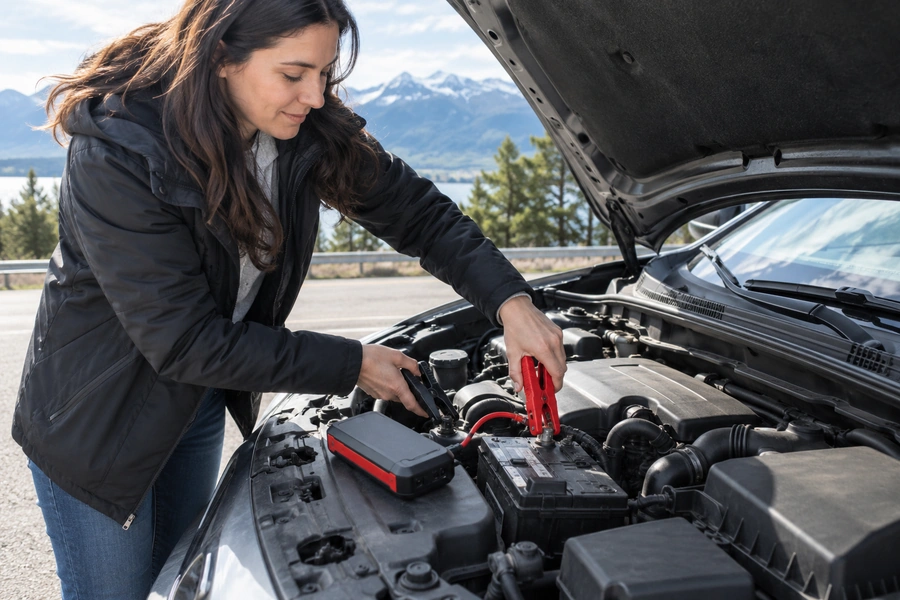
A portable jump starter contains its own rechargeable battery and connects to the vehicle's electrical system through positive and negative clamps. When the starter motor demands current, the jump pack supplements the weak vehicle battery with enough electrical power to crank the engine. Once the engine starts, the vehicle's charging system takes over.
A jump starter should therefore not be confused with a conventional battery charger.
A battery charger gradually transfers energy into a car battery. That process can take hours.
A jump starter is designed for a different purpose: providing enough power for a few seconds of cranking.
Car and Driver describes the distinction similarly, explaining that a jump starter supplies the power needed to start a vehicle, whereas battery chargers and maintainers are designed to restore or maintain battery charge over time.
This explains how a device small enough to fit inside a vehicle can start an engine.
It does not need to contain enough energy to run the vehicle for hours.
It only needs to deliver sufficient power during the short starting event.
AAA also describes portable jump starters as battery packs with jumper-clamp leads that allow a driver to start a vehicle without another car.
Can a Portable Jump Starter Start a Completely Dead Battery?
This depends on what “completely dead” actually means.
A portable jump starter can often start a vehicle with a deeply discharged battery, but extremely low battery voltage can create problems for some smart jump starters. Their safety electronics may fail to recognize the battery. Some models provide a manual override or boost function for this situation, but it must be used according to the manufacturer's instructions.
This limitation appears in real testing.
In Car and Driver's 2026 jump-starter comparison, vehicles with drained batteries were deliberately used to evaluate multiple devices. The publication found that the tested jump starters did not all behave identically, and one unit failed to recognize the low-voltage test battery.
This reveals an important point about modern jump packs.
Many contain intelligent clamp modules designed to detect:
reverse polarity,
short circuits,
incorrect connections,
and abnormal battery conditions.
Those protections make the product safer for ordinary users, but they also mean that the device needs to determine whether it is connected correctly before releasing high current.
If vehicle-battery voltage is extremely low, automatic detection can sometimes become difficult.
That is why some products include a manual override mode.
I would treat this feature carefully because overriding automatic protection may remove some safeguards. The manufacturer's instructions should always take priority.
Why Can Such a Small Battery Start a Car?
Size can be misleading because engine starting is primarily a short-duration power problem.
A portable jump starter works because starting an engine requires high current for only a short period. Modern lithium cells can deliver substantial current relative to their physical size. The jump starter therefore does not need the energy capacity of the vehicle battery; it needs enough short-duration output to help the starter motor turn the engine.
This distinction can be understood through two concepts:
| Measurement | What It Tells Me |
|---|---|
| Energy capacity | How much total energy is stored |
| Starting power/current | How strongly the device can support cranking |
| Peak current | Maximum short-duration output |
| Cranking capability | Ability to sustain useful starting current |
| Engine rating | Manufacturer's recommended engine range |
A small power bank designed to recharge a smartphone may store useful energy, but it cannot normally provide the enormous short-duration current needed by an automotive starter.
A jump starter is engineered differently.
Its battery cells, conductors, clamps, cables, electronics, and protection system are designed around high-current discharge.
This is also why I do not judge jump starters solely by physical size.
A compact lithium device can provide strong short-duration performance without containing enough energy to operate a vehicle continuously.
Do Portable Jump Starters Work in Cold Weather?
They can, but cold weather makes both the car battery and the portable jump starter work harder.
Portable jump starters can work in cold weather, but low temperatures reduce battery performance while the engine may require more cranking effort. I therefore prefer additional starting-power reserve for winter use and keep the jump starter charged. A unit that easily starts a vehicle in mild weather may have less performance margin during severe cold.
Cold conditions are one of the most common situations in which drivers discover battery weakness.
The vehicle's starter battery has less available performance, while engine cranking can become more difficult.
The jump starter itself also contains a battery, so its performance is temperature-dependent.
Real-world testing supports the usefulness of jump packs in these conditions. Car and Driver's current recommendation for its best overall portable jump starter came partly from cold-weather experience with the Clore JNC325, which the publication found effective during severe winter conditions.
However, this does not mean every small jump pack will perform equally well at very low temperatures.
For winter driving, I would consider additional capacity and starting headroom rather than buying a unit that only barely meets the vehicle's requirements.
I would also check the manufacturer's specified:
operating temperature,
storage temperature,
engine-size rating,
and charging instructions.
When Will a Portable Jump Starter Not Work?
A jump starter solves a starting-power problem. It does not solve every reason an engine refuses to start.
A portable jump starter may not work when the vehicle has a failed starter motor, severely damaged battery, poor terminal connection, major corrosion, fuel or ignition problem, blown fuse, incompatible electrical system, or another mechanical fault. A successful electrical connection cannot compensate for a failure elsewhere in the vehicle.
AAA identifies poor electrical connections as a common reason a jump attempt fails. Corrosion can prevent sufficient current from reaching the electrical system even when an external source is available.
The sound produced when attempting to start the vehicle can provide clues.
Rapid clicking commonly points toward insufficient battery power.
A single click with bright dashboard lights can indicate a starter problem instead.
If the engine cranks normally but never fires, I would also consider problems unrelated to battery power.
Another important case is physical battery damage.
AAA advises against attempting to jump a battery showing warning signs such as cracks, bulging, or indications of leakage. A damaged battery should be handled as a battery failure rather than treated as an ordinary low-charge condition.
A jump starter is an emergency power source, not a diagnostic tool or battery repair device.
Are Portable Jump Starters Better Than Jumper Cables?
For convenience and independence, they often are. For unlimited standby life, traditional cables still have an advantage.
Portable jump starters allow you to start a vehicle without finding another car, making them especially useful when driving alone or in remote locations. Jumper cables do not require charging and can remain useful for years, but they depend on another suitable vehicle and require both vehicles to be positioned close enough for safe connection.
The comparison looks like this:
| Feature | Portable Jump Starter | Jumper Cables |
|---|---|---|
| Second vehicle required | No | Yes |
| Internal battery | Yes | No |
| Must be recharged | Yes | No |
| Easy roadside use | Excellent | Depends on second vehicle |
| Portability | Excellent | Excellent |
| USB charging | Often available | No |
| Emergency light | Often available | No |
| Long-term storage maintenance | Required | Minimal |
| Engine compatibility | Must be checked | Cable gauge matters |
| Independent emergency use | Excellent | Limited |
AAA identifies portable jump starters as particularly useful for people who drive alone, travel remote routes, have an aging battery, or simply want an independent method of recovering from a discharged battery.
Traditional jumper cables still have one major advantage:
They do not have an internal battery that can lose charge.
A jump starter stored for months without checking may not have enough energy when it is finally needed.
That makes maintenance part of its reliability.
Can a Portable Jump Starter Damage Your Car?
Incorrect use can create risks, but modern safety features reduce common connection errors.
A correctly used jump starter designed for the vehicle's electrical system should not normally damage the car. However, incorrect polarity, incompatible voltage, damaged batteries, poor connections, or ignoring vehicle-specific instructions can create electrical and safety risks. I always check the vehicle owner's manual and jump-starter instructions before connecting the device.
Voltage compatibility is particularly important.
Most passenger cars use a 12V starting system, but not every vehicle uses the same architecture.
AAA warns that connecting incompatible electrical systems can cause expensive damage. It also recommends checking the battery condition before attempting a jump.
Modern jump packs often include electronic protection designed to reduce the risk of:
reverse polarity,
short circuits,
sparking,
overcurrent,
and overheating.
Those protections are valuable, especially for drivers who rarely perform jump starts.
However, electronics should not replace proper procedure.
I would never attempt to jump a battery that is visibly:
swollen,
cracked,
leaking,
or otherwise physically damaged.
When in doubt, roadside assistance is safer than experimenting with a damaged electrical system.
How Powerful Should a Portable Jump Starter Be?
The correct power level depends primarily on the vehicle rather than the largest number printed on the product.
I size a portable jump starter according to engine displacement, gasoline or diesel fuel type, climate, and manufacturer recommendations. Small gasoline engines generally need less starting capability, while large V6, V8, truck, and diesel engines require more reserve. I prefer realistic engine-size ratings and independent tests over comparing peak-amp marketing numbers alone.
Car and Driver's 2026 testing specifically warns that bigger peak-amperage numbers do not automatically make a product better. Its testing considers practical characteristics including actual starting performance, clamp quality, lead length, weight, portability, and ease of use.
This is a much better buying framework.
A typical small sedan does not necessarily benefit from carrying an enormous professional jump pack.
A large diesel pickup should not rely on the smallest compact unit simply because it is convenient.
My goal is sufficient starting margin without unnecessary bulk.
For cold climates, I would add more margin because low temperature makes starting more demanding.
For fleets or repeated use, I would also prioritize greater stored energy so the device can perform multiple starts before recharging.
How Long Does a Portable Jump Starter Hold Its Charge?
Lithium jump starters can remain ready for months, but they should still be checked periodically.
A quality lithium jump starter can typically retain useful charge for months in storage, but I would never assume it is ready indefinitely. Self-discharge, standby electronics, battery aging, and temperature all affect stored energy. Checking the charge level periodically and before long trips is one of the simplest ways to make the device dependable.
Consumer Reports notes that modern portable jump starters can generally hold their charge for months but recommends periodically checking the charge level. It also advises paying attention to the unit's temperature specifications when storing it inside a vehicle.
That point is especially important because cars experience extreme interior temperatures.
A vehicle parked in direct summer sunlight can become extremely hot.
Winter conditions create the opposite challenge.
AAA similarly advises keeping a portable jump starter charged and ready for use.
I therefore treat the jump starter like other emergency equipment.
I check it:
before a long road trip,
before winter,
after using it,
and periodically during normal vehicle maintenance.
The best jump starter in the world cannot start anything if its own battery is empty.
Does a Jump Starter Recharge the Car Battery?
Not in the same way as a dedicated charger.
A portable jump starter's main purpose is to provide enough immediate electrical power to crank the engine. It does not replace a battery charger or maintainer. After a successful jump, the battery and charging system should be checked—especially if the vehicle repeatedly requires assistance or the battery quickly becomes discharged again.
This distinction matters because drivers sometimes assume that successfully starting the engine means the battery problem has been fixed.
It has not necessarily been fixed.
The battery may have been discharged because:
lights were left on,
the vehicle sat unused,
the battery is aging,
the alternator is malfunctioning,
or there is an abnormal parasitic electrical load.
AAA notes that an old battery may fail to retain charge even after the vehicle has been jump-started. It recommends battery and charging-system testing when the problem persists.
Car and Driver makes the same practical distinction: repeatedly needing a jump suggests an underlying battery or charging-system problem that deserves investigation.
A jump starter gets me moving.
Diagnosis tells me why I stopped moving in the first place.
My Insights: Do Portable Car Jump Starters Actually Work
Looking across current hands-on testing, roadside guidance, and the underlying electrical principle, the answer is much clearer than the marketing around these products sometimes suggests.
Yes, portable car jump starters actually work. Their effectiveness comes from delivering a short burst of high current to support a weak vehicle battery during engine cranking. Real-world tests confirm that properly sized units can start vehicles with discharged batteries, but success depends on charge level, engine requirements, temperature, connections, and the actual cause of the no-start condition.
My First Insight: Real-World Testing Matters More Than Peak-Amps Marketing
The most useful evidence is simple:
Can the device start an actual vehicle with a discharged battery?
Car and Driver's 2026 comparison used vehicles with drained batteries and repeatedly tested jump starters on them. The results showed that many units worked, while performance and usability differed between models.
That tells me two things.
First, portable jump starters are legitimate automotive tools.
Second, not every product performs equally well.
I therefore put more weight on hands-on testing, supported engine sizes, clamp design, and manufacturer specifications than an enormous peak-current number printed on a product page.
My Second Insight: A Jump Starter Is Powerful Because the Job Is Short
A car's starter motor requires substantial electrical power.
But it does not normally require that power for an hour.
It needs it for seconds.
That is exactly where a lithium jump pack makes sense.
It combines relatively modest total energy storage with high short-duration output.
This is why comparing a jump starter with the physical size of the vehicle's lead-acid battery can be misleading.
They are performing different jobs.
The car battery supports repeated starting, accessories, and the broader 12V electrical system.
The jump pack is primarily an emergency high-power source.
My Third Insight: Most Failures Are About Conditions, Not Whether the Technology Works
When someone says, “My jump starter didn't work,” I would not immediately conclude that portable jump starters are ineffective.
I would investigate:
battery condition,
jump-pack charge,
clamp contact,
engine size,
temperature,
and whether the starter motor actually works.
AAA identifies poor electrical connections, terminal corrosion, failed batteries, and starter problems among reasons a jump attempt may fail.
The technology can work correctly while still being unable to fix the vehicle.
My Fourth Insight: Independence Is the Biggest Practical Advantage
Traditional jumper cables work.
But they require another suitable vehicle.
A portable jump starter changes the emergency from:
“I need somebody to help me.”
to:
“I may be able to start the car myself.”
That difference matters on rural roads, empty parking lots, early mornings, and late nights.
AAA specifically identifies this independence as a reason portable jump packs can be useful for solo and remote driving.
For me, that is more valuable than USB ports, flashlights, or other secondary features.
My Fifth Insight: Do Portable Car Jump Starters Actually Work?
Yes—but only within the problem they are designed to solve.
| Situation | Will a Portable Jump Starter Help? |
|---|---|
| Weak 12V starter battery | Usually yes |
| Battery discharged by lights | Usually yes |
| Cold weather weakened battery | Often yes, with sufficient power |
| Very low battery voltage | Possibly; model-dependent |
| Corroded battery terminals | Connection may prevent success |
| Failed starter motor | No |
| Fuel-system failure | No |
| Ignition-system failure | No |
| Severely damaged battery | Do not attempt a normal jump |
| Empty jump starter | No |
| Undersized jump starter | May fail |
| Repeated dead battery | Jump may work, but diagnosis is needed |
The core question is therefore not simply whether jump starters work.
The better question is:
Does the vehicle have a problem that a jump starter can solve?
If a healthy vehicle cannot crank because its starter battery has become discharged, a properly sized and charged portable jump starter has a clear electrical job: supply additional starting power for a few seconds.
Current independent testing demonstrates that this works in practice. Roadside-assistance guidance also recognizes portable jump packs as a legitimate alternative to using another vehicle.
But if the starter motor has failed, no amount of jump-pack marketing will repair it.
If the battery is physically damaged, attempting to jump it can be inappropriate.
If the clamps cannot make good electrical contact through heavy corrosion, available current cannot reach the starter effectively.
And if the jump pack has been sitting uncharged for a year, its rated performance is irrelevant at the moment it is needed.
That leads to my central conclusion:
Portable car jump starters really do work, but their reliability depends on matching the tool to the vehicle and maintaining it as emergency equipment. Choose enough starting capacity for the engine, keep the pack charged, store it within its specified temperature limits, understand the connection procedure, and recognize when a no-start condition requires diagnosis rather than another jump attempt.
Conclusion
Portable car jump starters really work for weak or discharged batteries, provided they are charged, properly sized, correctly connected, and the vehicle has no deeper fault.
](https://voltcrave-battery.com/wp-content/uploads/2026/09/The-Power-of-Commercial-and-Industrial-Energy-Storage-768x512.webp)
](https://voltcrave-battery.com/wp-content/uploads/2026/08/How-Can-We-Make-Energy-Storage-Systems-Denser-768x512.webp)
](https://voltcrave-battery.com/wp-content/uploads/2026/08/What-Is-the-Difference-Between-a-PCS-and-an-Inverter-768x512.webp)