

](https://voltcrave-battery.com/wp-content/uploads/2026/08/What-Is-the-Difference-Between-a-PCS-and-an-Inverter.webp)
PCS and inverter are often used interchangeably in battery storage, but treating them as identical can create confusion when designing or purchasing a BESS.
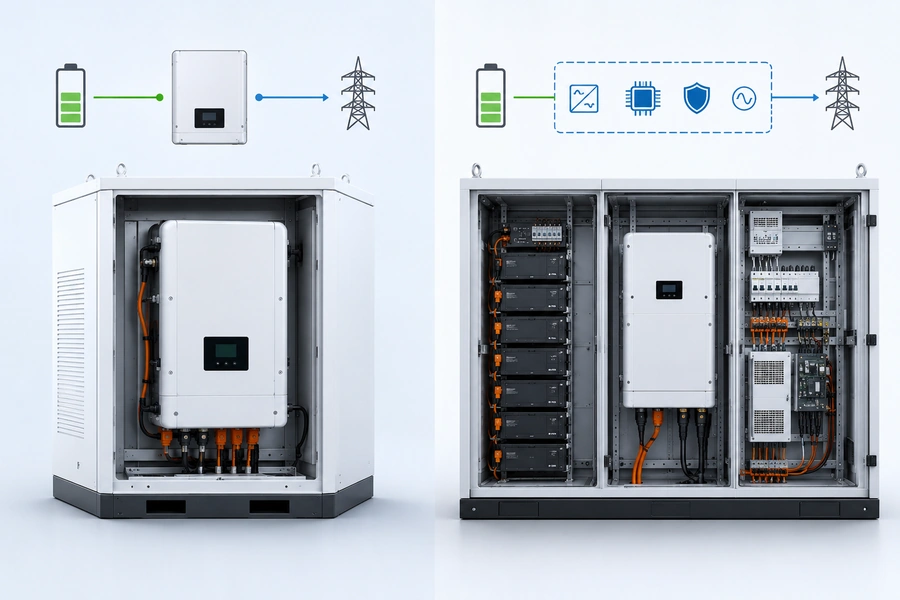
An inverter primarily converts DC electricity into AC electricity. A Power Conversion System, or PCS, is the broader power-electronics system that can include one or more bidirectional inverters plus controls, protection, synchronization, and power-conditioning functions. In a BESS, the PCS normally manages both battery charging and discharging between the DC battery and AC grid.
I therefore think of the inverter as the conversion engine, while the PCS is the complete power-conversion and grid-interface system. In smaller systems, however, a single bidirectional inverter may perform nearly all PCS functions, so manufacturers sometimes use the terms almost interchangeably.
What Does an Inverter Do?
The basic purpose of an inverter is power conversion. Batteries and solar modules naturally provide DC electricity, while most buildings and utility grids operate primarily with AC electricity.
An inverter converts DC power into AC power at the required voltage, frequency, and waveform. In solar systems, it converts PV-generated DC electricity for AC loads or the grid. In battery storage, an advanced bidirectional inverter can also reverse the process, converting AC electricity into DC electricity to charge the battery. DOE describes the BESS inverter as the equipment positioned between the battery and AC grid or loads, performing power conversion and control.
A Basic Solar Inverter Mainly Converts DC to AC
A conventional grid-connected solar PV system follows this energy path:
Solar panels → DC electricity → inverter → AC electricity → building/grid
The inverter takes the variable DC output of the solar array and produces AC electricity compatible with the electrical system.
Depending on its design, it may also perform:
- Maximum power point tracking
- Grid synchronization
- Voltage regulation
- Reactive power control
- Anti-islanding protection
- Fault monitoring
- Communications
Modern inverters are therefore much more sophisticated than a simple electronic DC-to-AC switch.
UL 1741 applies to inverters, converters, controllers, and interconnection-system equipment used with distributed energy resources. UL also identifies standards such as IEC 62909 specifically for bidirectional grid-connected power converters.
A Battery Inverter Is Usually Bidirectional
Battery storage introduces a second requirement.
The system must both charge and discharge.
During charging:
Grid AC → inverter/converter → battery DC
During discharging:
Battery DC → inverter → grid/load AC
Because power flows in both directions, the battery inverter is commonly called a bidirectional inverter.
DOE battery-storage documentation explicitly describes the link between the battery and grid as bidirectional and notes that the inverter participates in functions including voltage and frequency control, real and reactive power management, grid support, and potentially black start.
This is where the distinction between an inverter and PCS begins to become less obvious.
A sophisticated bidirectional inverter can perform many functions that people associate with a PCS.
What Does a PCS Do in a Battery Energy Storage System?
PCS stands for Power Conversion System. In a BESS, it is the interface between the DC battery system and the AC electrical network.
A BESS PCS converts electricity in both directions while also managing power quality, grid synchronization, active and reactive power, protection, operating modes, and communication with higher-level controls. DOE describes the PCS as the broader parent system that may encompass multiple inverters together with additional control, protection, and power-conditioning equipment.
The PCS Controls Battery Charging and Discharging
A simplified BESS architecture looks like this:
Battery → PCS → transformer → grid
During charging:
Grid → transformer → PCS → battery
During discharge:
Battery → PCS → transformer → grid
The PCS determines how much power flows and in which direction.
For example, a 2 MW/4 MWh BESS might receive an EMS command to discharge at 1.5 MW.
The EMS determines what the site should do.
The PCS executes the electrical command and controls the actual power flowing between the battery and AC system.
The battery management system, meanwhile, checks whether the battery can safely provide that power.
I therefore separate their responsibilities like this:
| Component | Primary role |
|---|---|
| BMS | Protects and manages the battery |
| PCS | Converts and controls electrical power |
| EMS | Optimizes when and why the BESS operates |
| Transformer | Changes AC voltage |
| Switchgear | Connects, isolates, and protects circuits |
DOE's BESS supply-chain report similarly describes communication between the BMS, EMS, and PCS as part of charge and discharge management and system-level operation.
A PCS Can Include More Than One Inverter
This is one of the clearest technical distinctions.
DOE describes the PCS as a larger system that can contain multiple inverters together with conversion equipment, power conditioning, controls, protection, and potentially transformers.
For example, a utility BESS may contain:
- Several inverter modules
- DC switching equipment
- AC filtering
- Protection systems
- Controllers
- Communications
- Cooling equipment
- Grid-interface functions
All of these together may be marketed as one PCS.
Calling the complete assembly simply an inverter can therefore understate its role.
What Is the Main Difference Between a PCS and an Inverter?
The simplest distinction is scope.
An inverter describes a specific power-conversion function or device, while PCS describes the broader system responsible for converting, conditioning, controlling, and coordinating electrical power. Every BESS PCS contains inverter functionality, but an inverter by itself is not necessarily a complete PCS.
PCS Is the Broader Term
I summarize the difference this way:
| Feature | Inverter | PCS |
|---|---|---|
| Main purpose | DC-to-AC conversion | Complete power conversion and management |
| DC → AC | Yes | Yes |
| AC → DC | Only if bidirectional | Normally yes in BESS |
| Battery charging | Not conventional PV inverter | Yes |
| Battery discharging | Yes if designed for battery use | Yes |
| Grid synchronization | Common | Yes |
| Active power control | Common | Yes |
| Reactive power control | Advanced models | Common grid-scale function |
| Protection | Device-level | Broader system protection |
| Multiple inverter modules | Usually no | Can include them |
| Grid-support functions | Model-dependent | Often central requirement |
| BESS application | Component/function | Major system subsystem |
DOE explicitly describes the PCS as the larger parent of the inverter and states that PCS covers system-level conversion, power quality, integration, control, monitoring, and protection.
But the Terms Can Overlap
This is where real-world terminology becomes complicated.
A manufacturer may sell a cabinet labeled:
500 kW PCS
Inside that cabinet may be one bidirectional inverter platform, filters, controls, and protection.
Another manufacturer might market very similar hardware as a:
500 kW battery inverter
Both pieces of equipment may perform almost identical AC/DC conversion.
Sungrow, for example, describes one utility product as a bidirectional power conversion system capable of battery charge/discharge management, four-quadrant operation, black start, and reactive power support.
The practical lesson is that I do not choose equipment based only on whether the manufacturer calls it an inverter or PCS.
I read the electrical specifications and functional scope.
Is a PCS Always Bidirectional?
In battery storage, bidirectional operation is one of the defining practical requirements.
A BESS PCS is normally bidirectional because the battery must absorb electricity during charging and return electricity during discharge. This requires AC-to-DC conversion in one direction and DC-to-AC conversion in the other. By contrast, a conventional solar inverter mainly transfers energy from the DC solar array toward the AC grid or loads. DOE's BESS documentation repeatedly refers to the AC/DC battery interface as bidirectional.
Charging Requires Rectifier Operation
When the battery is charged from an AC grid, the PCS behaves functionally as a rectifier:
AC → DC
The DC output must match the operating voltage and current limits of the battery.
The PCS receives operating limits through the BESS control hierarchy.
For example, the BMS may communicate:
- Maximum allowable charging current
- Maximum discharge current
- Battery voltage
- State of charge
- Temperature-related limits
- Fault status
The PCS then operates within those constraints.
Discharging Requires Inverter Operation
During discharge:
DC → AC
Now the PCS performs the classic inverter function.
However, it must still control:
- AC voltage
- Frequency
- Current
- Real power
- Reactive power
- Synchronization
- Grid-code behavior
Sungrow's utility PCS provides an example of current grid-scale functionality: its product documentation specifies bidirectional power conversion, four-quadrant operation, active and reactive power response, voltage/frequency ride-through functions, battery charge/discharge management, and black-start capability.
This illustrates why I see “bidirectional inverter” as describing the central conversion hardware, while “PCS” often describes the full operational package around that conversion function.
What Is the Difference Between a PCS and a Solar Inverter?
The difference becomes clearer when I compare a conventional PV plant with a battery plant.
A traditional solar inverter mainly converts PV-generated DC electricity into AC electricity. A BESS PCS must handle power in both directions because the battery alternates between charging and discharging. A hybrid solar inverter sits between these categories because it can integrate PV, batteries, AC loads, and grid connections within one device.
Conventional Solar Architecture
A basic solar system looks like:
PV → inverter → AC grid
Energy normally moves in one primary direction.
The inverter synchronizes with the grid and injects solar electricity.
Battery Storage Architecture
A BESS looks like:
Battery ↔ PCS ↔ AC grid
The double arrow matters.
The system repeatedly reverses power flow.
Hybrid Solar and Battery Architecture
A hybrid architecture can look like:
PV → hybrid inverter ↔ battery
↓
AC loads/grid
The hybrid inverter may include:
- Solar MPPTs
- Battery DC connections
- AC conversion
- Battery charging
- Grid interaction
- Backup control
Sungrow's current hybrid-inverter documentation, for example, describes an integrated bidirectional converter that can charge or discharge a battery while also managing solar inputs.
At residential scale, the phrase hybrid inverter is therefore more common than PCS.
At commercial and utility BESS scale, PCS is usually the more useful term because the power-conversion architecture may involve multiple inverter modules, broader grid controls, protection, and plant-level integration.
Can a PCS Provide Grid-Forming Functions?
Modern PCS platforms increasingly do more than follow the grid.
Advanced PCS equipment can support grid-following or grid-forming control depending on its hardware and control software. Grid-forming inverter technology can establish voltage and frequency references, support system stability, and potentially contribute to black-start operation instead of requiring an already-established grid waveform before injecting power.
Grid-Following Operation
Traditional grid-following equipment needs an existing grid voltage and frequency reference.
It measures the grid and synchronizes its output to that reference.
This has worked well for conventional solar plants and many BESS projects.
Grid-Forming Operation
A grid-forming PCS can behave differently.
DOE's UNIFI program explains that grid-forming inverters can help establish and maintain stable grid voltage and frequency and can potentially support black-start operation.
This matters as electrical systems include more:
- Solar
- Wind
- Battery storage
- Other inverter-based resources
The underlying conversion hardware is still inverter technology.
However, when I discuss a multi-megawatt BESS providing grid-forming services, I generally talk about the PCS because the capability depends on the integrated converters, controllers, protection, firmware, and plant controls rather than on the semiconductor switches alone.
How Do PCS, BMS, and EMS Work Together?
PCS is sometimes confused with both BMS and EMS because all three participate in battery charging and discharging.
The BMS protects the battery, the PCS physically converts and controls electrical power, and the EMS decides how the complete storage system should operate. They exchange information continuously, but their control levels are different. The BMS focuses on battery limits, the PCS on electrical conversion, and the EMS on site-level optimization. DOE's BESS architecture describes communications among BMS, PCS, and EMS as fundamental to storage-system operation.
Example: Peak Shaving
Suppose a factory wants to limit grid demand to 1 MW.
The building load rises to:
1.4 MW
The EMS calculates that the battery should provide:
400 kW
The process then works approximately like this:
EMS: Requests 400 kW discharge.
BMS: Confirms the battery's SOC, voltage, temperature, and current limits allow the request.
PCS: Converts battery DC power into approximately 400 kW of AC power.
Metering: Confirms site demand has fallen toward the target.
If battery temperature rises too far, the BMS may reduce the allowable discharge current.
The PCS must then obey the new power limit.
The EMS may respond by changing the facility's operating strategy.
This is why I do not describe the PCS as the “brain” of the whole BESS.
It has sophisticated controls, but the storage system normally uses a hierarchy of control systems.
Does the PCS Determine BESS Power Rating?
The PCS is one of the main components determining how much power a battery system can deliver.
Battery capacity determines how much energy a BESS stores in kWh or MWh, while PCS rating strongly influences how much AC power it can charge or discharge in kW or MW. A 1 MW PCS paired with a 4 MWh battery therefore creates approximately a four-hour nominal system at full rated power.
Energy and Power Are Different
Consider:
Battery capacity = 4 MWh
PCS power = 1 MW
Nominal duration:
4 MWh ÷ 1 MW = 4 hours
Now use the same battery with a 2 MW PCS:
4 MWh ÷ 2 MW = 2 hours
The battery stores the same energy.
The system delivers twice the power for roughly half the nominal duration.
This is why a BESS specification normally includes both:
- MW
- MWh
The PCS largely determines the MW side.
The battery largely determines the MWh side.
Other system limits can reduce actual performance, including battery current limits, temperature, state of charge, transformer rating, and grid interconnection constraints.
What Should I Check When Selecting a BESS PCS?
A PCS should be evaluated as critical grid-interface equipment rather than selected only from nominal kW.
I evaluate a BESS PCS by rated power, DC voltage window, efficiency, overload capability, reactive power range, bidirectional operation, grid-code compliance, protection, cooling, communications, grid-forming capability, black-start requirements, modularity, and compatibility with the selected battery and transformer. Certification requirements also depend on the project and jurisdiction.
My PCS Selection Checklist
| Specification | Why I check it |
|---|---|
| Rated kW/MW | Defines normal power capability |
| Rated kVA | Includes apparent-power capability |
| DC voltage window | Must match battery operating voltage |
| Maximum DC current | Must match battery current requirements |
| AC voltage | Must match transformer/grid architecture |
| Efficiency | Affects round-trip system losses |
| Bidirectional operation | Required for battery charging/discharging |
| Reactive power | Important for grid support |
| Overload capability | Helps with temporary high-power conditions |
| Grid-forming option | Relevant for advanced grid or microgrid applications |
| Black start | Relevant for resilience applications |
| Protection | Required for safe electrical operation |
| Communications | Needed for BMS and EMS integration |
| Modularity | Affects maintenance and availability |
| Certification | Required for code/grid compliance |
UL Solutions identifies UL 1741 as a key U.S. standard covering inverters, converters, controllers, and interconnection equipment used with DER, while IEC 62909 addresses bidirectional grid-connected power converters.
For a U.S. project, I also check the applicable utility interconnection rules and equipment certification rather than assuming that any bidirectional inverter can legally be connected to the grid.
My Insights: What Is the Difference Between a PCS and an Inverter
The distinction is easiest to understand by thinking about function versus system scope.
An inverter is the equipment that performs DC-to-AC conversion, while a PCS is the broader power-conversion system that may contain one or more bidirectional inverters plus control, protection, synchronization, and power-conditioning functions. In modern BESS products the terms often overlap, but PCS is generally the more complete system-level description.
I Think of the Inverter as the Core of the PCS
If I open a utility-scale PCS enclosure, the central power-electronics hardware performs inverter and rectifier functions.
During discharge:
DC → AC
During charging:
AC → DC
That bidirectional converter is the heart of the PCS.
But a working PCS may also coordinate:
- Switching
- Protection
- Grid synchronization
- Reactive power
- Voltage control
- Frequency response
- Fault handling
- Communications
- Black-start functions
DOE therefore describes the PCS as the larger parent system rather than simply another name for the inverter.
Terminology Depends on Project Scale
For a home solar system, I usually say:
solar inverter or hybrid inverter
For a commercial BESS, I increasingly say:
PCS
For a utility-scale battery project, PCS is usually the clearer term because it represents the complete battery-to-grid power interface.
This does not mean a hybrid inverter is technically primitive. Modern residential hybrid inverters can perform sophisticated bidirectional conversion and backup functions.
The terminology reflects architecture and industry convention as much as fundamental electronics.
I Do Not Compare PCS Products by Name Alone
One supplier may call its equipment a:
bidirectional inverter
Another may call similar equipment:
PCS
A third may call it:
power converter
UL itself groups inverters and converters within overlapping DER certification frameworks, which reflects how closely related these devices are.
I therefore compare actual capabilities:
- Can it charge and discharge?
- How many kW and kVA can it provide?
- What DC voltage range does it accept?
- Can it provide reactive power?
- Can it operate grid-forming?
- Does it support black start?
- What protection is included?
- What certifications apply?
- How does it communicate with the BMS and EMS?
Those questions tell me much more than the product label.
The Practical Rule
My simplest rule is:
Inverter = power-conversion device
PCS = power-conversion system
Every modern battery PCS needs inverter functionality, but the complete PCS can include much more than the inverter itself.
That distinction becomes increasingly important as BESS projects move beyond basic charging and discharging toward frequency response, voltage support, microgrid operation, grid forming, and black-start applications. DOE's current work on grid-forming inverter technologies demonstrates how power-electronic interfaces are becoming active grid-support assets rather than passive conversion devices.
Conclusion
An inverter performs the core DC/AC conversion. A PCS is the broader bidirectional conversion, control, protection, and grid-interface system used in a BESS.
](https://voltcrave-battery.com/wp-content/uploads/2026/08/Why-Are-Overseas-Energy-Storage-Projects-Difficult-to-Deploy-768x512.webp)
](https://voltcrave-battery.com/wp-content/uploads/2026/08/Is-There-an-All-in-One-Solar-Inverter-With-a-Battery-768x512.webp)
](https://voltcrave-battery.com/wp-content/uploads/2026/08/Standalone-Battery-Energy-Storage-What-You-Need-to-Know-768x512.webp)