

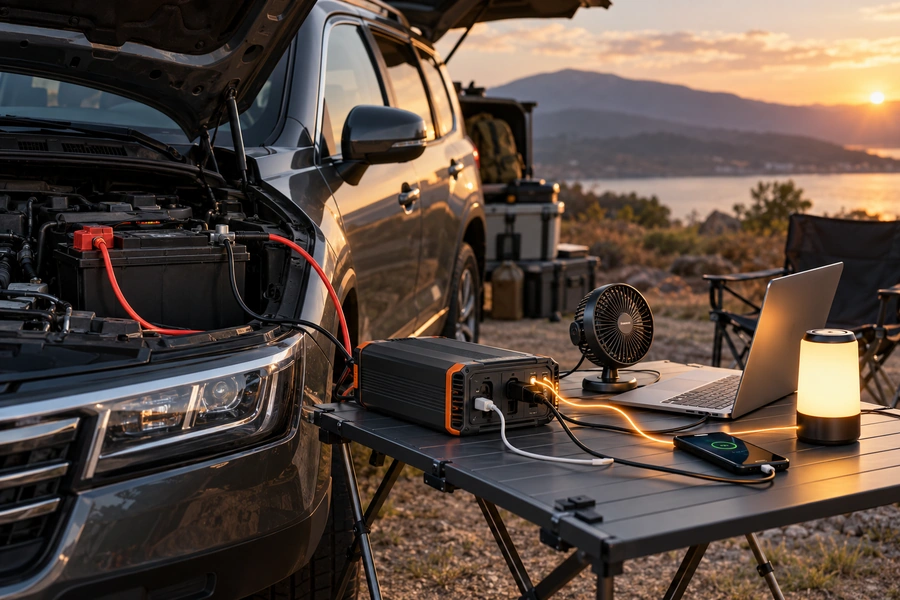
](https://voltcrave-battery.com/wp-content/uploads/2026/09/How-Long-Can-You-Run-an-Inverter-on-a-Car-Battery.webp)
Connecting an inverter to a car battery seems simple, but runtime can fall surprisingly fast once the AC load increases.
A car battery can run an inverter from less than 30 minutes to several hours, depending on battery capacity, appliance wattage, inverter efficiency, battery condition, and usable discharge. A typical 12V 60Ah battery stores about 720Wh nominally, but the practical usable energy may be considerably lower, especially with a starter battery.
The inverter's watt rating does not determine runtime by itself. To estimate runtime, I need to know the battery's watt-hours and the actual AC load.
How Do You Calculate How Long a Car Battery Will Run an Inverter?
Guessing from inverter size alone usually produces misleading runtime estimates.
To estimate inverter runtime, first convert battery capacity into watt-hours by multiplying battery voltage by amp-hours. Then multiply by the usable battery fraction and inverter efficiency before dividing by the appliance load in watts. A 12V 60Ah battery contains roughly 720Wh nominally, but not all of that energy should be treated as practically usable.
The basic calculation is:
Battery Energy (Wh) = Battery Voltage × Battery Capacity (Ah)
For a:
12V 60Ah battery:
12 × 60 = 720Wh
Now suppose the inverter is approximately:
90% efficient.
The theoretical AC energy would be:
720Wh × 0.90 = 648Wh
If the appliance consumes:
100W,
the idealized runtime would be:
648Wh ÷ 100W = 6.48 hours
But I would not expect a conventional starter battery to provide this full runtime safely.
Starter batteries are designed primarily to deliver a short burst of high current for engine starting. Repeated deep discharge can shorten their useful life, and real battery capacity also changes with:
discharge rate,
temperature,
battery age,
voltage cutoff,
and battery condition.
For practical planning, I therefore use:
Runtime ≈ Battery Wh × Usable Fraction × Inverter Efficiency ÷ AC Load
This gives a more useful estimate than simply dividing nominal battery capacity by appliance wattage.
How Long Will a 12V 60Ah Battery Run an Inverter?
A 60Ah starter battery may look large, but high-wattage appliances can consume its usable energy quickly.
A 12V 60Ah battery stores approximately 720Wh nominally. If only 50% is treated as usable and inverter efficiency is assumed to be 90%, approximately 324Wh would be available to the AC load in this simplified example. That could theoretically run a 100W load for about 3.2 hours or a 500W load for roughly 39 minutes.
Using:
12V × 60Ah = 720Wh
Assume for illustration:
50% usable battery capacity
and:
90% inverter efficiency.
Then:
720 × 0.50 × 0.90 = 324Wh usable AC energy
Estimated runtimes become:
| AC Load | Approximate Runtime |
|---|---|
| 50W | 6.5 hours |
| 100W | 3.2 hours |
| 200W | 1.6 hours |
| 300W | 1.1 hours |
| 500W | 39 minutes |
| 750W | 26 minutes |
| 1000W | 19 minutes |
These figures are simplified planning estimates, not guaranteed runtimes.
At high current, a lead-acid battery's effective available capacity can fall. Voltage can also sag enough for the inverter's low-voltage protection to shut down before the battery delivers the calculated energy.
The battery may therefore run a small:
laptop,
router,
fan,
or television
for considerably longer than it can operate:
a microwave,
coffee maker,
heater,
or high-power tool.
How Long Will a 100Ah Car Battery Run an Inverter?
A larger battery increases runtime, but the appliance still determines how quickly stored energy disappears.
A 12V 100Ah battery contains about 1,200Wh nominally. Using a conservative 50% usable fraction and 90% inverter efficiency gives approximately 540Wh of usable AC energy in a simplified calculation. That could support a 100W load for about 5.4 hours, a 300W load for 1.8 hours, or a 1,000W load for roughly 32 minutes.
The calculation is:
12V × 100Ah = 1,200Wh
Then:
1,200Wh × 0.50 × 0.90 = 540Wh
Estimated runtime:
| Appliance Load | Approximate Runtime |
|---|---|
| 50W | 10.8 hours |
| 100W | 5.4 hours |
| 200W | 2.7 hours |
| 300W | 1.8 hours |
| 500W | 1.1 hours |
| 1000W | 32 minutes |
| 1500W | 22 minutes |
Again, this assumes the battery can supply the required current.
That becomes increasingly important at high loads.
A 1,500W AC appliance at 90% inverter efficiency requires approximately:
1,500 ÷ 0.90 = 1,667W DC
At 12V:
1,667 ÷ 12 ≈ 139A
That is an enormous current compared with running a small electronic device.
The cable, battery terminals, fuse, battery chemistry, and inverter connections must all be capable of handling the required current.
Runtime is therefore only half of the question.
The other half is:
Can the battery safely deliver the required power?
How Long Can a Car Battery Run a 100W Inverter Load?
Small loads are where a car battery and inverter combination is most practical.
A 100W AC load may run for several hours from a typical car battery, depending on battery capacity and how deeply it is discharged. For example, a 12V 60Ah battery with a hypothetical 50% usable fraction and 90% inverter efficiency provides about 324Wh of AC energy, giving an estimated runtime of approximately 3.2 hours.
The important phrase is:
100W load
rather than:
100W inverter.
A 1000W inverter does not continuously consume 1000W simply because that number appears on the case.
If I connect a:
60W laptop
to a:
1000W inverter,
the main load is still approximately 60W plus inverter losses and standby consumption.
Similarly:
100W appliance on a 2000W inverter
does not mean the battery is supplying 2000W.
The inverter rating describes its output capability.
The appliance determines the actual demand.
For a 60Ah battery using our simplified 324Wh usable-energy assumption:
50W load → 6.5 hours
100W load → 3.2 hours
150W load → 2.2 hours
200W load → 1.6 hours
This is why car-battery inverters work much better for:
laptops,
small televisions,
routers,
camera equipment,
and:
low-power electronics
than for continuous electric heating.
How Long Can a Car Battery Run a 500W Inverter Load?
At 500W, battery current becomes much more significant.
A 500W AC load could theoretically run for about 39 minutes from a 12V 60Ah battery when assuming 50% usable capacity and 90% inverter efficiency. Real runtime may be shorter because high discharge current causes voltage drop, lead-acid capacity effects, cable losses, battery aging, and inverter low-voltage shutdown.
A 500W load at:
90% inverter efficiency
requires approximately:
500 ÷ 0.90 = 556W
from the battery.
At 12V:
556 ÷ 12 ≈ 46A
That is already a substantial continuous battery current.
If battery voltage under load falls closer to:
11.5V,
current becomes:
556 ÷ 11.5 ≈ 48A.
Cable resistance now matters.
A poor connection that seems harmless with a 5A load can become a serious problem around 50A.
This is why high-power inverters normally require:
short cables,
large conductor cross-sections,
properly crimped terminals,
and:
correct overcurrent protection.
At this power level, I would also pay close attention to whether the vehicle has:
a starter battery
or:
a deep-cycle battery.
A starter battery can deliver high current, but it is not designed for repeated deep energy cycling.
How Long Can a Car Battery Run a 1000W Inverter?
A 1000W appliance can drain the usable energy of an ordinary car battery extremely quickly.
A 1,000W AC load may provide only around 19 minutes of calculated runtime from a 12V 60Ah battery when assuming 50% usable capacity and 90% inverter efficiency. Actual runtime can be shorter because the battery must supply roughly 90–100A, causing voltage sag and reducing effective available capacity.
The DC power requirement at 90% efficiency is:
1,000 ÷ 0.90 = 1,111W
At 12V:
1,111 ÷ 12 ≈ 93A
Now compare that with a:
100W load.
It needs roughly:
111W DC
or about:
9A at 12V.
So increasing the AC load from:
100W → 1000W
increases battery current by roughly a factor of ten.
This creates much greater stress on:
battery,
cables,
connections,
and:
fuses.
It also increases voltage drop.
That means a 1000W inverter may technically be connected to a car battery, but using close to its full rated power for an extended period is a very different task from powering a laptop.
For sustained high-power AC loads, I prefer a battery system specifically designed for deep cycling rather than relying on the vehicle's starter battery.
Can You Run a 2000W Inverter From a Car Battery?
The inverter may be rated for 2000W, but an ordinary 12V vehicle electrical system may struggle to supply that much continuous power.
A 2,000W inverter can theoretically operate from a suitable 12V battery system, but full output requires extremely high DC current. At 90% efficiency, a 2,000W AC load needs about 2,222W from the battery, equivalent to roughly 185A at 12V before accounting for additional voltage drop and other losses.
The calculation is:
2,000W ÷ 0.90 = 2,222W
Then:
2,222W ÷ 12V ≈ 185A
At lower battery voltage:
2,222 ÷ 11.5 ≈ 193A
This explains why a:
2000W inverter
should not be treated like a simple accessory-socket device.
At full power it requires a serious DC electrical installation.
The system needs appropriate:
battery capacity,
battery discharge capability,
cable size,
fusing,
connections,
and:
ventilation.
A typical car starter battery might start an engine with high current for a short time, but delivering around:
180–200A continuously
is a very different duty cycle.
If someone genuinely needs 2kW AC for long periods, I would normally consider:
a dedicated deep-cycle battery bank,
LiFePO4 battery,
24V system,
or:
48V system
depending on the application.
Higher voltage reduces current for the same power.
Does the Inverter Size Affect Battery Runtime?
Only indirectly. The appliance load matters much more than the inverter's maximum rating.
A larger inverter does not automatically drain a battery at its full rated wattage. Battery runtime is mainly determined by the actual connected load, although larger inverters may have higher standby consumption. A 100W appliance connected to a 2,000W inverter still draws approximately 100W plus conversion and idle losses, not 2,000W continuously.
This is a common misunderstanding.
Consider:
2000W inverter + 100W laptop
versus:
500W inverter + 100W laptop.
Both are supplying approximately the same AC load.
The larger inverter may consume somewhat more power internally, depending on its design, but it does not automatically pull its full 2000W rating.
The inverter rating answers:
What maximum continuous load can this inverter support?
Battery capacity answers:
How much energy is stored?
Actual appliance wattage answers:
How quickly is that energy being consumed?
I summarize this as:
Inverter watts = capability
Battery Wh = stored energy
Load watts = consumption rate
All three matter, but they describe different things.
Can You Run an Inverter With the Car Engine Off?
Yes, but the inverter then draws stored energy directly from the battery.
An inverter can operate with the engine off, but the starter battery will gradually discharge. If battery voltage falls too far, the vehicle may not have enough energy left to restart the engine. Runtime should therefore be limited when using a starter battery, especially with high-power appliances or an older battery.
This is one of the biggest practical risks.
Imagine the car is parked overnight.
You use an inverter to power:
a laptop,
lights,
and:
a small fan.
Everything works normally.
But while the inverter is operating, the battery is losing charge.
The next morning, the battery may no longer provide enough cranking current to start the engine.
That is why I would not intentionally drain a starter battery to its theoretical maximum capacity.
A battery can still have some energy remaining while being too discharged to reliably crank the engine.
This is especially important in:
cold weather,
older vehicles,
or:
vehicles with aging batteries.
For repeated camping or off-grid inverter use, a dedicated auxiliary battery is generally a better architecture.
The vehicle's starter battery can then remain reserved for:
starting the vehicle.
Can You Run an Inverter While the Car Is Running?
Yes, but the alternator and vehicle electrical system determine how much additional continuous load can be supported.
Running the engine allows the alternator to supply electrical power and recharge the battery, potentially extending inverter runtime significantly. However, the inverter load must remain compatible with the alternator's available output after normal vehicle electrical loads are supplied. A large inverter can demand more current than the charging system can continuously provide.
Suppose the inverter is powering:
1000W AC.
At 90% efficiency, it needs about:
1,111W DC.
At a charging voltage around:
14V,
current is roughly:
1,111 ÷ 14 ≈ 79A.
The vehicle itself may simultaneously need power for:
fuel system,
engine electronics,
fans,
lights,
heated windows,
air conditioning,
and:
other accessories.
So an alternator rated for a certain maximum current does not mean all of that current is available to the inverter.
If inverter demand exceeds available alternator output:
the battery supplies the difference.
That means the battery can still discharge while the engine is running.
For high continuous loads, alternator thermal limits also matter.
Therefore, “engine running” does not mean:
unlimited inverter runtime.
It means the alternator becomes another energy source that may greatly extend runtime if correctly sized.
Will an Inverter Drain a Car Battery When Nothing Is Plugged In?
Usually, yes. Most powered-on inverters consume some standby energy.
An inverter can draw power even when no AC appliance is connected because its control electronics remain active. The exact no-load consumption varies by inverter design and operating mode. Over many hours, this standby draw can contribute to battery discharge, particularly with a small starter battery.
This is called:
idle consumption
or:
no-load draw.
Suppose an inverter consumes:
10W
while switched on with no load.
Over:
10 hours
it uses:
10W × 10h = 100Wh.
For a nominal:
720Wh
car battery, that is not trivial.
Some inverters offer:
power-saving mode,
eco mode,
or:
automatic load detection.
These functions can reduce standby consumption.
However, their behavior varies between models.
The safest rule is simple:
Turn the inverter off when AC power is not needed.
This reduces unnecessary battery discharge and prevents accidentally leaving the system energized for long periods.
Is a Car Starter Battery Good for Running an Inverter?
It can run an inverter, but it is not ideal for repeated deep discharge.
A car starter battery is designed primarily to provide high current for a few seconds during engine starting and then be recharged by the alternator. Repeatedly using a large portion of its capacity through an inverter can accelerate wear. Deep-cycle lead-acid or LiFePO4 batteries are generally better suited to repeated energy-storage use.
This comes down to battery design.
A starter battery prioritizes:
high cranking current.
An energy-storage battery prioritizes:
repeated charging and discharging.
Those are different jobs.
If I occasionally need to power:
a laptop,
camera charger,
or:
small electronic device,
using the car battery carefully may be reasonable.
If I need to run:
a refrigerator overnight,
camping equipment every weekend,
large power tools,
or:
continuous AC loads,
I would prefer a dedicated auxiliary battery.
A typical architecture could be:
Starter Battery → Charging System → Auxiliary Battery → Inverter → AC Loads
This separates vehicle starting from accessory energy storage.
It reduces the chance that using AC appliances leaves the vehicle unable to start.
How Can You Make an Inverter Run Longer on a Car Battery?
Runtime improves when the load is reduced, the battery stores more usable energy, and conversion losses are minimized.
To extend inverter runtime, reduce unnecessary AC loads, use an efficient inverter, switch off standby devices, choose appropriately sized appliances, maintain healthy battery connections, and consider a dedicated deep-cycle or LiFePO4 battery for repeated use. For large loads, increasing battery-bank capacity is more effective than simply installing a larger inverter.
Suppose the available AC energy is:
500Wh.
At:
500W load
runtime is approximately:
1 hour.
Reduce the load to:
250W
and theoretical runtime becomes:
2 hours.
Reduce it to:
100W
and runtime approaches:
5 hours.
The relationship is straightforward.
Lower watts mean longer runtime.
Increasing battery capacity has a similar effect.
If usable energy doubles from:
500Wh → 1000Wh,
runtime approximately doubles for the same load.
But buying a:
3000W inverter
instead of a:
1000W inverter
does not triple runtime.
It simply increases maximum potential AC output.
For runtime, battery energy is the key resource.
My Insights: How Long Can You Run an Inverter on a Car Battery
The answer depends much more on battery capacity and actual appliance wattage than on the inverter's advertised maximum rating.
A car battery may run an inverter for less than half an hour under a heavy 1,000W load or several hours with a 50–100W load. For a typical 12V 60Ah battery, a simplified 50%-usable and 90%-efficient calculation gives about 324Wh of AC energy, although real runtime can be lower.
My First Insight: Calculate Watt-Hours Before Runtime
Amp-hours alone can be misleading.
I convert:
Ah → Wh
first.
For example:
12V × 60Ah = 720Wh
Then I consider:
usable capacity,
inverter efficiency,
and:
actual load.
This gives a much more meaningful runtime estimate.
My Second Insight: Load Wattage Matters More Than Inverter Wattage
A:
2000W inverter
does not automatically consume:
2000W.
If it powers a:
100W load,
battery demand is approximately 100W plus losses.
If it powers a:
1800W load,
battery demand becomes enormous.
So the first question should not be:
“How big is my inverter?”
It should be:
“How many watts am I actually using?”
My Third Insight: High Power Creates a DC Current Problem
At 12V, even moderate AC loads require substantial current.
Using 90% efficiency:
500W AC ≈ 46A DC
1000W AC ≈ 93A DC
2000W AC ≈ 185A DC
These simplified calculations explain why:
cables,
fuses,
battery terminals,
and:
battery discharge capability
become critical as inverter size increases.
My Fourth Insight: A Starter Battery Should Be Protected for Starting
A car battery has another job after the inverter is switched off:
start the engine.
That means I do not treat its full nominal Wh as disposable energy.
For occasional low-power use, a starter battery can be useful.
For frequent or overnight inverter use, a dedicated deep-cycle battery architecture is generally more appropriate.
That keeps accessory energy consumption separate from vehicle starting.
My Fifth Insight: How Long Can You Run an Inverter on a Car Battery?
This directly answers the H1.
Using a 12V 60Ah battery, 50% usable capacity, and 90% inverter efficiency as a simplified planning example:
| AC Load | Estimated Runtime |
|---|---|
| 50W | 6.5 hours |
| 100W | 3.2 hours |
| 200W | 1.6 hours |
| 300W | 1.1 hours |
| 500W | 39 minutes |
| 750W | 26 minutes |
| 1000W | 19 minutes |
So, how long can you run an inverter on a car battery?
The practical answer is:
anywhere from minutes to several hours.
The three most important numbers are:
battery voltage,
battery amp-hours,
and:
actual appliance watts.
I start with:
Battery Wh = Voltage × Ah
Then:
Usable AC Wh ≈ Battery Wh × Usable Fraction × Inverter Efficiency
Finally:
Runtime ≈ Usable AC Wh ÷ Appliance Watts
For a:
12V 60Ah battery:
nominal energy is:
720Wh.
Using a conservative illustrative 50% usable fraction:
360Wh.
At 90% inverter efficiency:
324Wh
reaches the AC load in the simplified calculation.
A:
100W load
therefore gives:
324 ÷ 100 = 3.24 hours.
A:
500W load
gives:
324 ÷ 500 = 0.648 hours
or approximately:
39 minutes.
A:
1000W load
gives only about:
19 minutes.
Real results can be lower.
This is especially true with lead-acid starter batteries under high current because voltage sag, discharge-rate effects, battery condition, temperature, cable losses, and inverter low-voltage cutoff can reduce usable runtime.
The most useful rule is therefore:
Check watts to know how fast energy is being consumed. Check watt-hours to know how much energy is available. Check DC amps to know whether the battery and wiring can safely deliver the required power.
If the goal is occasional low-power use, a car battery can be practical.
If the goal is long-duration or high-power AC operation, a dedicated deep-cycle or LiFePO4 battery system is usually the better energy-storage solution.
Conclusion
A car battery can run an inverter from minutes to hours. Runtime depends mainly on battery Wh, usable capacity, inverter efficiency, appliance watts, and battery condition.
](https://voltcrave-battery.com/wp-content/uploads/2026/08/How-Much-Battery-Storage-Do-You-Need-to-Run-a-House-768x512.webp)
](https://voltcrave-battery.com/wp-content/uploads/2026/08/What-Are-BESS-Containers-Used-For-768x512.webp)
](https://voltcrave-battery.com/wp-content/uploads/2026/06/What-is-BESS-A-Comprehensive-Overview-of-Battery-Energy-Storage-Systems-768x512.jpg)