

](https://voltcrave-battery.com/wp-content/uploads/2026/08/How-Does-Utility-Scale-Battery-Storage-Work.webp)
Wind and solar power can generate huge amounts of electricity, but they do not always produce power at the exact moment the grid needs it most. That mismatch creates one of the biggest challenges in modern power systems.
Utility-scale battery storage works by charging when electricity is abundant or inexpensive and discharging when electricity is more valuable or needed for grid reliability. I think of it as a large grid-connected energy buffer made up of battery cells, battery management systems, power conversion systems, thermal controls, transformers, protection equipment, and energy management software. Together, these components allow electricity to be stored, converted, controlled, and released back to the grid at the right time.
Unlike a small home battery, a utility-scale battery energy storage system is designed for grid services at much larger power and energy levels. These projects are commonly rated in MW for power and MWh for energy, and they may support renewable-energy shifting, peak shaving, frequency regulation, reserve capacity, transmission support, or black start preparation. The International Energy Agency reports that global battery-storage additions reached 108 GW in 2025, up 40% from 2024, making battery storage the fastest-growing power technology.
What Is Utility-Scale Battery Storage?
The phrase sounds simple, but it refers to a complete grid asset rather than just a group of batteries inside a container.
A utility-scale battery energy storage system, often called a utility-scale BESS, is a large stationary energy-storage project connected to the power grid. It stores electrical energy in batteries and uses power electronics and control systems to charge and discharge electricity in ways that support grid operation, renewable integration, and electricity-market participation.
It Is More Than a Battery
When people imagine utility battery storage, they often picture shipping containers full of cells. That is only one part of the system.
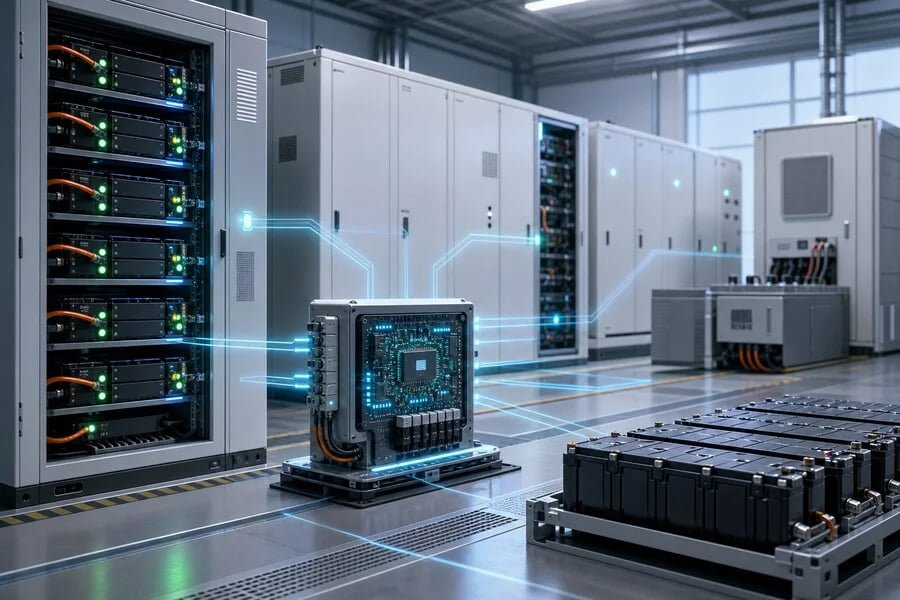
A typical utility-scale BESS includes:
| Component | Main role |
|---|---|
| Battery cells/modules | Store energy electrochemically |
| Battery racks/containers | Organize and house the battery system |
| BMS | Monitors and protects battery operation |
| PCS/inverters | Convert DC battery power to AC grid power and back |
| EMS/controller | Decides when and how the battery operates |
| Thermal management | Maintains battery temperature |
| Transformer | Matches BESS voltage to grid voltage |
| Switchgear/protection | Controls connection and fault isolation |
| Monitoring/SCADA | Provides supervision and remote control |
UL also treats an ESS as a complete system rather than only a battery pack. Its UL 9540 framework covers charging, discharging, controls, communications, power conversion, and related system functions.
For me, that system-level definition is essential.
A utility-scale BESS is not merely energy in a box.
It is a grid-connected power asset.
How Does Utility-Scale Battery Storage Actually Work?
The core idea is straightforward: electricity is stored when supply exceeds immediate value and discharged later when the grid benefits more from it.
A utility-scale battery storage system charges by taking electricity from the grid or a co-located renewable plant and converting it into DC energy stored in battery cells. It discharges by reversing the process: battery DC power passes through the PCS, becomes AC electricity, and is delivered back to the grid or to connected loads. The EMS controls these actions according to market signals, grid conditions, and operating limits.
Charging Mode
Suppose a solar farm is producing strongly at noon while grid demand is moderate.
Instead of exporting all that electricity immediately, some energy can be diverted into the battery.
The energy flow looks like this:
Solar plant or grid AC
↓
PCS converts AC to DC
↓
Battery stores DC energy
If the project is DC-coupled with solar, the exact path can vary, but the principle remains the same: excess generation is stored rather than wasted or sold at a low-value moment.
Discharging Mode
Later in the evening, solar production falls while electricity demand rises.
The BESS can release stored energy.
The flow reverses:
Battery DC
↓
PCS converts DC to AC
↓
Transformer and switchgear connect to grid
↓
Electricity delivered to grid/load
This is what allows solar energy produced at noon to help serve evening demand.
The EMS Makes the Battery Useful
The battery does not decide on its own when to charge or discharge.
That role belongs to the Energy Management System.
The EMS may respond to:
- Electricity prices
- Dispatch instructions
- Frequency deviations
- Renewable output
- State of charge
- Grid congestion
- Reserve requirements
I think of the EMS as the brain of the BESS.
The battery stores energy.
The PCS moves energy.
The EMS decides when the movement creates value.
Why Do Utility-Scale Batteries Use Both MW and MWh Ratings?
Understanding utility-scale storage requires separating power from energy.
Power, measured in MW, tells me how fast a battery can charge or discharge. Energy, measured in MWh, tells me how long it can sustain that output. A utility-scale BESS needs both ratings because grid services depend on both instantaneous power capability and total stored energy.
MW Measures Power
If a BESS is rated at:
100 MW
it can theoretically deliver or absorb up to 100 MW at a given moment.
That matters for services such as:
- Frequency response
- Peak shaving
- Fast reserves
- Grid balancing
MWh Measures Stored Energy
If the same system is rated at:
400 MWh
then its nominal duration at full output is:
400 MWh ÷ 100 MW = 4 hours
That means it can theoretically discharge:
100 MW for 4 hours
or:
50 MW for 8 hours
depending on system design and operating strategy.
| Example BESS | Power | Energy | Nominal duration |
|---|---|---|---|
| A | 50 MW | 100 MWh | 2 h |
| B | 100 MW | 400 MWh | 4 h |
| C | 200 MW | 800 MWh | 4 h |
| D | 300 MW | 600 MWh | 2 h |
This is why I never ask only:
“How big is the battery?”
I ask:
“How many MW?”
and:
“How many MWh?”
Those are different design questions.
What Happens Inside a Utility-Scale Battery System?
The system contains several layers of electrical and software control that work together continuously.
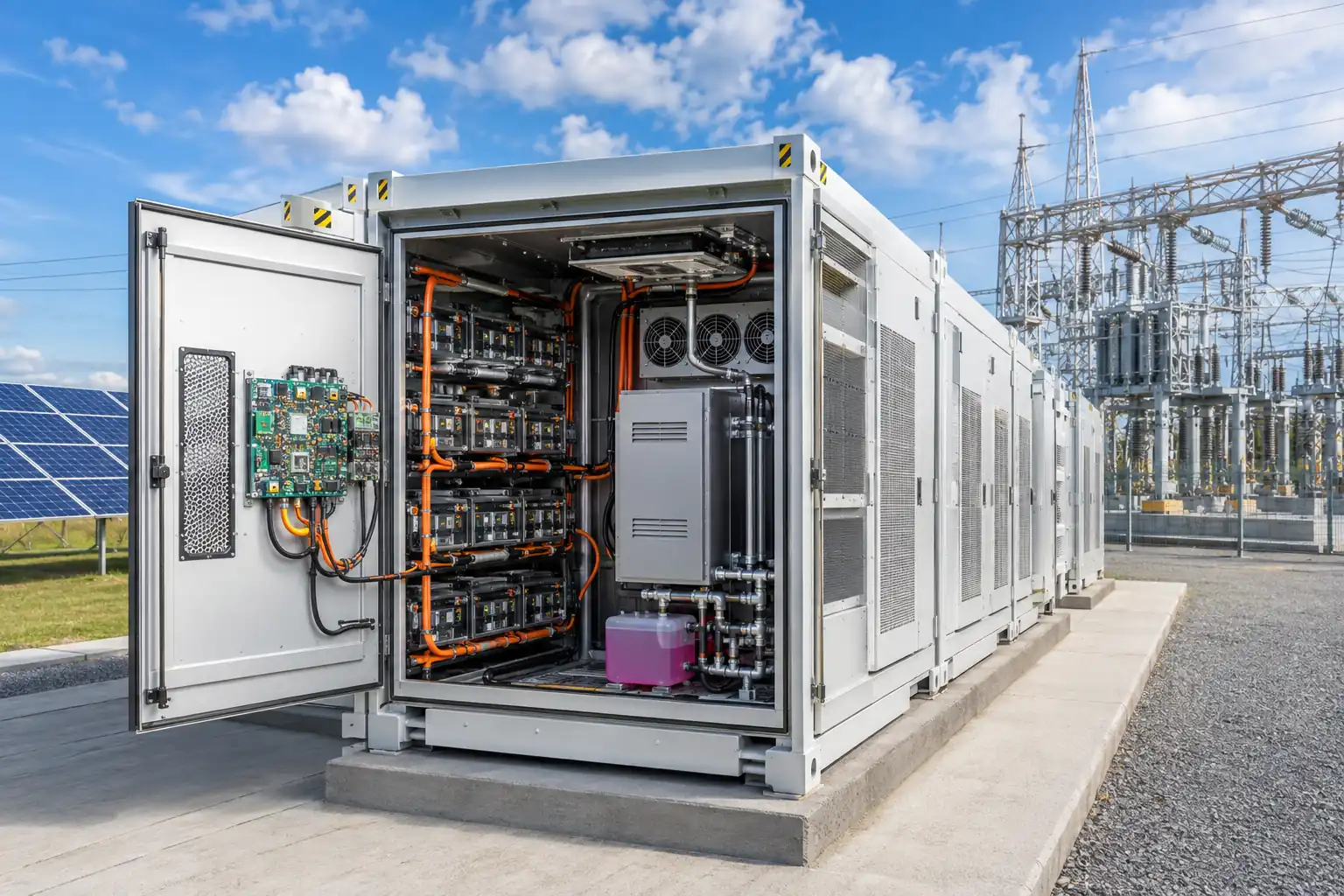
Inside a utility-scale BESS, battery cells are grouped into modules, racks, and containers. The BMS monitors voltage, current, temperature, and state of charge. The PCS manages bidirectional power conversion. Thermal systems control operating temperature. Supervisory software coordinates dispatch, alarms, and grid interaction. All of these elements must operate together for the project to perform safely and reliably.
The Battery Cells Store the Energy
Most modern utility-scale BESS projects use lithium-ion batteries, and the IEA reports that LFP accounted for around 90% of battery-storage deployments in 2025.
Cells are arranged into:
- Modules
- Packs
- Racks
- Containers or cabinets
This creates a large structured DC energy-storage block.
The BMS Protects the Battery
The Battery Management System tracks:
- Cell voltage
- Temperature
- Current
- State of charge
- Fault conditions
If values move outside safe limits, the BMS can reduce power or isolate part of the system.
Without the BMS, the battery would not operate safely or consistently.
The PCS Connects the Battery to the Grid
The battery stores DC electricity.
The grid operates with AC electricity.
The Power Conversion System bridges that difference.
During charging:
AC → DC
During discharge:
DC → AC
The PCS also helps manage:
- Reactive power
- Grid synchronization
- Frequency response
- Power quality
That is why PCS performance is a major differentiator among utility-scale integrators.
Thermal Management Controls Temperature
Large batteries generate heat.
Temperature affects:
- Performance
- Lifetime
- Safety
- Available power
So utility-scale BESS projects include air cooling or liquid cooling systems to keep batteries within their intended operating range.
For me, cooling is not a minor accessory.
It is part of the core engineering.
What Services Can Utility-Scale Battery Storage Provide?
A utility-scale battery is valuable because the same stored electricity can support several grid needs.
Utility-scale batteries can provide energy shifting, renewable firming, peak shaving, frequency regulation, operating reserves, ramp-rate control, congestion relief, capacity support, black start support, and sometimes deferral of transmission or distribution upgrades. The exact value depends on market rules, grid conditions, and project design.
Renewable Energy Shifting
A battery can capture electricity from solar or wind when output is high and release it later when output falls.
This is one of the most visible use cases.
Peak Shaving
If grid demand rises sharply for a short period, the BESS can discharge to reduce the peak seen by the grid.
That can reduce the need for more expensive peak-generation resources.
Frequency Regulation
Grid frequency must remain close to its target level.
Because batteries respond very quickly, they are well suited to correcting small short-term imbalances between supply and demand.
Reserve and Capacity Support
A battery can sit partly charged and available in case the grid suddenly needs extra power.
In that role, it acts like a standby reliability resource.
Renewable Firming and Smoothing
Wind and solar can fluctuate quickly.
A BESS can smooth those changes so the power delivered to the grid becomes more predictable.
The U.S. Department of Energy notes that advanced inverters and storage systems can support the grid through voltage and frequency services, while helping renewable systems operate more flexibly.
How Do Utility-Scale Batteries Work With Solar and Wind?
Utility-scale batteries are often paired with renewable generation because storage helps convert variable output into more controllable power.
When paired with solar or wind, utility-scale batteries absorb excess renewable electricity during periods of strong generation and discharge it when renewable output drops or electricity demand increases. This makes renewable power more dispatchable and can reduce curtailment, improve market value, and support grid reliability.
Solar + Battery Example
Imagine a solar plant producing:
200 MW
at noon.
Grid demand or export pricing may only justify:
140 MW
immediately.
The remaining:
60 MW
can be stored in the battery.
Later, when solar output falls to zero, the battery can discharge that stored energy into the evening peak.
Wind + Battery Example
Wind generation can vary unpredictably.
A BESS can smooth short-term fluctuations by charging when wind spikes and discharging when wind temporarily drops.
That makes the wind project's output more stable.
Co-Located Projects Can Share Infrastructure
A battery and renewable plant at the same site may share:
- Land
- Interconnection
- Transformer infrastructure
- Controls
- Development costs
DOE explains that solar-plus-storage projects can benefit from shared hardware and development efficiencies compared with fully separate facilities.
For me, this is one reason co-located storage has become so important.
It improves both the technical performance and the economic value of renewable generation.
How Fast Can Utility-Scale Battery Storage Respond?
One of the main reasons batteries are so attractive to grid operators is speed.
Utility-scale battery storage can respond extremely quickly—often in fractions of a second to a few seconds—because it uses power electronics rather than combustion or mechanical ramping. That fast response makes BESS especially useful for frequency regulation, contingency response, renewable smoothing, and other dynamic grid services.
Batteries Respond Faster Than Thermal Plants
A gas turbine or other conventional generator may need time to ramp.
A battery can change output almost immediately because:
- The energy is already stored
- The PCS is electronically controlled
- No combustion process needs to start
This fast response is a major reason batteries have become important grid assets.
Speed Changes Which Grid Problems Storage Can Solve
Because response is fast, a BESS can help with:
- Frequency deviations
- Renewable ramps
- Short-duration imbalances
- Fast reserves
- Voltage support in some configurations
That speed is harder to achieve with many conventional resources.
How Safe Is Utility-Scale Battery Storage?
Batteries must be engineered carefully because utility-scale projects contain large amounts of stored energy.
Utility-scale battery storage is safe when properly designed, tested, installed, and operated as a complete system. Safety depends on battery chemistry, BMS protection, thermal management, enclosure design, fire detection, protection coordination, and compliance with system-level standards and codes such as UL 9540, UL 9540A, and NFPA 855 in the United States.
Safety Is a System Issue
I never judge safety by chemistry name alone.
LFP has become the dominant storage chemistry, but the complete system still matters.
UL 9540 addresses the ESS as a complete system, while UL 9540A is used to evaluate thermal-runaway fire propagation behavior. UL's current guidance also notes that the 2026 edition of NFPA 855 and the 2024 International Fire Code rely on these system-level testing approaches for many installations.
Safety Layers Typically Include
- Cell design
- Module protection
- BMS monitoring
- Cooling systems
- PCS controls
- Gas detection
- Fire detection
- Ventilation
- Site spacing
- Emergency procedures
For me, the correct question is not:
“Can a battery burn?”
It is:
“How has the project been engineered to prevent, detect, isolate, and manage abnormal events?”
What Are the Main Limitations of Utility-Scale Battery Storage?
Batteries are powerful tools, but they are not perfect substitutes for every other energy resource.
The main limitations of utility-scale battery storage include finite duration, degradation over time, upfront capital cost, safety and permitting requirements, and the fact that a battery stores electricity rather than creating new energy. It is strongest for short- to medium-duration applications, especially when paired with renewable generation or used for high-value grid services.
Duration Is Finite
A battery with:
100 MW / 400 MWh
cannot discharge 100 MW forever.
Its nominal full-power duration is four hours.
For much longer shortages, another source of energy is still required.
Batteries Degrade
Over years of cycling and calendar aging, usable capacity declines.
That means long-term project economics must account for degradation and possible augmentation.
They Store Energy; They Do Not Produce Fuel
A battery must be charged from somewhere:
- Solar
- Wind
- Grid electricity
- Other generation
It shifts and controls electricity.
It does not create primary energy on its own.
That is why I see utility-scale batteries as a complement to generation, not a total replacement for every other asset.
My Insights: How Does Utility-Scale Battery Storage Work
The most important idea is that utility-scale battery storage is not just about storing electricity. It is about making the power system more controllable.
Utility-scale battery storage works by converting surplus or low-value electricity into stored electrochemical energy and then returning that energy to the grid when it is more valuable or needed for reliability. I see the real innovation not only in the battery cells, but in the integration of BMS, PCS, EMS, cooling, and grid controls that turn a battery into a flexible utility asset.
Storage Changes Time Into a Grid Resource
The grid has always required supply and demand to match in real time.
Batteries relax that constraint by allowing electricity generated now to be used later.
That is why they are so important for renewable-heavy grids.
A solar plant no longer has to deliver all its value only when the sun shines.
A wind plant no longer has to accept every fluctuation as unavoidable.
Storage changes those resources from more variable generation into more manageable generation.
PCS and EMS Are Just as Important as the Battery
When people talk about utility batteries, they often focus entirely on chemistry.
I think that misses much of the engineering value.
A utility-scale BESS is really an interaction of:
battery cells + BMS + PCS + thermal systems + EMS + grid protection
The PCS determines how power is exchanged with the grid.
The EMS determines when the battery should operate and for which service.
Without those two layers, the battery would be far less useful commercially and technically.
Utility-Scale BESS Is Becoming Core Grid Infrastructure
The market data confirms this shift.
The IEA reports that global battery additions reached 108 GW in 2025, and storage became the fastest-growing power technology.
That tells me storage is no longer a niche pilot technology.
It is becoming part of mainstream electricity infrastructure.
I Expect the Role of Batteries to Expand Further
The future role of utility-scale storage will likely extend beyond simple energy arbitrage.
I expect increasing emphasis on:
- Grid-forming operation
- Renewable firming
- Fast reserves
- Congestion management
- Co-located solar and wind
- Longer-duration configurations
- More intelligent dispatch software
In other words, the battery is evolving from a passive storage device into an active grid-support platform.
That is why utility-scale battery storage matters so much.
It does not just hold electricity.
It helps make the entire electricity system more flexible, reliable, and compatible with large amounts of renewable energy.
Conclusion
Utility-scale battery storage works by charging when electricity is available and discharging when the grid needs it most. Its real value comes from combining stored energy with fast power electronics, intelligent controls, and grid-level flexibility.
](https://voltcrave-battery.com/wp-content/uploads/2026/06/Why-Battery-Management-System-BMS-Matters-in-Battery-Energy-Storage-System-768x512.jpg)
](https://voltcrave-battery.com/wp-content/uploads/2026/08/How-High-Voltage-LifePO4-Battery-Works-768x512.webp)
](https://voltcrave-battery.com/wp-content/uploads/2026/08/What-Determines-the-Lifespan-of-a-BESS-Battery-768x512.webp)