
](https://voltcrave-battery.com/wp-content/uploads/2026/08/What-Are-the-Risks-and-Challenges-of-Installing-a-100kW-Solar-Battery.webp)
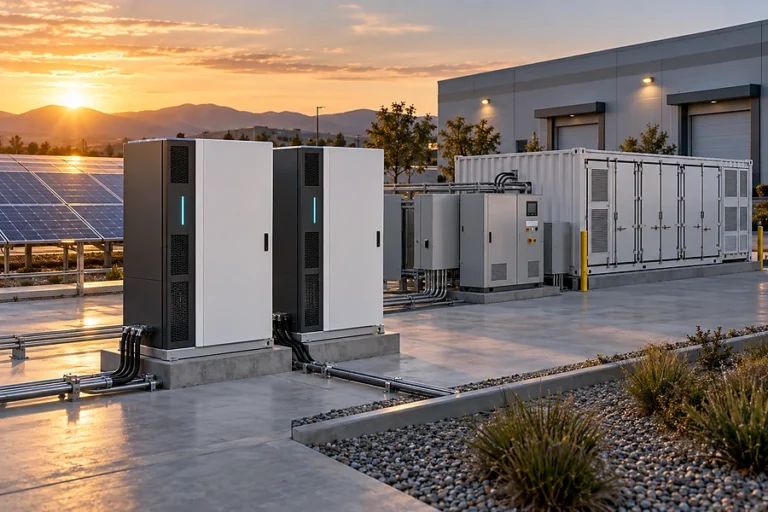
Installing a 100kW solar battery system can reduce peak demand, improve solar self-consumption, and support backup power, but commercial-scale storage introduces significant technical, safety, permitting, and financial challenges.
The main risks of installing a 100kW solar battery include incorrect battery sizing, fire and thermal-runaway hazards, inverter or PCS mismatch, grid-interconnection delays, inadequate thermal management, high installation costs, maintenance requirements, and poor site planning. A safe project requires certified equipment, proper electrical protection, realistic load analysis, fire-safety engineering, and approval from the relevant authority having jurisdiction.
I also make one distinction immediately: 100kW normally describes power, not battery capacity. A 100kW BESS could be paired with 100kWh, 200kWh, 400kWh, or another energy capacity depending on the required discharge duration.
What Does a 100kW Solar Battery System Actually Mean?
The phrase “100kW solar battery” is convenient, but it can hide an important sizing question.
A 100kW battery energy storage system normally refers to a system capable of charging or discharging at approximately 100 kilowatts of power. Its stored energy must be specified separately in kilowatt-hours. For example, a 100kW/200kWh system can theoretically operate at full rated power for about two hours, while a 100kW/400kWh system represents roughly four hours of nominal duration.
kW and kWh Solve Different Problems
I use:
kW = power
and:
kWh = energy
The simplified relationship is:
Duration = Energy ÷ Power
For example:
| BESS Rating | Nominal Duration at 100kW |
|---|---|
| 100kW / 100kWh | 1 hour |
| 100kW / 200kWh | 2 hours |
| 100kW / 300kWh | 3 hours |
| 100kW / 400kWh | 4 hours |
These are theoretical figures. Actual usable duration can be affected by:
- Usable depth of discharge
- Inverter efficiency
- Auxiliary loads
- Battery degradation
- Temperature
- Operating reserve
This distinction matters because an incorrectly sized system may technically provide 100kW but still fail to meet the business objective.
For example, if a factory needs to shave a 100kW peak for four hours, a 100kW/100kWh battery is far too small even though its power rating looks correct.
What Is the Biggest Safety Risk of Installing a 100kW Battery?
For lithium-ion systems, one of the most important safety concerns is thermal runaway and the possibility of fire or combustible-gas generation.
A 100kW commercial battery contains much more stored energy than a small residential battery, so a cell failure can create a more serious system-level hazard. Lithium-ion thermal runaway can release heat and flammable gases, and safety design must therefore address propagation, gas accumulation, ignition, fire spread, emergency shutdown, and separation from nearby equipment or buildings.
UL Solutions explains that current ESS safety requirements focus heavily on thermal-runaway propagation, fire behavior, gas release, and explosion risks. The 2026 edition of NFPA 855 increases the emphasis on large-scale fire testing and fire/explosion analysis for lithium-ion BESS installations.
Thermal Runaway Is Not Just “A Battery Getting Hot”
Normal battery heating occurs during charging and discharging.
Thermal runaway is different.
A severe internal failure may create:
cell failure
↓
rapid heat generation
↓
gas release
↓
possible propagation to neighboring cells
↓
possible ignition or deflagration
This is why BESS safety cannot depend only on normal cooling.
A commercial system may need coordinated protection involving:
- Cell monitoring
- BMS alarms
- Temperature sensors
- Smoke detection
- Gas detection
- Fire barriers
- Ventilation
- Deflagration protection
- Emergency shutdown
- Appropriate separation distances
UL 9540A evaluates thermal-runaway and fire behavior at different levels, including cell, module, and installation-level testing.
Why Are UL 9540 and UL 9540A Important?
Certification and fire testing are major parts of reducing risk and gaining project approval.
UL 9540 addresses the safety of complete energy storage systems and equipment, while UL 9540A is a test method used to evaluate thermal-runaway propagation and fire behavior. For a commercial 100kW lithium-ion system, I would verify the exact system certification and applicable fire-test documentation rather than accepting a generic claim that the battery cells themselves are “safe.”
Cell Certification Is Not the Same as System Certification
A BESS contains more than cells.
It may include:
- Battery modules
- Racks
- BMS
- PCS
- Disconnects
- Contactors
- Cooling equipment
- Fire protection
- Communications
- Enclosure
The safety of one component does not automatically prove the safety of the complete installed system.
UL Solutions notes that NFPA 855 and installation codes use UL 9540 and UL 9540A data to support decisions about ESS installation, spacing, and fire protection.
Requirements Are Becoming More Demanding
As of 2026, UL Solutions reports that updated NFPA 855 requirements place stronger emphasis on representative large-scale fire testing for lithium-ion BESS and on explosion-risk analysis aligned with NFPA 68 and NFPA 69.
That has a practical consequence:
a technically good battery product can still face permitting delays if the required safety documentation is incomplete.
Can a 100kW Battery Be Installed Anywhere?
No. Site selection is one of the most underestimated challenges.
A 100kW battery requires a suitable location with adequate structural capacity, electrical access, ventilation or cooling, maintenance clearance, fire-service access, and separation from exposures. Local codes and the authority having jurisdiction may also restrict indoor placement, spacing, room configuration, or proximity to occupied areas.
A Battery Room Is Not Just Empty Floor Space
Before installation, I would evaluate:
- Floor loading
- Wall and ceiling construction
- Drainage
- Flood risk
- Ambient temperature
- Ventilation
- Fire detection
- Emergency exits
- Equipment clearances
- Maintenance access
- Cable routing
Outdoor equipment introduces different problems:
- Heat
- Freezing temperatures
- Rain
- Flooding
- Salt air
- Dust
- Corrosion
- Vehicle impact
The enclosure rating and thermal-management design must match the environment.
Fire Separation Can Affect the Entire Layout
Battery cabinets or containers cannot simply be packed together as tightly as physically possible.
Large-scale fire testing can provide information about heat release, propagation, and appropriate separation distances. UL notes that current large-scale tests are intended to help code officials assess whether fire can spread from one BESS unit to neighboring units or nearby buildings.
That means fire-safety requirements can directly affect:
usable site area.
What Are the Grid-Interconnection Challenges?
A commercial battery normally interacts with an existing electrical system and may also interact with the utility grid.
A 100kW BESS may require utility review, protection studies, export controls, metering changes, relay settings, transformer evaluation, and interconnection approval. If solar, battery storage, backup generation, and grid export are combined, the control architecture becomes even more important because the system must operate correctly in both normal and abnormal grid conditions.
Adding a Battery Changes Power Flow
Without storage:
Grid → facility
and:
Solar → facility / grid
With storage:
Grid ↔ battery
Solar → battery
Battery → facility
and potentially:
Battery → grid
These bidirectional power flows can affect:
- Transformer loading
- Feeder protection
- Export limits
- Metering
- Utility operating requirements
A facility may want a battery only for:
peak shaving
and not for grid export.
In that case, the EMS and PCS may need controls that prevent unintended export.
Backup Adds Another Layer
If the battery must operate during an outage, the system also needs appropriate:
- Transfer equipment
- Islanding control
- Grid-forming capability where required
- Load management
- Protection coordination
A standard grid-connected PCS does not automatically provide backup power simply because a battery is attached.
What Happens If the Battery and PCS Are Not Properly Matched?
Compatibility problems can stop a project before commissioning or cause unreliable operation later.
The battery and PCS must match in DC voltage range, current limits, power rating, communications, BMS protocol, protection logic, and charge/discharge limits. A 100kW inverter cannot simply be paired with any battery bank that appears to have enough kilowatt-hours. Exact manufacturer compatibility is much more important than nominal voltage alone.
Voltage Window Matters
A battery voltage changes with state of charge.
Suppose a PCS accepts:
600–900V DC
but the battery operates:
500–750V DC
The system may not use its full operating range.
Potential consequences include:
- Reduced usable capacity
- Power derating
- Startup failure
- Protection trips
Communications Matter Too
Modern commercial BESS normally requires communication between:
Battery BMS ↔ PCS ↔ EMS
Common protocols may include CAN or Modbus, but the physical communication method alone does not guarantee compatibility.
The systems also need to agree on data such as:
- SOC
- Maximum charge current
- Maximum discharge current
- Voltage limits
- Temperature limits
- Fault states
A battery and inverter can therefore be electrically similar but operationally incompatible.
Why Is Thermal Management a Challenge?
Battery life and power capability are strongly influenced by temperature.
A 100kW BESS needs a thermal-management system capable of keeping battery cells within their approved temperature range and minimizing cell-to-cell temperature differences. Poor cooling can increase degradation, reduce available power, create unequal aging between modules, and increase the likelihood of temperature-related protective shutdowns.
Cooling Must Match the Duty Cycle
A battery used once per month for emergency backup experiences a very different thermal profile from a battery performing daily:
- Peak shaving
- Solar shifting
- Demand management
- Arbitrage
Frequent charging and discharging generates more heat.
The cooling solution might use:
air cooling
or:
liquid cooling.
The correct design depends on:
- Cell density
- C-rate
- Ambient conditions
- Container design
- Required thermal uniformity
The cooling system also consumes electricity.
These auxiliary loads reduce net efficiency and should be included in project modeling.
What Are the Electrical Risks of a 100kW Solar Battery?
Commercial storage systems can contain dangerous DC voltage and significant short-circuit energy.
The electrical risks of a 100kW BESS include electric shock, DC arc hazards, short circuits, incorrect polarity, insulation faults, overcurrent, failed contactors, and unsafe maintenance conditions. Proper disconnects, fuses, breakers, grounding, insulation monitoring, lockout/tagout procedures, and qualified electrical installation are essential.
DC Faults Can Be Serious
Battery systems differ from ordinary AC circuits because the battery remains an energy source even when the grid is disconnected.
Disconnecting:
utility power
does not necessarily de-energize:
battery DC conductors.
The system must have defined isolation points.
For high-voltage battery architecture, designers may also require:
- DC contactors
- Precharge circuits
- Fuses
- Insulation monitoring
Precharge is particularly important when connecting a battery to a PCS containing large DC-link capacitors.
Without controlled precharge:
battery voltage → capacitor inrush current
can produce damaging current spikes.
What Is the Risk of Incorrect Battery Sizing?
A poorly sized system may operate safely yet fail economically.
Oversizing can increase capital cost and leave battery capacity underused, while undersizing may prevent the system from meeting peak-shaving, backup, or solar-shifting objectives. I therefore size a 100kW battery from interval load data and required operating duration rather than choosing capacity from a generic rule of thumb.
Example: Peak Shaving
Suppose a business wants to reduce a peak by:
100kW
for:
3 hours.
The theoretical energy required is:
100kW × 3h = 300kWh
But a 300kWh nominal battery may still be insufficient after accounting for:
- Usable SOC window
- Conversion losses
- Degradation
- Operating reserve
A larger nominal capacity may therefore be required.
Example: Backup
Suppose critical loads are:
60kW
and need:
4 hours
of operation.
The theoretical requirement becomes:
60kW × 4h = 240kWh.
The question is no longer:
“Do I need a 100kW battery?”
It becomes:
“What combination of kW and usable kWh meets the backup requirement?”
That is a much better engineering question.
What Are the Financial Risks?
Commercial battery storage can require substantial upfront investment, and savings are not guaranteed.
Financial risks include inaccurate electricity-tariff assumptions, poor demand-charge modeling, underestimated installation costs, battery degradation, replacement expenses, financing costs, permitting delays, and uncertain future operating patterns. A 100kW system should therefore be evaluated using interval load data and realistic lifetime cash flows rather than simple battery cost per kWh.
Hidden Costs Can Be Significant
The battery equipment is only part of the project.
Other costs may include:
- PCS
- Transformer
- Switchgear
- Engineering
- Permitting
- Utility studies
- Concrete pads
- Fire protection
- HVAC
- Communications
- Commissioning
- Electrical upgrades
A low battery-module price does not guarantee a low installed-system cost.
Revenue Can Be Overestimated
A model may assume that the battery can simultaneously provide:
- Peak shaving
- Backup
- Solar shifting
- Arbitrage
But these uses can conflict.
For example, keeping the battery fully charged for backup reduces the capacity available for daily arbitrage.
That is why I model operating priorities explicitly.
How Does Battery Degradation Affect a 100kW System?
The battery will not retain its original usable capacity forever.
Lithium-ion batteries gradually lose capacity and sometimes power capability through calendar aging and cycling. A project that requires a specific usable kWh output in year ten may therefore need initial oversizing, augmentation, operating limits, or a replacement strategy to maintain performance throughout the contract or financial life.
Degradation Depends on More Than Cycle Count
Battery aging is influenced by:
- Temperature
- Depth of discharge
- Average SOC
- Charge rate
- Discharge rate
- Calendar time
- Cell consistency
A statement such as:
“6,000 cycles”
is not enough information by itself.
I want to know:
- 6,000 cycles at what DoD?
- At what temperature?
- At what C-rate?
- To what remaining capacity?
This matters when comparing warranties from different manufacturers.
What Maintenance Challenges Should Be Expected?
A 100kW BESS is not necessarily maintenance-free.
Although lithium-ion batteries require less routine mechanical maintenance than fuel generators, the complete storage system still requires inspection and monitoring. Cooling equipment, electrical connections, filters, pumps or fans, communications, fire-detection components, PCS equipment, software, and battery health all need attention during the project life.
Monitoring Is Particularly Important
Modern BESS monitoring may track:
- Cell voltage
- Module temperature
- SOC
- SOH
- Current
- Cooling status
- PCS alarms
- Insulation faults
- Communication faults
The purpose is not just to collect data.
Early detection can identify:
small abnormality → maintenance action
before it becomes:
system shutdown or serious fault.
A good service agreement therefore has real value.
Can Permitting Delay a 100kW Solar Battery Project?
Yes. Permitting can become one of the most unpredictable project risks.
A 100kW commercial BESS may require reviews from electrical, building, planning, fire, and utility authorities. Requirements can differ by jurisdiction, and modern lithium-ion storage is receiving increasingly detailed fire and explosion review. Incomplete UL documentation, unclear layouts, or insufficient fire-test evidence can lead to resubmissions and schedule delays.
UL Solutions reports that the 2026 NFPA 855 environment has increased technical documentation and safety-analysis expectations and can contribute to longer AHJ review cycles and more resubmissions.
Documentation Should Be Prepared Early
I would expect a project package to potentially require:
- One-line diagram
- Site plan
- Equipment data sheets
- UL certification information
- UL 9540A documentation
- Fire-safety plan
- Emergency response information
- Electrical calculations
- Interconnection documents
Exact requirements depend on jurisdiction.
The important planning principle is:
do not order equipment first and investigate code requirements later.
My Insights: What Are the Risks and Challenges of Installing a 100kW Solar Battery
A 100kW battery can be a valuable commercial energy asset, but I think the biggest mistake is treating it as a large plug-and-play appliance.
The risks and challenges of installing a 100kW solar battery include fire and thermal-runaway hazards, high-voltage electrical risk, incorrect kW/kWh sizing, PCS incompatibility, thermal-management demands, permitting and interconnection delays, site-layout constraints, battery degradation, and uncertain project economics. The best way to reduce these risks is to design the system around its intended operating duty before selecting hardware.
My First Insight: “100kW” Is Not Enough to Size the Project
The first question I ask is:
100kW for how long?
If the answer is:
1 hour
I may need roughly:
100kWh usable energy.
If the answer is:
4 hours
I may need roughly:
400kWh usable energy.
That difference changes:
- Battery quantity
- Space
- Cost
- Cooling
- Fire load
So the real project definition should look more like:
100kW / 400kWh BESS
rather than simply:
100kW battery.
My Second Insight: Safety Must Be Designed at the System Level
A high-quality cell alone does not make the installation safe.
I evaluate:
cell + module + rack + BMS + PCS + enclosure + cooling + fire protection + site layout.
UL 9540 and UL 9540A exist partly because ESS risk needs to be evaluated beyond the individual cell level. Current NFPA 855 requirements also increasingly rely on representative system-level and large-scale fire behavior.
This is especially important for commercial systems with substantial stored energy.
My Third Insight: Permitting Risk Should Be Managed Before Equipment Purchase
I would involve the:
AHJ + utility + fire authority + electrical designer
early.
A battery may appear perfect technically but become difficult to install if:
- Required fire-test data is missing
- Separation distances are impractical
- Utility export approval is delayed
- Transformer capacity is insufficient
Current UL guidance specifically notes that evolving requirements can increase review complexity and documentation demands.
Early review can prevent expensive redesign.
My Fourth Insight: The Economic Risk Is Often More Important Than the Technical Risk
A properly engineered BESS can operate perfectly and still be a bad investment.
Suppose the battery is installed for demand-charge savings.
If actual peak events occur at different times than expected, the battery may:
- discharge too early
- run out of energy
- miss the real peak
The equipment works.
The financial model fails.
That is why I start with:
12 months or more of interval load data
where possible.
Then I model:
- Peak demand
- Solar production
- Tariff structure
- Load growth
- Battery degradation
The application should define the battery.
My Fifth Insight: What Are the Risks and Challenges of Installing a 100kW Solar Battery in Practical Terms?
This directly answers the H1 question.
I use the following risk checklist:
| Risk Area | Key Question |
|---|---|
| Power sizing | Is 100kW enough for the peak load? |
| Energy sizing | How many kWh are actually required? |
| Battery safety | Is the ESS properly certified? |
| Fire risk | Is thermal-runaway/fire-test data available? |
| Electrical safety | Are protection and isolation correctly engineered? |
| PCS compatibility | Does the inverter match the battery voltage and BMS? |
| Cooling | Can temperature be controlled at full duty? |
| Site layout | Is enough space available for safe installation? |
| Grid connection | Has the utility approved the configuration? |
| Backup design | Can the system intentionally island if required? |
| Permitting | Have AHJ requirements been checked early? |
| Degradation | Will usable capacity still meet future requirements? |
| Maintenance | Who monitors and services the system? |
| Economics | Are savings based on real interval-load data? |
| Warranty | Are operating conditions compatible with warranty terms? |
My preferred installation sequence is:
Step 1: Define the business objective.
Is the battery for:
- Peak shaving?
- Solar self-consumption?
- Backup?
- Energy arbitrage?
- EV charging support?
Step 2: Define both kW and kWh.
Step 3: Review utility and AHJ requirements.
Step 4: Select certified, compatible battery and PCS equipment.
Step 5: Complete electrical, thermal, and fire-safety engineering.
Step 6: Model lifetime degradation and economics.
Step 7: Commission and verify the actual system under load.
The central point is simple:
A 100kW solar battery is large enough that mistakes become expensive.
The most serious risk is therefore not one individual component. It is designing the battery, inverter, fire protection, site, grid connection, and operating strategy as separate pieces instead of one integrated energy storage system.
Conclusion
A 100kW solar battery can deliver substantial value, but safe installation requires correct kW/kWh sizing, certified equipment, fire and electrical protection, thermal management, interconnection planning, and realistic lifecycle economics.
](https://voltcrave-battery.com/wp-content/uploads/2026/08/What-Is-a-Commercial-Battery-Storage-System-768x512.webp)
](https://voltcrave-battery.com/wp-content/uploads/2026/08/What-Is-Commercial-Energy-Storage-768x512.webp)