


Battery energy storage systems can improve grid flexibility and renewable energy use, but they also introduce costs, technical limits, safety requirements, and long-term operating risks.
The main disadvantages of BESS are high upfront cost, battery degradation, limited discharge duration, energy losses, fire and thermal-runaway risk, complex grid integration, supply-chain dependence, and eventual recycling or replacement. I do not see these disadvantages as reasons to avoid BESS, but they must be included in project design and lifecycle economics.
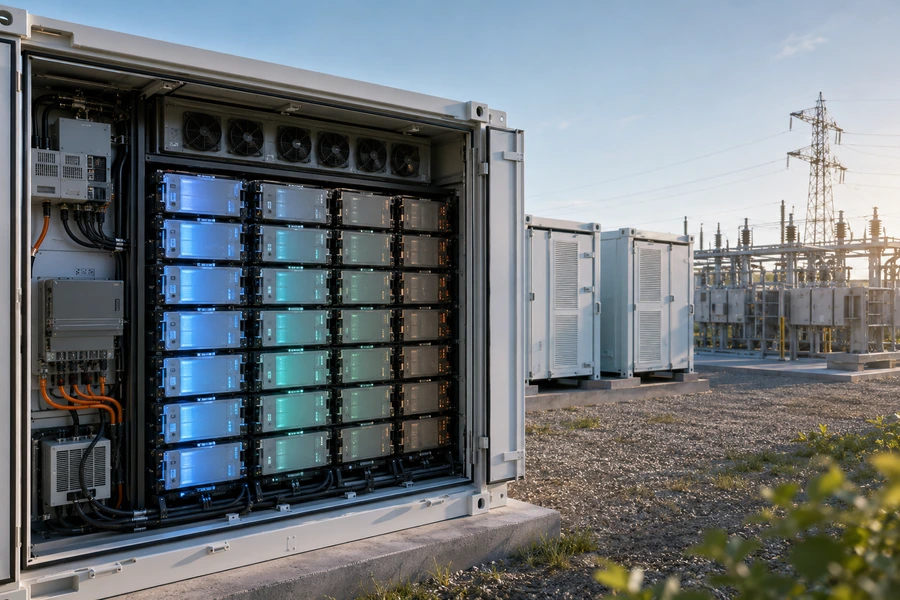
I evaluate a BESS as a complete power asset rather than a battery container. The cells, inverter, cooling system, BMS, EMS, fire controls, transformers, software, interconnection, maintenance, and end-of-life plan all influence whether the system provides enough value to justify its limitations.
Why Is the High Cost of BESS a Disadvantage?
Battery prices have fallen significantly, but a complete BESS still requires substantial capital. The battery cells are only one part of the project.
High upfront cost is one of the main disadvantages of BESS because owners must pay for batteries, power conversion, thermal management, switchgear, transformers, controls, safety equipment, engineering, construction, commissioning, and grid interconnection. The system may also require future augmentation, replacement, software support, insurance, and decommissioning expenses.
A BESS Costs More Than Its Battery Cells
When I review a supplier quotation, I separate the battery cost from the total installed project cost.
A utility or commercial BESS may include:
- Battery cells, modules, and racks
- Battery management systems
- Container or cabinet enclosures
- HVAC or liquid cooling
- Power conversion systems
- Medium-voltage transformers
- AC and DC switchgear
- Fire and gas detection
- Energy management software
- SCADA and communications
- Foundations and civil works
- Cabling and trenching
- Grid studies and interconnection
- Testing and commissioning
PNNL’s Energy Storage Cost and Performance Database evaluates storage through procurement, installation, grid connection, operating costs, and end-of-life expenses rather than battery price alone. Its lifecycle framework also includes augmentation, replacement, and major overhaul requirements.
| Cost area | Why it can become expensive |
|---|---|
| Battery capacity | More MWh require more cells and enclosures |
| PCS and electrical equipment | High MW ratings require larger conversion and grid equipment |
| Interconnection | Utility upgrades can add major cost |
| Safety systems | Detection, separation, ventilation, and fire controls are required |
| Construction | Soil, drainage, access, foundations, and cables vary by site |
| Maintenance | Cooling, sensors, software, and electrical equipment need service |
| Augmentation | Additional cells may be required as the original battery degrades |
| End of life | Removal, transport, and recycling create future expenses |
Financial Returns Are Not Guaranteed
I do not assume that every BESS will recover its cost.
A project may earn money through energy arbitrage, capacity payments, frequency regulation, demand-charge reduction, or renewable-energy shifting. However, market prices can change.
If many batteries enter the same market, they may reduce the price differences or ancillary-service revenues that originally made the project attractive.
A BESS may therefore perform technically as expected and still produce a weaker financial return than the original model predicted.
I test several revenue scenarios before procurement. I also separate guaranteed contracted revenue from merchant revenue that depends on future electricity prices.
Does Battery Degradation Reduce BESS Performance?
A battery is not a permanent storage medium. Electrochemical cells change as they age and cycle.
Battery degradation is a major BESS disadvantage because usable energy and power gradually decline with calendar age and operation. High temperature, deep cycling, high current, and stressful states of charge can accelerate degradation. A project may need extra initial capacity, later augmentation, module replacement, or more conservative dispatch to maintain its contracted performance.
Capacity Falls Over Time
A newly commissioned battery may begin with enough usable energy to provide a four-hour discharge.
After years of operation, the same system may store less energy. If the contract still requires the original output and duration, the operator must compensate for this lost capacity.
I normally account for degradation in three ways:
- Oversize the battery when it is installed.
- Add battery modules during the project life.
- Accept gradually lower usable energy.
The correct strategy depends on the warranty and the commercial contract.
PNNL’s lifecycle cost methodology specifically includes augmentation, replacement, and major overhaul because storage technologies have different cycle lives, calendar lives, and degradation characteristics.
Battery Use Affects Battery Life
The same LFP battery can age differently in two projects.
A backup system may cycle only occasionally but remain at a high state of charge for long periods. An arbitrage battery may complete deep charge-discharge cycles almost every day.
I examine:
- Depth of discharge
- Number of cycles
- Charge and discharge rate
- Cell temperature
- Average state of charge
- Time spent near maximum charge
- Cooling consistency
- Cell imbalance
The BMS can manage these conditions, but it cannot stop chemical aging completely.
Degradation Creates a Performance-Warranty Risk
A warranty may promise a minimum remaining capacity after a defined number of years, cycles, or energy throughput.
I read the warranty carefully because these conditions are not equivalent.
A system can remain inside its calendar warranty while reaching a throughput limit. Another system may cycle very little but still lose capacity through calendar aging.
For a large BESS, even a small difference between expected and actual degradation can represent many megawatt-hours of lost energy.
Are BESS Systems Limited by Storage Duration and Efficiency?
A battery can respond quickly, but it cannot supply power forever. This is one of the most important technical limits of conventional BESS.
Most lithium-ion BESS projects are designed for hours rather than days of continuous discharge. They also lose part of the energy during charging, storage, conversion, cooling, and discharging. These limits make BESS highly useful for daily balancing and peak shifting but less suitable as the only solution for prolonged energy shortages.
A Battery Has Finite Energy
MW describes how fast a BESS can deliver power. MWh describes how long it can continue.
A 100 MW/400 MWh system can theoretically provide 100 MW for around four hours before considering reserves and losses.
After that, it must recharge.
This means a battery cannot replace every power plant or transmission connection. A multi-day period of weak renewable generation may require other resources.
I may combine BESS with:
- Flexible generation
- Demand response
- Long-duration storage
- Pumped hydropower
- Transmission
- Thermal storage
- Hydrogen or other fuels
The limitation becomes more important as required storage duration increases because adding additional hours usually requires additional battery cells.
Storage Creates Energy Losses
No BESS returns every unit of electricity used to charge it.
Losses occur in:
- Battery internal resistance
- PCS conversion
- Transformers
- Cables
- Cooling and heating
- Pumps and fans
- BMS and controls
- Standby equipment
This means the system must receive more energy than it later delivers.
For daily energy arbitrage, those losses directly affect profitability. The electricity-price difference must be large enough to cover efficiency losses, degradation, operating costs, and financing.
Longer Duration May Favor Other Technologies
Lithium-ion storage is highly competitive for many short- and medium-duration applications, but the cost structure becomes less attractive when the project needs much more energy capacity.
PNNL evaluates several alternatives, including flow batteries, zinc, compressed-air storage, pumped hydro, hydrogen, and thermal storage, because duration and lifecycle requirements can make other technologies more suitable.
I therefore select a battery after defining the required discharge duration. I do not choose lithium-ion first and then force it to fit every application.
What Safety Risks Are Associated With BESS?
Modern BESS equipment uses multiple protection layers, but lithium-ion batteries still contain large amounts of stored energy.
The main BESS safety concern is thermal runaway. A damaged, defective, overheated, or electrically abused cell can release heat and gases, and the failure may spread to neighboring cells or modules. Large BESS incidents can be difficult to manage and may require evacuation, air monitoring, prolonged cooling, and specialized cleanup.
Thermal Runaway Can Propagate
A cell can enter thermal runaway when internal heat production becomes uncontrollable.
Possible initiating conditions include:
- Internal short circuits
- Manufacturing defects
- Overcharging
- Excessive temperature
- Mechanical damage
- Cooling failure
- Electrical faults
- External fire exposure
A well-designed system uses BMS protection, thermal management, barriers, sensors, and electrical isolation to reduce the risk.
However, EPA notes that lithium-ion BESS fires can be difficult to extinguish and may reignite hours or days later. Incidents can also release hazardous gases and require specialized battery cleanup and disposal.
Safety Requirements Increase Project Complexity
Safety must be designed at several levels.
| Safety layer | Typical measures |
|---|---|
| Cell | Quality control and stable chemistry |
| Module | Barriers, spacing, and thermal design |
| BMS | Voltage, current, and temperature protection |
| Container | Cooling, gas detection, smoke detection |
| Electrical system | Fuses, breakers, contactors, isolation |
| Site | Separation distance and emergency access |
| Operations | Monitoring and preventive maintenance |
| Emergency response | Fire-service planning and shutdown procedures |
EPA recommends considering battery chemistry, manufacturing quality, system integration, BMS capabilities, remote thermal or fire monitoring, and coordination with local first responders before installation.
I see these requirements as necessary safety controls, but they add equipment, engineering, permitting, training, and operating costs.
Rare Incidents Can Have Large Consequences
BESS failure rates have improved as technology and design have matured. EPA notes that failure incidents per deployed GWh have declined.
However, a large event can still have a major local effect. The January 2025 Moss Landing fire resulted in a temporary evacuation of about 1,200 residents, and cleanup continued well into 2026.
For this reason, I include low-probability, high-consequence events in site selection and insurance planning.
What Supply Chain and Environmental Disadvantages Does BESS Have?
Battery storage can help integrate clean energy, but battery production itself requires minerals, industrial processing, manufacturing, transport, and eventual recycling.
BESS has supply-chain and environmental disadvantages because lithium-ion batteries depend on concentrated manufacturing networks and critical materials. The industry also needs more recycling capacity and clear end-of-life processes. These issues can expose projects to tariffs, export controls, geopolitical disruption, shipping delays, and future disposal costs.
Battery Manufacturing Is Geographically Concentrated
The IEA’s 2026 Energy Technology Perspectives report estimates that China accounts for around 80% of lithium-ion battery supply-chain production capacity and even higher shares in some upstream and component stages.
The concentration is particularly important for LFP.
IEA analysis published in 2026 says production of LFP cathode materials and precursors remains almost entirely concentrated in China. It also notes strong concentration in graphite anode materials and other battery components.
This creates procurement risks from:
- Export controls
- Tariffs
- Trade restrictions
- Political disputes
- Shipping disruptions
- Local-content requirements
- Currency movements
- Limited alternative suppliers
The risk is important because LFP now represents around 90% of global battery-storage deployments.
Recycling Is Necessary but Still Developing
Lithium-ion batteries can contain lithium, graphite, copper, nickel, cobalt, manganese, aluminum, and other valuable materials depending on the chemistry.
Recycling can recover some of these resources and reduce the need for new material production.
However, the IEA notes that recycling currently contributes only a limited share of the critical minerals needed for rapidly growing battery demand because most batteries installed during the recent expansion have not yet reached end of life.
I therefore include end-of-life responsibility in the original BESS contract.
I ask:
- Who removes the battery?
- Who pays for transport?
- Which recycler accepts the chemistry?
- Who handles damaged batteries?
- Who owns recovered materials?
- What happens if the manufacturer no longer exists?
BESS Still Has a Physical Footprint
Utility-scale battery projects require land, access roads, electrical infrastructure, fire-service access, drainage, transformers, and separation between equipment.
A battery can be easier to site than a large power plant, but it is not invisible infrastructure.
Community concerns about fire risk, noise from cooling equipment, visual impact, land use, and emergency response can slow permitting.
Does Grid Integration Create Additional BESS Disadvantages?
A battery can be installed quickly as equipment, but the grid may not be ready to accept it.
Grid integration can become a major BESS disadvantage because projects may face long interconnection studies, network-upgrade costs, protection requirements, permitting delays, and uncertain rules for market participation. The battery itself can be ready while the project remains unable to operate commercially.
Interconnection Can Become the Bottleneck
Battery-storage development can move faster than transmission and substation construction.
A utility may require:
- Power-flow studies
- Short-circuit studies
- Protection coordination
- New transformers
- Metering
- Communications
- Feeder reinforcement
- Substation upgrades
IEA analysis in 2026 identifies delays in grid connection and permitting as notable barriers that could determine the future pace of battery-storage growth.
This risk can be difficult to estimate at the beginning of a project.
BESS Control Systems Are Complex
A modern project combines several digital and electrical systems:
- BMS
- PCS
- EMS
- SCADA
- Plant controller
- Utility communications
- Fire system
- Cooling controls
- Market-dispatch software
These systems must exchange accurate information.
A communication failure or poor software integration can reduce availability even when every battery cell is healthy.
Cybersecurity also becomes more important as systems use remote monitoring, cloud software, and automated market participation. The IEA specifically identifies cybersecurity as an additional consideration for increasingly strategic battery supply chains and infrastructure.
My Insights: What Are the Disadvantages of BESS
I believe the largest disadvantage is not any single technical problem. It is that BESS value depends on several systems working correctly for many years.
The disadvantages of BESS include high lifecycle cost, degradation, limited energy duration, conversion losses, safety risk, complex interconnection, concentrated supply chains, and end-of-life obligations. I can reduce most of these disadvantages through good engineering, but I cannot completely remove the battery’s finite energy, aging, efficiency loss, or economic uncertainty.
I Separate Manageable Risks From Fundamental Limits
Some disadvantages can be strongly reduced through engineering.
Better cooling can reduce thermal stress. Better BMS algorithms can protect cells. Fire barriers can reduce propagation. Strong contracts can clarify warranty responsibility.
Other limits remain fundamental.
A battery will eventually age. It will lose some energy during charging and discharging. It will run empty when the stored energy is exhausted.
I therefore divide BESS disadvantages into two groups:
| Type | Examples |
|---|---|
| Manageable project risks | Poor integration, weak cooling, inadequate safety planning, weak service |
| Fundamental technology limits | Finite duration, degradation, conversion loss, eventual replacement |
This distinction helps me avoid unrealistic procurement specifications.
Cheap Battery Hardware Does Not Guarantee a Cheap Project
Cell prices can fall while total project costs remain high.
Interconnection, transformers, permitting, labor, financing, insurance, and construction can become a larger part of the budget.
I therefore focus on lifecycle cost rather than container price.
PNNL’s levelized-cost approach reflects this logic by including capital investment, O&M, cycle and calendar life, augmentation, replacement, financing, and other factors when comparing storage technologies.
System Integration Is Becoming More Important Than Chemistry Alone
LFP now dominates new BESS deployment, but the chemistry does not determine whether the project succeeds.
A strong system needs:
- Accurate BMS control
- Reliable PCS equipment
- Uniform thermal management
- Tested safety architecture
- Stable communications
- Good EMS software
- Local technical support
- Spare parts
- Clear warranties
I would choose a better-integrated system over a cheaper battery with unclear responsibility between suppliers.
BESS Should Solve a Specific Problem
I do not install storage simply because batteries are becoming popular.
I first define the problem:
- Is the site reducing peak demand?
- Is it shifting solar energy?
- Is it providing backup?
- Is it selling ancillary services?
- Is it relieving grid congestion?
- Is it supporting renewable generation?
Then I determine whether the value of solving that problem exceeds the complete lifecycle cost and risk.
This approach also reveals when another storage technology, grid upgrade, demand-response program, or generation resource may be better.
Diversification Will Reduce Some Disadvantages
The BESS market will probably become more diverse.
LFP will remain important for daily cycling, but sodium-ion, flow batteries, zinc systems, iron-based batteries, compressed air, thermal storage, and other technologies may reduce specific disadvantages in certain applications.
A longer-duration technology may use cheaper storage media. Another chemistry may reduce dependence on lithium. A flow battery may tolerate more cycles.
I do not expect one technology to eliminate every weakness. I expect future projects to use different storage technologies for different grid problems.
Conclusion
BESS disadvantages include cost, degradation, limited duration, efficiency losses, safety risk, supply-chain dependence, and integration complexity. I manage them through lifecycle planning rather than battery selection alone.
](https://voltcrave-battery.com/wp-content/uploads/2026/08/What-Is-the-Lifespan-of-a-BESS-Battery-768x512.webp)
](https://voltcrave-battery.com/wp-content/uploads/2026/08/Why-a-Movable-All-in-One-Energy-Storage-System-Is-the-Future-768x512.webp)
](https://voltcrave-battery.com/wp-content/uploads/2026/05/What-is-Commercial-and-Industrial-Energy-Storage-768x512.jpg)