
](https://voltcrave-battery.com/wp-content/uploads/2026/09/What-Are-the-Common-Problems-With-Sine-Wave-Inverters.webp)
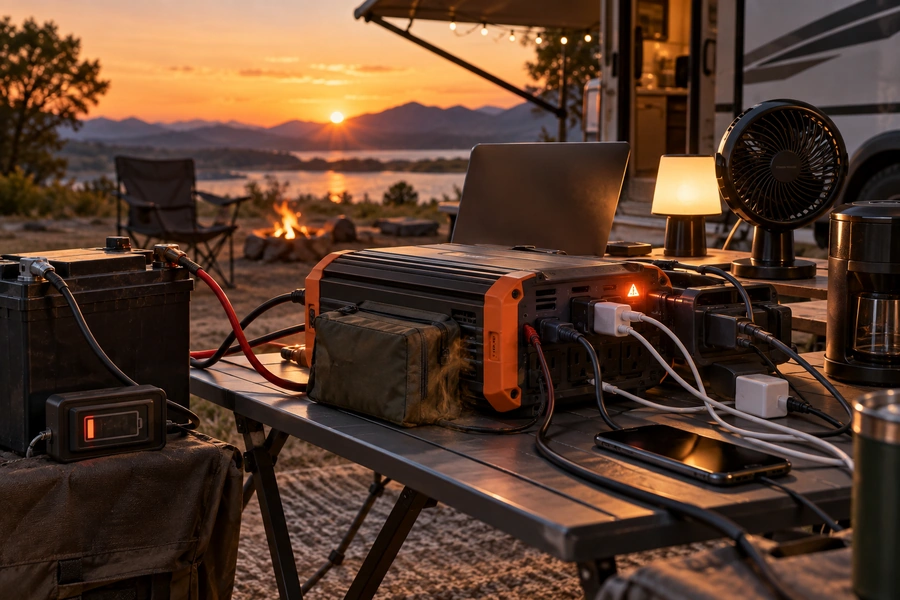
A pure sine wave inverter can provide clean AC power, yet even a good inverter may shut down, alarm, overheat, or fail when the surrounding system is poorly matched.
Common sine wave inverter problems include overload shutdown, low battery voltage, overheating, excessive battery drain, startup-surge failure, incorrect AC output, cooling-fan problems, loose DC connections, blown fuses, grounding or GFCI issues, and complete inverter failure. Many apparent inverter faults actually originate from the battery, wiring, or connected appliance.
I therefore troubleshoot the whole DC-to-AC power system, rather than assuming the inverter itself is defective.
Why Does a Pure Sine Wave Inverter Keep Shutting Off?
Unexpected shutdown is one of the most common inverter complaints, but several protection systems can produce the same symptom.
A pure sine wave inverter may shut down because of low DC voltage, high DC voltage, overload, excessive startup surge, overheating, short circuit, or an internal fault. The correct diagnosis starts by checking the inverter's fault indicator or error code, battery voltage under load, connected appliance wattage, cable condition, and operating temperature.
The basic system is:
Battery → DC Cables → Inverter → AC Load
A problem at any point can cause shutdown.
Suppose a 12V inverter powers a:
1,000W AC load.
If inverter efficiency is approximately:
90%,
battery-side power is roughly:
1,000 ÷ 0.90 = 1,111W
At 12V, current is approximately:
1,111 ÷ 12 = 93A
That is a substantial DC current.
If the battery is weak, cables are undersized, or terminals are loose, voltage at the inverter may fall sharply.
The inverter then detects:
low input voltage
and shuts down.
The user may conclude:
“My inverter is broken.”
But the actual problem may be voltage drop between the battery and inverter.
This is why measuring battery voltage only when no load is connected can be misleading.
The more useful measurement is:
voltage at the inverter DC terminals while the load is operating.
Why Does an Inverter Show Low Voltage Even When the Battery Is Charged?
A battery can show acceptable open-circuit voltage yet drop below the inverter's operating threshold when a heavy load is applied.
An inverter may report low voltage despite a charged battery when high current causes battery voltage sag or excessive voltage drop through undersized cables, long cable runs, loose terminals, corroded connections, fuses, or disconnects. A weak or aging battery can produce the same symptom because its voltage collapses more severely under load.
Consider a battery showing:
12.7V
with the inverter off.
That appears healthy.
Now switch on a large appliance.
Current rises to:
100A.
If the battery and wiring together cause a:
1.5V drop,
the inverter sees only:
11.2V.
Its low-voltage protection may activate.
This explains why the relevant equation is:
Voltage Drop = Current × Resistance
Even small resistance becomes important at high current.
Suppose total cable and connection resistance is:
0.01Ω.
At:
10A
the voltage drop is:
10 × 0.01 = 0.1V
At:
100A
the same resistance produces:
100 × 0.01 = 1V
Nothing about the cable changed.
Only current increased.
This is why DC-side cable sizing and connection quality become increasingly important as inverter wattage rises.
Why Does a Sine Wave Inverter Overheat?
Inverters are efficient, but they are never perfectly efficient. Some battery energy always becomes heat.
A sine wave inverter can overheat because of high continuous loads, inadequate ventilation, blocked air vents, high ambient temperature, cooling-fan failure, excessive internal losses, or installation in a confined space. When internal temperature exceeds the inverter's protection threshold, output may be reduced or completely shut down until the unit cools.
Suppose an inverter delivers:
2,000W AC
at:
90% efficiency.
Required DC power is:
2,000 ÷ 0.90 ≈ 2,222W
The difference is approximately:
222W.
Not every watt of loss appears identically as inverter heat under all conditions, but the example shows why thermal management matters.
A high-power inverter may need to dissipate substantial heat.
Installing it:
inside a sealed box,
next to a heat source,
under direct sunlight,
or:
against blocked ventilation openings
can make cooling difficult.
Dust can also restrict airflow.
If the inverter uses internal fans, fan performance matters more as load and temperature rise.
Overtemperature shutdown is therefore not necessarily a defect.
It may be the inverter protecting its power electronics.
I first check:
ambient temperature,
airflow,
fan operation,
vent clearance,
and:
actual AC load.
Why Does an Inverter Drain the Battery So Fast?
Fast battery drain is often caused by misunderstanding the relationship between watts and watt-hours.
An inverter can drain a battery quickly when connected appliances consume high power, because the battery must provide both the AC load energy and conversion losses. Battery capacity, usable depth of discharge, inverter efficiency, idle consumption, and appliance runtime determine how long the system lasts. A larger inverter rating alone does not provide more stored energy.
Suppose the battery is:
12V 100Ah.
Nominal energy is:
12 × 100 = 1,200Wh
If the AC appliance consumes:
1,000W,
even the theoretical nominal energy represents only:
1,200 ÷ 1,000 = 1.2 hours
before losses and discharge limitations.
Actual usable runtime can be substantially shorter.
Now reduce the load to:
100W.
The same battery contains enough nominal energy for roughly:
12 hours
before considering losses and usable capacity.
So when someone says:
“My 2000W inverter drains my battery too quickly,”
I ask:
“What is plugged into it?”
A 2000W inverter powering a 100W device does not normally draw 2000W continuously.
The connected load is the primary energy consumer.
However, the inverter itself also has:
idle consumption,
control electronics,
fans,
and:
conversion losses.
Those should be included when estimating runtime.
Why Won't My Inverter Start a Refrigerator or Air Conditioner?
Motor-driven appliances can briefly demand much more power during startup than during normal operation.
A sine wave inverter may fail to start a refrigerator, air conditioner, pump, compressor, or power tool when the appliance's startup surge exceeds the inverter's peak-power capability or lasts longer than the inverter can support. Battery voltage sag and inadequate DC wiring can make startup problems worse even when the inverter's continuous rating appears sufficient.
Suppose a refrigerator uses:
200W
while running.
It would be tempting to assume:
500W inverter = enough.
But the compressor might temporarily demand several times its normal running power during startup.
If the startup demand reaches:
1,000W,
a 500W inverter may shut down.
The same issue appears with:
air conditioners,
compressors,
pumps,
circular saws,
and:
other motor loads.
This is why I check both:
continuous watts
and:
surge watts.
I also check surge duration.
An inverter might advertise:
2,000W continuous
and:
4,000W surge.
But if that surge rating is available only very briefly, it may still fail to start a motor that needs elevated power for longer.
The battery must also support the surge.
A powerful inverter connected to a weak battery cannot create energy the battery is unable to supply.
Why Is My Pure Sine Wave Inverter Beeping?
Beeping is usually a warning rather than a random noise.
A pure sine wave inverter may beep to indicate low battery voltage, overload, high temperature, input overvoltage, short circuit, or another protection condition. Because alarm meanings vary between manufacturers, the inverter's display, LEDs, fault code, and manual should be checked before assuming the sound indicates a specific problem.
The same beep can mean different things on different models.
That is why I avoid saying:
“Three beeps always mean low battery.”
There is no universal alarm-code language across all inverter manufacturers.
However, several conditions are common.
If beeping starts when a large appliance turns on, I investigate:
overload
or:
voltage sag.
If beeping begins after the inverter has operated near maximum load for a long period, I investigate:
temperature.
If it starts after the battery has been used for hours, I investigate:
low battery voltage.
A useful troubleshooting sequence is:
Fault code → battery voltage under load → AC load → DC connections → temperature
rather than replacing components immediately.
Why Is My Inverter Fan Always Running?
Cooling fans respond to inverter design, load, and temperature, so continuous fan operation is not automatically a failure.
An inverter fan may run continuously when AC load is high, internal temperature is elevated, ambient temperature is warm, or the inverter's control strategy uses continuous cooling. Abnormal fan behavior becomes more concerning when the fan is unusually noisy, fails to rotate despite high temperature, repeatedly starts and stops unexpectedly, or the inverter overheats.
Different inverter designs control fans differently.
Some use:
temperature-based control.
Others use:
load-based control.
Some combine both.
A fan running while the inverter powers:
1,500W
may be completely normal.
A fan running continuously with:
no AC load
in a cool environment deserves more investigation, although it can still be normal for a particular model.
The reverse problem can be more serious.
If an inverter becomes hot under load while the fan never starts, possible causes include:
fan failure,
temperature-sensor fault,
control-board problem,
or:
blocked fan movement.
I would not operate a high-power inverter indefinitely if its required cooling system is clearly not functioning.
Thermal protection may eventually shut it down, but repeated excessive temperatures can reduce component life.
Why Does a Pure Sine Wave Inverter Make Noise?
Some inverter noise is normal, while new or unusually loud sounds may indicate a problem.
Pure sine wave inverters can produce fan noise, transformer hum, relay clicks, and faint high-frequency switching sounds during normal operation. Excessive buzzing, rattling, repeated relay clicking, or rapidly changing fan noise can indicate overload, unstable battery voltage, loose components, poor connections, or an internal fault and should be investigated.
A pure sine wave inverter is called “pure sine wave” because of its AC output waveform.
That does not mean:
silent inverter.
Internally, it still contains high-frequency switching electronics.
Depending on design, it may also contain:
inductors,
transformers,
relays,
capacitors,
and:
cooling fans.
These can create audible sounds.
A repeated:
click-click-click
when a load starts may indicate that the inverter is:
trying to start,
detecting low voltage,
shutting down,
and:
trying again.
That can happen when a battery is too weak to support the load.
Similarly, excessive buzzing that appears only under heavy load may point toward:
electrical stress,
loose connections,
or:
the load itself.
The useful question is not simply:
“Does the inverter make noise?”
It is:
“Has the sound changed, and under what operating condition does it occur?”
Why Is the Inverter Output Voltage Too High or Too Low?
Unexpected AC voltage can come from measurement methods, operating conditions, regulation problems, or inverter faults.
A pure sine wave inverter should regulate AC output within the manufacturer's specified range. Abnormally high or low voltage can result from overload, unstable DC input, internal regulation faults, damaged power electronics, or measurement errors. A true-RMS meter is generally preferable when evaluating AC output, particularly when waveform quality is uncertain.
For a nominal:
120V AC inverter,
the output should remain near its designed regulation range.
For a nominal:
230V AC inverter,
the same principle applies.
If voltage drops dramatically only when a large load is connected, I check:
battery voltage,
DC cable voltage drop,
and:
inverter overload
before concluding that the AC regulation circuit is defective.
If output voltage remains abnormal even with:
a healthy battery,
correct wiring,
and:
a small known load,
the inverter may require professional diagnosis.
I would also avoid opening a high-power inverter simply to investigate.
Large inverters contain high-voltage circuitry and capacitors that may retain dangerous energy even after the battery is disconnected.
Why Does the Inverter Work With Some Appliances but Not Others?
A power rating alone does not guarantee compatibility.
An inverter may operate some appliances but reject others because electrical loads differ in startup surge, power factor, waveform sensitivity, grounding requirements, leakage current, and control electronics. Pure sine wave output generally provides broad compatibility, but the inverter still needs sufficient continuous power, surge capability, correct voltage and frequency, and an appropriate grounding arrangement.
Consider two appliances rated:
500W.
Appliance A is a resistive heater.
Appliance B contains a compressor.
Although both display 500W, their startup behavior can be completely different.
The heater may draw approximately its rated power immediately.
The compressor may briefly demand much more.
Electronic appliances can introduce other issues.
Some equipment contains:
switch-mode power supplies,
motor controllers,
chargers,
or:
sensitive protection circuits.
Grounding can also matter.
Certain appliances expect specific:
neutral-ground relationships,
GFCI behavior,
or:
earth connections.
Portable inverter systems do not always replicate a building electrical system exactly.
Therefore, if one appliance works while another does not, I compare:
continuous wattage,
startup surge,
voltage,
frequency,
grounding requirements,
and:
manufacturer compatibility guidance.
Why Does an Inverter Trip the GFCI or Breaker?
A breaker trip means the protection system detected a condition it was designed to respond to.
An inverter may trip a breaker or GFCI because of overload, short circuit, leakage current, appliance faults, grounding configuration, neutral-ground bonding, or incompatible downstream wiring. Because grounding requirements depend on inverter design and installation type, neutral and ground should never be modified simply to stop nuisance tripping without following the manufacturer's wiring instructions.
There are two different protection concepts here.
A circuit breaker commonly responds to:
overcurrent.
A GFCI/RCD responds to:
current imbalance or leakage.
If a breaker trips when several appliances operate together, total load may exceed the circuit or inverter rating.
If a GFCI trips with one specific appliance, that appliance may have:
leakage current
or:
a fault.
But inverter grounding arrangements can also affect protection behavior.
This becomes especially important with:
portable inverters,
RV systems,
boats,
off-grid solar,
and:
backup installations.
I do not recommend experimenting with neutral-ground bonds without understanding the inverter topology.
Incorrect grounding can create a shock hazard.
For persistent GFCI or grounding problems, the correct wiring diagram and local electrical requirements should guide troubleshooting.
Why Does an Inverter Blow Fuses?
A blown fuse usually indicates excessive current or a fault, not simply an inconvenient component.
An inverter can blow its DC fuse because of overload, short circuit, reversed polarity, internal failure, incorrect fuse sizing, damaged wiring, or excessive current during a fault condition. Repeatedly replacing a fuse without identifying the cause can damage equipment and create a fire risk. The correct fuse type and rating should follow the inverter manufacturer's specifications.
A fuse protects wiring and equipment from excessive current.
Suppose a 12V inverter draws:
150A
at high load.
The DC protection system must be designed for that current level.
But simply installing a much larger fuse to stop nuisance blowing is dangerous.
The fuse rating must coordinate with:
cable ampacity,
inverter requirements,
and:
system design.
If the fuse suddenly begins blowing after months of normal operation, I would investigate:
damaged cables,
loose terminals,
short circuits,
inverter failure,
or:
changes in connected loads.
If it blows immediately after installation, I would verify:
battery polarity,
cable routing,
fuse specification,
and:
wiring configuration.
A fuse is a safety device.
Its failure is a symptom that deserves investigation.
Can Bad Battery Cables Cause Inverter Problems?
Yes. DC wiring is one of the most overlooked parts of inverter installations.
Undersized, excessively long, loose, damaged, or corroded battery cables can cause voltage drop, heating, low-voltage alarms, reduced inverter output, intermittent shutdown, and poor surge performance. Because a 12V high-power inverter can draw more than 100A, even small connection resistance can create significant voltage loss and heat.
Consider:
P = V × I
For:
1,500W
of DC power:
at 12V → approximately 125A
at 24V → approximately 62.5A
at 48V → approximately 31.25A
This demonstrates why low-voltage inverter systems require heavy DC conductors.
Cable loss also follows approximately:
P loss = I²R
If current doubles while resistance stays the same, resistive loss increases by approximately four times.
That is why a cable connection that seems acceptable at:
20A
may become problematic at:
100A.
Signs of poor DC connections can include:
hot terminals,
discolored insulation,
intermittent alarms,
voltage drop,
or:
inverter shutdown during high loads.
The battery-to-inverter connection should therefore be treated as part of the power system, not as an afterthought.
How Can You Prevent Common Pure Sine Wave Inverter Problems?
Most inverter problems are easier to prevent during system design than to diagnose after installation.
Common inverter problems can be reduced by choosing adequate continuous and surge capacity, matching DC voltage correctly, using a healthy battery with sufficient discharge capability, installing properly sized short cables and overcurrent protection, maintaining ventilation, avoiding sustained overload, checking connections, and following the manufacturer's grounding and installation requirements.
I start by sizing the inverter against:
maximum simultaneous AC load.
Then I check:
largest startup surge.
Next comes the battery.
It needs enough:
stored energy
and:
current capability.
Then I calculate the DC current.
For example, a:
2,000W
load at:
90% efficiency
requires about:
2,222W DC.
At 12V:
≈185A
At 24V:
≈93A
At 48V:
≈46A
This is why increasing system voltage can be useful for higher-power systems.
Finally, I check:
cable length,
fuse protection,
ventilation,
ambient temperature,
grounding,
and:
load compatibility.
A high-quality pure sine wave inverter cannot compensate for a battery that is too small or wiring that is badly undersized.
My Insights: What Are the Common Problems With Sine Wave Inverters
The most important troubleshooting lesson is that an inverter alarm does not automatically mean the inverter itself has failed.
The most common sine wave inverter problems are low-voltage shutdown, overload, excessive startup surge, overheating, rapid battery drain, poor DC connections, cooling-fan issues, abnormal output voltage, grounding or GFCI problems, blown fuses, and internal component failure. Many can be prevented through correct sizing, adequate battery capacity, proper wiring, ventilation, and installation.
My First Insight: Many “Inverter Problems” Are Actually Battery Problems
The inverter is often the first device to report the problem.
That does not mean it caused the problem.
A weak battery can produce:
low-voltage alarms,
repeated shutdown,
poor surge performance,
and:
relay cycling.
The inverter may simply be protecting itself.
That is why battery voltage should be measured:
under load
rather than only when the system is idle.
My Second Insight: High Wattage Becomes High DC Current Very Quickly
At 12V, large inverter loads require enormous current.
At approximately 90% efficiency:
500W AC ≈ 46A DC
1000W AC ≈ 93A DC
2000W AC ≈ 185A DC
This explains why many problems appear only when a heavy appliance is switched on.
The inverter may work perfectly with:
a laptop
but fail with:
a microwave.
The difference may be DC current rather than waveform quality.
My Third Insight: Continuous Watts and Surge Watts Solve Different Problems
Continuous output answers:
Can the inverter keep the appliance running?
Surge output answers:
Can the inverter start it?
Motor-driven equipment makes this distinction especially important.
A refrigerator may run comfortably once its compressor is moving but demand much more power during startup.
An inverter can therefore appear large enough based on running watts and still shut down during startup.
My Fourth Insight: Pure Sine Wave Does Not Mean Problem-Free
Pure sine wave describes:
AC waveform quality.
It does not guarantee:
unlimited power,
perfect efficiency,
zero heat,
unlimited surge,
correct grounding,
or:
infinite battery runtime.
A pure sine wave inverter can still be:
overloaded,
overheated,
poorly wired,
connected to an undersized battery,
or:
incorrectly installed.
Waveform quality is only one part of inverter performance.
My Fifth Insight: What Are the Common Problems With Sine Wave Inverters?
This directly answers the H1.
| Common Problem | Likely Causes | What to Check First |
|---|---|---|
| Inverter shuts down | Overload, low voltage, overheating | Fault code and battery voltage |
| Low-voltage alarm | Weak battery, voltage drop | DC voltage under load |
| Overheating | High load, poor airflow | Load and ventilation |
| Battery drains quickly | High AC demand | Actual appliance watts |
| Motor will not start | Insufficient surge | Startup watts |
| Continuous beeping | Protection warning | Display/manual |
| Fan always runs | Heat or high load | Temperature and load |
| Fan does not run | Fan/control fault | Temperature and fan operation |
| Buzzing or clicking | Load, low voltage, relays | Battery and connections |
| Wrong AC voltage | Regulation/input issue | DC and AC voltage |
| GFCI trips | Leakage/grounding issue | Appliance and wiring |
| Fuse blows | Excess current/short | Wiring and load |
| Hot DC cables | Undersized/loose cables | Cable and terminals |
| Appliance incompatibility | Surge/grounding/load characteristics | Appliance requirements |
| No AC output | Protection or internal failure | Fault status and DC input |
So, what are the common problems with sine wave inverters?
Most problems fall into five groups:
1. Battery problems
The battery may be:
weak,
undersized,
discharged,
or:
unable to supply enough current.
2. Wiring problems
The system may have:
undersized cables,
long cable runs,
loose terminals,
corrosion,
or:
incorrect fusing.
3. Load problems
Connected appliances may exceed:
continuous power,
surge power,
or:
the battery's current capability.
4. Thermal problems
The inverter may have:
poor ventilation,
blocked cooling,
fan failure,
or:
excessive ambient temperature.
5. Inverter hardware problems
Power semiconductors,
capacitors,
relays,
fans,
sensors,
or:
control electronics
can eventually fail.
The most useful troubleshooting sequence I use is:
Check fault code → Check battery voltage under load → Check AC load → Check DC wiring → Check temperature → Check grounding → Suspect internal inverter failure last.
This order prevents unnecessary replacement of a perfectly functional inverter.
A pure sine wave inverter is fundamentally a power-conversion device:
Battery DC → Inverter → AC Load
If the battery cannot provide the required energy, the inverter cannot solve it.
If the cables cannot carry the required current, the inverter cannot solve it.
If the appliance requires more surge power than the inverter can deliver, the inverter cannot solve it.
And if the inverter cannot remove the heat created during conversion, thermal protection may shut it down.
For this reason, reliable inverter performance depends on the entire electrical system, not simply the quality of the inverter itself.
Conclusion
Common sine wave inverter problems include shutdowns, overheating, low voltage, overload, battery drain, surge failure, wiring faults, grounding issues, and component failure.
](https://voltcrave-battery.com/wp-content/uploads/2026/08/The-Ultimate-Guide-to-Energy-Storage-All-in-One-vs.-Split-Systems-Which-Is-Right-for-You-768x512.webp)
](https://voltcrave-battery.com/wp-content/uploads/2026/08/Industrial-Energy-Storage-Smarter-Systems-and-Better-Power-768x512.webp)
](https://voltcrave-battery.com/wp-content/uploads/2026/06/What-Are-the-Pros-and-Cons-of-Solar-Energy-Storage-768x512.jpg)