
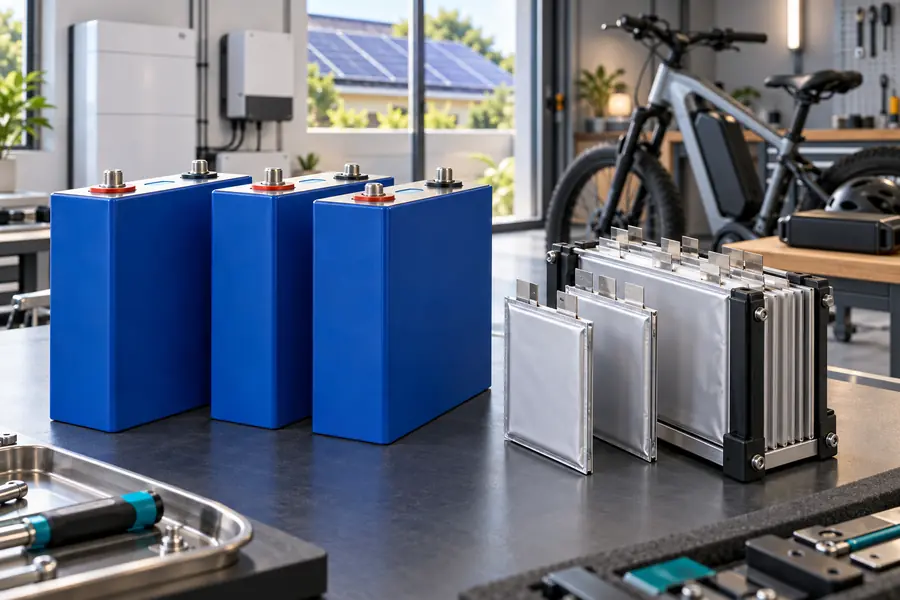
](https://voltcrave-battery.com/wp-content/uploads/2026/10/Which-Is-Better-LiFePO4-or-Lithium-Battery.webp)
Battery labels are confusing: LiFePO4 is already a lithium battery, so comparing “LiFePO4 vs lithium” can hide the real chemistry, performance, safety, and cost differences.
For most stationary storage, RV, marine, and solar applications, LiFePO4 is usually the better choice because it offers long cycle life, competitive cost, and favorable thermal stability. Conventional high-energy lithium-ion chemistries such as NMC are better when low weight, compact size, and maximum energy density matter more than extreme longevity.
LiFePO4 offers longer cycle life and strong value for storage, while NMC lithium-ion provides higher energy density and lower weight. LiFePO4 is a lithium-ion chemistry.
Is LiFePO4 Actually a Lithium Battery?
The phrase “lithium battery” is often used as though it describes one chemistry, which can make battery comparisons misleading.
Yes. LiFePO4, also called LFP or lithium iron phosphate, is a lithium-ion battery chemistry. NMC, NCA, LCO, and LMO are also lithium-ion chemistries. Therefore, the useful comparison is not really LiFePO4 versus lithium, but LiFePO4 versus other lithium-ion chemistries with different cathode materials and performance characteristics.
A lithium-ion battery is a broad technology family.
Different lithium-ion batteries can use different cathode materials.
Common examples include:
LFP — Lithium Iron Phosphate
NMC — Lithium Nickel Manganese Cobalt Oxide
NCA — Lithium Nickel Cobalt Aluminum Oxide
LCO — Lithium Cobalt Oxide
These chemistries can behave very differently even though they all belong to the lithium-ion family.
This distinction matters because many buyers see two products advertised as:
Lithium Battery
and:
LiFePO4 Battery
and assume the first is a completely different battery technology.
It is not.
A better way to frame the question is:
LiFePO4 vs NMC
or:
LFP vs high-energy lithium-ion.
The chemistry determines important characteristics such as:
energy density,
material cost,
thermal behavior,
cycle performance,
voltage characteristics,
and application suitability.
Current market adoption demonstrates how important LFP has become. The IEA reports that LFP represented more than 55% of global EV battery deployment in 2025. In stationary battery storage, its position is even stronger: LFP now represents around 90% of global battery-storage deployments.
This does not mean LFP is universally better.
It means its particular combination of performance characteristics has become extremely attractive for applications where:
weight is not the only priority.
Is LiFePO4 Better Than NMC or Other Lithium-Ion Batteries?
Choosing between LFP and higher-energy lithium-ion chemistries requires a trade-off between lifespan, cost, energy density, size, weight, and thermal behavior.
LiFePO4 is generally better when cycle life, frequent charging, stationary storage, cost, and thermal stability matter most. NMC-type lithium-ion batteries are generally better when high energy density, low weight, and compact dimensions are more important. Neither chemistry wins every category, so the correct choice depends on the application.
One of LFP's strongest advantages is its suitability for frequent cycling.
The IEA reports that LFP now accounts for around 90% of battery-storage deployments and describes it as typically cheaper and better suited to frequent cycling than competing higher-energy-density chemistries.
Cost is another major advantage.
According to the IEA's 2026 analysis, average LFP battery packs were more than 40% cheaper per kWh than NMC packs in 2025, although the IEA notes that part of this difference reflects the different applications in which the two chemistries are used.
NMC has a major advantage of its own:
energy density.
The latest-generation cell figures cited by the IEA reach roughly:
205 Wh/kg for LFP
versus:
265 Wh/kg for NMC.
That difference matters enormously when the battery must move.
Consider two battery systems requiring the same:
60 kWh
of cell-level energy.
Using simplified theoretical energy-density values:
At 205 Wh/kg:
60,000 ÷ 205
≈ 293 kg
At 265 Wh/kg:
60,000 ÷ 265
≈ 226 kg
Actual battery packs weigh more because they also include:
BMS,
cooling,
structural components,
busbars,
wiring,
protection,
and enclosure systems.
But the calculation explains the fundamental trade-off.
For a stationary solar battery, an additional 50 kilograms may matter very little.
For:
an electric motorcycle,
a performance EV,
a drone,
or portable equipment,
the weight penalty can be critical.
A useful comparison is:
| Characteristic | LiFePO4 / LFP | NMC-Type Lithium-Ion |
|---|---|---|
| Cycle-life priority | Strong | Product-dependent |
| Energy density | Lower | Higher |
| Weight for equal energy | Higher | Lower |
| Typical cost | Lower | Higher |
| Frequent cycling | Excellent fit | Good, design-dependent |
| Thermal stability | Favorable | Requires stronger thermal management |
| Stationary storage | Excellent | Less common |
| Weight-sensitive applications | Less ideal | Excellent |
| EV use | Increasing rapidly | Still important |
| Solar storage | Excellent | Possible, but often unnecessary |
The correct conclusion is therefore not:
LFP is always better.
It is:
LFP is better when its strengths match the application.
Which Battery Is Better for Solar, RV, EV, and Portable Applications?
A chemistry that performs exceptionally well in home storage may be a poor choice for an aircraft, drone, or lightweight vehicle.
LiFePO4 is usually the stronger choice for solar storage, RV batteries, marine house batteries, backup systems, and other applications where cycle life and durability outweigh minimum weight. Higher-energy lithium-ion chemistries such as NMC are generally stronger for long-range EVs, drones, e-bikes, and compact electronics where energy density directly affects range and portability.
For solar energy storage, LFP is particularly attractive.
Stationary storage is not highly sensitive to weight.
Homeowners care more about:
daily cycling,
long-term reliability,
cost per usable kWh,
power capability,
and safety engineering.
The IEA's finding that LFP represents around 90% of current global battery-storage deployment illustrates how strongly the stationary-storage market has moved toward this chemistry.
For RV and marine house batteries, LFP can also be an excellent choice.
These systems benefit from rechargeable energy storage that can cycle repeatedly and replace heavier traditional battery technologies.
However, system voltage, BMS limits, charger compatibility, low-temperature charging restrictions, alternator charging, and inverter requirements still need to be checked.
For electric vehicles, the answer is more balanced.
The IEA reports that LFP exceeded 55% of global EV battery deployment in 2025, demonstrating that lower energy density no longer prevents widespread automotive use.
But NMC remains valuable when engineers want:
longer range,
smaller battery volume,
or lower battery mass.
This is why the correct chemistry for an affordable commuter EV may differ from the chemistry used in a premium long-range vehicle.
For e-bikes and portable devices, weight becomes even more important.
A bicycle rider can feel an additional kilogram.
A homeowner generally does not care whether a wall-mounted battery weighs:
90 kg
or:
100 kg.
That difference changes chemistry priorities.
A simple selection framework is:
Stationary Solar → LFP
RV / Marine Storage → Usually LFP
Home Backup → Usually LFP
Affordable EV → Increasingly LFP
Long-Range / Weight-Sensitive EV → NMC can be advantageous
Drone / Aviation → High-energy lithium-ion
Compact Electronics → High-energy lithium-ion
The application should choose the chemistry.
The chemistry should not choose the application.
What Should You Compare Before Choosing LiFePO4 or Lithium-Ion?
Chemistry is important, but focusing only on the letters printed on the battery can hide more important system-level differences.
Before choosing a battery, compare usable energy, continuous and peak power, cycle-life test conditions, operating temperature, charging limits, BMS quality, weight, dimensions, compatibility, warranty, certification, and lifetime cost. A high-quality NMC system can be better than a poorly engineered LFP system, and chemistry alone does not guarantee safety or reliability.
I would first compare:
Usable kWh
rather than only nominal capacity.
Then compare:
continuous kW
and:
peak power.
A large battery with insufficient power capability may not operate the intended load.
Next, examine:
cycle-life conditions.
A manufacturer claiming:
6,000 cycles
should specify:
depth of discharge,
temperature,
charge rate,
discharge rate,
and remaining-capacity threshold.
Without those conditions, comparing cycle numbers can be misleading.
Temperature also matters.
Battery charging and discharge limits may change significantly in cold or hot environments.
LFP batteries in particular can require careful charging control at low temperatures.
The BMS should therefore manage:
cell voltage,
temperature,
current,
balancing,
overcharge protection,
over-discharge protection,
and fault conditions.
Safety also needs to be evaluated at system level.
UL notes that lithium-ion battery systems contain stored electrical energy and flammable electrolyte, and that overheating, internal shorts, incorrect charging, mechanical damage, and other failures can contribute to thermal runaway. UL therefore recommends appropriate certification, correct charging, inspection, and system-level precautions.
This means:
LFP ≠ Fire-Proof
and:
NMC ≠ Automatically Unsafe.
Complete battery safety depends on:
Cells + BMS + Thermal Management + Electrical Protection + Enclosure + Charger + System Design
Warranty is another important comparison.
Instead of looking only at:
10 years
or:
5 years,
check whether the warranty specifies:
remaining capacity,
total throughput,
cycle limits,
application restrictions,
temperature conditions,
and labor or replacement coverage.
The final purchasing equation should therefore be:
Chemistry + System Design + Compatibility + Warranty + Lifetime Cost
rather than simply:
LFP vs Lithium.
My Insights: Which Is Better, LiFePO4 or Lithium Battery
Calling one battery universally better can lead to poor choices, because stationary storage, vehicles, and portable devices reward very different combinations of weight, life, cost, and power.
For most solar, RV, marine, backup, and stationary-storage applications, LiFePO4 is usually better because it combines long cycle life, competitive cost, useful power, and favorable thermal stability. For weight-sensitive applications such as long-range EVs, drones, and compact electronics, higher-energy lithium-ion chemistries such as NMC can be the better choice.
The most important point is that:
LiFePO4 is itself a lithium-ion battery.
Therefore, I would not ask:
“LiFePO4 or lithium?”
I would ask:
“LFP or which other lithium-ion chemistry?”
For stationary storage, LFP has become the dominant answer. Its roughly 90% share of global battery-storage deployments reflects its suitability for frequent cycling and competitive economics.
For mobility, the decision is more balanced. LFP already represents more than half of global EV battery deployment, while higher-energy chemistries retain advantages where battery mass and volume strongly affect performance.
So my practical recommendation is:
Choose LFP for life, value, and stationary cycling.
Choose NMC-type lithium-ion when weight and energy density dominate.
The best battery is ultimately the one whose:
capacity,
power,
cycle life,
temperature limits,
size,
weight,
BMS,
and safety design
match the application.
Conclusion
LiFePO4 is usually better for storage and frequent cycling, while high-energy lithium-ion chemistries are better when compact size and minimum weight are the main priorities.
](https://voltcrave-battery.com/wp-content/uploads/2026/06/Why-Is-It-So-Important-to-Store-Energy-in-Large-Scale-Batteries-768x512.jpg)
](https://voltcrave-battery.com/wp-content/uploads/2026/09/12V-vs-24V-vs-48V-Batteries-for-Solar-Systems-Whats-the-Difference-768x512.webp)
](https://voltcrave-battery.com/wp-content/uploads/2026/08/What-Is-the-Lifespan-of-a-Solar-Inverter-768x512.webp)







































