
](https://voltcrave-battery.com/wp-content/uploads/2026/09/Why-Are-All-in-One-Energy-Storage-Systems-Becoming-the-New-Standard.webp)
Traditional energy storage can involve separate batteries, inverters, controls, monitoring, and protection. As energy systems become smarter, that fragmented architecture creates unnecessary complexity.
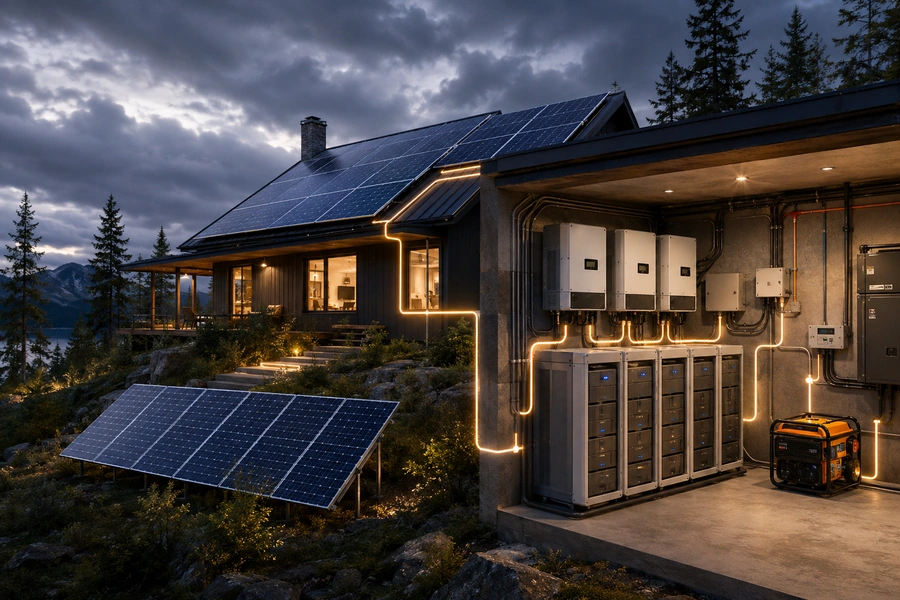
All-in-one energy storage systems are becoming a new standard because they integrate batteries, power conversion, BMS, EMS, monitoring, protection, and often backup functions into one coordinated platform. This integration can simplify installation, improve compatibility, support solar self-consumption, enable intelligent energy management, and create a more scalable solution for homes and businesses.
The trend also reflects a much larger change in electricity systems. Battery storage is now the fastest-growing power technology, with 108 GW of new capacity deployed globally in 2025, according to the IEA. As storage becomes more common, the focus is shifting from simply installing batteries to creating integrated energy-management systems.
What Is an All-in-One Energy Storage System?
A battery alone stores electricity. An all-in-one ESS combines storage with the equipment required to control and use that electricity effectively.
An all-in-one energy storage system integrates battery storage with major supporting components such as a BMS, inverter or PCS, EMS, monitoring, thermal management, electrical protection, and communications. Depending on the application, it can connect solar PV, the utility grid, household or commercial loads, backup circuits, and other distributed energy resources.
A simplified architecture is:
Solar + Grid → All-in-One ESS → Loads
Inside the system:
Battery + BMS + PCS/Inverter + EMS + Protection + Monitoring
The battery provides:
energy storage.
The inverter or PCS provides:
power conversion.
The BMS provides:
battery monitoring and protection.
The EMS provides:
operating decisions.
This integration is important because modern energy storage is no longer only about storing electricity.
The real objective is to control:
where energy comes from, where it goes, and when it should be used.
The U.S. Department of Energy describes storage as a way to capture electricity when supply is high and release it when demand increases, helping balance the electrical system and support variable energy resources.
An all-in-one ESS takes this principle and packages more of the required hardware and controls into a coordinated platform.
Why Is Integration Becoming So Important in Energy Storage?
As solar, batteries, EV charging, smart loads, and backup requirements increase, the number of components that need to communicate also increases.
Integration matters because energy storage performance depends on batteries, power electronics, controls, protection, and monitoring working together. An all-in-one architecture reduces interfaces between separately selected components, making it easier to coordinate charging, discharging, renewable generation, grid interaction, backup reserve, and energy consumption through one system.
Consider a traditional architecture:
Solar Inverter → Battery Inverter → Battery → Controller → Monitoring → Backup Equipment
Each component may require separate:
configuration,
communication,
compatibility checks,
firmware,
monitoring,
and:
installation work.
Now compare an integrated architecture:
Solar + Grid → All-in-One ESS → Loads
Much of the system complexity still exists.
It has not disappeared.
Instead, more of that complexity has moved inside a pre-engineered platform.
This is a critical distinction.
The main advantage of an all-in-one ESS is not simply that it looks cleaner.
Its deeper advantage is that:
battery + inverter + controls + monitoring
can be designed to operate together from the beginning.
That can reduce integration friction and simplify system-level energy management.
How Do All-in-One Energy Storage Systems Simplify Installation?
Installing several independent energy devices can require additional wiring, communications, protection, and commissioning.
All-in-one energy storage can simplify installation by combining major storage, power-conversion, control, monitoring, and protection functions within a coordinated system. Fewer external interfaces can reduce compatibility work, communication connections, and equipment coordination, although electrical design, permitting, interconnection, protection, and code-compliant installation are still required.
Think of a conventional system as several boxes:
Battery
*
Inverter
*
BMS
*
Controller
*
Monitoring
*
Backup Interface
An integrated product may consolidate many of these functions.
That can reduce the number of equipment interfaces an installer must coordinate.
It may also simplify commissioning because the system manufacturer has already defined how core components communicate.
For homeowners and businesses, this can create another advantage:
centralized monitoring.
Instead of opening different platforms to check:
solar production,
battery SOC,
grid import,
load consumption,
and:
backup status,
an integrated ESS may display them through one interface.
However, “all-in-one” should never be interpreted as:
plug in anywhere with no engineering required.
Grid-connected energy storage remains electrical infrastructure.
System location, wiring, protection, interconnection, installation codes, and equipment ratings still matter.
How Does an All-in-One ESS Improve Solar Energy Use?
Solar generation often peaks at a different time from electricity demand.
An all-in-one ESS can improve solar self-consumption by storing surplus PV electricity during high-production periods and releasing it later when solar output falls. By coordinating solar generation, battery SOC, household or commercial demand, and grid exchange, the system can shift renewable electricity from when it is generated to when it is more useful.
DOE explains that solar energy is not always produced when energy is needed most and that storage allows solar electricity to be used at a different time from when it was generated.
Consider a home producing:
30kWh/day of solar electricity.
Direct daytime consumption:
14kWh
Potential surplus:
30 – 14 = 16kWh
Without storage, that surplus may be exported or otherwise handled according to the local tariff and system configuration.
With storage:
Solar → Battery
Later:
Battery → Home
Suppose the battery captures:
10kWh
of surplus solar.
That electricity can potentially serve evening loads that would otherwise require grid electricity.
This is called:
energy shifting
or:
time shifting.
The same principle applies at larger commercial scales.
Storage does not create additional solar electricity.
It makes existing solar generation more flexible in time.
NREL research has also examined combinations of residential solar, storage, and controllable loads, showing how coordinated solar-plus technologies can increase solar self-consumption and improve system economics under certain tariff structures.
Why Is Smart Energy Management a Major Advantage?
The value of a battery depends on more than its capacity. The system must decide when stored energy should be used.
Smart energy management allows an all-in-one ESS to coordinate battery SOC, renewable generation, electricity demand, grid conditions, tariffs, backup reserve, and potentially forecasts. Instead of following a simple charge-discharge schedule, the system can allocate limited battery capacity according to solar self-consumption, peak reduction, backup readiness, or other operating priorities.
Imagine a:
20kWh battery.
The owner wants to reserve:
5kWh
for emergencies.
The remaining capacity may be used for:
solar shifting,
peak management,
or:
time-of-use optimization.
The EMS must therefore decide:
Charge now?
Discharge now?
Save energy for later?
Maintain backup reserve?
This changes the role of the battery.
A traditional battery is primarily:
stored energy.
A smart integrated ESS becomes:
stored energy + automated decision-making.
That distinction becomes more important as homes and businesses add:
EV chargers,
heat pumps,
electric water heating,
smart appliances,
and:
other flexible electrical loads.
The IEA notes that electricity systems increasingly need flexibility as variable solar and wind expand alongside concentrated loads such as EVs and heat pumps.
How Do All-in-One Systems Improve Backup Power?
Energy storage can maintain electricity for selected loads when normal grid supply fails, provided the system is designed for islanded backup operation.
An all-in-one ESS can simplify backup power by coordinating battery storage, inverter operation, transfer or isolation functions, monitoring, and energy management within one platform. During an outage, a properly configured system can disconnect from the grid and supply designated loads using stored battery energy and, in compatible solar-plus-storage systems, available solar generation.
DOE explains that solar panels alone generally do not provide resilience during a grid outage because conventional grid-connected PV systems shut down for safety. Properly configured inverters and storage are needed to support islanded operation.
The difference can be illustrated as:
Solar Only + Grid Outage → Solar may shut down
versus:
Solar + Compatible ESS + Islanding → Backup Loads
Suppose a system has:
15kWh usable battery energy.
Average critical load:
500W
Simplified theoretical runtime:
15kWh ÷ 0.5kW = 30 hours
At:
1.5kW
the same battery provides:
15 ÷ 1.5 = 10 hours
before considering conversion losses and other operating constraints.
This illustrates an important rule:
Battery kWh determines energy availability.
Inverter kW determines instantaneous power capability.
An integrated system needs both values to match the backup objective.
Are All-in-One Energy Storage Systems More Scalable?
Energy requirements can change as users add solar panels, EVs, heat pumps, equipment, or new electrical loads.
Some all-in-one ESS platforms combine integrated controls with modular battery expansion, allowing users to increase storage capacity while maintaining a coordinated system architecture. Scalability can make the system more adaptable to future electrification, but expansion limits, inverter ratings, battery compatibility, communications, and manufacturer requirements should be verified before installation.
All-in-one and modular are not opposites.
A system can be:
integrated
and:
expandable.
For example, an integrated platform might start with:
10kWh
and later support:
20kWh
or:
30kWh
using compatible modules.
This can be useful when a household initially has:
solar + normal household loads
but later adds:
EV charging + heat pump.
However, increasing battery capacity does not necessarily increase inverter power.
A system may expand from:
10kWh → 20kWh
while still having:
5kW inverter output.
Therefore:
more kWh ≠ automatically more kW.
Users should consider both future:
energy requirements
and:
power requirements.
Do All-in-One ESS Reduce Energy Costs?
Integrated storage can improve how electricity is consumed, but savings depend heavily on tariffs and operating conditions.
An all-in-one ESS may reduce electricity costs by increasing solar self-consumption, shifting energy between lower- and higher-cost periods, and managing peak demand. However, actual savings depend on local electricity tariffs, export compensation, system efficiency, battery degradation, equipment cost, financing, load patterns, and the available operating strategy.
Consider a simplified tariff:
Off-peak electricity = $0.15/kWh
Peak electricity = $0.40/kWh
The nominal difference is:
$0.25/kWh
A battery could potentially charge during a lower-cost period and discharge during a higher-cost period where permitted.
But the $0.25 difference is not automatically profit.
Storage has:
conversion losses,
battery degradation,
capital cost,
and:
auxiliary consumption.
For solar homes, another calculation matters:
export solar now
versus:
store solar and avoid purchasing electricity later.
That comparison can vary dramatically by utility.
This is why I would not claim that an all-in-one ESS always lowers electricity bills.
Its financial value depends on the local energy market and how intelligently the system is operated.
Why Is LFP Becoming Common in Integrated Energy Storage?
Stationary storage places different priorities on battery chemistry than mobile applications such as electric vehicles.
Lithium iron phosphate, or LFP, has become a dominant chemistry in battery storage because it offers a useful combination of cost, cycling characteristics, and suitability for stationary applications. The IEA reports that LFP represented around 90% of battery-storage deployments in 2025, although complete system design remains critical to performance and safety.
LFP is a:
lithium-ion chemistry.
Therefore, the correct comparison is not:
LFP vs. lithium-ion.
It is:
LFP vs. other lithium-ion chemistries.
Stationary systems generally have less pressure to minimize every kilogram of battery weight than EVs.
That allows designers to place greater emphasis on:
cost,
cycling,
thermal characteristics,
and:
stationary service life.
But chemistry should not be used as a substitute for complete safety engineering.
An LFP system still needs:
BMS protection,
thermal management,
electrical protection,
appropriate enclosure design,
and:
correct installation.
Are All-in-One Energy Storage Systems Safer?
Integration can improve coordination between protection systems, but safety depends on the complete product and installation.
An all-in-one ESS can integrate battery monitoring, thermal management, electrical protection, fault controls, and communications within one engineered platform. However, integration alone does not guarantee safety. System certification, battery quality, BMS performance, enclosure design, fire behavior, installation location, electrical protection, and applicable codes remain essential.
UL 9540 is an important system-level standard for energy storage systems and equipment in North America. UL notes that residential ESS requirements can involve certification and installation requirements under relevant codes and standards.
Fire testing is also evolving.
UL 9540A remains an established thermal-runaway fire-propagation test method, while UL has also developed UL 9540B specifically around large-scale fire testing considerations for residential ESS of 20kWh or less.
The important distinction is:
Battery cell safety ≠ complete ESS safety.
A complete system includes:
cells,
modules,
BMS,
inverter,
electrical protection,
thermal controls,
enclosure,
installation,
and:
operating software.
All of these layers matter.
Why Are All-in-One Systems Important for EVs and Home Electrification?
The electrification of transport and heating is increasing both household energy consumption and instantaneous power demand.
All-in-one energy storage can help coordinate EV charging, solar generation, household demand, and battery power instead of allowing each load to operate independently. Intelligent control can prioritize direct solar use, schedule flexible charging, reduce simultaneous grid peaks, and preserve battery reserve according to the user's energy-management strategy.
Imagine:
EV charger = 7kW
Heat pump = 3kW
Cooking = 3kW
Other household load = 2kW
Total:
15kW
If everything operates simultaneously, grid demand can become high.
An integrated EMS could instead:
delay EV charging,
use available solar,
discharge the battery during a peak,
or:
shift another flexible load.
This illustrates an important principle.
The solution to electrification is not always:
install a bigger battery.
Sometimes it is:
coordinate loads more intelligently.
That is one reason all-in-one architecture matters.
It provides a central control point for increasingly complex energy flows.
What Are the Limitations of All-in-One Energy Storage Systems?
Integration has advantages, but it also introduces tradeoffs that should be considered before choosing a system.
Potential limitations of all-in-one ESS include ecosystem dependence, proprietary communications, expansion restrictions, inverter power limits, upfront cost, battery degradation, conversion losses, and reduced flexibility to replace individual components. Buyers should compare not only battery capacity but also inverter power, usable energy, expansion options, warranty, software support, and system certification.
Suppose an integrated system contains:
20kWh battery
and:
6kW inverter.
It may store enough energy for many hours of moderate consumption.
But it cannot continuously supply:
10kW
simply because the battery contains 20kWh.
Likewise, a highly integrated system may require compatible expansion batteries.
A third-party battery might not communicate correctly with its:
BMS,
EMS,
or:
inverter.
Integration therefore creates both:
simplicity
and:
ecosystem dependence.
The right choice depends on whether the user prioritizes:
simplicity,
flexibility,
expandability,
serviceability,
or:
component independence.
My Insights: Why Are All-in-One Energy Storage Systems Becoming the New Standard
The strongest trend is not simply toward larger batteries. It is toward storage systems that combine hardware, power electronics, software, and energy management into one coordinated architecture.
All-in-one energy storage systems are becoming a new standard because energy storage increasingly needs to perform several jobs simultaneously. Integrated platforms can coordinate batteries, solar, grid power, loads, backup, and smart controls while simplifying system architecture. As renewable generation and electrification expand, this integrated approach becomes increasingly valuable.
My First Insight: Integration Is Replacing Fragmentation
The old approach often looks like:
Battery + Inverter + Controller + Monitoring + Backup Equipment
The integrated approach becomes:
One Coordinated Energy Platform
The components still exist.
But their relationships are designed together.
That is the real advantage.
My Second Insight: Software Is Becoming as Important as Battery Hardware
Battery capacity answers:
How much energy can I store?
Software answers:
When should I use it?
A sophisticated EMS can coordinate:
solar,
battery SOC,
loads,
backup reserve,
electricity prices,
and:
EV charging.
As systems become more complex, that decision-making becomes increasingly important.
My Third Insight: Storage Is Moving From Backup to Daily Energy Management
A traditional backup battery might wait for an outage.
Modern storage can operate every day.
It can:
store midday solar,
serve evening loads,
manage peaks,
coordinate EV charging,
and:
maintain emergency reserve.
DOE and IEA both describe storage as an important flexibility resource for balancing supply and demand and integrating variable renewable electricity.
My Fourth Insight: The New Standard Will Be Defined by the Complete System
I would not compare integrated ESS products using:
battery kWh alone.
The more useful framework is:
Battery Capacity + Inverter Power + BMS + EMS + Safety + Expansion + Monitoring + Compatibility
A 20kWh system with poor controls or inadequate inverter output may be less useful for a particular application than a smaller system whose complete architecture matches the load.
My Fifth Insight: Why Are All-in-One Energy Storage Systems Becoming the New Standard?
This directly answers the H1.
| Energy Storage Requirement | Why All-in-One ESS Fits |
|---|---|
| Battery Storage | Integrates energy capacity into one platform |
| Power Conversion | Coordinates inverter/PCS operation with the battery |
| Solar Integration | Stores surplus renewable electricity for later use |
| Smart Energy Management | Uses EMS controls to determine when energy should move |
| Backup Power | Coordinates stored energy with compatible outage operation |
| Peak Management | Discharges battery energy during high-demand periods |
| EV Integration | Helps coordinate charging with solar, grid, and household loads |
| Monitoring | Centralizes energy-flow and system-status information |
| Installation | Reduces separate component interfaces |
| Expansion | Some platforms support modular capacity growth |
| Safety | Allows protection and monitoring functions to be engineered together |
The underlying transition can be summarized as:
Old Energy Storage
Battery → Store Electricity
versus:
All-in-One Energy Storage
Generate → Store → Convert → Monitor → Optimize → Protect → Use
That difference matters because electricity systems are becoming more dynamic.
The IEA reported that global battery-storage deployment reached 108GW of new capacity in 2025, up 40% from 2024, while installed capacity had grown to eleven times its 2021 level. Around 20% of new battery capacity in 2025 was behind the meter in commercial and residential applications.
At the same time, solar, wind, EVs, heat pumps, and other electrified loads are increasing the need for flexibility. The IEA identifies batteries as a versatile tool that can shift renewable generation, balance power systems, support security of supply, and help integrate new electrical loads.
This creates a logical evolution:
More Renewable Energy → Greater Need for Storage
More Storage → Greater Need for Control
More Electrical Loads → Greater Need for Coordination
More Components → Greater Value From Integration
That is why the future is unlikely to be defined simply by the battery with the highest kWh rating.
The stronger direction is toward systems that can coordinate:
Battery + Inverter + Solar + Grid + Loads + EV + Backup + EMS
through one architecture.
All-in-one energy storage does not mean every component must physically occupy a single enclosure, nor does it mean one design is ideal for every project.
The important idea is functional integration.
When batteries, power electronics, monitoring, protection, and intelligent controls operate as a coordinated platform, energy storage becomes easier to manage and capable of performing more functions.
That combination of integration, intelligence, flexibility, and simplified system architecture is why all-in-one energy storage systems are increasingly positioned to become a new standard for residential and distributed energy management.
Conclusion
All-in-one energy storage is becoming a new standard by integrating batteries, power conversion, smart controls, backup, renewable energy, monitoring, and protection into one coordinated platform.
](https://voltcrave-battery.com/wp-content/uploads/2026/09/How-to-Choose-the-Best-Lithium-Battery-for-Off-Grid-Solar-Power-768x512.webp)
](https://voltcrave-battery.com/wp-content/uploads/2026/09/Off-Grid-Solar-Battery-Storage-How-Do-You-Build-a-Reliable-Power-System-768x512.webp)
](https://voltcrave-battery.com/wp-content/uploads/2026/10/The-Ultimate-Mobile-Power-Guide-10ft-vs.-20ft-Mobile-Battery-Energy-Storage-Systems-768x512.webp)







































