
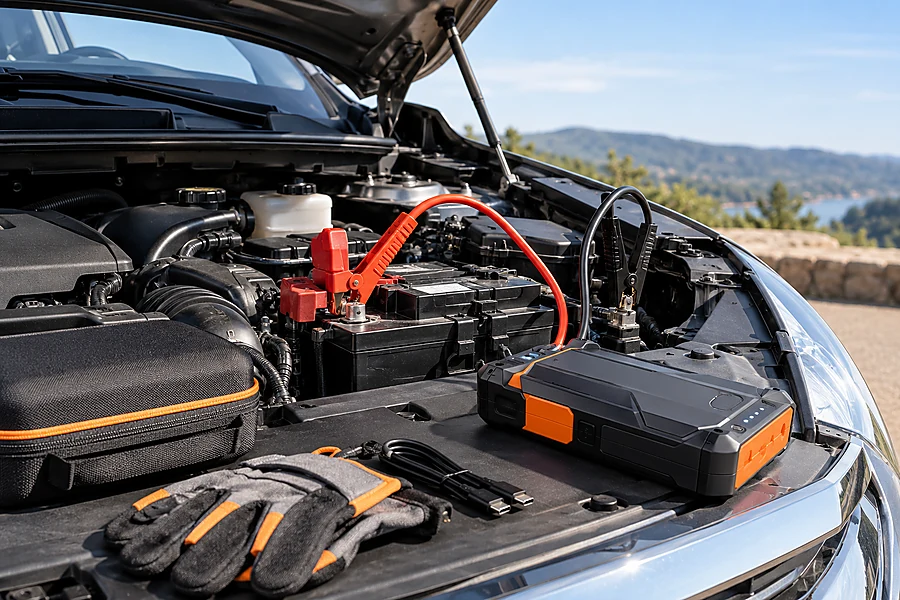
](https://voltcrave-battery.com/wp-content/uploads/2026/10/What-Is-the-Best-Portable-Jump-Starter-Pack.webp)
A dead car battery can leave you stranded without warning, and the wrong jump starter may lack enough power when you need it most.
For most drivers, the Clore Jump-N-Carry JNC325 is one of the strongest all-around portable jump starter choices in 2026 because it combines proven starting performance, long cables, straightforward controls, multiple protection features, and UL 2743 compliance. Smaller cars may need less power, while large gasoline or diesel engines require a stronger unit.
There is no single portable jump starter that is ideal for every vehicle. I would choose one by matching its starting capability to the engine, then checking cable quality, safety protection, battery condition, cold-weather performance, charging speed, portability, and independent testing.
What Is the Best Portable Jump Starter Pack in 2026?
Peak amperage attracts attention, but real-world starting ability involves much more than one headline specification.
Based on current 2026 independent testing, the Clore Jump-N-Carry JNC325 is a strong best-overall choice for typical passenger vehicles, SUVs, pickups, and light-duty applications. Car and Driver selected it as its Best Overall portable jump starter after hands-on testing, citing its cable length, ease of use, and balanced specifications.
Clore specifies the JNC325 with 450 Start Assist Amps, 24-inch cables, #6 AWG output leads, reverse-polarity protection, backfeed protection, over-voltage protection, overheat protection, two USB outlets, a DC outlet, and UL 2743 compliance. It weighs about 4.3 pounds.
This combination matters because a jump starter is an emergency tool.
When a vehicle refuses to start, I care about whether I can:
reach the battery terminals,
attach the clamps securely,
understand what the device is doing,
override low-voltage detection when appropriate,
and crank the engine reliably.
That is more useful than simply buying the product with the largest advertised peak-current number.
For a normal sedan or crossover, however, the JNC325 may offer more capacity and cost than necessary.
NOCO's GB40 is significantly more compact. NOCO rates it at 1,000A peak for 12V lead-acid batteries, with gasoline engines up to 6.0L and diesel engines up to 3.0L. It weighs roughly 2.45 pounds and carries an IP65 enclosure rating.
So I would frame the choice this way:
Best Overall Balance → Clore JNC325
Best Compact Everyday Option → NOCO GB40
Best High-Power Option → GOOLOO GT6000
Best Feature-Rich Alternative → HULKMAN Alpha85
Is the Clore Jump-N-Carry JNC325 the Best Overall Jump Starter?
Independent testing gives the JNC325 a strong case for buyers who want balanced performance rather than the smallest possible unit.
The JNC325 stands out because it combines substantial starting ability with useful 24-inch cable reach, full-size clamps, straightforward controls, an override feature, multiple safety protections, USB power, and UL 2743 compliance. It is larger and more expensive than many compact lithium models, but its design is well suited to serious roadside use.
Car and Driver's May 2026 hands-on comparison selected the JNC325 as Best Overall.
The publication tested jump starters on vehicles with deeply discharged batteries and considered:
weight,
ease of use,
lead length,
clamp quality,
portability,
and additional features.
Its testers highlighted the JNC325's cable length and straightforward operation.
The cable length is easy to overlook.
A powerful battery pack becomes frustrating if the positive and negative connection points are far apart or the battery sits deep inside the engine bay.
Clore provides:
24-inch cable reach
with:
#6 AWG output leads.
The unit also includes an override function.
That can matter because intelligent jump starters may refuse to activate if battery voltage is extremely low. An override function can allow operation in those situations when used according to the manufacturer's instructions.
For me, those practical details make a stronger buying case than the peak-amp specification alone.
Is the NOCO GB40 a Good Portable Jump Starter?
Drivers who want something compact enough to leave in the trunk may prefer the NOCO GB40.
The NOCO Boost Plus GB40 is a compact 12V lithium-ion jump starter rated at 1,000A peak, up to 6.0L gasoline engines and 3.0L diesel engines. It weighs about 2.45 pounds, has IP65 enclosure protection, a 100-lumen flashlight, USB charging capability, and is easier to store than many larger jump packs.
Car and Driver identified the GB40 as its Most Compact choice in its 2026 comparison.
That positioning makes sense.
A jump starter sitting in your garage cannot help much when your battery dies in a parking lot.
For ordinary drivers, portability affects whether the product stays:
in the trunk,
under a seat,
or inside an emergency kit.
NOCO says the GB40 can support gasoline engines up to 6.0L and diesel engines up to 3.0L.
That covers many passenger cars and SUVs.
The GB40 is therefore especially attractive when the priorities are:
compact size + simple storage + mainstream vehicle compatibility.
Its limitation is equally clear.
A large diesel truck or exceptionally large engine may justify stepping up to a more powerful model.
What Is the Best Jump Starter for Large Engines?
Larger engines and diesel applications generally deserve more starting margin than a small four-cylinder gasoline engine.
For large-engine applications, the GOOLOO GT6000 is a high-output option. GOOLOO specifies 6,000A peak current, compatibility with 12V vehicles up to 12.0L diesel and gasoline engines, a 27,000mAh internal power bank, 100W USB-C charging, and a 400-lumen flashlight.
Car and Driver's 2026 tested guide selected the GT6000 as its choice for large engines.
This is where product selection should begin with:
Vehicle → Engine → Battery → Starting Requirement
rather than:
Largest Amp Number → Purchase
A small gasoline sedan does not normally require the same jump-start equipment as:
a large pickup,
diesel truck,
tractor,
RV,
or commercial vehicle.
GOOLOO also specifies 100W bidirectional USB-C charging and a large internal battery.
Those features make it useful as an emergency power bank, but they also increase size and complexity.
More starting capability can be valuable.
It is not automatically better for every driver.
Is the HULKMAN Alpha85 a Good Alternative?
The HULKMAN Alpha85 sits between small minimalist jump starters and larger high-output emergency power packs.
The HULKMAN Alpha85 is rated at 2,000A peak and supports 12V vehicles with gasoline engines up to 8.5L and diesel engines up to 6.0L. It also includes a 74Wh battery, 20,000mAh rated capacity at 3.7V, USB-C and USB-A outputs, a DC output, an information display, and IP65 protection.
HULKMAN specifies the unit at approximately:
2.57 pounds
with:
74Wh
of internal battery energy.
It also supports up to 65W input under its supported fast-charging system, although charging accessories and package contents should be checked for the exact version being purchased.
The screen is one of its practical advantages.
Instead of relying only on a few indicator lights, the display provides battery and operational information.
That can make the device easier for less experienced users to understand during an emergency.
I would consider the Alpha85 particularly when someone wants:
strong starting capability,
portable-device charging,
DC accessory output,
and more detailed status information
in one package.
Is the Clore JNC660 Better for Professional Use?
Portable lithium jump starters are convenient, but professional workshops and fleets sometimes prioritize rugged cables and repeated starting ability over minimum weight.
The Clore JNC660 is a traditional professional-oriented 12V jump starter rated at 1,700 peak amps and 425 cranking amps. It uses 46-inch #2 AWG welding-cable leads, industrial-grade clamps, a built-in automatic charger, and weighs about 18 pounds, making it far less portable but well suited to shop and fleet environments.
This illustrates why the word:
portable
has different meanings.
A 2.5-pound lithium pack can live in a glovebox or trunk.
An 18-pound professional jump box is portable in the sense that a technician can carry it from vehicle to vehicle.
Those are different use cases.
For an everyday commuter, I would generally prefer the smaller lithium pack.
For:
repair shops,
fleet service,
dealerships,
marinas,
and frequent vehicle starting,
the JNC660 architecture may be more appropriate.
Clore specifically positions it for professional and commercial starting environments.
How Many Amps Should a Portable Jump Starter Have?
Peak amps alone do not tell the complete story.
A jump starter should provide enough starting capability for the engine size and battery condition specified by its manufacturer. Small gasoline engines usually require less starting power than large gasoline or diesel engines. Instead of choosing by peak amps alone, compare manufacturer engine ratings, starting-current specifications, cable quality, battery capacity, and independent testing.
Different manufacturers also describe starting performance differently.
NOCO highlights:
peak amps
and:
supported engine displacement.
Clore provides:
Start Assist Amps
for the JNC325 and both:
peak amps + cranking amps
for the JNC660.
This makes headline numbers difficult to compare perfectly across brands.
A product advertising:
4,000A peak
is not automatically four times as useful as a:
1,000A
unit.
Peak current is only one part of the starting event.
Other factors include:
battery voltage under load,
internal battery resistance,
cable resistance,
clamp contact quality,
temperature,
engine size,
engine oil viscosity,
and the condition of the vehicle battery.
I would therefore prioritize the manufacturer's supported engine-size specification and credible real-world testing over the biggest number on the packaging.
What Size Jump Starter Do I Need for My Car?
The ideal jump starter depends first on whether the vehicle uses a 12V starting battery and then on engine displacement.
For a typical gasoline passenger car, a compact unit such as the NOCO GB40 may provide sufficient capability. Larger V6, V8, pickup, SUV, or diesel applications should be matched to a unit with a higher manufacturer engine rating, such as the JNC325, HULKMAN Alpha85, or GOOLOO GT6000.
For example, NOCO rates the GB40 for:
up to 6.0L gasoline
and:
up to 3.0L diesel.
HULKMAN rates the Alpha85 for:
up to 8.5L gasoline
and:
up to 6.0L diesel.
GOOLOO rates the GT6000 for:
up to 12.0L diesel
and broadly covers 12V gasoline-engine applications according to its current product documentation.
The correct sequence is:
Check Vehicle Voltage → Check Engine Size → Check Manufacturer Rating → Compare Features
Do not begin with:
“I want the highest amperage.”
Can a Portable Jump Starter Start a Completely Dead Battery?
Sometimes, but the answer depends on battery condition and the jump starter's design.
Some portable jump starters include a manual or override mode that can help when the vehicle battery voltage is too low for the automatic safety circuit to recognize it. This function should be used only according to the manufacturer's instructions because it may bypass parts of the normal automatic connection-detection process.
During Car and Driver's testing, the JNC325 required use of its override button on a deeply discharged test battery and successfully started the vehicle.
Clore confirms that the JNC325 has an override feature.
This is a useful capability.
However, there is an important difference between:
deeply discharged
and:
physically failed.
A battery with:
internal damage,
a shorted cell,
severe corrosion,
physical swelling,
or other faults
may not be a normal jump-start situation.
A jump starter helps provide temporary cranking power.
It does not repair a failed battery.
Are Lithium Jump Starters Better Than Lead-Acid Jump Starters?
Lithium units dominate the compact consumer category because they can provide high power from a much smaller package.
Lithium jump starters are generally more compact and lighter than traditional lead-acid booster packs, making them easier to store in a vehicle. Traditional lead-acid units can still be attractive for professional environments where ruggedness, long cables, repeated shop use, and established service routines matter more than minimum weight.
Compare two Clore products.
JNC325 lithium:
4.3 pounds.
JNC660:
18 pounds.
That is a substantial portability difference.
But lithium batteries also require careful safety engineering.
CPSC notes that high-energy-density batteries require safeguards against hazards such as overheating, fire, and explosion and should be tested as part of the complete product and charger system.
So lithium provides excellent:
power-to-weight performance.
It does not eliminate the importance of:
quality,
protection circuits,
correct charging,
and safe storage.
What Safety Features Should a Portable Jump Starter Have?
Safety deserves more attention than USB ports or flashlight brightness.
I would look for reverse-polarity protection, short-circuit protection, over-voltage protection, thermal protection, clear status indicators, secure clamps, appropriate charging controls, and credible third-party safety certification where available. UL 2743 is the relevant UL standard covering portable power packs that can include automotive jump-start functionality.
UL Solutions explains that UL 2743 covers portable battery power packs and can include products with a vehicle-booster function.
Clore states that its JNC325 conforms to UL 2743.
This is not merely theoretical.
On September 17, 2026, CPSC warned consumers to stop using specific Hererod PW40 and EW40 jump starters/power banks after reports involving fires and property damage. The warning stated that their internal lithium-ion batteries could ignite or explode.
That does not mean portable jump starters in general are unsafe.
It means safety and manufacturer credibility should be part of the purchasing decision.
Before buying, I would also check current product recalls and safety warnings.
How Long Does a Portable Jump Starter Hold a Charge?
Standby time varies significantly by internal battery, electronics, temperature, age, and manufacturer design.
Portable jump starters can remain useful for months between charges, but owners should not assume a unit stored for a year will still be ready. Battery self-discharge, temperature, age, and standby electronics gradually reduce charge. The safest routine is to inspect and recharge the pack periodically according to the manufacturer's instructions.
HULKMAN, for example, states that its Alpha85 can retain charge for up to 18 months under its specified storage conditions, but also notes that temperature affects self-discharge.
That figure should not be generalized to every jump starter.
A more practical maintenance approach is to:
check the charge indicator regularly,
recharge after use,
recharge before long trips,
and avoid assuming that a device stored indefinitely will remain ready.
Cold weather deserves particular attention.
The exact operating and charging temperature ranges differ among products.
NOCO specifies an operating range for the GB40, while HULKMAN publishes separate operating and storage limits for the Alpha85.
Always use the manufacturer's specification for the specific model.
Is a Jump Starter With an Air Compressor Worth It?
An integrated air compressor can make sense for drivers who want one emergency device instead of separate tools.
A combination jump starter and air compressor is useful when trunk space is limited and the driver wants protection against both a discharged battery and low tire pressure. However, combined devices are usually larger and more complex, so buyers should compare compressor performance and jump-start performance separately rather than assuming an all-in-one product excels at both.
The buying decision is essentially:
Separate Tools
versus:
Integrated Emergency Tool.
Separate tools can offer:
better specialization,
easier replacement,
and potentially higher individual performance.
An integrated device can reduce:
storage space,
number of chargers,
and number of emergency items in the vehicle.
Neither architecture is universally better.
For an everyday emergency kit, convenience may win.
For professional or frequent use, I often prefer dedicated equipment.
Can a Jump Starter Also Work as a Power Bank?
Many lithium jump starters can charge phones and other portable electronics.
USB power-bank functionality is now common in portable lithium jump starters. The HULKMAN Alpha85 offers USB-A and USB-C output, the GOOLOO GT6000 supports high-power USB-C charging, and the Clore JNC325 includes two USB outputs. These functions add convenience but should remain secondary to reliable starting performance and safety.
A large internal battery can be useful during:
road trips,
power outages,
camping,
and roadside emergencies.
But I would not choose a jump starter primarily because it has:
more USB ports.
Its primary job is:
Start the Vehicle.
Everything else is secondary.
How Should You Choose a Portable Jump Starter?
Start with compatibility and starting performance, then compare convenience features.
Choose a jump starter by checking vehicle voltage, engine size, manufacturer engine rating, starting capability, cable reach, clamp quality, manual override, battery capacity, operating temperature, safety protections, charging speed, size, weight, warranty, and independent testing. Avoid choosing only by the largest advertised peak-current number.
My comparison checklist is:
| Factor | Why It Matters |
|---|---|
| Vehicle voltage | Must match the starting system |
| Gas/diesel engine rating | Indicates intended engine range |
| Starting performance | Determines whether it can crank the engine |
| Cable length | Affects battery-terminal access |
| Clamp quality | Affects electrical connection |
| Override mode | Useful for deeply discharged batteries |
| Safety protection | Reduces connection and fault risks |
| Certification | Adds third-party safety verification |
| Operating temperature | Important for winter use |
| Battery capacity | Affects reserve and accessory use |
| Charging speed | Determines readiness after use |
| Size and weight | Determines whether you will actually carry it |
| USB/DC outputs | Adds emergency utility |
| Warranty/support | Important if the battery or electronics fail |
The ideal product is not:
Maximum Specification.
It is:
Enough Starting Capability + Reliable Design + Appropriate Safety + Useful Portability.
My Insights: How Should I Evaluate Portable Jump Starters
A portable jump starter is an emergency tool, so dependable starting performance should outweigh impressive marketing specifications.
I would first match the jump starter to the vehicle, then evaluate cables, clamps, override capability, temperature limits, safety protection, certification, portability, and independent test results. Peak amperage matters, but it should never be treated as the only measure of quality or real-world starting performance.
My First Insight: Peak Amps Should Not Be the Only Buying Metric
Peak-current numbers are easy to market.
Real starting performance also depends on:
battery quality,
voltage under load,
cables,
clamps,
temperature,
and engine conditions.
I would therefore use peak amps as one screening metric rather than a complete quality score.
My Second Insight: Cable and Clamp Design Matter More Than Many Buyers Expect
The jump starter must transfer current from its internal battery to the vehicle starter circuit.
Poor access or weak connections can reduce the usefulness of otherwise powerful electronics.
This is one reason the JNC325's 24-inch cable reach was a meaningful advantage in independent testing.
My Third Insight: A Jump Starter Is Only Useful If It Is Charged
The strongest pack in the market is useless if its internal battery is empty.
I would:
check it periodically,
recharge after use,
keep it within recommended temperatures,
and check it before long trips.
Emergency equipment needs maintenance too.
My Fourth Insight: Safety Certification Deserves More Attention
Portable jump starters contain high-energy batteries capable of delivering very large currents.
UL 2743 specifically covers portable power packs that may provide automotive boosting capability.
Recent CPSC warnings also demonstrate why recall history and battery safety should not be ignored.
My Fifth Insight: What Is the Best Portable Jump Starter Pack?
For most drivers, the Clore Jump-N-Carry JNC325 is one of the strongest overall portable jump starter choices in 2026 because independent testing found a good balance of starting performance, cable reach, usability, portability, and features, while Clore specifies UL 2743 compliance and multiple electrical protections. The best individual choice still depends on vehicle size and intended use.
For different needs, I would summarize the market this way:
Clore JNC325 → Best Overall Balance
NOCO GB40 → Best Compact Everyday Choice
GOOLOO GT6000 → Best for Large Engines
HULKMAN Alpha85 → Best Feature-Rich Alternative
Clore JNC660 → Best for Traditional Professional/Shop Use
The selection process should be:
Vehicle Voltage → Engine Size → Starting Capability → Safety → Cable Design → Portability → Extra Features
not:
Highest Peak Amps → Buy.
Conclusion
The best portable jump starter matches your vehicle, starts reliably, has strong safety protection, and remains easy to keep charged and stored for emergencies.
](https://voltcrave-battery.com/wp-content/uploads/2026/08/What-Is-an-Energy-Management-Backup-Unit-for-Telecom-Base-Stations-768x512.webp)
](https://voltcrave-battery.com/wp-content/uploads/2026/09/Off-Grid-Solar-Battery-Storage-How-Do-You-Build-a-Reliable-Power-System-768x512.webp)
](https://voltcrave-battery.com/wp-content/uploads/2026/10/What-Is-the-Highest-Power-Battery-768x512.webp)







































