
](https://voltcrave-battery.com/wp-content/uploads/2026/10/What-Is-the-Best-Electricity-Backup-System-for-My-Home.webp)
Power outages can stop refrigeration, internet, HVAC, pumps, and essential electronics, while an undersized backup system may fail when household demand suddenly increases.
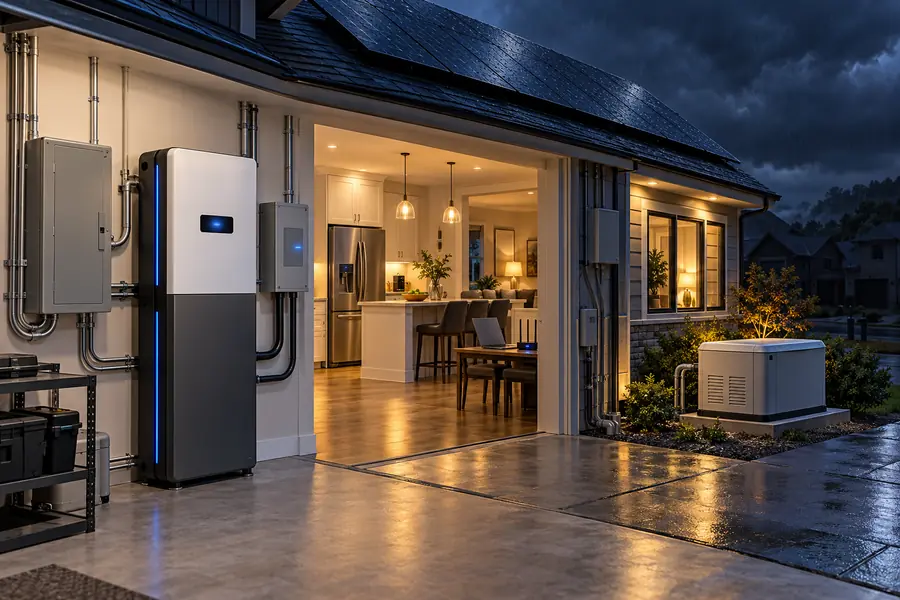
For most homes, a professionally installed LFP battery with automatic backup switching is the best all-around electricity backup system. Pairing it with solar improves resilience by recharging the battery during daylight. For frequent multi-day outages, adding a natural-gas or propane standby generator usually provides stronger long-duration protection than relying on battery storage alone.
Choose batteries for quiet backup, solar batteries for daytime recharging, generators for extended outages, or hybrid systems for maximum resilience, based on power and duration.
What Is the Best Overall Electricity Backup System for a Home?
The largest battery or generator is not automatically the best system because every household has a different outage profile.
For most homeowners, a fixed LFP home battery provides the strongest balance of automatic operation, quiet performance, low routine maintenance, solar compatibility, and everyday energy management. A generator becomes increasingly valuable when outages regularly last multiple days, while combining battery storage, solar, and generation offers the strongest option for homes requiring very high resilience.
A modern home battery can automatically begin supplying electricity when utility power disappears.
This makes it particularly useful for keeping:
refrigerators,
freezers,
Wi-Fi,
lighting,
security systems,
computers,
medical equipment,
and selected HVAC loads
operating without manually starting equipment.
The U.S. Department of Energy explains that batteries can store electricity for later use and provide backup power during outages. When combined with residential solar, stored solar energy can also be used after sunlight disappears or after the grid goes down.
Current residential batteries demonstrate how much power a single unit can provide.
Tesla Powerwall 3, for example, provides:
13.5 kWh nominal energy
with configurations up to:
11.5 kW continuous AC power.
FranklinWH's current aPower 2 provides:
15 kWh usable energy
10 kW continuous discharge
and:
15 kW peak output for 10 seconds.
It uses LFP chemistry and supports expansion through multiple units.
These products illustrate why battery backup has become practical for much more than lights and electronics.
A properly designed system can potentially operate:
refrigeration,
well pumps,
HVAC,
kitchen appliances,
and other substantial loads.
However, every battery eventually reaches a low state of charge.
That is its main limitation.
A battery provides:
stored energy.
A generator provides:
new electrical energy from fuel.
Generac describes modern standby generators as permanently installed systems that automatically detect an outage and begin supplying electricity within seconds. They typically operate on either natural gas or liquid propane.
That means the best choice depends heavily on outage duration.
For outages lasting:
minutes to several hours
I generally favor:
battery backup.
For outages lasting:
multiple days
a generator or hybrid system becomes increasingly attractive.
For maximum resilience:
Solar + Battery + Generator
offers the strongest combination because the home has three independent energy sources in addition to the grid.
Why LFP Is a Strong Home-Battery Chemistry
LFP, or lithium iron phosphate, is especially well suited to stationary batteries.
Its advantages include:
strong cycling,
favorable thermal characteristics,
competitive cost,
and practical power capability.
Weight matters much less for a battery attached to a garage wall than for:
an EV,
e-bike,
or drone.
That makes LFP's lower energy density less important for residential storage.
But chemistry alone should never determine the system.
The complete backup solution also requires:
BMS controls,
inverters,
switching equipment,
electrical protection,
thermal design,
software,
and correct installation.
How Much Battery Capacity and Power Does a Home Need?
Home-backup systems are frequently oversized or undersized because homeowners confuse energy with power.
Battery energy is measured in kilowatt-hours and determines approximately how long backup can last. Inverter power is measured in kilowatts and determines how many appliances can operate simultaneously. Critical-load backup may need around 10–20 kWh, while longer whole-home backup can require 20–40 kWh or considerably more.
The two most important numbers are:
kWh = How Long
kW = How Much at Once
Suppose your critical household loads average:
1 kW.
For:
10 hours
you theoretically need:
10 kWh.
For:
20 hours
you need:
20 kWh.
Now suppose your outage load averages:
3 kW.
For 10 hours:
3 kW × 10 hours
= 30 kWh.
The required battery becomes much larger.
This is why household size alone cannot determine storage capacity.
A 3,000-square-foot home carefully operating:
refrigeration,
Wi-Fi,
lights,
and one efficient HVAC zone
might consume less backup energy than a smaller house operating:
electric resistance heating,
electric water heating,
cooking appliances,
and multiple large loads.
Critical Loads vs Whole-Home Backup
For many households, the most economical strategy is:
back up essential loads first.
Imagine a home with a 15 kWh battery.
At:
5 kW average demand
the theoretical runtime is:
15 ÷ 5
= 3 hours.
Reduce demand to:
1 kW
and the same battery theoretically lasts:
15 ÷ 1
= 15 hours.
Nothing changed about the battery.
The homeowner changed the load.
This is why load management can sometimes provide more resilience than simply purchasing additional batteries.
Useful backup loads often include:
refrigerator,
freezer,
Wi-Fi,
lights,
medical equipment,
security,
selected outlets,
and limited heating or cooling.
Large discretionary loads may include:
EV charging,
electric dryers,
pool pumps,
electric ovens,
and resistance water heating.
Why kW Matters Just as Much as kWh
Consider two batteries:
| System | Energy | Continuous Power |
|---|---|---|
| Battery A | 20 kWh | 5 kW |
| Battery B | 13.5 kWh | 11.5 kW |
Battery A stores more electricity.
Battery B can operate more electrical load at one time.
This distinction becomes especially important with:
air conditioners,
well pumps,
compressors,
and motors.
Tesla's current Powerwall 3 specifications list 13.5 kWh nominal capacity and up to 11.5 kW continuous output, along with motor-start capability intended for demanding residential loads.
Therefore:
More kWh does not automatically mean stronger backup.
The correct design needs enough:
kWh for duration
and:
kW for appliance demand.
Is Solar Plus Battery Better Than a Generator for Home Backup?
Solar batteries and generators solve different problems, so comparing them as direct substitutes can be misleading.
Solar plus battery is usually better for quiet, renewable backup and everyday energy management, while a generator is stronger for long outages when sufficient fuel remains available. For homes exposed to both frequent short outages and occasional multi-day failures, combining solar, battery storage, and a standby generator can provide greater resilience than either technology alone.
Solar provides a major advantage over battery-only backup:
it can add new energy during the outage.
Without solar:
Battery → House → Battery Depletes
With solar:
Solar → House
and potentially:
Solar → Battery Recharge
The Department of Energy notes that conventional grid-connected solar generally shuts down when utility power disappears for safety.
For solar to continue powering a house during an outage, the system needs suitable inverter controls and storage capable of operating independently from the grid.
This means:
Solar Panels Alone ≠ Reliable Backup System
while:
Properly Configured Solar + Battery = Backup-Capable System.
Imagine a battery begins an outage with:
15 kWh
of usable energy.
The household consumes:
10 kWh overnight.
Without solar, only 5 kWh remains the following morning.
If the solar system can generate enough surplus electricity during the next day to operate household loads and replace much of those 10 kWh, the battery can enter the second night with substantial energy again.
This can dramatically extend resilience.
But solar output depends on:
weather,
season,
shade,
roof orientation,
smoke,
snow,
and array capacity.
Therefore:
Solar + Battery ≠ Unlimited Electricity.
Several poor-solar days can still create an energy deficit.
When a Generator Is Better
A generator does not depend on sunshine.
It converts:
natural gas
or:
propane
into electricity.
Generac notes that standby systems can automatically detect grid failure, supply the home, and shut down after utility power returns.
For a household experiencing:
three-day,
five-day,
or longer outages,
this ability can be extremely valuable.
Its disadvantages include:
fuel dependence,
noise,
engine maintenance,
emissions,
and installation requirements.
This produces a useful comparison:
| Backup System | Strongest Advantage | Main Limitation |
|---|---|---|
| Battery | Quiet automatic backup | Finite energy |
| Solar + battery | Can recharge during outage | Weather dependent |
| Generator | Long runtime with fuel | Fuel, noise, maintenance |
| Battery + generator | Fast backup + long duration | More complexity |
| Solar + battery + generator | Maximum energy diversity | Highest system complexity |
Why Hybrid Backup Can Be Better
A hybrid architecture allows each technology to handle the task it performs best.
During a:
10-minute outage
the battery can handle everything without starting an engine.
During an:
overnight outage
the battery may remain sufficient.
During a:
multi-day outage
solar can recharge the battery during daylight.
If poor weather persists, the generator can provide dispatchable electricity.
This creates:
Battery → Immediate Response
Solar → Renewable Recharge
Generator → Extended Energy Supply
For homes where continuous electricity is critical, that diversity can be more valuable than simply installing a very large battery.
What Safety and Installation Factors Should You Check?
A residential backup system is not just a battery or generator; it becomes part of the home's electrical infrastructure.
Before choosing a backup system, verify system certification, electrical compatibility, transfer equipment, installation location, battery operating limits, generator fuel and exhaust requirements, local permitting, warranty, and expansion options. For U.S. residential battery installations, UL 9540 and UL 9540A are important parts of the current ESS safety framework.
UL describes UL 9540 as the foundational product-safety standard for complete energy storage systems.
UL 9540A is used to evaluate thermal-runaway and fire-propagation behavior under severe failure conditions.
The 2026 edition of NFPA 855 references UL 9540A for relevant fire and large-scale fire testing, and the sixth edition of UL 9540A was published in March 2026.
That means homeowners should evaluate:
the complete ESS
rather than simply asking whether the cells are LFP.
LFP has useful thermal characteristics, but:
LFP ≠ Zero Risk.
Installation design still matters.
Check the Backup Transfer Architecture
A house needs a safe method of separating from the utility grid during an outage.
This prevents the home backup system from energizing utility lines unexpectedly.
The system may use:
a backup gateway,
system controller,
automatic transfer equipment,
or another approved architecture.
This function is central to true home backup.
A battery sitting in a garage without appropriate electrical integration is not automatically a whole-home backup system.
Check Future Expansion
Home electricity consumption can increase after adding:
an EV,
heat pump,
electric water heater,
induction cooking,
or other electrification loads.
A modular battery can make future expansion easier.
Tesla currently supports additional storage expansion around Powerwall 3, while FranklinWH's aPower 2 architecture supports multiple battery units in a residential system.
Expansion is particularly valuable when the homeowner initially backs up only:
essential loads
but later wants:
greater outage duration
or:
whole-home coverage.
Check Warranty and Service
A battery may remain installed for a decade or longer.
Therefore, compare:
warranty years,
throughput limits,
remaining-capacity guarantees,
labor provisions,
installer support,
and replacement availability.
A lower purchase price can become less attractive if service support is weak.
The complete decision should therefore consider:
Purchase Cost + Installation + Maintenance + Fuel + Replacement + Lifetime Energy Throughput
rather than upfront price alone.
My Insights: What Is the Best Electricity Backup System for My Home
Choosing backup equipment without understanding household power and outage duration can create an expensive system that still cannot run essential appliances when the grid fails.
For most homes, I recommend an LFP battery with automatic backup switching as the best all-around electricity backup system. Adding solar improves resilience through daytime recharging, while homeowners facing frequent multi-day outages should add a standby generator. The strongest high-resilience architecture is therefore solar plus battery plus generator, sized around critical loads.
For a typical household, I would begin with:
critical loads first
rather than:
whole-house consumption first.
A practical design sequence is:
Critical Loads → Peak kW → Average kW → Required Hours → Battery kWh → Solar Recharge → Generator Requirement
For short outages and everyday energy management:
Battery
is usually the strongest foundation.
For homes already using solar:
Solar + Battery
creates a more capable system because stored energy can potentially be replenished during an outage. DOE specifically notes that solar-plus-storage can support resilience when properly configured to operate independently from the grid.
For locations where outages frequently last several days:
Battery + Generator
can provide a better balance than simply adding more battery capacity.
And when uninterrupted electricity has particularly high value:
Solar + Battery + Generator
provides the greatest diversity of energy sources.
My preferred hierarchy is therefore:
| Home Requirement | Best-Fit System |
|---|---|
| Short outages | Battery |
| Solar self-consumption + backup | Solar + battery |
| Frequent long outages | Battery + generator |
| Essential loads on a budget | Smaller battery + load management |
| Whole-home backup | Larger battery / multi-battery system |
| Maximum resilience | Solar + battery + generator |
The final answer should not be determined by the biggest advertised battery.
It should be determined by:
how many kilowatts must stay online
and:
how many kilowatt-hours are required until electricity can be replenished.
Conclusion
For most homes, battery backup is the best foundation. Add solar for renewable recharging and generator support when reliable multi-day electricity is essential.
](https://voltcrave-battery.com/wp-content/uploads/2026/08/How-Does-Temperature-Affect-BESS-Battery-Life-768x512.webp)
](https://voltcrave-battery.com/wp-content/uploads/2026/08/What-Are-the-Three-Types-of-Energy-Storage-768x512.webp)
](https://voltcrave-battery.com/wp-content/uploads/2026/10/Who-Is-the-Best-Lithium-Cell-Manufacturer-768x512.webp)