
](https://voltcrave-battery.com/wp-content/uploads/2026/09/Top-5-Applications-of-BESS-Containers-in-Renewable-Energy-Projects.webp)
Solar and wind power are variable. Without storage, renewable electricity can be produced when demand is low and unavailable when demand rises.
The top five applications of BESS containers in renewable energy projects are renewable energy shifting, grid stabilization, peak shaving and demand management, microgrid and backup power, and renewable-powered EV charging. Containerized battery energy storage helps projects store surplus electricity, control power flow, reduce curtailment, and deliver renewable energy when it creates more value.
I see a BESS container as more than a large battery. It is a modular energy platform combining battery storage, controls, thermal management, protection, and power electronics to make variable renewable generation more controllable.
What Is a BESS Container in a Renewable Energy Project?
Renewable projects need a way to separate the time electricity is generated from the time electricity is consumed.
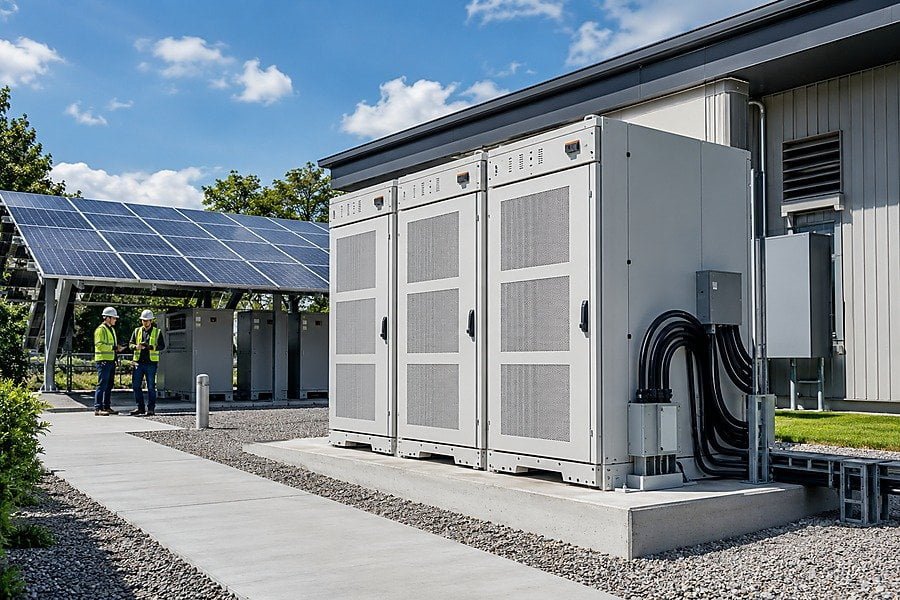
A BESS container is a modular battery energy storage system housed in a purpose-built enclosure. It typically integrates battery cells, modules, racks, BMS, thermal management, fire protection, monitoring, and DC equipment, while working with a PCS and EMS to charge from renewable generation and discharge electricity when required.
A simplified architecture is:
Solar / Wind → PCS → BESS → PCS → Load / Grid
Depending on system design, the PCS may be located inside or outside the battery enclosure.
The battery stores energy in:
kWh or MWh.
The PCS determines charging and discharging power in:
kW or MW.
The BMS protects and supervises the battery.
The EMS determines when charging and discharging should occur.
For example, imagine a solar farm producing:
10MW
while the grid can accept only:
8MW.
Instead of immediately curtailing the remaining:
2MW,
the project may charge a BESS, assuming battery capacity, PCS rating, state of charge, and interconnection conditions allow it.
Later:
BESS → Grid
can return some of that stored energy.
That basic ability—move renewable electricity through time—supports many of the most valuable BESS applications.
Why Are BESS Containers Important for Solar and Wind Projects?
Renewable generation follows environmental conditions rather than electricity demand.
BESS containers make solar and wind generation more flexible by storing surplus energy and releasing it later. Depending on project design and market rules, storage can support energy shifting, renewable integration, frequency response, capacity management, peak reduction, backup power, microgrids, and other grid services while reducing the operational impact of variable generation.
Solar has a predictable daily challenge.
Production usually rises during daylight and falls toward zero after sunset.
Electricity demand does not necessarily follow the same curve.
Wind creates a different challenge.
Generation can change according to:
wind speed,
weather systems,
season,
and:
local conditions.
A BESS creates a controllable resource between renewable generation and the grid.
Instead of:
Renewable Generation → Immediate Consumption
the project can operate as:
Renewable Generation → Battery → Later Consumption
This does not create additional renewable energy.
Storage shifts energy and introduces conversion losses.
But it gives project operators more control over when available renewable energy is delivered.
That distinction is central to understanding the following five applications.
1. How Do BESS Containers Store Excess Solar and Wind Energy?
Energy shifting is one of the most direct applications of battery storage in renewable projects.
BESS containers can charge when solar or wind production exceeds immediate demand or export requirements and discharge that energy later when renewable output falls or electricity demand increases. This time-shifting function can improve renewable-energy utilization, reduce some curtailment, and make variable generation available during more valuable periods.
Consider a solar project.
At midday:
Solar generation = 10MW
Immediate export/load = 7MW
Potential surplus = 3MW
If the BESS can accept:
3MW
for:
2 hours,
the energy charged would be approximately:
3MW × 2h = 6MWh
before considering charging losses and operating limits.
Later in the evening, solar generation falls.
The battery can discharge part of that stored energy.
The energy path becomes:
Midday Solar → BESS → Evening Load/Grid
This is commonly called:
energy shifting
or:
time shifting.
The same concept applies to wind.
A wind farm may produce strongly during a low-demand period.
Storage allows some of that energy to be held for later use rather than requiring generation and consumption to happen at exactly the same time.
Why Does Energy Shifting Matter?
Renewable projects frequently experience mismatches between:
generation profile
and:
demand profile.
BESS reduces that timing constraint.
However, battery capacity must be selected carefully.
A:
10MW / 10MWh
BESS has approximately one hour of nominal duration at rated power.
A:
10MW / 40MWh
system has approximately four hours.
The basic relationship is:
Duration = Energy Capacity ÷ Power
So:
40MWh ÷ 10MW = 4 hours
before considering usable SOC, efficiency, reserve, and degradation.
This is why MW and MWh must always be considered together.
2. How Do BESS Containers Help Stabilize Renewable Energy on the Grid?
Solar and wind output can change faster than conventional demand-management systems would prefer.
BESS containers can respond rapidly to charging and discharging commands, making them useful for grid-support applications associated with variable renewable generation. Depending on the power system and market, BESS can participate in frequency regulation, ramp-rate control, voltage support through appropriate power electronics, renewable smoothing, and other ancillary services.
Imagine cloud cover moves across a solar plant.
PV output falls.
Later, sunlight returns and production rises.
A BESS can be controlled to reduce the rate at which the combined plant output changes.
Conceptually:
Variable Solar Output + Controlled BESS Output = Smoother Plant Output
Suppose solar production suddenly falls by:
2MW.
If the BESS has sufficient power capability and stored energy, it may temporarily discharge to reduce the net change seen at the point of interconnection.
When solar production increases again, the BESS may:
reduce discharge,
stop discharging,
or:
begin charging.
The same principle can be applied to wind.
Why Is Power Rating Important for Grid Support?
Grid-support applications can require rapid power response.
That makes:
MW
particularly important.
A battery may contain:
100MWh
of energy, but if its PCS can deliver only:
10MW,
it cannot suddenly provide:
50MW
of response.
Conversely, a:
50MW / 25MWh
system has substantial power capability but only:
25 ÷ 50 = 0.5 hours
of nominal energy at full output.
Different applications therefore require different power-to-energy ratios.
This is why a BESS optimized for:
fast grid response
may look different from one optimized for:
four-hour solar shifting.
3. How Can BESS Containers Reduce Peak Demand and Improve Energy Management?
Renewable generation and battery storage can work together to reduce power drawn from the grid during high-demand periods.
BESS containers support peak shaving by charging when renewable generation is abundant or electricity demand is lower and discharging when site demand reaches a target threshold. For commercial and industrial renewable projects, this can reduce grid peak demand, increase solar self-consumption, and improve control over when electricity is imported or exported.
Consider a factory with:
normal grid demand = 2MW
afternoon peak demand = 3MW
The facility wants to limit grid import to:
2.2MW.
During the peak:
3MW – 2.2MW = 0.8MW
The BESS could supply:
800kW
assuming sufficient power and energy capacity.
If this support is required for:
2 hours,
energy requirement is approximately:
0.8MW × 2h = 1.6MWh
before losses and reserve.
Now add rooftop or ground-mounted solar.
During midday, solar can:
serve factory loads directly,
charge the battery,
or:
export energy where permitted.
Later:
Solar-Charged BESS → Factory Peak Load
This creates a useful renewable-energy management loop.
What Is the Difference Between Peak Shaving and Energy Shifting?
The concepts overlap, but their objectives differ.
Energy shifting focuses on moving energy from one time to another.
Peak shaving focuses on reducing maximum grid or facility demand.
A BESS can perform both.
However, using battery capacity for one service can reduce capacity available for another.
That is why the EMS becomes important.
It must decide whether stored energy should be reserved for:
peak demand,
backup,
grid services,
or:
another objective.
This is often called value stacking, although actual participation depends on project design, interconnection agreements, tariffs, and market rules.
4. How Are BESS Containers Used in Renewable Microgrids and Backup Power?
Remote and resilience-focused projects need electricity even when renewable production or the utility grid is unavailable.
BESS containers are widely applicable to renewable microgrids because they can store solar or wind energy and supply loads when generation is insufficient. When combined with suitable controls, inverters, switchgear, and other generation sources, BESS can support islanded operation, critical-load backup, renewable self-consumption, and reduced generator runtime.
Consider a remote microgrid containing:
Solar + BESS + Backup Generator + Loads
During daylight:
Solar → Loads
and surplus energy can follow:
Solar → BESS
At night:
BESS → Loads
If the battery approaches its operating limit and solar remains unavailable:
Generator → Loads / BESS
This architecture can reduce dependence on continuously operating fuel generators.
The battery handles short-term and daily energy balancing.
The generator can provide longer-duration backup when required.
How Do You Size a BESS for a Renewable Microgrid?
Start with critical energy demand.
Suppose a remote facility needs:
100kW average critical load
for:
10 hours
without solar.
Required AC energy is:
100kW × 10h = 1MWh
But I would not simply specify a:
1MWh nominal battery.
The design must account for:
inverter/PCS losses,
usable SOC,
battery reserve,
temperature,
degradation,
load growth,
and:
required redundancy.
The PV array must also be able to recharge the battery while serving daytime loads.
This leads to a fundamental microgrid principle:
BESS provides stored energy.
Solar or wind must replace that energy.
A large battery cannot compensate indefinitely for an undersized renewable-generation system.
5. How Do BESS Containers Support Renewable-Powered EV Charging?
High-power EV charging can create large, concentrated electrical loads that do not always align with available grid or solar capacity.
BESS containers can support EV charging sites by storing electricity from solar or the grid and discharging during high charging demand. This can reduce short-duration grid peaks, improve the use of locally generated renewable electricity, and help sites manage charging power where grid connection capacity is constrained.
Consider an EV charging site with:
Grid connection = 500kW
Solar production = 300kW
Peak EV charging demand = 900kW
At a moment when solar is producing its full example output:
500kW grid + 300kW solar = 800kW
Demand is:
900kW
The remaining:
100kW
could theoretically come from the BESS.
Now imagine solar production falls to:
100kW.
Available grid + solar becomes:
500 + 100 = 600kW
The BESS may need to supply:
900 – 600 = 300kW
to maintain the same charging demand.
The system becomes:
Grid + Solar + BESS → EV Chargers
Why Does Battery Duration Matter for EV Charging?
Power alone is insufficient.
Suppose the BESS needs to provide:
300kW
for:
2 hours.
Energy requirement is:
300kW × 2h = 600kWh
before losses and reserve.
If the charging peak lasts only:
15 minutes,
the energy requirement is much smaller:
300kW × 0.25h = 75kWh
This is why actual charging profiles matter when sizing a BESS.
A battery designed for short peak support can have a different kWh-to-kW ratio from a battery intended to support an entire charging hub for several hours.
What Components Make These BESS Applications Possible?
The battery cells alone cannot perform renewable-energy management.
A containerized BESS relies on coordinated battery racks, BMS, PCS, EMS, thermal management, electrical protection, monitoring, communications, and safety systems. The BMS protects battery operation, the PCS controls bidirectional power conversion, and the EMS determines when stored energy should be charged, discharged, or reserved for another application.
A typical architecture can be represented as:
Battery Cells → Modules → Racks → BMS → DC System → PCS → Transformer → Grid
Above that physical power layer sits:
EMS / Plant Controller
The EMS may use information such as:
solar production,
wind generation,
battery SOC,
site demand,
electricity price,
grid command,
and:
forecast data.
The objective is not simply:
charge when possible.
It is to determine when charging or discharging best supports the project's operating strategy.
For renewable projects, software and controls therefore have a major influence on the value produced by the physical battery assets.
How Do MW and MWh Affect BESS Container Applications?
A BESS can be large in energy but small in power, or large in power but relatively short in duration.
MW measures how quickly a BESS can charge or discharge, while MWh measures how much energy it can store. Renewable energy projects need both values because grid response, peak shaving, EV charging, and renewable shifting can require very different combinations of power and duration.
Consider:
| BESS Rating | Nominal Duration | Example Application |
|---|---|---|
| 10MW / 5MWh | 0.5 hour | Fast power support |
| 10MW / 10MWh | 1 hour | Short-duration balancing |
| 10MW / 20MWh | 2 hours | Peak management |
| 10MW / 40MWh | 4 hours | Solar energy shifting |
| 10MW / 80MWh | 8 hours | Longer-duration energy shifting |
The applications in the table are illustrative rather than fixed rules.
A:
10MW / 40MWh
BESS can theoretically discharge:
10MW for four hours.
But it could also discharge:
5MW for eight hours
if the equipment and operating limits permit.
Actual usable duration depends on:
SOC limits,
efficiency,
reserve,
temperature,
degradation,
and:
operating strategy.
This flexibility is one reason containerized batteries can support multiple renewable applications.
Why Are BESS Systems Built in Containers?
Large renewable projects benefit from modular equipment that can be manufactured and integrated in repeatable blocks.
Containerized BESS packages battery equipment and supporting systems into modular enclosures that can simplify transportation, factory integration, site deployment, expansion, and maintenance planning. Modern battery containers are often purpose-built energy-storage enclosures rather than ordinary shipping containers, with designs optimized for thermal management, electrical protection, monitoring, and safety.
Imagine a renewable project needs:
100MWh
of storage.
If a hypothetical battery container provides:
5MWh,
the energy portion of the project might require:
100 ÷ 5 = 20 containers
before considering redundancy, operating reserve, auxiliary equipment, and actual manufacturer architecture.
If the project later expands, additional storage blocks may be added where the electrical and site design supports expansion.
This modular approach can make large projects easier to standardize.
However, a BESS project includes much more than the containers themselves.
A complete site can also require:
PCS equipment,
transformers,
switchgear,
cabling,
communications,
fire-safety infrastructure,
site controls,
foundations,
and:
grid interconnection equipment.
So “containerized” describes the modular packaging architecture, not the entire project.
How Does BESS Reduce Renewable Energy Curtailment?
Storage can capture some renewable generation that would otherwise need to be reduced, although it cannot eliminate every form of curtailment.
When renewable output exceeds export capability or immediate demand, a BESS may charge using some of the available energy instead of allowing it to be curtailed. The stored electricity can then be discharged later, provided the battery has available capacity, sufficient charging power, and a later opportunity to export or serve loads.
Suppose:
Solar production = 50MW
Export limit = 40MW
Potential excess = 10MW
A BESS with at least:
10MW charging capability
could potentially absorb some or all of that excess for a period.
If the condition lasts:
3 hours,
the theoretical energy involved is:
10MW × 3h = 30MWh
A:
10MW / 10MWh
battery could not absorb the full three-hour event.
A:
10MW / 40MWh
battery potentially has much more energy capacity available for that purpose, depending on starting SOC and operating limits.
This demonstrates again why both:
MW
and:
MWh
matter.
Storage cannot capture surplus renewable generation if the battery is already full.
Therefore, forecasting and EMS strategy are important for curtailment management.
How Long Do BESS Containers Last in Renewable Energy Projects?
Battery lifetime depends on how the system is operated rather than simply how many years it has been installed.
BESS container life depends on battery chemistry, temperature, cycle frequency, depth of discharge, C-rate, SOC strategy, cell quality, thermal management, and end-of-life capacity requirements. Renewable projects should therefore evaluate both calendar aging and cycle aging, while long-term projects may use augmentation to maintain required energy capacity.
Consider a BESS performing:
one equivalent full cycle per day.
That represents approximately:
365 EFC per year.
Over:
10 years:
365 × 10 = 3650 EFC
Over:
15 years:
365 × 15 = 5475 EFC
But real battery cycling is rarely this simple.
A system participating in grid services may perform many partial charge/discharge events.
A solar-shifting battery may follow a more predictable daily cycle.
A backup-focused battery may spend long periods near a selected SOC with relatively few deep cycles.
These different applications create different degradation profiles.
Therefore, lifetime should be evaluated in terms of:
years + cycles + energy throughput + remaining capacity
rather than using a single cycle-life number.
My Insights: Top 5 Applications of BESS Containers in Renewable Energy Projects
The most useful way to understand containerized storage is to focus on what problem it solves between renewable generation and electricity demand.
BESS containers create a controllable energy buffer between variable renewable generation and the grid or load. Their five major applications are renewable energy shifting, grid stabilization, peak shaving and energy management, renewable microgrids and backup power, and EV charging support. Each application requires a different balance of MW, MWh, controls, and operating strategy.
My First Insight: The Real Product Is Time Flexibility
Solar and wind produce:
energy.
BESS adds:
timing flexibility.
That distinction is fundamental.
The battery does not create renewable electricity.
Instead, it changes:
when that electricity can be used.
That ability can transform midday solar into evening electricity or nighttime wind into daytime energy.
My Second Insight: Every Application Needs a Different MW-to-MWh Ratio
A fast grid-response battery may need:
high MW
but relatively limited MWh.
A solar-shifting project may need:
high MWh
to sustain discharge for several hours.
An EV charging project may need:
high short-duration power.
A microgrid may prioritize:
longer autonomy.
Therefore, there is no universal “best” BESS container size.
The application should determine the architecture.
My Third Insight: Software Is as Important as Battery Capacity
A battery that charges and discharges at the wrong times can waste valuable capacity.
The EMS determines how stored energy is allocated between:
renewable shifting,
peak shaving,
backup reserve,
EV charging,
and:
grid services.
As projects combine more applications, control strategy becomes increasingly important.
The physical battery provides capability.
The EMS decides how that capability is used.
My Fourth Insight: Containerization Makes Renewable Storage Scalable
Renewable projects can require:
a few MWh
or:
hundreds of MWh.
Containerized architecture allows storage to be organized into repeatable modular blocks.
That supports:
factory integration,
transport,
site expansion,
standardized engineering,
and:
maintenance planning.
But the container is only one part of the complete BESS plant.
My Fifth Insight: Top 5 Applications of BESS Containers in Renewable Energy Projects
This directly answers the H1.
| Top Application | What the BESS Does | Renewable Energy Benefit |
|---|---|---|
| 1. Solar & Wind Energy Shifting | Stores surplus renewable energy and discharges later | Moves generation to higher-demand periods |
| 2. Grid Stabilization | Rapidly adjusts charging/discharging power | Helps manage variable renewable output |
| 3. Peak Shaving & Energy Management | Supplies power during site or grid peaks | Improves control of renewable energy use |
| 4. Microgrids & Backup Power | Stores renewable energy for low-generation or outage periods | Improves resilience and renewable self-consumption |
| 5. EV Charging Support | Supplements grid and solar power during charging peaks | Helps integrate renewable energy with high-power charging |
The common energy flow behind all five applications is:
Renewable Generation → BESS → Controlled Energy Delivery
But each application changes the reason for storing energy.
For solar and wind shifting, the objective is:
move energy through time.
For grid stabilization, the objective is:
control power rapidly.
For peak shaving, the objective is:
reduce maximum demand or manage grid exchange.
For microgrids, the objective is:
maintain energy availability when renewable production or grid power is insufficient.
For EV charging, the objective is:
support concentrated high-power loads while making better use of available renewable generation and grid capacity.
This is why I do not define a BESS container simply as:
a large lithium battery in a box.
A better definition is:
a modular, controllable energy-storage platform that allows renewable electricity to be stored, managed, and delivered according to the needs of the project.
That ability to control both power and time is what makes BESS containers increasingly important across solar farms, wind projects, commercial renewable systems, microgrids, and renewable-powered charging infrastructure.
Conclusion
BESS containers make renewable energy more controllable through energy shifting, grid support, peak management, microgrid resilience, and EV charging integration.
](https://voltcrave-battery.com/wp-content/uploads/2026/10/Which-Is-Better-LiFePO4-or-Lithium-Battery-768x512.webp)
](https://voltcrave-battery.com/wp-content/uploads/2026/09/How-Long-Does-a-Solar-Lithium-Battery-Last-768x512.webp)
](https://voltcrave-battery.com/wp-content/uploads/2026/06/A-Complete-Guide-to-the-Lifespan-of-Lithium-Ion-Solar-Batteries-768x512.jpg)







































