
](https://voltcrave-battery.com/wp-content/uploads/2026/10/What-Is-a-Mobile-Energy-Storage-System.webp)
Power outages and grid constraints can leave critical loads without electricity, while fixed batteries cannot always move to where energy is needed most.
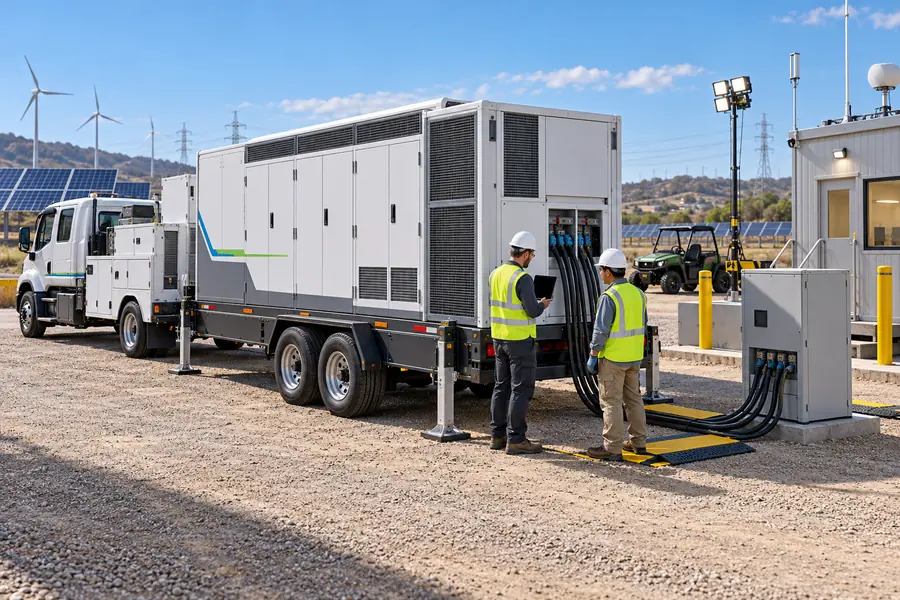
A mobile energy storage system is a transportable battery-based system that stores electrical energy and delivers it where temporary or flexible power is needed. It may be mounted on a trailer, truck, container, or bidirectional electric vehicle, and typically combines batteries, power conversion, controls, protection, thermal management, and connection equipment.
Unlike stationary systems, mobile energy storage transports stored electricity where needed, from portable power stations to trailer-mounted batteries, improving flexibility, reliability, and emergency power access.
What Is a Mobile Energy Storage System and How Does It Work?
A stationary battery can only serve the location where it is installed. During emergencies or temporary projects, that limitation can reduce its usefulness.
A mobile energy storage system, often shortened to Mobile ESS or MESS, stores electricity in batteries and transports that stored energy or power capability between locations. The system is charged from the grid, solar, generators, or other sources, moved where required, connected to the local load or grid, and discharged when electricity is needed.
Sandia National Laboratories describes mobile energy storage as an important grid-edge technology for improving reliability and resilience, particularly as utilities prepare for widespread outages and changing grid conditions.
At its simplest, the operating sequence is:
Energy Source → Mobile Battery → Transport → Local Load or Grid
For example, a mobile battery may charge at a utility facility during low-demand hours.
It can then be transported to:
a construction site,
a commercial building,
a damaged distribution feeder,
an EV charging location,
a temporary event,
or a critical facility.
Once connected, the battery can discharge through its inverter or power conversion system.
The main components normally include:
Battery Cells and Modules
These store the electrical energy.
Battery Management System — BMS
The BMS monitors cell voltage, temperature, current, state of charge, and operating limits.
Power Conversion System — PCS or Inverter
This converts battery DC electricity into usable AC electricity and may support bidirectional charging.
Thermal Management
Air or liquid cooling helps maintain suitable battery temperatures.
Protection Equipment
Fuses, breakers, contactors, isolation monitoring, and emergency controls protect the system.
Energy Management System — EMS
The EMS determines when and how the battery charges or discharges.
Connection Equipment
Cables, switchgear, transformers, connectors, and control interfaces allow the mobile ESS to connect safely to a site.
The operating principle is similar to a stationary BESS.
The main difference is:
mobility.
Instead of buying separate batteries for multiple locations, one mobile asset can potentially serve different sites at different times.
This makes mobile storage especially interesting for utilities and businesses with geographically changing power requirements.
DOE also recognizes bidirectional electric vehicles as mobile battery storage. When paired with compatible bidirectional charging equipment, an EV can discharge power to a building through vehicle-to-building, or V2B, and potentially support the grid through vehicle-to-grid, or V2G, applications.
So:
Mobile ESS is broader than a battery trailer.
It can include several forms of movable electrical storage.
What Types of Mobile Energy Storage Systems Are Available?
The term mobile energy storage covers systems ranging from compact portable batteries to utility-scale transportable BESS units, so the categories should not be treated as interchangeable.
The main mobile energy storage categories include portable power stations, towable battery trailers, truck- or container-mounted BESS, mobile EV-charging systems, and bidirectional electric vehicles. Their energy capacity, output power, voltage, connection method, transportation requirements, and intended applications can differ dramatically.
A useful comparison is:
| Mobile Storage Type | Typical Role | Mobility | Main Application |
|---|---|---|---|
| Portable power station | Small backup loads | Hand-carried or wheeled | Homes, camping, tools |
| Battery trailer | Temporary site power | Towed by vehicle | C&I, construction, events |
| Containerized mobile BESS | Large temporary power | Truck/semi-trailer transport | Utilities, industrial sites |
| Mobile EV charging ESS | Temporary charging | Vehicle/trailer mounted | EV fleets and charging support |
| Bidirectional EV | Transport + energy storage | Self-propelled | V2H, V2B, V2G |
PNNL describes Mobile-ESS as an emerging resilience and emergency-response tool and notes that the market includes commercially available systems, different deployment strategies, and real-world applications.
Portable Power Stations
These are the smallest form.
They typically integrate:
battery,
inverter,
charger,
BMS,
AC outlets,
USB outputs,
and sometimes solar charging.
They are useful for:
homes,
camping,
emergency electronics,
mobile work,
and small appliances.
However, a consumer portable power station should not automatically be considered equivalent to a commercial or utility Mobile ESS.
Towable Battery Trailers
A battery trailer places a larger ESS on a towable platform.
It can be transported between sites and connected when temporary electricity is required.
These systems can replace or reduce generator use for:
construction,
maintenance,
events,
temporary industrial loads,
and emergency response.
Truck- or Container-Mounted BESS
Larger mobile storage systems may use containerized or skid-mounted battery blocks transported by truck.
These systems can support:
utility operations,
microgrids,
critical facilities,
grid maintenance,
temporary substations,
and renewable integration.
Their key advantage is that the battery can serve one site today and another location later.
Sandia's grid-resilience work specifically considers routing mobile energy storage systems before forecast events such as severe storms.
Bidirectional Electric Vehicles
EVs represent another category.
DOE notes that bidirectional vehicles can support building loads and potentially complement:
solar PV,
other distributed energy resources,
and backup generators.
This creates the concept:
Transportation Asset + Energy Storage Asset
inside one platform.
Not every EV supports bidirectional power, so V2H, V2B, or V2G capability must be verified for the specific vehicle and charging equipment.
Where Are Mobile Energy Storage Systems Used and What Benefits Do They Provide?
Fixed batteries are excellent when the power requirement remains at one location, but many energy problems move with emergencies, projects, fleets, and temporary loads.
Mobile energy storage is used for emergency backup, grid resilience, construction power, temporary industrial loads, renewable integration, EV charging, microgrids, peak management, and planned grid maintenance. Its main advantage is flexibility: one battery asset can potentially serve multiple locations instead of remaining permanently installed at a single site.
One important use case is:
Emergency Response.
A major storm can damage electricity infrastructure unevenly.
Some neighborhoods may recover quickly while other locations remain without power.
A mobile battery can be repositioned toward:
critical facilities,
temporary shelters,
communications equipment,
or infrastructure repair sites.
Sandia research has examined Mobile ESS for outage mitigation, pre-placement before storms, and black-start restoration.
Another important application is:
Planned Grid Maintenance.
Utilities sometimes need to disconnect equipment for:
repairs,
upgrades,
or replacement.
A transportable battery can temporarily support loads that would otherwise experience an outage.
Mobile storage can also support:
Peak Shaving.
Suppose a commercial facility only experiences very high demand for several weeks each year.
Installing a permanent battery there may leave an expensive asset underused during the rest of the year.
A mobile battery could potentially support that site during the high-demand period and then move elsewhere.
This creates a key advantage:
Energy Flexibility + Geographic Flexibility.
A stationary battery shifts electricity through:
time.
A mobile battery can potentially shift electricity through:
time and location.
Mobile storage can also support renewable energy.
A temporary microgrid might combine:
Solar + Mobile BESS + Local Loads
to provide power at a remote or temporary location.
DOE describes microgrids as localized systems capable of operating in grid-connected or islanded modes and using distributed energy resources to improve reliability and resilience.
Mobile batteries can become one flexible resource inside that architecture.
Another growing application is:
EV Charging Support.
A business may need charging capacity before permanent grid infrastructure is available.
A mobile battery can potentially supply temporary charging or reduce peak grid demand.
UL now identifies UL 3202 as a safety standard addressing mobile electric-vehicle charging systems integrated with energy storage.
Mobile storage can therefore help with:
temporary charging,
fleet charging,
event charging,
grid-constrained charging sites,
and infrastructure transitions.
Compared with diesel generators, batteries also offer:
quiet operation,
no local exhaust while discharging,
rapid response,
and the ability to recharge from electricity or renewable resources.
However, batteries have finite stored energy.
A diesel generator can continue producing energy while fuel is available.
A mobile battery must eventually recharge.
Therefore:
Mobile BESS ≠ Generator in Every Use Case.
The better solution depends on required:
kW,
kWh,
duration,
recharge opportunity,
transport requirements,
and operating conditions.
What Should You Consider When Choosing or Deploying a Mobile Energy Storage System?
Mobility creates flexibility, but it also introduces transportation, connection, environmental, mechanical, fire-safety, and operating requirements that stationary batteries may not face in the same way.
A Mobile ESS should be selected by evaluating usable kWh, continuous and peak kW, voltage, transport weight, connection method, recharge speed, battery chemistry, thermal management, environmental protection, BMS and EMS controls, grid compatibility, safety certification, local codes, and the frequency with which the system will be transported between sites.
The first distinction is:
kW versus kWh.
kW = Power
kWh = Energy
A:
500 kW / 1 MWh
mobile BESS can theoretically discharge at full rated power for approximately:
2 hours
before accounting for operational limitations.
A:
1 MW / 1 MWh
system has approximately:
1 hour
of nominal duration at full output.
Both store:
1 MWh.
But their power capability differs.
The second consideration is:
Mobility.
A battery becomes more difficult to transport as:
energy increases,
weight increases,
cooling systems grow,
and transformers or switchgear become larger.
This creates an engineering trade-off:
More Energy per Mobile Unit
versus:
Easier Transportation and Deployment.
Connection design also matters.
A genuine mobile ESS should support efficient deployment at the destination.
That may require standardized:
power connectors,
communications,
switchgear,
transformers,
grounding,
protection,
and control interfaces.
Another major consideration is:
Battery Safety.
UL 9540 evaluates ESS at the complete-system level, including charging, discharging, controls, protection, communication, and other system functions.
UL also notes an important distinction when mobile or portable storage is used in a stationary installation: the applicable certification and installation requirements depend on the intended use, and simply combining individually certified components does not create a certified stationary ESS.
In the United States, current ESS requirements continue to evolve. UL notes that the 2026 edition of NFPA 855 and the 2024 International Fire Code include fire and large-scale testing requirements in certain ESS situations.
NFPA lists the current edition of NFPA 855 as:
2026.
This means buyers should not assume:
Mobile = Exempt From ESS Safety Requirements.
The final installation and operating mode determine which requirements apply.
The selection process should therefore be:
Application → Required kW → Required kWh → Runtime → Transport Method → Connection → Recharge → Controls → Safety → Economics
rather than simply:
Choose the Largest Battery Trailer Available.
My Insights: What Is a Mobile Energy Storage System
Fixed batteries can strengthen one site, but emergencies and temporary loads move; without transportable storage, operators may need diesel generators or accept longer outages and costly delays.
A mobile energy storage system is a movable ESS that stores electricity and can be deployed where power is temporarily required. Most systems combine battery modules, BMS, inverter or PCS, thermal management, protection, controls, and standardized connections. Common forms include towable battery trailers, containerized systems, and bidirectional electric vehicles today.
The defining advantage is not simply that the battery has wheels or fits on a trailer. It is that stored electricity becomes geographically flexible.
That makes Mobile ESS especially valuable where power requirements change between:
locations,
seasons,
projects,
maintenance windows,
and emergency events.
A stationary BESS mainly performs:
energy shifting through time.
A Mobile ESS can perform:
energy shifting through time + energy shifting through location.
That is the concept that separates mobile energy storage from conventional fixed battery storage.
Conclusion
Mobile energy storage combines batteries, power electronics, controls, and transportability, allowing stored electricity to support changing locations, temporary loads, emergencies, microgrids, and grid operations.
](https://voltcrave-battery.com/wp-content/uploads/2026/10/Which-Is-Better-a-Power-Station-or-a-Power-Inverter-768x512.webp)
](https://voltcrave-battery.com/wp-content/uploads/2026/09/ESS-Battery-Price-Trends-2026-Cost-Breakdown-ROI-Analysis-768x512.webp)
](https://voltcrave-battery.com/wp-content/uploads/2026/08/How-to-Pick-the-Right-Portable-Power-Station-768x512.webp)







































