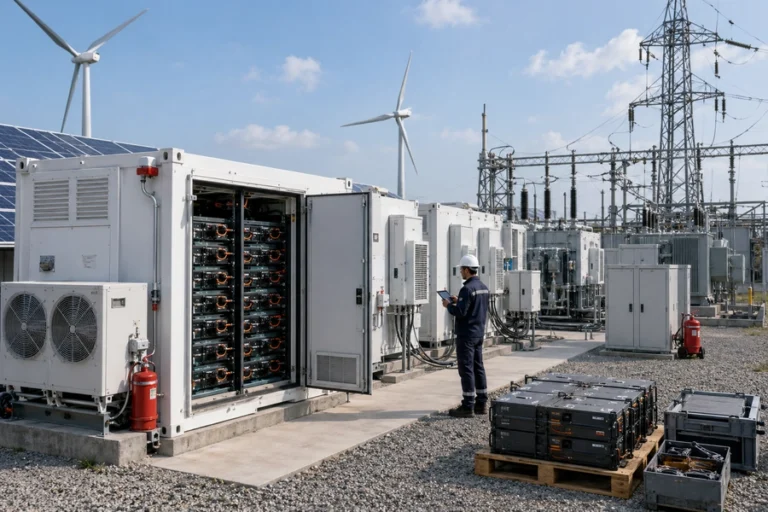
](https://voltcrave-battery.com/wp-content/uploads/2026/09/The-Ultimate-Guide-to-LiFePO4-10-kWh-Systems.webp)
Choosing a 10 kWh battery sounds simple, but voltage, inverter power, usable capacity, solar size, backup loads, and installation design can dramatically change real performance.
A LiFePO4 10 kWh system stores approximately 10 kilowatt-hours of electrical energy using lithium iron phosphate batteries. It can support home solar, backup power, off-grid systems, C&I loads, and other applications. Actual runtime depends on usable battery capacity, inverter efficiency, load power, reserve SOC, temperature, and battery-management settings.
LiFePO4 dominates battery storage, but buyers should focus on matching battery capacity, power output, voltage, inverter size, solar capacity, and load requirements for optimal performance.
What Is a LiFePO4 10 kWh Battery System?
A 10 kWh system is defined primarily by its energy-storage capacity, not by how much instantaneous power it can deliver.
A LiFePO4 10 kWh battery system is a rechargeable lithium iron phosphate energy-storage system with approximately 10 kilowatt-hours of nominal capacity. It usually includes battery cells or modules, a Battery Management System, protection equipment, communications, and connections to a compatible inverter or PCS that converts stored DC electricity into usable AC power.
The first concept to understand is:
kWh = Energy
while:
kW = Power.
A 10 kWh battery does not automatically mean:
10 kW output.
For example, one 10 kWh system might support:
5 kW continuous power
while another might support:
10 kW.
The exact output depends on the battery design, BMS current limit, voltage, inverter, wiring, temperature, and manufacturer specifications.
This distinction determines what the system can actually operate.
A battery may contain enough energy to run a large appliance for several hours but still lack sufficient instantaneous power to start it.
Therefore, a complete 10 kWh system should be evaluated using at least:
Battery Energy + Battery Power + Voltage + Inverter Power + BMS Limits.
How Long Will a 10 kWh LiFePO4 Battery Last?
Runtime depends on the load connected to the battery.
A 10 kWh LiFePO4 battery theoretically supplies a 1 kW load for 10 hours, a 2 kW load for five hours, or a 5 kW load for two hours. Real runtime is shorter because some capacity may be reserved and energy is lost through the battery, inverter, wiring, and other system components.
The basic calculation is:
Runtime = Usable Battery Energy ÷ Average Load
Using the full nominal 10 kWh only for simple illustration:
| Average Load | Theoretical Runtime |
|---|---|
| 250 W | 40 hours |
| 500 W | 20 hours |
| 1 kW | 10 hours |
| 2 kW | 5 hours |
| 3 kW | 3.3 hours |
| 5 kW | 2 hours |
| 10 kW | 1 hour |
Real-world runtime will normally differ.
Suppose a 10 kWh system makes:
9 kWh
available within the selected SOC operating window.
If downstream efficiency were:
90%,
usable AC energy would be approximately:
9 × 0.90 = 8.1 kWh.
At an average:
1 kW load,
that would provide roughly:
8.1 hours
under simplified assumptions.
At:
2 kW,
approximately:
4.05 hours.
This is why runtime estimates should use usable energy rather than simply reading “10 kWh” from the product name.
Is 10 kWh Enough to Power a House?
For some homes, 10 kWh is substantial. For others, it is only a few hours of energy.
A 10 kWh battery can provide meaningful home backup when critical loads are carefully selected, but whether it is enough depends on household electricity consumption. Refrigeration, lighting, internet, electronics, and selected outlets may operate for many hours, while air conditioning, electric heating, water heating, cooking, or EV charging can drain 10 kWh much faster.
Consider a critical-load profile averaging:
500 W.
Theoretical runtime:
10 ÷ 0.5 = 20 hours.
Now consider a home averaging:
2 kW.
Theoretical runtime falls to:
10 ÷ 2 = 5 hours.
At:
5 kW
it becomes only:
2 hours.
The important design question is therefore not:
“Can 10 kWh power my house?”
It is:
“Which loads must the 10 kWh battery power, and for how long?”
For backup applications, I prefer to separate loads into:
Critical Loads
and:
Non-Critical Loads.
Critical loads might include refrigeration, internet, communications, essential lighting, medical equipment where applicable, security equipment, and selected outlets.
Large discretionary loads can remain disconnected during an outage.
This can dramatically extend runtime without increasing battery capacity.
What Does 51.2V 200Ah Mean for a 10 kWh LiFePO4 Battery?
Many nominal 10 kWh LiFePO4 batteries use a 51.2V architecture.
A 51.2V 200Ah LiFePO4 battery stores approximately 10.24 kWh of nominal energy because energy equals voltage multiplied by amp-hours. The 51.2V figure commonly corresponds to a 16-cell-series LFP architecture using approximately 3.2V nominal voltage per cell, although exact system design varies by manufacturer.
The energy calculation is:
51.2 V × 200 Ah = 10,240 Wh
or:
10.24 kWh.
This is why many products marketed as:
10 kWh batteries
are technically rated around:
10.24 kWh.
Similarly:
51.2 V × 100 Ah = 5.12 kWh
and:
51.2 V × 300 Ah = 15.36 kWh.
However, nominal energy is not necessarily usable AC energy.
You still need to consider:
SOC limits,
BMS restrictions,
inverter losses,
temperature,
and:
reserve capacity.
The voltage also matters for current.
At the same power:
Higher Voltage → Lower Current.
That becomes particularly important as inverter power increases.
Why Are 48V and 51.2V Common in LiFePO4 Systems?
These voltage classes offer a practical balance between energy capacity, inverter compatibility, and current.
Many residential and small commercial LiFePO4 systems use nominal 48V-class battery architectures, with 51.2V common for LFP because sixteen approximately 3.2V nominal cells in series produce 51.2V. This voltage range reduces current substantially compared with 12V or 24V systems when supplying several kilowatts of power.
Power follows:
P = V × I.
Ignoring losses, a:
5,000 W
load at:
12V
requires approximately:
5,000 ÷ 12 = 417 A.
At:
24V
it requires:
5,000 ÷ 24 = 208 A.
At:
51.2V
it requires:
5,000 ÷ 51.2 ≈ 98 A.
That difference is enormous.
High current increases requirements for:
cable size,
busbars,
fuses,
contactors,
connectors,
and:
thermal management.
This is why large energy-storage systems generally move away from 12V architectures.
For a 10 kWh stationary battery paired with a multi-kilowatt inverter, a 48V-class architecture is much more practical than trying to move the same power at 12V.
What Size Inverter Do You Need for a 10 kWh LiFePO4 Battery?
Battery energy capacity does not determine inverter size by itself.
The correct inverter size for a 10 kWh LiFePO4 battery depends on maximum simultaneous AC load, surge requirements, battery discharge limits, system voltage, and whether the inverter also manages solar charging. Common systems may use several kilowatts of inverter capacity, but the inverter must remain compatible with the battery's BMS and continuous discharge capability.
Suppose your loads are:
Refrigerator = 200 W
Lighting = 300 W
Electronics = 300 W
Water pump = 1,000 W
Other loads = 700 W
Total simultaneous load:
2.5 kW.
A 5 kW inverter may provide useful headroom.
But now suppose the home also needs:
Air conditioning = 3 kW
Cooking load = 2 kW
Water heater = 3 kW.
Potential simultaneous demand can quickly exceed:
8–10 kW.
The battery must also support that power.
If a 51.2V battery is limited by its BMS to:
100 A continuous discharge,
the simplified DC power limit is:
51.2 × 100 = 5.12 kW.
Installing a:
10 kW inverter
does not magically make the battery capable of supplying 10 kW continuously.
Battery, BMS, and inverter need to be designed as a system.
How Much Solar Do You Need to Charge a 10 kWh LiFePO4 Battery?
Solar size depends on available sunlight, charging window, household loads, system losses, and how deeply the battery needs to recharge.
A 10 kWh battery does not require one fixed solar-array size. As a rough energy calculation, replenishing 10 kWh in one day with five equivalent peak-sun-hours would theoretically require 2 kW of PV before system losses and simultaneous household consumption. Real systems normally require additional solar capacity to cover losses and daytime loads.
The simplified formula is:
Solar Size = Daily Energy Requirement ÷ (Peak Sun Hours × System Factor)
Suppose the battery needs:
10 kWh/day
and the location receives:
5 peak sun hours.
Using an illustrative:
80% overall system factor,
PV requirement becomes:
10 ÷ (5 × 0.8)
= 2.5 kW.
But this assumes solar exists primarily to charge the battery.
Now suppose the house consumes another:
15 kWh/day.
Total daily energy requirement becomes:
10 + 15 = 25 kWh.
Then:
25 ÷ (5 × 0.8)
= 6.25 kW.
This illustrates why battery capacity alone cannot determine solar-array size.
The design needs:
Daily Load + Battery Recharge Requirement + Solar Resource + Losses.
How Long Does It Take to Charge a 10 kWh LiFePO4 Battery?
Charging time depends mainly on charging power and battery limitations.
A 10 kWh battery theoretically takes five hours to charge at 2 kW, two hours at 5 kW, or one hour at 10 kW. Actual charging takes longer because charging power can vary, energy conversion creates losses, solar output fluctuates, and the BMS or inverter may reduce power near operating limits.
The simplified relationship is:
Charging Time = Energy ÷ Charging Power.
For a 10 kWh battery:
At 1 kW:
10 hours.
At 2 kW:
5 hours.
At 5 kW:
2 hours.
At 10 kW:
1 hour.
But a 10 kWh battery cannot automatically accept a:
10 kW charge rate.
The manufacturer may specify a lower maximum continuous charge current.
For example, at 51.2V:
50 A
corresponds approximately to:
51.2 × 50 = 2.56 kW.
At:
100 A
it is approximately:
5.12 kW.
Always use the battery manufacturer's actual charge-current limits rather than calculating charging power from capacity alone.
What Is the Difference Between Nominal and Usable Battery Capacity?
This distinction directly affects runtime.
Nominal capacity is the total energy represented by the battery's rated voltage and amp-hour capacity, while usable capacity is the energy intentionally available within the permitted operating SOC range. Real AC energy delivered to loads can be lower again because the inverter, battery, wiring, and other components introduce losses.
Imagine:
Nominal capacity = 10.24 kWh
Allowed usable capacity = 90%.
Then:
10.24 × 0.90 = 9.216 kWh.
If subsequent conversion efficiency is:
90%,
simplified AC energy becomes:
9.216 × 0.90
= 8.29 kWh.
These percentages are examples, not universal specifications.
Actual systems vary.
NREL's 2024 residential battery-storage model uses 85% as a representative round-trip efficiency for its modeled lithium-ion storage system. This is a modeling assumption rather than a specification that should be applied to every 10 kWh battery.
The practical lesson is simple:
10 kWh Nominal ≠ 10 kWh Delivered to AC Loads.
How Long Does a 10 kWh LiFePO4 Battery Last Before Replacement?
Battery life cannot be reduced to one universal number of years or cycles.
A LiFePO4 battery's service life depends on cell quality, depth of discharge, charge rate, discharge rate, temperature, average SOC, cycle frequency, BMS settings, and manufacturer design. Buyers should therefore compare the product's documented cycle-life conditions, warranty years, energy-throughput limits, and retained-capacity guarantee rather than relying on a generic LiFePO4 lifespan claim.
Suppose a battery is cycled once per day.
Over:
10 years
that equals approximately:
365 × 10 = 3,650 cycles.
Over:
15 years
it becomes:
365 × 15 = 5,475 cycles.
But a cycle count without test conditions can be misleading.
A manufacturer might state a cycle-life figure under a specific:
depth of discharge,
temperature,
charge/discharge rate,
and:
end-of-life capacity threshold.
Change those conditions and real performance may change.
NREL's residential battery-storage model assumes approximately one cycle per day and models a 15-year system lifetime with augmentation costs incorporated into fixed O&M. That is a modeling framework, not a guarantee that every LiFePO4 product will last 15 years.
Why Is LiFePO4 Popular for 10 kWh Energy Storage?
Stationary storage prioritizes different characteristics from smartphones or high-performance electric vehicles.
LiFePO4 is popular for 10 kWh stationary systems because LFP offers a strong combination of cost, frequent-cycling suitability, and thermal characteristics. It has lower energy density than some competing lithium-ion chemistries, but stationary systems usually care less about weight than vehicles, making LFP particularly attractive for solar and backup storage.
The IEA reports that LFP represented around:
90%
of battery-storage deployments in 2025.
Only five years earlier, its share was:
well below 50%.
That rapid transition shows how strongly stationary storage has moved toward LFP.
The IEA specifically notes that LFP is less energy-dense than rival chemistries commonly used in EVs but is typically cheaper and better suited to frequent cycling.
For a stationary:
10 kWh home battery,
weight and volume are usually less restrictive than inside an electric vehicle.
This allows system designers to prioritize other characteristics.
Can You Expand a 10 kWh LiFePO4 System Later?
Many systems are modular, but expansion should never be assumed without checking the manufacturer's design.
A modular 10 kWh LiFePO4 system may allow additional battery modules to be connected later, increasing total kWh while retaining the original inverter architecture. However, expansion depends on BMS communication, battery model compatibility, inverter limits, parallel-unit limits, firmware, cable design, protection equipment, and manufacturer rules for mixing batteries of different ages.
Conceptually:
10 kWh + 10 kWh = 20 kWh.
Then:
20 kWh + 10 kWh = 30 kWh.
But electrical integration is more complicated.
Parallel batteries need appropriate:
current sharing,
communications,
busbars,
fuses or breakers,
cabling,
and:
BMS coordination.
The inverter may also create a bottleneck.
Suppose:
Battery capacity = 30 kWh
but:
Inverter = 5 kW.
The system has plenty of energy but can still deliver only around the inverter's permitted power.
This creates:
High Energy + Limited Power.
For buyers planning future expansion, I recommend checking scalability before purchasing the first battery.
Is One 10 kWh Battery Better Than Two 5 kWh Batteries?
Both architectures can provide approximately the same nominal energy but may differ in flexibility and redundancy.
One 10 kWh battery can simplify wiring and installation, while two 5 kWh modules may provide greater modularity and easier future expansion. The better architecture depends on BMS design, parallel operation, inverter compatibility, physical installation, maintenance requirements, redundancy strategy, maximum current, and total system cost.
Energy alone is simple:
5 kWh + 5 kWh = 10 kWh.
But consider failure behavior.
If the system consists of:
1 × 10 kWh module
and that module is unavailable:
Available capacity may become:
0 kWh.
If the architecture supports independent operation of:
2 × 5 kWh modules,
one unavailable module may theoretically leave:
5 kWh.
That sounds better, but only if the system actually supports continued operation under that condition.
Modularity can also simplify expansion.
A user might begin with:
10 kWh
and later increase to:
15 kWh
or:
20 kWh.
But more modules also mean more:
connections,
protection points,
communications,
and:
installation complexity.
There is no universal winner.
Can a 10 kWh Battery Run Air Conditioning?
Yes, but air conditioning can consume battery energy quickly.
A 10 kWh LiFePO4 system can run compatible air-conditioning equipment if the inverter and battery provide sufficient continuous and surge power. Runtime depends on the AC unit's actual average consumption rather than only its nameplate rating, and simultaneous household loads can significantly reduce available operating time.
Suppose the air conditioner averages:
1.5 kW.
Ignoring losses:
10 ÷ 1.5 ≈ 6.7 hours.
If the rest of the home simultaneously averages:
500 W,
total load becomes:
2 kW.
Then:
10 ÷ 2 = 5 hours.
If a larger HVAC system creates:
4 kW
of average total load:
10 ÷ 4 = 2.5 hours.
Real runtime will be shorter when usable-capacity limits and conversion losses are included.
Starting power also matters.
A compressor may require a higher short-duration surge than its normal operating consumption.
Therefore, both:
kWh
and:
kW/surge capability
must be checked.
Can a 10 kWh LiFePO4 Battery Work Off-Grid?
A 10 kWh battery can be useful off-grid, but battery capacity alone does not create a reliable off-grid system.
A 10 kWh LiFePO4 battery can support an off-grid solar system when its capacity matches daily loads and renewable generation. Reliable off-grid design also requires sufficient PV capacity, inverter power, charging capability, reserve energy, seasonal solar analysis, load management, and often an additional backup source for extended periods of poor weather.
Suppose daily household consumption is:
8 kWh/day.
A nominal 10 kWh battery may appear sufficient for:
more than one day.
But if the system reserves capacity and accounts for losses, actual autonomy may be:
less than one full day.
Now consider three cloudy days.
The battery alone cannot solve that problem unless storage is substantially increased.
This is why off-grid design should evaluate:
Daily Consumption
Peak Power
Night Consumption
Solar Production
Seasonal Solar Variation
Required Autonomy
and:
Backup Strategy.
A generator may be more economical than installing enough batteries to cover an extremely rare multi-day low-solar event.
What Safety Features Should a 10 kWh LiFePO4 System Have?
LFP has useful stationary-storage characteristics, but no lithium-ion battery should be treated as risk-free.
A 10 kWh LiFePO4 system should include a properly engineered BMS, overcurrent and short-circuit protection, temperature monitoring, disconnects, appropriate enclosure design, compatible inverter communications, correct wiring, and installation that follows applicable electrical and fire codes. Certification and system-level safety testing matter in addition to battery chemistry.
The BMS commonly monitors:
cell voltage,
pack voltage,
current,
temperature,
SOC,
and:
fault conditions.
It may disconnect charging or discharging when operating limits are exceeded.
For energy-storage systems in North America, it is also important to understand the distinction between:
UL 9540
and:
UL 9540A.
UL describes UL 9540 as the foundational product safety standard for ESS, while UL 9540A provides a standardized method for evaluating thermal-runaway and fire behavior.
UL 9540A evaluates battery behavior at different levels, including cells, modules and larger system configurations.
The 2026 edition of NFPA 855 also places stronger emphasis on large-scale fire testing.
This leads to an important buying principle:
Do Not Evaluate Safety From Chemistry Alone.
Evaluate the complete system.
What Should You Look for When Buying a 10 kWh LiFePO4 Battery?
Capacity is only the beginning of the specification sheet.
When comparing 10 kWh LiFePO4 systems, check nominal and usable capacity, continuous and peak power, system voltage, maximum charge and discharge current, inverter compatibility, BMS communications, cycle-life test conditions, warranty, retained-capacity terms, operating temperature, certifications, scalability, monitoring, and total installed cost.
A useful comparison starts with four numbers:
1. Nominal kWh
How much energy does the battery theoretically contain?
2. Usable kWh
How much is actually available under the recommended operating window?
3. Continuous kW
How much power can the battery continuously supply?
4. Peak kW
Can it support short-duration startup or surge loads?
Then examine the conditions behind the numbers.
A claim such as:
6,000 cycles
is incomplete without knowing:
depth of discharge,
temperature,
C-rate,
and:
retained capacity at end of test.
Likewise:
10-year warranty
does not necessarily mean unlimited cycling for ten years.
The warranty may contain:
throughput limits,
capacity-retention conditions,
operating-temperature requirements,
and:
installation restrictions.
Compare complete warranty documents, not marketing headlines.
How Do You Size a 10 kWh System for Backup Power?
Backup sizing should begin with critical loads and desired runtime.
To determine whether 10 kWh is enough for backup, calculate the average power of essential loads and multiply it by the required backup duration. Then adjust for usable battery capacity, conversion losses, reserve SOC, and expected battery degradation. High-power appliances must also remain within the battery and inverter's kW limits.
The basic equation is:
Required Energy = Critical Load × Backup Duration
Suppose critical loads average:
400 W.
For:
12 hours
energy requirement is:
0.4 × 12 = 4.8 kWh.
For:
24 hours
it becomes:
0.4 × 24 = 9.6 kWh.
A nominal 10 kWh battery is therefore much closer to a one-day solution for this load than for a:
2 kW
whole-home load.
At 2 kW:
2 × 24 = 48 kWh.
This is why whole-home backup can require several times more storage than essential-load backup.
Before buying more batteries, reducing outage loads can sometimes be the more economical strategy.
What Are the Advantages and Disadvantages of a 10 kWh LiFePO4 System?
The 10 kWh class occupies a useful middle ground between small backup batteries and much larger energy-storage installations.
A 10 kWh LiFePO4 system offers meaningful energy capacity, modularity, solar compatibility, frequent-cycling capability, and relatively compact stationary storage. Its disadvantages include upfront cost, finite lifetime, conversion losses, installation complexity, temperature limitations, inverter compatibility requirements, and limited runtime when powering large loads such as HVAC, electric heating, cooking, or EV charging.
Its strongest applications include:
home solar self-consumption,
essential-load backup,
small off-grid systems,
cabins,
telecom,
small commercial loads,
and:
modular storage expansion.
Its weakest use case is expecting 10 kWh to behave like unlimited whole-building backup.
For example:
10 kWh ÷ 500 W = 20 theoretical hours.
But:
10 kWh ÷ 5 kW = 2 theoretical hours.
Same battery.
Very different experience.
That is why the load profile is more important than the phrase:
“10 kWh battery.”
My Insights: What Should You Really Know About LiFePO4 10 kWh Systems
The biggest mistake is evaluating a 10 kWh system as if capacity were its only important specification.
A good LiFePO4 10 kWh system should be treated as a complete energy architecture rather than simply a large battery. Capacity determines stored energy, power determines which loads it can operate, voltage affects current, the inverter controls AC delivery, solar determines renewable recharge, and the BMS protects the battery throughout operation.
My First Insight: 10 kWh Tells You Energy, Not Power
This is the most important technical distinction.
A:
10 kWh / 3 kW
system
and:
10 kWh / 10 kW
system
store similar energy but behave very differently.
The second can potentially support much larger instantaneous loads.
Therefore:
kWh answers “how long?”
while:
kW answers “how much at once?”
Both numbers are essential.
My Second Insight: A 51.2V Architecture Makes Multi-Kilowatt Storage More Practical
At:
5 kW,
a 51.2V battery theoretically operates around:
98 A
before considering losses and voltage variation.
At 12V, the same simplified power calculation requires approximately:
417 A.
That difference affects:
cabling,
protection,
heat,
connectors,
and:
system engineering.
This explains why 48V-class systems are common around this storage size.
My Third Insight: Load Management Can Be Cheaper Than Buying More Batteries
Suppose a home requires:
2 kW
during an outage.
A 10 kWh battery gives roughly:
5 theoretical hours.
Reduce the essential load to:
500 W
and the theoretical duration becomes:
20 hours.
The battery did not change.
The load did.
This is why backup planning should start with:
essential loads
rather than:
battery shopping.
My Fourth Insight: LiFePO4 Chemistry Is Important, but System Engineering Matters More
LFP's market position is strong. The IEA reports it represented around 90% of global battery-storage deployments in 2025.
But chemistry alone does not determine whether a storage installation is good.
A complete system also depends on:
BMS quality,
inverter compatibility,
electrical protection,
thermal design,
installation,
controls,
certification,
and:
warranty support.
A good cell inside a poorly integrated system is still a poor energy-storage solution.
My Fifth Insight: The Ultimate Guide to LiFePO4 10 kWh Systems
The central lesson is that 10 kWh is only the starting point.
| Question | What Matters |
|---|---|
| What is it? | Approximately 10 kWh of LFP energy storage |
| Common voltage class | Often 48V-class / 51.2V |
| 51.2V × 200Ah | 10.24 kWh nominal |
| What does kWh mean? | Stored energy |
| What does kW mean? | Instantaneous power |
| 1 kW theoretical runtime | About 10 hours |
| 2 kW theoretical runtime | About 5 hours |
| 5 kW theoretical runtime | About 2 hours |
| Actual runtime | Lower after usable-capacity limits and losses |
| Solar charging | Depends on PV size, sunlight, loads, and losses |
| Inverter sizing | Based on simultaneous and surge loads |
| Battery output | Limited by BMS, voltage, current, and design |
| Expansion | Depends on battery and inverter compatibility |
| Backup value | Strongly depends on critical-load management |
| Off-grid use | Requires adequate PV and autonomy planning |
| Chemistry | LiFePO4 is a lithium-ion chemistry |
| Market position | LFP represented ~90% of 2025 storage deployments |
| Safety | BMS + protection + installation + system testing |
| Key standard concept | UL 9540 is ESS product/system safety; UL 9540A evaluates thermal-runaway/fire behavior |
| Best buying strategy | Compare complete system, not kWh alone |
A useful way to understand the complete system is:
Solar → Inverter/Charger → 10 kWh LiFePO4 Battery → Inverter → Loads
with the:
BMS
protecting the battery and communicating operating limits.
For a grid-connected solar system, the architecture may become:
Grid + Solar + Battery ↔ Hybrid Inverter → Home Loads.
For an off-grid system:
Solar + Battery + Optional Generator → Inverter → Loads.
The design process should therefore begin with:
Load → Power → Runtime → Energy → Battery → Inverter → Solar.
Suppose I need:
1 kW
of critical loads for:
8 hours.
The theoretical energy requirement is:
1 × 8 = 8 kWh.
A 10 kWh battery could be a logical starting point.
But suppose I need:
4 kW
for:
8 hours.
Required energy becomes:
4 × 8 = 32 kWh.
One 10 kWh battery is clearly insufficient for that duration.
Now suppose my energy requirement is only:
6 kWh
but one appliance requires a:
7 kW startup surge.
Energy capacity may be sufficient, yet the battery or inverter could still fail to support the appliance because:
power capability is insufficient.
This demonstrates why a battery should never be selected using kWh alone.
The complete relationship is:
Battery kWh = How Much Energy
Battery/Inverter kW = How Much Power
Voltage = How Power Is Electrically Delivered
Solar kW = How Quickly Renewable Energy Can Be Generated
Load kW = How Quickly Stored Energy Is Consumed
EMS/BMS = How the System Is Controlled and Protected
Once those relationships are understood, a 10 kWh LiFePO4 system becomes much easier to evaluate.
It is large enough to provide meaningful residential or small-site energy storage, yet small enough that load management remains extremely important.
For light essential loads, 10 kWh can provide long backup duration.
For heavy whole-home loads, it can disappear quickly.
For solar, it can shift several kilowatt-hours from daytime to evening.
For off-grid systems, it can provide useful overnight storage but may need additional modules for multi-day autonomy.
For modular systems, it can also serve as the first building block toward:
20 kWh, 30 kWh, or larger storage capacity.
The ultimate buying principle is therefore straightforward:
Do not ask only, “Is 10 kWh enough?”
Ask:
“Is 10 kWh enough energy, with enough kW, the right voltage, the right inverter, enough solar, and the correct safety architecture for my actual loads?”
That question leads to a much better LiFePO4 system.
Conclusion
A 10 kWh LiFePO4 system can deliver powerful solar and backup storage, but successful performance depends on matching battery energy, power, voltage, inverter, solar, and loads.
](https://voltcrave-battery.com/wp-content/uploads/2026/08/What-Are-the-Three-Types-of-Energy-Storage-768x512.webp)
](https://voltcrave-battery.com/wp-content/uploads/2026/09/How-Long-Does-a-Commercial-ESS-Really-Take-to-Pay-Back-768x512.webp)